Cenannas and Inis Muiredaig807 CE
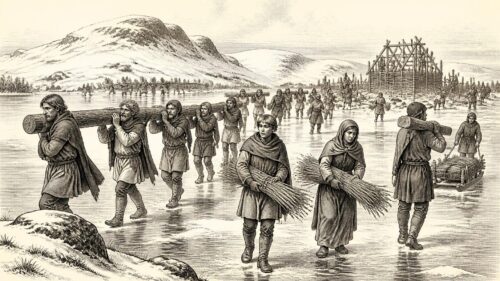
In 807, annalistic sources record the construction of a new Columban monastery at Cenannas, later Kells, probably strengthening Iona’s Irish connections after attacks on its community. Raiders described as gentiles burned Inis Muiredaig and attacked another site, possibly coastal Roscam, demonstrating monastic vulnerability to seaborne violence. Conflict also erupted between Cork and Clonfert, causing heavy losses among ecclesiastics. Deaths included Armagh’s abbot Connmach, regional rulers Artgal and Murchad, and the anchorite-scribe Elarius. Killings in Airthir and Kintyre underline political instability. Under Áed Oirdnide’s overlordship, Ireland remained fragmented. A blood-red moon was also noted, while chronology differs among annals in transmission.
Dateline
The annalistic record for 807 CE catches Ireland at a moment when the pressures of kingship, monastic power and seaborne violence were all visible at once. The entries are brief and do not provide a continuous narrative; most lack a season, day or explanation. Yet they range from Armagh and Kells to Loch Cré, the Shannon region and the Atlantic coast. Read carefully, they show an island whose great churches were centres of learning and authority, but also communities with property, rivals and vulnerable shorelines.
There is an important chronological caution. The Annals of Ulster place these notices under their annal U807, although their heading gives AD 806 under the annals’ internal reckoning. Modern historical convention normally assigns the material discussed here to 807 CE. Other Irish chronicles preserve some of the same events under different year numbers. That variation reflects the difficulties of medieval annal chronology, not evidence that the events occurred repeatedly.
A New Columban House at Cenannas
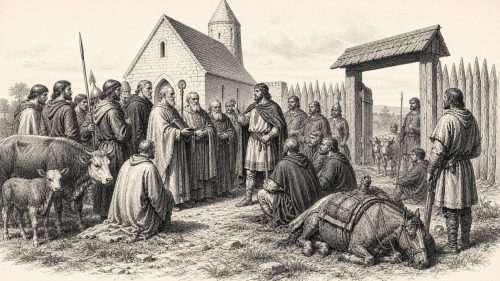
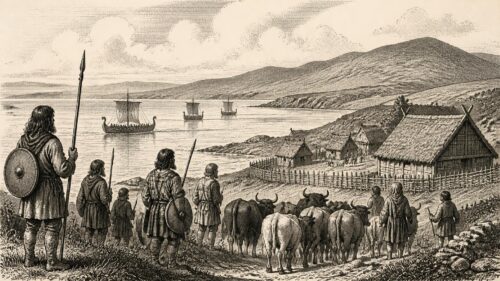
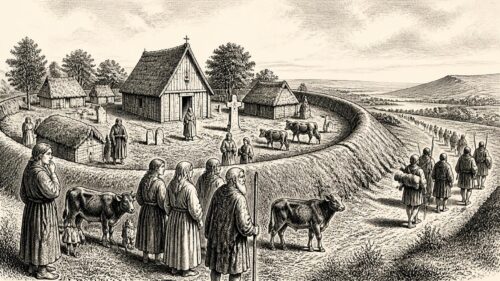
The most constructive entry of the year records the building of a new monastery of Colum Cille at Cenannas, modern Kells in County Meath. The wording establishes construction in 807; it does not say that a finished stone church, a fully settled town or any surviving structure dates precisely from that year. Nonetheless, the foundation was a consequential development. Kells would become one of the principal houses of the Columban federation and an enduring centre of ecclesiastical culture in Ireland.
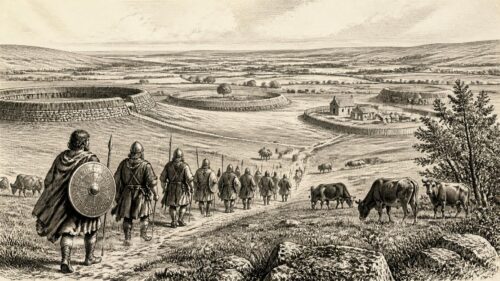
The immediate background is clear enough, though it belongs partly to earlier years. The Columban community on Iona had suffered repeated attacks, including the killing of sixty-eight members of its community in 806. Establishing or enlarging a house at inland Cenannas offered the familia of Colum Cille a more secure base on Irish territory. It should not be imagined as a simple, total evacuation of Iona: Columban religious life continued across the Irish Sea. Rather, 807 marks a decisive investment in a second centre, connected to Iona by saints’ cult, personnel, books, landholding and institutional memory.
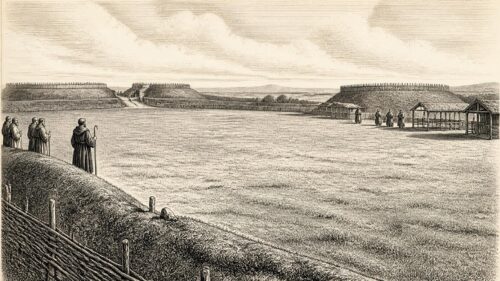
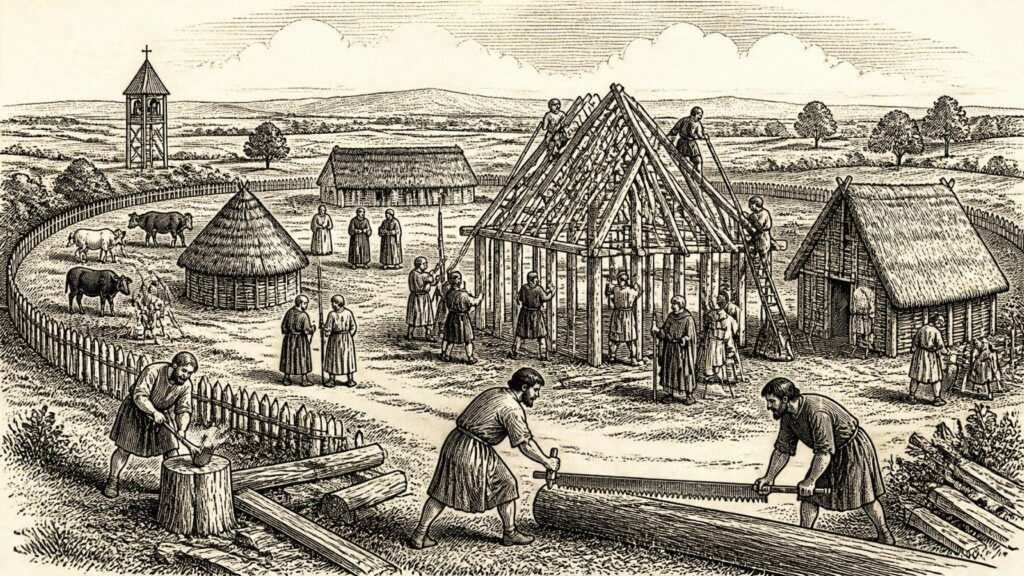
That decision also had political meaning. Cenannas stood in the Midlands and near the heartlands contested by leading Uí Néill dynasties. Monasteries were not secluded islands outside secular life. They held land and dependent households, received gifts, offered sanctuary, trained clerics and scribes, and could lend prestige to rulers. A new Columban foundation needed labour, timber, food supplies and protection. The annal gives no donor’s name and no description of the buildings, so it would be wrong to assign every later feature of Kells to 807. But the entry permits a glimpse of people clearing ground, erecting a precinct and creating the institutional framework from which the great monastic settlement grew.
Fire on the Western Sea
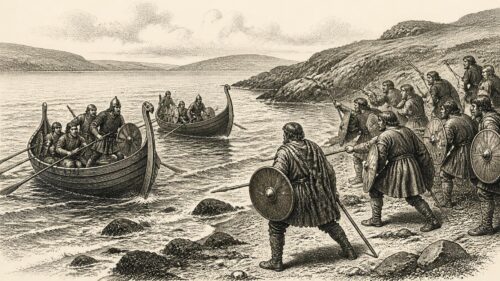
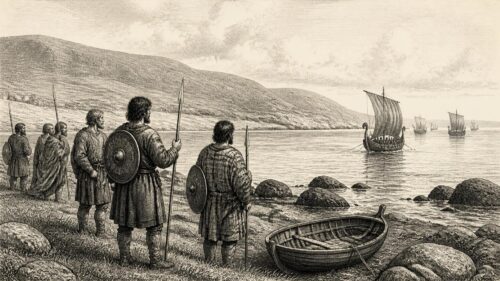
The year also contains one of the early notices of raiders called gentiles, literally “heathens” in the annalists’ Latin. The Annals of Ulster say that they burned Inis Muiredaig and invaded Ros Comáin. Chronicon Scotorum similarly records the burning, but calls the second place Ros Cam. Later annalistic traditions likewise preserve Ros Cam. The difference matters. Ros Comáin could suggest inland Roscommon; Ros Cam is usually identified with the coastal ecclesiastical site of Roscam near Galway Bay. Since the texts disagree, the responsible conclusion is that a maritime raiding force burned Inis Muiredaig and then struck a place whose precise identification requires caution.
Inis Muiredaig is often identified with Inishmurray, off the Sligo coast, but the name alone does not remove all doubt. What is firm is the pattern: an island community was burned and a second target was attacked from the sea. The raiders were not named by homeland, nor were their numbers, ships, casualties or booty recorded. Calling them “Vikings” is reasonable modern shorthand for the Scandinavian raiders of the early Viking Age, but it should not conceal the annal’s more limited evidence.
The attack exposed a hard contradiction in the geography of monastic Ireland. Offshore islands gave religious communities isolation, fisheries, maritime connections and a landscape suited to ascetic life. The same accessibility made them exposed to crews able to move swiftly along coasts and through bays. The assault of 807 should therefore not be treated as the sudden beginning of all Scandinavian contact with Ireland: raids on islands had already been reported. It is, however, a sharply dated reminder that coastal churches and their stores of food, livestock, metalwork, vessels and portable religious objects could become targets. A scholarly reconstruction identifies the attack on Ros Cam as the earliest recorded raid on the Irish mainland, but that is a statement about surviving records, not proof that no earlier landing occurred.
Churches in Conflict
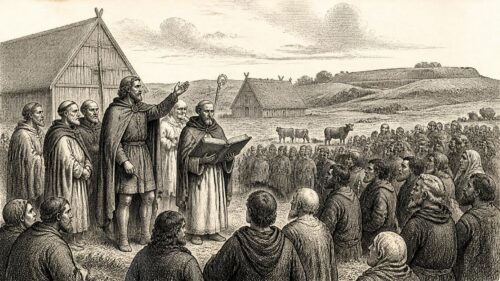
Violence in 807 was not confined to foreign raiders. The Annals of Ulster report a battle between the community of Corcach, Cork, and that of Cluain Ferta Brénainn, Clonfert in east Galway. The annalist’s language is exceptionally stark: there was slaughter of countless ordinary ecclesiastics and of prominent men from Cork’s community. No cause, battlefield or victor is supplied. Nor can the conflict safely be reduced to a quarrel between monks in a cloister.
An Irish monastic familia was a large social body. It could include clergy, students, tenants, craftspeople, dependants and people linked to a church through land, patronage or kinship. Its interests might overlap with those of regional rulers. The entry thus reveals that major churches could mobilise substantial followings and become entangled in armed disputes. It does not reveal whether the immediate issue was land, jurisdiction, protection, dynastic alliance or some local grievance. The loss of unnamed “ordinary ecclesiastics” is especially sobering: annals usually preserve elite names, but this notice briefly acknowledges a wider human cost.
Both churches had weight beyond their immediate districts. Cork was a significant southern ecclesiastical settlement, while Clonfert belonged to the wider cultic and institutional inheritance of St Brendan. Their clash demonstrates that Irish Christianity in this period was neither politically uniform nor automatically pacific. Religious standing could intensify competition because churches were also holders of wealth, rights and local influence.
Deaths, Succession and Regional Rule
Several deaths and killings show the fragility of authority. Connmach son of Dub dá Leithe, abbot of Armagh, died suddenly. His father had been a leading figure in the ecclesiastical lineage later known as Clann Sínaig. Connmach’s death came amid a period in which control of Armagh was contested by rival clerical interests. As the church claiming the inheritance of Patrick, Armagh carried exceptional spiritual and political prestige. The bare notice of a sudden death consequently had implications well beyond one household: succession there could affect alliances among the Airgialla, the northern Uí Néill and local ecclesiastical families.
Artgal son of Cathasach, king of Uí Chruinn of Airthir, was slain in the same year. Airthir lay in the political world around Armagh, so this killing belongs to the same northern landscape of contested lordship and church patronage. The record does not name Artgal’s killer or explain the dispute. It should not be made into evidence for a particular succession war, but it confirms that violence touched regional kings as well as religious communities.
Elsewhere, Conall son of Tadc was killed by Conall son of Aedacán in Cenn Tíre, Kintyre. Kintyre lies in western Scotland, but its inclusion in Irish annals is a reminder that the Gaelic maritime world crossed the North Channel. Sea routes linked north-east Ireland, Dál Riata and the Hebrides for travel, kinship, warfare and ecclesiastical exchange. This entry has no stated Irish target, yet it belongs to an Irish historical horizon broader than the island’s modern coastline.
In the south-west, Murchad son of Flann, king of Uí Fhidgente, died. Uí Fhidgente occupied territory centred in what is now west County Limerick. The annal records a death, not a battle or deposition, and nothing certain can be said about the manner of his passing or the identity of his successor. Still, the notice matters because it records a change at the head of a regional people at a time when Munster was a mosaic of competing kingdoms and powerful churches.
Over this fragmented political order stood Áed Oirdnide of Cenél nÉogain, king of Tara in 807. His authority was real but not equivalent to rule by a later unitary state. Recent campaigns in Mide and Leinster illustrate the reach of his power, while the separate deaths, killings and church conflict recorded in 807 reveal the autonomy retained by local dynasties and institutions. Ireland’s political map was made up of overlapping claims, negotiated submissions and recurrent coercion.
Learning, Asceticism and a Red Moon
Amid building, burning and killing, the annals also mark the death of Elarius, described as both anchorite and scribe of Loch Cré. The identification joins two ideals often kept apart in modern imagination: solitary religious discipline and literate work. An anchorite could pursue an austere devotional life while remaining valued for counsel, prayer and learning. Elarius’s title as scribe shows the status attached to writing within the religious culture of the period. The annal does not name a manuscript copied by him or describe his dwelling, but it makes his dual vocation historically secure.
The final memorable notice is celestial: “the moon was turned to the colour of blood”. It is a recorded observation, not a securely dated scientific report. A lunar eclipse is one possible explanation for a reddened moon, but the annal gives neither a day nor enough observational detail to identify the phenomenon with certainty. For contemporaries, such sights could be unsettling and meaningful; for historians, the entry also shows that annalists considered extraordinary natural appearances worth preserving beside deaths, warfare and construction.
Thus 807 was not merely a year of raids. It saw a new Columban institution take shape at Cenannas; a coastal religious landscape suffer attack; a devastating conflict between two church communities; and changes in Armagh, Airthir and Uí Fhidgente. Its sources are compressed, partial and sometimes chronologically difficult. Their very compression, however, preserves a vivid truth: early medieval Ireland was connected by roads, rivers and sea lanes, and its churches stood at the centre of both cultural achievement and worldly contest.
Primary Sources
- The Annals of Ulster: Year U807
- Chronicon Scotorum: Annals CS805–CS809
- Vikings in Irish Chronicles, 794–902: Data
- Vikings in Irish Chronicles, 794–902: Introduction
- Annals of the Four Masters
- Annals of the Four Masters: edition and translation details
- Annals of Inisfallen
- The Annals of Tigernach
- Exploring the Irish Annals
- Áed Oirdnide | Dictionary of Irish Biography
- Dub-dá-leithe | Dictionary of Irish Biography
- Irish School of Illumination, c. 650–1100 | Heritage Ireland
- Kells Heritage Town | Meath County Council
- Kells Historic Core Architectural Conservation Area | Meath County Council
- Kells | Irish Historic Towns Atlas
- Book of Kells: Exploring the Evidence that Points to Pictish Origins | Trinity College Dublin
- Colm Cille's Spiral: The Object | Trinity College Dublin
- The Vikings in Ninth-Century Ireland: Sources and Settlements
- Early Medieval Ireland, AD 400–1100: The Evidence from Archaeological Excavations | Royal Irish Academy
- The Triads of Ireland | CELT
- The Life of St Cainnech of Aghaboe
- The Céli Dé and Ecclesiastical Government in Ireland