Cobha’s Fallen King800 CE
In 800, the Annals of Ulster record a battle between the Ulaid and Uí Echach Cobha, in which Echu, king of Cobha, died and Cairell’s force prevailed. Bresal of Cenél Loégairi was killed by his brothers, illustrating dynastic rivalry. Rónán’s relics were placed in a gold and silver casket, showing ecclesiastical resources and devotion. Deaths included abbots of Clondalkin, Domnach Sechnaill and Iona, linking Ireland to Columban networks across the Irish Sea. A rainy summer affected rural conditions without recorded disaster. Together, these selective notices reveal contested kingship, influential churches, maritime connections, and an agrarian society closely dependent on weather.
Dateline
The year 800 is unusually well illuminated by the Irish annals, though not by a single grand narrative. Its entries record a battle in Ulster, the death of an abbot on Iona, the enshrinement of a saint’s relics, deaths among ecclesiastical and royal elites, and a notably wet summer. Read together, they show an island of many small polities and powerful churches, where warfare, devotion, agriculture and seaborne connections shaped daily security. The evidence is concise and selective: it names losses at the top of society far more readily than it describes ordinary households. Yet its very selectivity reveals what contemporaries believed worthy of permanent record.
Dating a Sparse Year
The principal contemporary chronological framework is the Annals of Ulster. Its annal headed AD 800 records the events considered here. Later compilations preserve much of the same material under different year numbers because Irish annals can differ in their chronological systems and copying traditions. The Annals of the Four Masters, compiled in the seventeenth century from earlier material, explicitly corrects its corresponding annal to 801. That does not provide grounds for moving the events out of 800; rather, it is a reminder that medieval annal dates require comparison between witnesses. For this calendar-year survey, the AD 800 heading of the Annals of Ulster provides the clearest basis.
Nothing in the surviving record suggests a single ruler directing all Ireland in the modern sense. Áed Oirdnide of the northern Uí Néill had begun his reign as overking only a few years earlier, in 797, but his authority depended on alliances, hostages, campaigning and the willingness of regional dynasties to recognise it. Beneath that elevated kingship lay a dense political map of túatha and larger dynastic groupings. Ulster, Connacht, Mide, Brega, Leinster, Munster and the midlands each contained several competing powers. The battle recorded in 800 belongs to that political world: a conflict within the northern province, not a war between neatly bounded nations.
Battle Between Ulaid and Cobha
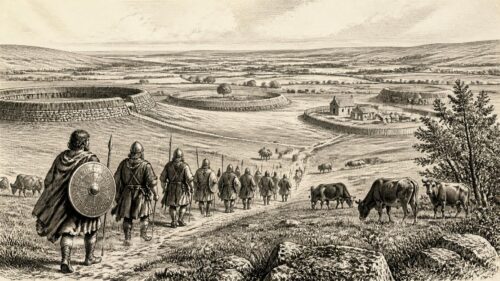
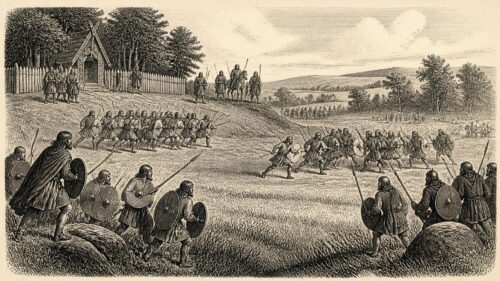
The year’s most direct political event was a battle between the Ulaid and the Uí Echach Cobha. Echu son of Ailill, king of Cobha, was killed; Cairell son of Cathal also fell on the opposing side, while the annal states that Cairell’s army was victorious. The fighting therefore cost both sides prominent men even as it delivered a tactical success to one force. The annalist gives no cause, no battlefield description and no casualty total. It would be unsafe to invent either a dispute over succession or a campaign plan. What can responsibly be said is that the death of Echu removed a ruler from Cobha, an important territory in what is now south-eastern Ulster, and that this would have created an immediate question of succession and allegiance.
The wording is also revealing. The Uí Echach Cobha were a branch within the wider political geography of Ulaid, rather than an external people in a simple ethnic contest. “Ulaid” could refer to an overkingly interest, a wider population, or a coalition acting under a leading dynasty. The battle demonstrates the layered character of power in early medieval Ireland. A king’s authority was personal, kin-based and territorial; it could be contested by neighbouring kindreds whose members shared cultural and political institutions. Warfare was thus often local in location but consequential in its rearrangement of rank, tribute and clientship.
Another killing noted that year likewise exposes the hazards within a ruling kin-group. Bresal son of Gormgal, of Cenél Loégairi in Brega, was treacherously killed by his brothers. The annal does not explain the quarrel, and “treacherously” is the chronicler’s moral judgement rather than a full legal account. Still, fratricidal killing was a stark reminder that royal succession was rarely automatic. Several men of a ruling lineage might possess a claim, and competition could turn lethal. Such violence was not evidence of political chaos everywhere; it was one of the brutal means by which particular branches of a dynasty rose or disappeared.
Rónán’s Relics and Ecclesiastical Wealth
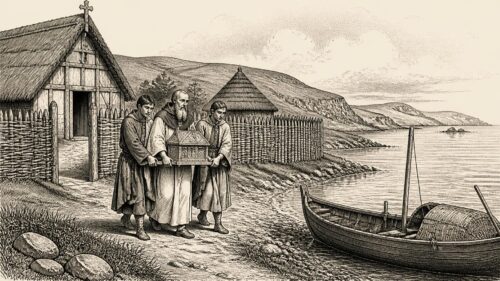
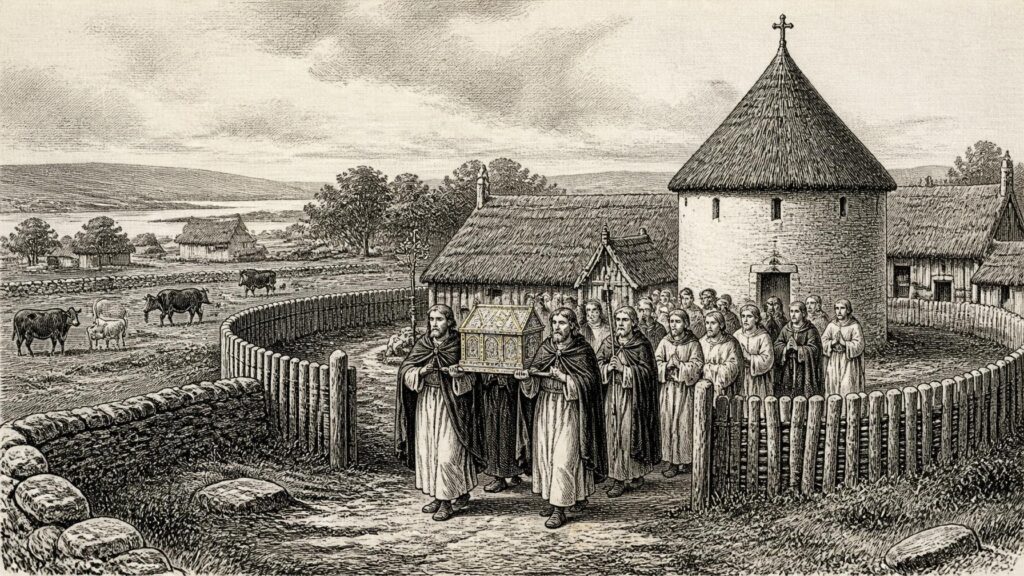
In a very different register, the annal records “the placing of the relics of Rónán son of Berach in a gold and silver casket”. This is a firmly dated act, but the brief notice does not name the craftworkers, patron, church or precise form of the container. It should not be imagined automatically as a surviving object or assigned elaborate decoration without evidence. Nonetheless, the entry is important. It shows that bodily remains associated with a revered holy figure were considered sufficiently valuable, both spiritually and materially, to be enclosed in precious metal.
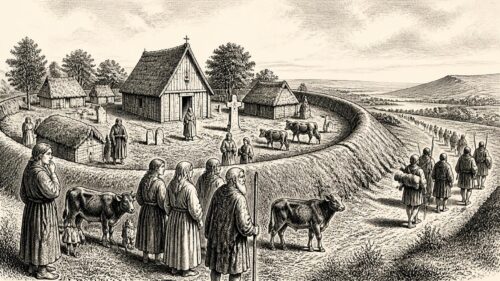
Reliquaries did more than preserve bones. They made sanctity visible and portable, bound communities to their founder-saints, and asserted the standing of the churches that held them. A gold-and-silver casket required access to skilled metalworkers, costly raw materials and patronage. Its commissioning therefore points to resources concentrated in an ecclesiastical institution and to an audience prepared to honour, visit and protect a saint’s relics. In a society where churches possessed land, livestock, dependants and learned personnel, devotional art was inseparable from institutional authority. The record of Rónán’s enshrinement is consequently evidence for religion, craftsmanship and political economy at once.
The annals also preserve several deaths within the Church: Feidlimid grandson of Lugaid, abbot of Clondalkin; Ruamnus, abbot of Domnach Sechnaill; Cathrannach son of Cathal; and the anchorite Ninnid. Be Fáil, daughter of Cathal and queen of Donnchad, also died. The list is not a census of Ireland’s religious or secular leadership, but it demonstrates the range of statuses that mattered to annalists. Abbots could be managers of substantial communities as well as spiritual leaders; an anchorite represented a more solitary ideal of religious life; and a queen was identified through both her natal and marital connections. Religious houses and royal households were distinct institutions, yet they relied on the same landscape of landholding, kinship, patronage and reputation.
Iona After Bresal
The death of Bresal son of Ségéne, abbot of Í, or Iona, was another event of consequence in 800. The annal says that he died in the thirty-first year of his leadership. Iona lay off the western coast of what is now Scotland, but it was directly relevant to Irish history: it was the chief centre of the Columban federation, with deep connections to Irish churches, rulers and pilgrims. The Irish Sea was not a distant frontier. It was a route for clerics, books, relics, goods and political contacts linking Ireland, western Scotland and the islands.
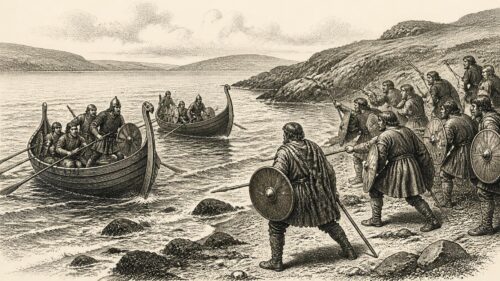
Bresal’s death occurred in a troubling recent context. Raiding groups described by the annals as heathens had attacked Iona in 795, and had struck other islands and coastal churches in the years around the turn of the century. There is no recorded Viking assault on Ireland or Iona specifically in 800, and the year should not be presented as one of a raid merely because threats existed. Yet Bresal’s succession came when Columban communities had already learned that their maritime world could bring violent predation as well as communication. The later burning of Iona in 802 and the killing of sixty-eight members of its community in 806 underline the vulnerability that was already becoming apparent, but those are later events, not happenings of 800.
A Rainy Summer, Rural Work
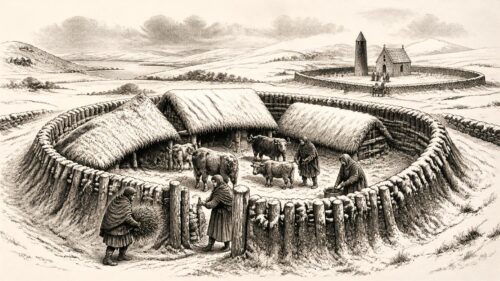
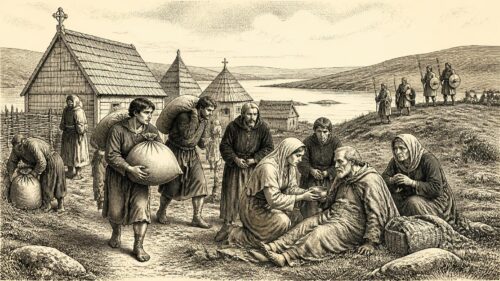
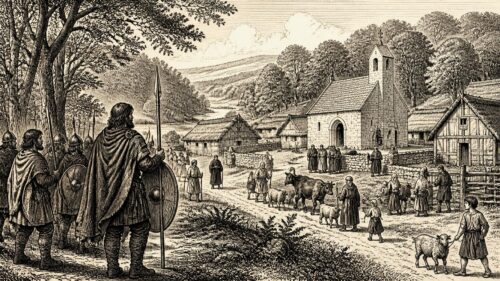
The final weather notice is deceptively short: “a rainy summer”. It does not state famine, failed harvests or flooding, and none should be asserted for 800. Rain mattered nevertheless in an overwhelmingly rural society. Most people lived in dispersed farmsteads, including ringforts, cashels, crannógs and unenclosed settlements, and worked a managed countryside of pasture, fields, tracks, mills, kilns and woodland resources. Cattle remained a principal measure of wealth and a central source of food, hides and dairy produce. At the same time, archaeological evidence indicates that cereal cultivation had become increasingly important from the eighth century onwards, with barley and oats dominant and wheat, rye, flax, peas and beans cultivated in smaller quantities or particular settings.
A wet summer could complicate haymaking, travel, grazing and the drying, harvesting and storage of grain. Grain-drying kilns found on early medieval sites are a material reminder that crops often needed artificial drying in Ireland’s climate. For tenants, labourers, slaves and free farming households, the weather notice points towards work that annals otherwise leave unnamed: tending animals, repairing fences, preparing dairy foods, grinding grain, maintaining buildings, spinning wool and preserving supplies for winter. The annal’s emphasis on rain is therefore best understood not as proof of disaster but as recognition that seasonal conditions affected the foundations of society.
In 800, Ireland was neither isolated nor unified. Conflict in Cobha, a precious shrine for Rónán, the passing of Iona’s abbot, elite deaths and rain over the fields belong to one connected historical landscape. They show political authority contested among kindreds, churches investing in holy memory and material splendour, and rural communities whose prosperity depended on land, livestock, crops and weather. The year’s surviving notices are small in scale, but they offer a precise glimpse of the pressures and institutions that structured early medieval Irish life.
Primary Sources
- The Annals of Ulster
- The Annals of Ulster: Irish and Latin Text
- Annals of the Four Masters, Part 62
- Annals of the Four Masters
- Chronicon Scotorum
- Chronicon Scotorum: Introduction and Bibliographical Information
- Annals of Inisfallen
- Navigator for the Annals of Inisfallen
- Irish Texts at CELT
- Agriculture, Settlement and Society in Early Medieval Ireland
- Early Medieval Farming and Food Production: A Review of the Archaeobotanical Evidence from Archaeological Excavations in Ireland
- Early Medieval Ireland: Archaeological Excavations, 1930–2009
- The Economy of Early Medieval Ireland
- Early Medieval Ireland: Investigating Social, Economic and Settlement Change, AD 400–1100
- Early Medieval Rural Settlement Archaeology in Ireland and the Impact of Large Infrastructural Developments
- Early Medieval Ireland, AD 400–1100: The Evidence from Archaeological Excavations
- Changing Human-Cattle Relationships in Ireland: A 6000-Year Isotopic Perspective
- Í > IOUA > IONA – Iona’s Namescape
- Iona and the Shrine of Columba, c. 800–1200
- A New Jerusalem ‘At the Ends of the Earth’: Interpreting Charles Thomas’s Excavations at Iona Abbey 1956–63
- The Vikings in Ninth-Century Ireland: Sources and Settlements
- Vikings in Ireland and Scotland