Rónán’s Silver-Gold Shrine801 CE
In 801, Irish annals record the enshrinement of relics of Rónán son of Berach at Dromiskin in a gold-and-silver casket, demonstrating monastic wealth, patronage and saintly prestige. Bresal son of Ségéne died after thirty-one years as abbot of Iona, a major Columban centre linked to Ireland; no raid there is attested that year. Warfare between the Ulaid and Uí Echach Coba killed Echu son of Ailill and Cairell son of Cathal, although Cairell’s force won. Obits included abbots, nobles, Be Fáil and the anchorite Ninnid. Bresal of Cenél Loégairi was murdered by kinsmen. Rainy summer affected society reliant on farming.
Dateline
For Ireland in 801, the surviving record is unusually revealing precisely because it is so spare. A handful of annalistic notices preserves a ceremonial act at Dromiskin, a battle in the north-east, the deaths of churchmen and rulers’ kin, an intra-dynastic killing, and a blunt observation on the weather: a rainy summer. None is a complete story by itself. Together, however, they show an island in which religious institutions, local kingships and agricultural conditions were closely bound together.
The year also requires a word of chronological caution. The relevant sequence in the Annals of Ulster is conventionally numbered U801 but carries an internal AD date one year earlier. Modern synchronisation of the Irish annals treats the entries discussed here as belonging to 801 CE. That matters because later compilations sometimes shift events by several years or combine separate episodes. The account of 801 must therefore rest chiefly on the notices that can be securely assigned to this calendar year, rather than on attractive but misdated later traditions.
A Shrine at Dromiskin
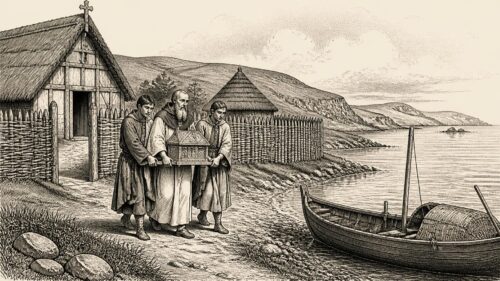
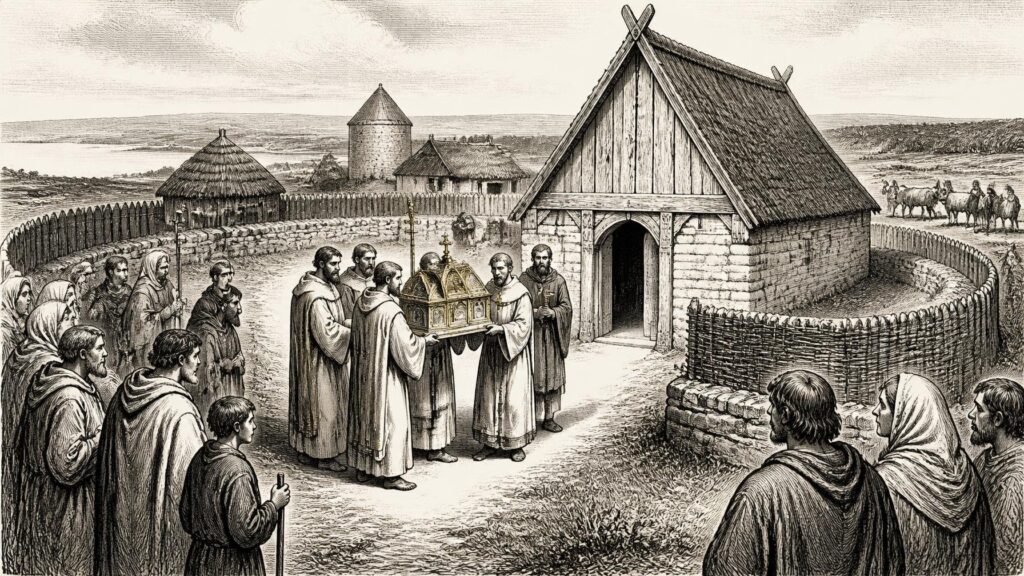
The year’s most vivid entry records the placing of the relics of Rónán son of Berach in a casket of gold and silver. Rónán was associated with the monastery at Dromiskin in what is now County Louth, and had died more than a century earlier. The annalist does not describe a procession, name the craftsmen, or say whether the relics were bodily remains or objects associated with the saint. Yet the entry is important precisely because it records the completed act of enshrinement, not merely the possession of relics.
To place a saint’s remains or contact relics in a precious shrine was to make holiness visible, portable and politically meaningful. Gold and silver represented a major concentration of wealth in an overwhelmingly rural economy where cattle, land and food renders were fundamental measures of power. A costly reliquary was not everyday ornament. It required access to metal, skilled workmanship and patrons able to direct surplus resources towards a church. It also made a statement: Dromiskin possessed a saint whose protection, memory and prestige were worth safeguarding in exceptional material form.
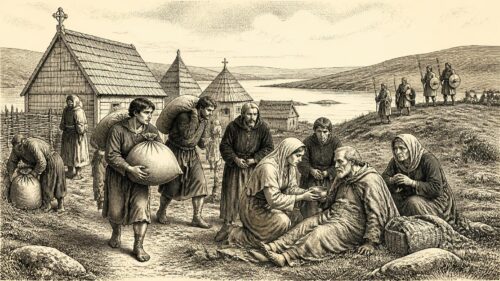
The ceremony should not be imagined as an isolated devotional gesture. Irish monasteries were religious communities, but they were also landholders, employers, centres of hospitality and learning, and nodes within networks of kinship and patronage. Their estates depended on the labour and produce of tenants and dependants; their churches attracted offerings and visitors; their leaders could be influential figures in local politics. The enshrinement of Rónán strengthened the public identity of the community by joining its present-day resources to a revered founder of the past.
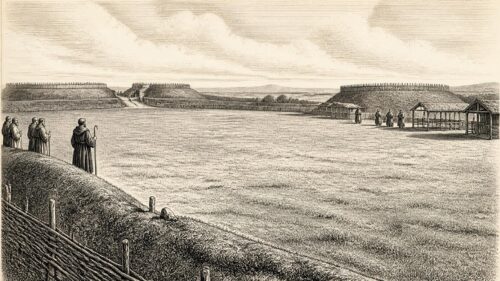
Dromiskin’s later surviving round tower and high cross are not evidence for the precise appearance of the site in 801, and should not be projected unchanged into that year. They do, nevertheless, mark the long afterlife of a monastic place whose importance was already clear in the annalistic record. In 801, its community could present the relics of Rónán in a precious container at a moment when saints’ cults, institutional memory and material display were becoming increasingly prominent features of ecclesiastical life.
Bresal’s Final Year at Í
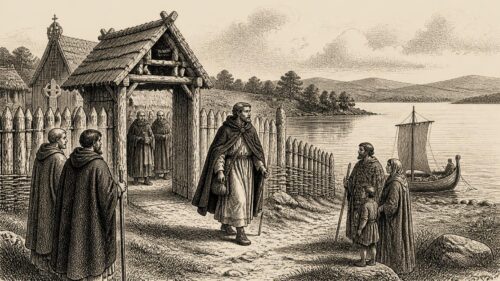
Another entry marks the death of Bresal son of Ségéne, abbot of Í, better known as Iona, in his thirty-first year as superior. Iona lies in the Inner Hebrides rather than in modern Ireland, but it belonged to a Gaelic ecclesiastical world shaped by the legacy of Colum Cille and by enduring connections across the North Channel. Its abbots had standing among churches in Ireland as well as in western Scotland. Bresal’s long tenure therefore mattered beyond the island itself.
The annal gives no assessment of his rule, no description of his burial and no formal account of succession. It does, however, preserve the length of his leadership, an indication that the stability and continuity of Iona’s headship were worth recording. Thirty-one years spanned a generation. During such a period, an abbot would have overseen a community’s estates, worship, scholarly activity and relations with allied churches and lay patrons. The office was spiritual, but it also carried institutional responsibility in a landscape without a centralised national church or state.
Bresal died as maritime raiding had begun to trouble the Irish Sea world. Earlier annals had already noted attacks on islands and churches in the 790s. Nothing in the securely dated notices for 801 says that Iona was burned, attacked, or suffered a massacre in that year. Those events belong to later dates: Iona’s burning is conventionally placed in 802, while the killing of sixty-eight members of its community belongs to 806. This distinction is essential. The death of Bresal in 801 was a change of leadership at a great Columban centre, not itself an attested raid.
War in Uí Echach Coba
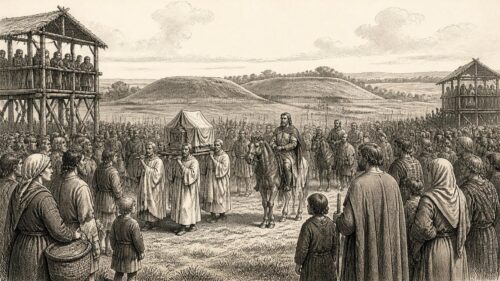
The principal conflict recorded for the year took place between the Ulaid and the Uí Echach Coba, in the northern and north-eastern political world. Echu son of Ailill, king of Cuib, fell in the fighting. On the opposing side, Cairell son of Cathal also died, yet the annalist states that his army was victorious. The compressed notice gives neither battlefield nor cause, and it would be unsafe to supply either. What it does show is that victory could be bought at the cost of senior leaders, and that political identities in this region were neither simple nor fixed.
‘Ulaid’ could denote a major over-kingdom, but its authority was exercised among smaller constituent peoples and dynasties. Uí Echach Coba was one such regional power, associated with the territory around modern south Down and adjoining districts. Kingship worked through competing kindreds, military followings, client relationships and control of agricultural resources. A battle was not necessarily a struggle for an entire province. It may have concerned status, tribute, disputed lordship, succession, or the recovery of cattle and other movable wealth. The annals do not tell us which.
That limitation is instructive. Early medieval Irish chroniclers generally recorded outcomes of concern to elite households and churches: the death of a king, the fall of a notable person, a victory, a raid or an ecclesiastical event. They seldom provide the experience of the ordinary cultivators whose crops, animals and labour sustained the forces involved. Yet those people bore the practical consequences of conflict: demands for food, transport and shelter, the loss of livestock, and the insecurity created when armed groups moved through a district.
Deaths, Kinship and Religious Office
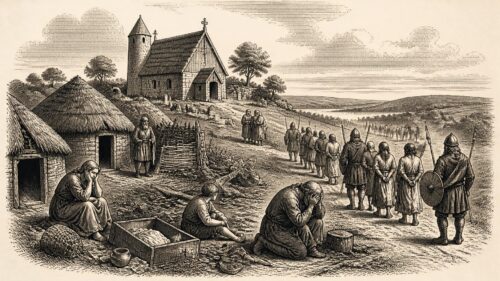
The annal also records the deaths of Feidlimid grandson of Lugaid, abbot of Cluain Dolcáin, now Clondalkin, and Ruamnus, abbot of Domnach Sechnaill. These brief obits remind us that monasteries across Ireland were governed by named individuals whose passing was news of more than local importance. The death of an abbot could raise questions of succession, control of church property and the relationship between an ecclesiastical community and the kindred that supported it. In 801, however, the sources provide no reliable detail about either succession, so the fact of death must remain the limit of the claim.
Be Fáil, daughter of Cathal and queen of Donnchad, also died. Donnchad Midi, king of Tara and leading figure of Clann Cholmáin, had died in 797. Be Fáil’s obit therefore recalled a woman connected to one of the most powerful ruling families of the preceding generation. Royal marriages bound dynasties together and could carry long political consequences through children, fosterage and alliances. Her notice is a rare glimpse of a high-status woman entering the annalistic record in her own right, though only through the language of father and husband.
Elsewhere, Bresal son of Gormgal of Cenél Loégairi was treacherously killed by his own kinsmen. The phrase is concise but emphatic. It signals the danger within a lineage as well as from external enemies. In a society where rank and inheritance were shared among branches of extended ruling families, kinsmen could be allies, rivals and threats at once. The killing should not be inflated into evidence for a wider war; it is, however, a firm reminder that political violence could emerge from the internal competition of a single people.
The deaths of Cathrannach son of Cathal of Maenmag and of the anchorite Ninnid complete the year’s short catalogue of losses. Their pairing in the annal places a regional lay figure beside a religious ascetic. Such juxtapositions are characteristic of Irish annals: kings, abbots, scholars, anchorites and nobles all appear within the same yearly framework, because secular and religious authority operated in overlapping rather than wholly separate spheres.
The Rainy Summer
The final notice is only two words in Latin translation: a rainy summer. It is tempting to turn this into a tale of failed harvests or famine, but the source does not do so. No crop failure, livestock mortality or food shortage is recorded for 801, and none should be invented. Rainfall could have had very different effects depending on locality, soil, timing and the crops grown. It might hinder haymaking, make travel and campaigning more difficult, waterlog fields, or simply mark a season memorable enough to enter the chronicle.
Even so, the observation matters. Most people in Ireland lived through mixed farming and pastoral work, and the calendar of labour depended on weather. A wet summer touched the routines that supported monasteries and kings alike: grain cultivation, grazing, hay, movement along roads and rivers, and the collection of renders. In that modest annalistic phrase, the natural environment enters the same record as shrines, deaths and warfare.
Thus 801 was not defined by a single island-wide turning point. Its surviving evidence instead reveals the texture of early medieval Ireland: a saint honoured in costly metalwork at Dromiskin; a great Columban abbot completing a long career; violent rivalry in the north-east; the continuing importance of royal and ecclesiastical households; and a summer wet enough to be remembered. The year’s few entries are fragments, but they are fragments of a connected society.
Primary Sources
- The Annals of Ulster: Year U801
- The Annals of Ulster
- The Annals of Ulster: Original Irish and Latin Text
- Chronological Synchronisation of the Irish Annals
- The Chronology and Sources of the Early Irish Annals
- Vikings in Irish Chronicles, 794–902: Data
- Dromiskin Church, High Cross, and Round Tower
- Dromiskin
- Iona and the Shrine of Columba, c. 800–1200
- Early Mechanisms of Abbatial Succession: The Case of Iona (563–704)
- Donnchad Midi
- Kingship, Society, and Sacrality: Rank, Power, and Ideology in Early Medieval Ireland
- The Powers of Kings
- The Church and the World in Early Christian Ireland
- Appendix: The Chronicles as a Record of Literacy, 797–1002
- Early Christian Monasteries
- Patrician and Early Christian Architecture
- Waterways Corridor Study: Lanesborough to Shannonbridge
- Annals of Inisfallen: Annals AI800–AI805
- Chronicon Scotorum
- Annals of Tigernach
- Annals of the Four Masters: Annals M797–M803
- Vikings in Early Medieval Ireland