The Burning of Inis Pátraic797 CE
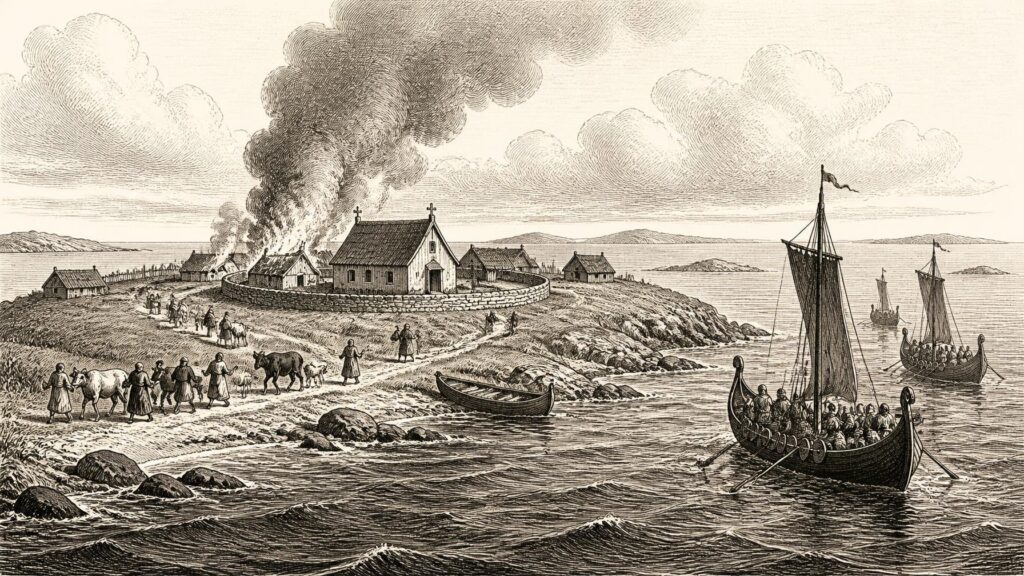
In 797, heathen raiders burned Inis Pátraic, probably Holmpatrick near Skerries, seized cattle-tribute, broke Do-Chonna’s shrine, and made incursions in Ireland and Alba. The attack demonstrates early maritime raiding against exposed church communities and regional wealth, but does not prove settlement or identify attackers beyond the annals’ term heathens. Simultaneously, Donnchad Midi, dominant Southern Uí Néill king of Tara, died, while Áed Oirdnide defeated his supporters at Druim Ríg, devastated Mide and began his reign. Annals also record deaths among Kildare, Clonmacnoise and Inis Cathaig clergy, revealing ecclesiastical institutions embedded in political, economic and learned networks across Irish regional society.
Dateline
In 797, Ireland’s political centre and its vulnerable eastern seaboard were both shaken. The year is remembered above all for a seaborne attack on Inis Pátraic, the island community usually identified with Holmpatrick off the coast near modern Skerries, and for the collapse of Donnchad Midi’s long dominance among the Uí Néill. These were very different events, but together they show an island in which power depended on control of people, livestock, churches and strategic routes by land and sea. The evidence is unusually terse. Irish annals preserve no continuous narrative of 797, no individual testimony from the victims of the raid, and no reliable tally of losses. Yet their brief notices are revealing precisely because they record what contemporaries considered worth remembering: a king’s death, a victorious battle, the ravaging of a rival heartland, an island monastery burned, cattle taken, and a shrine broken.
A Coastal Community Attacked
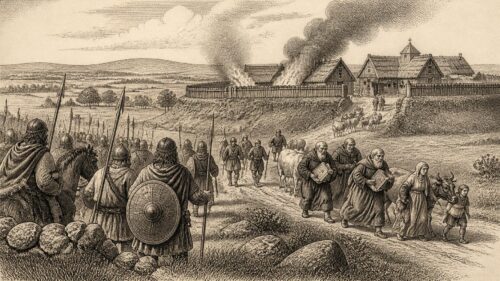
The firmest record for the calendar year comes from the Annals of Ulster. Under an entry explicitly equated by its editor with AD 797, they report the burning of Inis Pátraic by gennti, ‘heathens’ or ‘pagans’. The attackers took the cattle-tribute of the territories, broke the shrine of Do-Chonna, and made great incursions in both Ireland and Alba, meaning Britain or Scotland. The annalist’s language is important. It does not identify the raiders by a modern ethnic label. Later writers called such attackers Norsemen or Danes, and modern histories normally place the episode within the opening Viking raids on Ireland, but the contemporary-style annal itself calls them only heathens. That is the safest description to retain for the event itself.
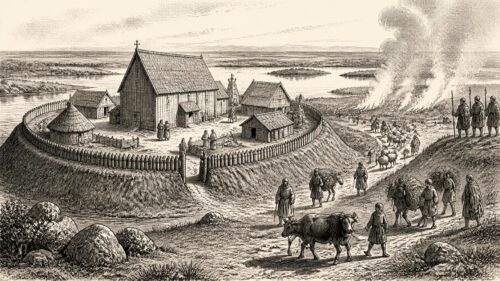
Inis Pátraic is commonly located at Holmpatrick, a small island off north County Dublin. This identification is plausible because the island lay beside the coast of Brega and because local ecclesiastical tradition associates it with Mochonna or Do-Chonna. It is not beyond dispute: scholarship has considered other islands named for Patrick, including St Patrick’s Isle at Peel on the Isle of Man. The location near Skerries should therefore be treated as the leading interpretation rather than an established certainty. Whichever island was meant, the entry describes a religious settlement exposed to the Irish Sea, not an inland monastery reached after a long campaign.
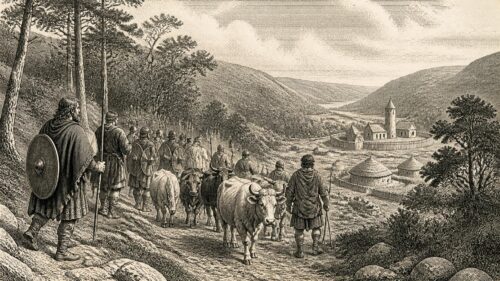
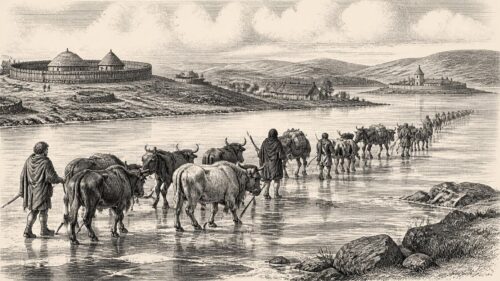
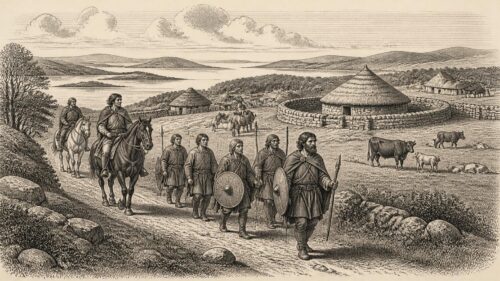
The taking of cattle deserves as much attention as the burning. Cattle were central stores of movable wealth in early medieval Ireland: they supplied food, hides, dairy produce, breeding stock and the means to meet tribute and legal compensation. The phrase translated as ‘cattle-tribute’ suggests that raiders seized an organised levy or the herds through which nearby territories met obligations, rather than merely a few animals encountered by chance. The practical difficulty of driving livestock to ships, or of holding them temporarily on shore, indicates a raid with planning and local reach. It also brought violence into the economic life of communities beyond the island itself. Families and rulers in the adjacent districts lost resources that underpinned subsistence, status and political obligation.
The broken shrine of Do-Chonna was another kind of loss. A shrine could be both a sacred container for relics and a costly object of metalwork, wood and ornament. Its destruction injured the standing of the saint’s community while also yielding portable material to attackers. The wording says that the shrine was broken; it does not prove that relics were removed, nor does it allow a reconstruction of the object’s appearance. Nevertheless, the annal records the act because sacred property mattered publicly. An assault on such a shrine was not simply theft. It was a demonstration that a church’s protections, prestige and accumulated wealth could be breached.
Raids Across the Irish Sea
The notice adds that the raiders made incursions in Ireland and Alba. This places the attack within an Irish Sea world rather than treating it as an isolated local disaster. Seafarers were already able to move between Irish, Scottish and island coasts, while ecclesiastical communities maintained connections across those waters. The annal does not identify a base, route, fleet size or destination in Alba, so none should be invented. Nor is there evidence in this year for a permanent Scandinavian town or a settled Viking colony at Dublin. What can responsibly be said is narrower and more significant: by 797, mobile raiding parties could threaten island churches and territorial resources on more than one side of the sea.
This was not the first alarming entry of its kind. Earlier notices, securely belonging to the mid-790s, record attacks on islands including Rechru and Skye. That context helps explain why the burning of Inis Pátraic belongs to the beginning of a sustained period of northern seaborne raiding. It must not, however, be made to bear the weight of later history. The longphuirt, towns, dynasties and mixed Irish-Scandinavian societies of later centuries did not yet exist in their familiar forms. In 797 the evidence is for raiding, not settlement; for a sharp maritime shock, not the foundation of a new political order.
Donnchad Midi’s End
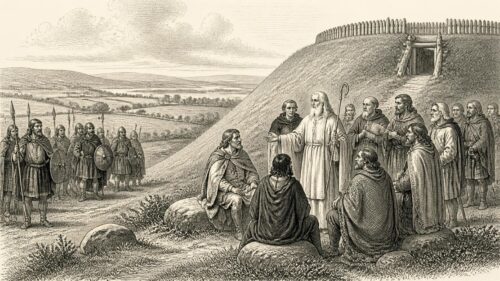
At almost the same time, the balance of power in central Ireland changed decisively. Donnchad Midi, king of Tara and leading member of Clann Cholmáin of the Southern Uí Néill, died in 797. The Annals of Inisfallen place his death in that year, while modern prosopographical scholarship also dates it to 797. The Annals of Ulster preserve the notice in an entry whose internal year-numbering is one year earlier than the modern equivalent, an example of why annal dates require care. The important point is not a falsely precise day of death, but that Donnchad’s death opened a contested succession during 797.
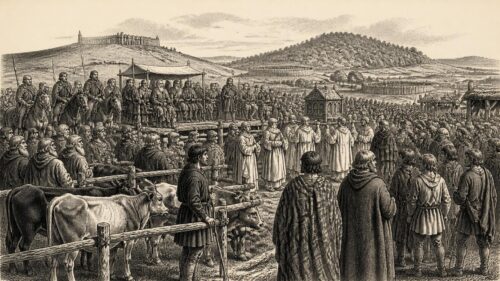
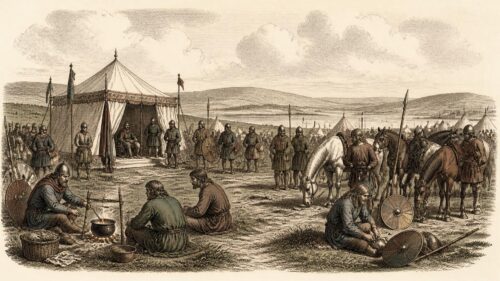
Donnchad had been among the most powerful rulers in Ireland for decades. His title as king of Tara expressed a claim to supremacy among the Uí Néill and to influence beyond Mide; it did not make him a monarch governing a unified Irish state. His authority rested on kinship, military capacity, tribute, alliances and intervention in church affairs. The death of such a ruler did not automatically pass power to a single heir. It created an opportunity for his rivals and exposed the vulnerability of his own kindred in Mide.
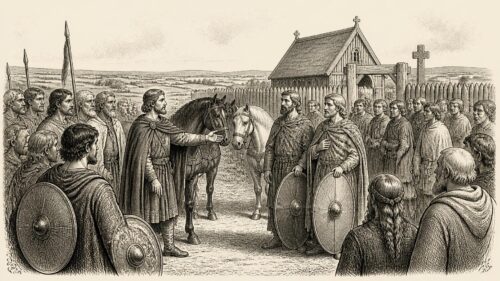
The annals record a battle at Druim Ríg in which Áed son of Niall son of Fergal was victor. Several members of Donnchad’s wider family were killed, including Donnchad’s brothers Fínnechta and Diarmait Odar. The place is generally associated with Drumree in County Meath, in Brega south of Tailtiu, though early medieval place-identification is not always absolute. The annal does not expressly say that Donnchad himself fell in the battle. Later interpretation, supported by regnal evidence, considers it possible that he was killed in the same conflict; that remains an inference, not a firm statement of the surviving annal.
Áed’s victory was followed by the devastation of Mide and, in the annalist’s words, the beginning of his reign. This wording captures the political reality better than any neat succession list. Áed, a Cenél nEógain ruler from the Northern Uí Néill, had defeated the armed supporters of the old order and then carried war into Clann Cholmáin’s core territory. ‘Devastation’ is the annal’s summary, not a detailed description of burnt farms or a casualty figure. Still, it clearly signals coercion on a regional scale. A ruler who wished to be accepted as king of Tara had to make his predominance real in the landscapes, clientships and tribute networks of Mide.
Churches, Offices and Memory
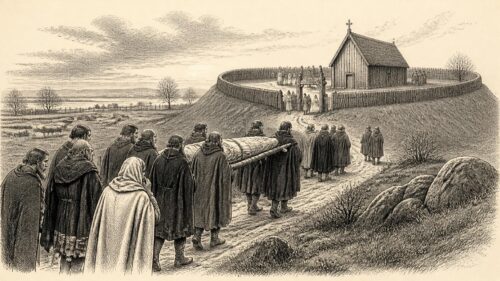
The year’s notices also illuminate the institutional density of Irish Christianity. The Annals of Ulster record the death of Eódu, grandson of Dícuill, abbot of Cell Dara, modern Kildare, and of Forinnán of Imlech Fia. They also note the death of Connmach, identified specifically as a scribe of Cluain Moccu Nóis, Clonmacnoise. The latter designation is valuable: it shows the annalist recognising scholarly labour as an office worth recording, not merely royal and clerical rank. Such men participated in the writing, copying and preservation of learned texts, even though no surviving manuscript can confidently be assigned to Connmach’s hand.
Other entries around the succession crisis make the connection between political and ecclesiastical life equally clear. Condal, daughter of Murchad, abbess of the elders’ house at Kildare, died; Ailmedair, steward of Clonmacnoise, also appears among the dead. These notices should not be turned into biographies for which the evidence does not exist. They do show, however, that major churches were administered through offices held by named people, including women of high-status families. Kildare and Clonmacnoise were not remote spiritual retreats. They were communities with land, dependants, learning, pastoral claims and political importance.
In Munster, the Annals of Inisfallen record the death of Ólchobar son of Flann, abbot of Inis Cathaig, Scattery Island in the Shannon estuary. This is a useful counterpoint to the eastern raid. Irish religious life in 797 was dispersed through island, riverine and inland foundations, each connected to local lordship and wider networks of devotion and learning. The death notices do not prove tranquillity, prosperity or uniform practice. Rather, they reveal the framework through which communities organised authority and remembered loss.
What 797 Does Not Show
The surviving evidence does not report a harvest failure, epidemic, major environmental disaster or new settlement foundation for this year. It would be misleading to fill those silences with picturesque assumptions about weather, peasant routines or universal fear of raiders. Nor should a much later entry in the Annals of the Four Masters, which places the burning of Iona under its year 797 but labels that year ‘recte 802’, be used as proof that Iona was burned in calendar year 797. Iona’s early raids belong to the wider context, but the securely dated Irish event for this article is the attack on Inis Pátraic.
Even so, 797 marks a real conjunction of developments. In the east, raiders showed that coastal churches and the cattle resources around them were exposed to Irish Sea violence. In the centre, Áed Oirdnide used victory and devastation to displace a Southern Uí Néill rival and establish a new paramountcy. Across Ireland, abbots, an abbess, a steward and a scribe appear in the record, reminding us that kingship and warfare operated beside durable ecclesiastical institutions. The year was not the moment when Ireland became ‘Viking’ or when one king united the island. It was a year in which maritime predation and dynastic warfare made the fragility of wealth, sanctity and political power unmistakably visible.
Primary Sources
- The Annals of Ulster, Year U797
- The Annals of Ulster, Year U798
- The Annals of Ulster
- Annals of Inisfallen, Part 35
- Annals of the Four Masters, Part 63
- Annals of the Four Masters
- Chronicon Scotorum
- The Annals of Tigernach
- Donnchad Midi
- Áed Oirdnide
- Muirgius
- Áed Oirdnide mac Néill: (d. 819), high-king of Ireland
- Vikings in Irish Chronicles, 794–902: Data
- The Vikings in Ninth-Century Ireland: Sources and Settlements
- Inis Phátraic, Dochonna, and the ‘798 Incident’
- Underwater Archaeology Impact Assessment for Skerries Harbour Pier Wall Upgrade
- General Vikings in Ireland
- The Earliest Wave of Viking Activity? The Norwegian Evidence Revisited
- The Beginning of the Viking Age in the West
- The Martyrology of Oengus the Culdee
- Félire Óengusso: Problems of Dating
- The Annals of Tigernach / Library Catalogue
- Annals of Inisfallen to Go on Public Display in University College Cork