Muirgius at Dún Ganiba798 CE
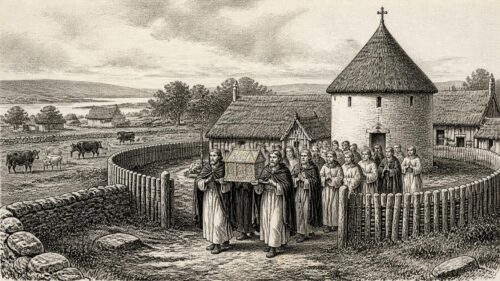
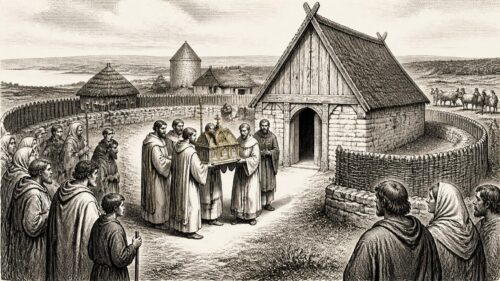
In 798, according to the Annals of Ulster’s chronology, Muirgius son of Tommaltach defeated fellow Connacht forces at Dún Ganiba, strengthening Uí Briúin Aí authority without securing permanent provincial control. Elsewhere, Murchad son of Domnall won at Finnabair in Tethba, where several rulers died. The annals also record kin-slaying, the murder of Abbot Blathmac, deaths among secular and ecclesiastical leaders, and severe snowfall that killed people and cattle. Gormgal son of Dindathach proclaimed Patrick’s law in Connacht, illustrating church power. These events reveal a politically fragmented Ireland shaped by warfare, succession, religious authority, and environmental vulnerability during this turbulent period.
Dateline
The annalistic evidence for this year centres on Connacht, where the overking Muirgius son of Tommaltach won a battle at Dún Ganiba. The entry is conventionally numbered U799 in the Annals of Ulster, but its surviving chronological heading equates it with AD 798. Such medieval Irish year-counting is not always straightforward: later annalistic compilations and modern reconstructions sometimes place the same sequence in 799. It is therefore safest to treat the fighting, deaths, snowfall and ecclesiastical action recorded together as a closely connected late-790s dossier, while following the Ulster annal’s AD 798 placement here.
Dún Ganiba was no mere clash on Ireland’s political margins. Muirgius’s victory was one stage in the making of a more commanding Connacht kingship. It also unfolded in a country where power was dispersed: provincial overkings depended upon local dynasties, allied church communities, movable wealth in cattle and food renders, and the ability to compel recognition rather than rule through a permanent state. The year’s notices of battle, treacherous killing, severe weather and religious law reveal how fragile that authority could be.
Victory Within Connacht
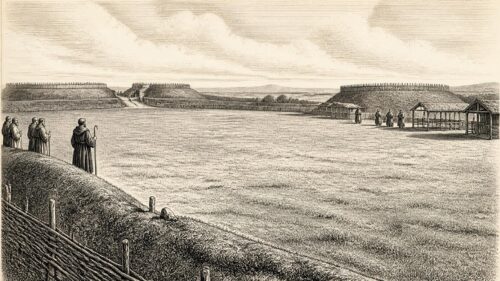
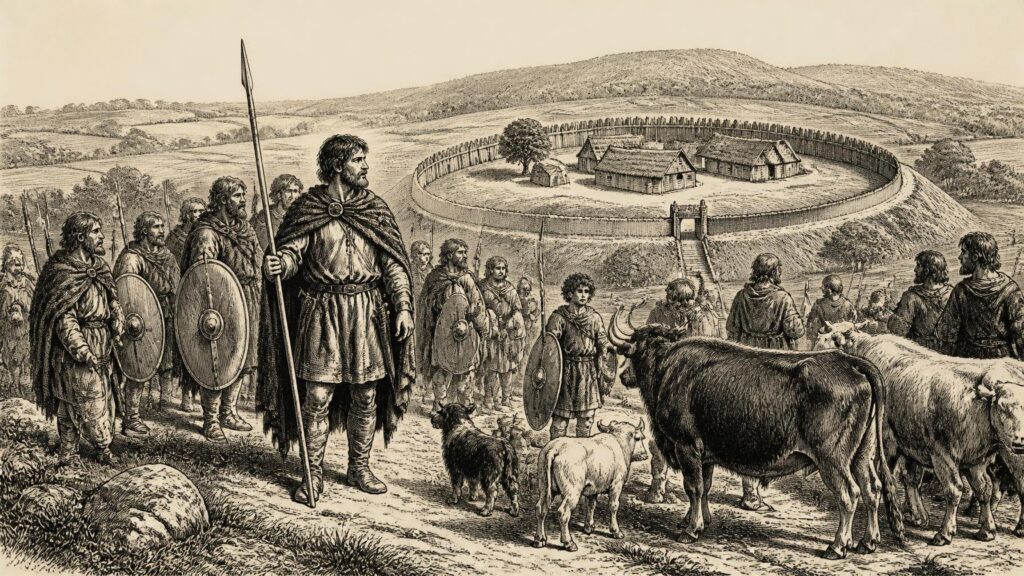
The Annals of Ulster state plainly that Dún Ganiba was fought “between the Connachta themselves”. Coscrach son of Donn, Gaiscedach and many others fell; Muirgius son of Tommaltach was victor. The site has not been securely identified, and the annal does not describe the opposing forces, tactics or immediate settlement. Its brevity should not be filled with invented detail. Yet the identification of the contest as an internal Connacht war is itself significant. This was not a campaign against an external invader but a struggle over rank, land, dependants and the provincial order.
Muirgius belonged to the Uí Briúin Aí, a dynasty rooted in Mag Aí, the fertile plain around modern north Roscommon and north-east Galway. He had emerged as Connacht’s leading king during the 790s, after conflicts among rival Uí Briúin branches and older Connacht dynasties. Dún Ganiba was therefore part of an established contest, not the sudden rise of an unknown warlord. Modern scholarship considers his opponents likely to have included interests connected with the Ciarraige and Uí Fhiachrach, though the annal itself names only casualties. The victory strengthened a ruler who would go on to dominate the province for much of the following decade.
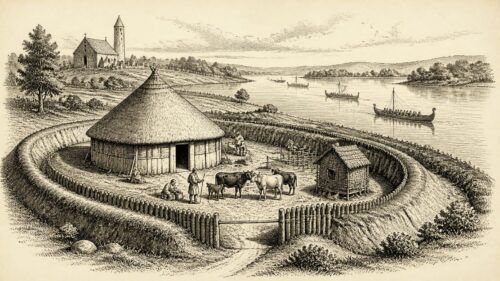
That dominance should not be mistaken for uninterrupted control. Early medieval Irish kingship worked through personal lordship. A victorious king could take hostages, exact food-rents, reward followers, recognise local rulers or replace them; but each of those acts required continuing force and negotiation. Connacht’s landscape of smaller peoples and territories made it especially difficult to turn victory into unquestioned obedience. The battle at Dún Ganiba represents consolidation, not final unification.
Bloodshed in Tethba
Another battle in the same annal-year occurred at Finnabair in Tethba, the midland region north of the lower Shannon. Murchad son of Domnall won, while the dead included Fergus son of Ailgil, lord of Cenél Cairpri, Coscarach son of Ceithernach, Dub Innrecht son of Artgal and Murchad son of Connmach. The wording calls several of these men kings. Even allowing for the annals’ flexible use of royal titles, the list conveys a serious reversal among the political elite.
The event is a useful corrective to any map of Ireland divided into a few neat kingdoms. Tethba lay among overlapping spheres of influence: Mide, Brega, Connacht and the northern Uí Néill world all touched its political horizons. Cenél Cairpri was a regional people rather than a modern county or nation. A battle there could rearrange local lordships without producing a change visible in later national boundaries. For households in the affected districts, however, the result could mean a new lord, demands for cattle or provisions, the taking of hostages, and the loss of kin who had formed a fighting retinue.
At the wider level, Áed Oirdnide of the Cenél nÉogain had only recently become king of Tara after imposing himself in Mide. His kingship represented a powerful northern Uí Néill claim to supremacy, but it did not erase regional conflict. No surviving record assigns Áed a direct role in Finnabair or Dún Ganiba. The important point is the limitation of high kingship: major battles could occur in Connacht and the midlands as contests among local and provincial interests, without a recorded intervention by Tara.
Killing, Succession and Exposure
The year’s violence was not confined to battlefields. Domnall son of Donnchad was “treacherously killed by his kinsmen”. The notice supplies neither place nor motive, but its language matters. Kinship was the principal language of political legitimacy, because eligible rulers usually came from a restricted royal kindred. It was also a source of danger. Brothers, cousins and more distant relatives could become competitors for offices, territories and inheritances. Calling a killing treacherous was not an explanation; it was an annalist’s judgement that the death violated expectations of proper conduct.
The abbot Blathmac son of Guaire of Cluain Fhota Báetáin was likewise killed, named alongside Máel Ruanaid and Follaman son of Donnchad. An abbot in this period was not simply the head of a secluded religious house. Major churches possessed estates, dependants, learned personnel and prestigious saints’ cults. Their leaders could belong to powerful families and participate in local politics. Blathmac’s killing consequently belongs in the same historical world as the year’s secular conflicts, even though the surviving line gives no safe basis for assigning a motive or calling it a raid, feud or dispute over an abbacy.
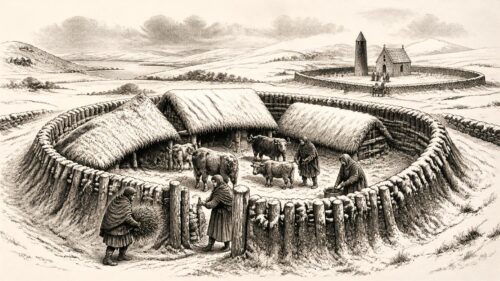
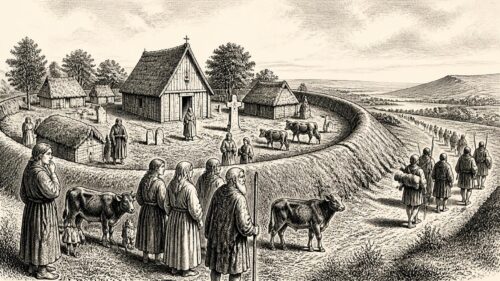
Against these human conflicts comes a stark environmental notice: a great snowfall in which many people and cattle perished. The annal gives no month, duration or region. It cannot prove an island-wide climatic catastrophe, and it should not be turned into a precise weather reconstruction. Nevertheless, the reported loss of both people and livestock shows what contemporaries regarded as exceptional and memorable. Cattle were central stores of wealth, food and social obligation. A hard snowfall could make fodder inaccessible, impede travel, weaken animals, disrupt the movement of rents and place already vulnerable households under acute strain.
Churches as Networks of Power
A cluster of obituaries maps the religious infrastructure of Ireland more effectively than any single monument could. Feradach son of Ségéne, abbot of Rechru, died; so did Anaile of Clonmacnoise, Ceithernach of Glendalough, Siadal grandson of Comán of Cell Achaid, Fiannachtach of Ferns, Suibne of Kildalkey and Breislén of Bere Island. These places ranged from a midland river-centre and a Wicklow valley to Leinster churches and an Atlantic island. Their appearance together does not mean that the communities were centrally governed. It does show the annalist’s interest in a dense network of ecclesiastical institutions whose leaders mattered beyond their own enclosures.
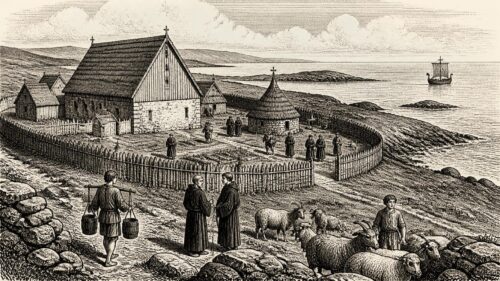
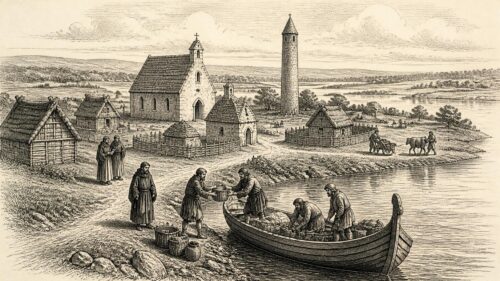
Clonmacnoise, on the Shannon, was a centre of learning, craft production and commemoration as well as prayer. Glendalough occupied a strategically and spiritually striking valley in the Wicklow mountains. Rechru, modern Lambay Island, stood in the Irish Sea off Dublin’s coast. The varied locations remind us that monasteries were connected to farmland, waterways, coastal routes and aristocratic patronage. Their communities included not only clerics and scholars but also labourers, craftspeople, tenants and visitors. The deaths recorded in 798 were changes in leadership within institutions that managed land and resources, preserved learning and mediated between saints, rulers and local society.
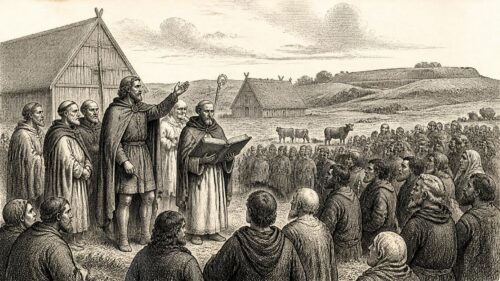
The most overtly political ecclesiastical notice says that Gormgal son of Dindathach promulgated Patrick’s law in Connacht. A “law” of a saint was not a modern statute book imposed by a bureaucracy. It was a sacred and practical regime of protection, dues and authority, associated here with Patrick and therefore with Armagh. Its proclamation could reinforce the standing of a church, regulate relations with lay rulers and collect support through the saint’s prestige. Gormgal’s action in Connacht is particularly revealing because Muirgius was strengthening his own position there. The coincidence does not prove that the two men planned it together, but it demonstrates that royal consolidation and ecclesiastical claims could operate in the same political arena.
A Year Without a Single Centre
The evidence for 798 does not describe a unified Irish response to one national crisis. It instead preserves several local crises and assertions of authority: Muirgius’s Connacht victory, Murchad’s success in Tethba, a kin-slaying, an abbot’s murder, a damaging snowfall and the extension of Patrick’s law. The deaths of Ailill son of Innrechtach, king of Uí Maine in Connacht, and Dúnfhlaith, daughter of Flaithbertach son of Loingsech, further underline the importance of succession and dynastic memory. Neither obituary permits a confident account of what followed, but both marked the passing of figures embedded in regional power.
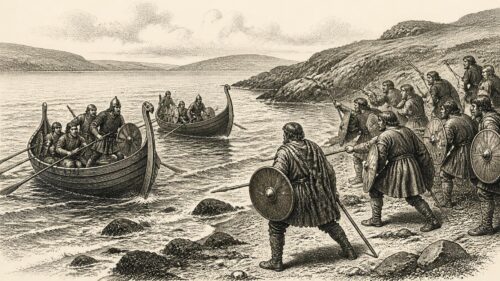
It is also important to note what the surviving notices do not say. The Irish Sea had already seen attacks on church sites in the preceding years, and the new Scandinavian presence was becoming a grave concern around Ireland and Alba. Yet this annal-year does not record a fresh Viking raid. Nor does it offer evidence for new towns, coinage, permanent foreign settlement or a nationwide response to seaborne violence in 798. The year’s story is primarily inland and Irish: rival rulers fought for advantage, churches renewed their claims, and winter exposed the dependence of communities on people, animals and stores.
Dún Ganiba stands at the centre because it made Muirgius the named victor, but the wider record gives the battle its meaning. His achievement was made in a Connacht where allegiance had to be won repeatedly, where church law could validate authority, and where an exceptionally severe snowfall could threaten the material basis of lordship. In 798, power in Ireland was neither static nor solitary. It was contested in battle, proclaimed through saints, inherited within families and measured, at the hardest moment, in the survival of cattle and people.
Primary Sources
- The Annals of Ulster
- The Annals of Ulster, Year U799
- The Annals of Ulster, Year U798
- Annals of the Four Masters
- Annals of Inisfallen
- Vikings in Irish Chronicles, 794–902: Data
- Muirgius
- Patrick (Patricius, Pátraic, Pádraig)
- Annals of Tigernach
- Annals of Tigernach
- Chronicon Scotorum
- Exploring the Irish Annals
- Literacy and Identity in Early Medieval Ireland
- The Céli Dé and Ecclesiastical Government in Ireland
- A Poem on the Kings of Connaught
- Early Irish Monasticism
- High Crosses
- Glendalough Monastic Site and Visitor Centre
- Early Monastic Churches
- Climate in Medieval Ireland