Dub Innrecht’s Last Illness768 CE
Conventionally dated to 768, the annals record transitions rather than a national crisis in Ireland. Dub Innrecht, Uí Briúin king of Connacht, died from bloody flux, creating an undocumented succession question but not evidence of epidemic or civil war. Ecclesiastical leadership changed with the deaths of Aedán of Lismore, the senior abbot at Clonmacnoise, Fer dá Crích son of Suibne at Armagh, and Coibdenach of Cell Tóma. Eithne of Brega, styled queen of Tara’s kings, was praised for penance. These selective notices illuminate intertwined dynastic, religious and economic authority in a rural, fragmented Ireland connected to Britain through learned networks.
Dateline
The surviving record for 768 is brief, but it is unusually revealing. Its notices do not describe a single campaign, royal assembly or disaster that overtook all Ireland. Instead, they mark a sequence of deaths: a king of Connacht struck down by a named illness; leading churchmen at Armagh, Lismore and Clonmacnoise; a royal woman associated with Tara whose penance is remembered as much as her rank. Together, these entries show how political authority, religious leadership and family standing were entangled in eighth-century Ireland.
There is an important chronological caution. The events are conventionally cited under 768, although the manuscript tradition and later annal compilations sometimes place the same notices under different year numbers. This is not evidence for several separate deaths. It reflects the well-known dating difficulties of medieval Irish annals, whose year headings could drift as scribes copied successive kalends. What can responsibly be said is that the cluster belongs to the historical year conventionally reckoned as 768.
A Connacht King Dies
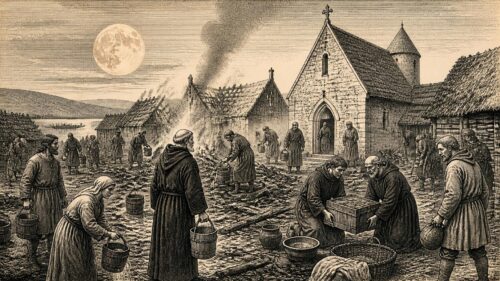
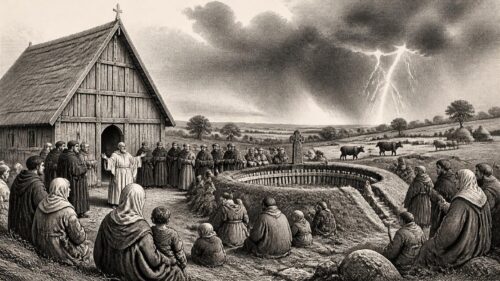
The most politically consequential entry records the death of Dub Innrecht son of Cathal, king of Connacht, “from the bloody flux”. The phrase identifies an illness, probably a severe intestinal complaint involving dysentery-like symptoms, but it should not be enlarged into a claim that a nationwide epidemic struck Ireland in 768. The annalist reports the king’s death and its cause; it does not say how widespread the sickness was, how long it lasted, or whether other communities suffered similarly.
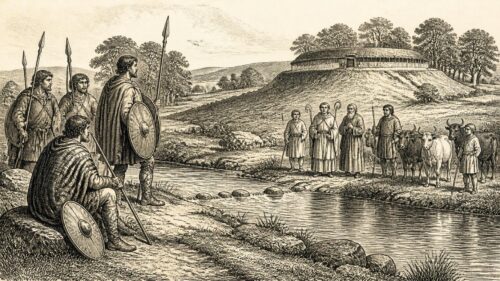
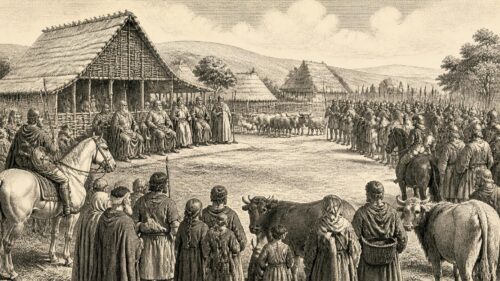
Even so, the death of a provincial king was never a private matter. Connacht was not a unified modern region ruled by a bureaucratic state. It was a kingship contested among powerful dynastic kindreds, with authority exercised through personal allegiance, military following, cattle wealth, hostages, marriage connections and control of important churches. Dub Innrecht belonged to the Uí Briúin, a leading Connacht dynasty. His removal created an immediate question of succession, even though the annals do not preserve a detailed account of the negotiations, rival claims or settlement that followed.
That silence matters. Medieval Irish annals are often strongest at recording deaths, killings, raids, ecclesiastical successions and major battles, but they do not offer a continuous narrative of government. Dub Innrecht’s obituary confirms a change at the apex of Connacht; it does not licence a reconstruction of a palace coup, civil war or coronation. In 768, the evidence establishes disruption at the top of one of Ireland’s principal overkingdoms, not the manner in which that disruption was resolved.
The wider political setting helps explain the importance of such a death. Ireland consisted of numerous kingdoms, from local lordships to larger provincial powers. In the midlands, Donnchad Midi of Clann Cholmáin was consolidating his position within the southern Uí Néill. He would become one of the dominant rulers of the later eighth century, but the clearer evidence for his major expeditions and wider claims belongs to the years after 768. It would therefore be misleading to portray this year as one in which he already exercised settled command over all Ireland. Connacht’s succession remained a regional matter, albeit one with consequences for the balance of power beyond the province.
Leadership Changes in Great Churches
The annals also record a striking concentration of ecclesiastical deaths. Aedán, abbot of Les Mór, rested in 768. Les Mór is Lismore in present-day County Waterford, an important Munster church on the Blackwater system. The Annals of Inisfallen independently preserve Aedán’s death, lending useful support to the notice. Lismore’s position connected its religious community to the agricultural and political landscape of the Déisi and to river and coastal routes that linked southern Ireland with wider Irish Sea networks.
At Clonmacnoise, on the Shannon in what is now County Offaly, the annals record the death of the grandson of Miannach, described both as abbot and as senior. The latter title should not be treated as decorative. It indicates recognised standing within a large religious community, where authority could be distributed among an abbot, bishops, scribes, teachers, stewards and other office-holders. The annalist’s naming of both roles suggests that this was a man of consequence in the institution’s internal hierarchy.
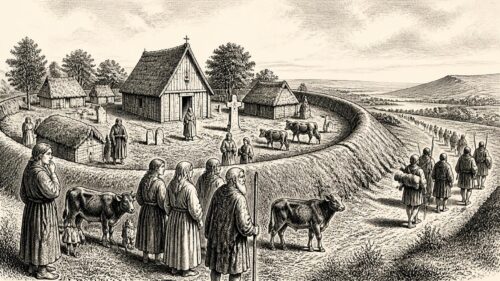
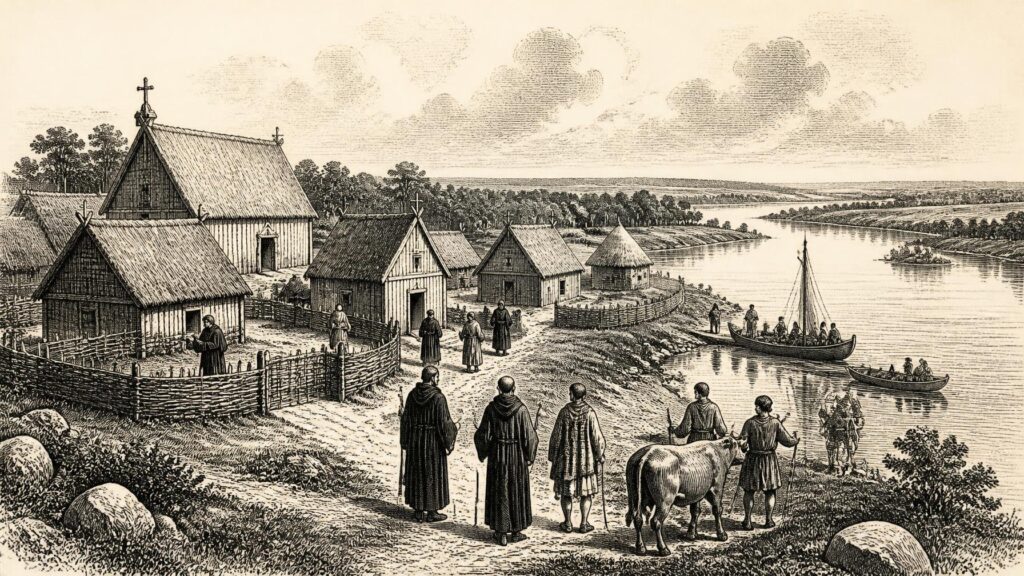
Clonmacnoise was more than an isolated retreat for prayer. By the eighth century it stood within a densely connected midland landscape, close to the Shannon crossing routes and to several competing kingdoms. Archaeology indicates that the settlement around its ecclesiastical core expanded substantially during the early medieval period, with houses, craft activity and organised routes as well as churches and burial grounds. In 768, the death of one prominent cleric did not halt that wider community, but it did require the redistribution of office, influence and resources.
Fer dá Crích son of Suibne, abbot of Armagh, also died. Armagh’s abbot held the prestigious title of successor of Patrick, and the office carried both spiritual authority and very practical claims to land, tribute, protection and patronage. The Laud Synchronisms preserve Fer dá Crích within a succession list of Patrick’s heirs, corroborating the importance which later learned tradition attached to his tenure. His death thus had consequences beyond a single monastery: it affected one of the island’s foremost ecclesiastical institutions.
Care is needed with his name. More than one eighth-century churchman was called Fer dá Crích, and modern accounts can conflate them. The man whose death is entered in 768 was the abbot of Armagh, son of Suibne. He should not automatically be identified with the earlier reform-minded Fer-dá-Chrích associated with Dairinis and the religious formation of Máel Ruain of Tallaght. Similar names in Irish sources do not by themselves establish identity, kinship or shared activity.
Coibdenach, abbot of Cell Tóma, is also recorded as having died. The surviving notice tells us little about the community’s size or location, yet its inclusion is significant. The annals did not attempt to list every death in Ireland. They selected people considered memorable within networks of religious learning, patronage and record-keeping. A year that notices leaders at Armagh, Lismore, Clonmacnoise and Cell Tóma demonstrates the reach of those networks across provincial boundaries.
Eithne and Tara’s Royal Language
The entry for Eithne daughter of Bresal of Brega is among the most evocative in the year’s record. She is called the “queen of kings of Temair” – Tara – and is said to have attained the heavenly kingdom after penance. The phrase is exceptional and deliberately exalted. It associates Eithne with the royal world of Tara, the symbolic centre of Uí Néill claims to pre-eminence, while also presenting her final reputation in penitential Christian terms.
It would be rash, however, to turn this compressed formula into a detailed biography. The annal does not identify Eithne’s husband or husbands, specify her political interventions, or describe the penance she performed. Nor does it prove that she held formal governmental office. What it does show is that elite women could be remembered in annalistic writing through both dynastic identity and religious achievement. Eithne’s father is located in Brega, an area of great political importance around the lower Boyne and Tara; her obituary preserves a connection between female status, royal alliances and salvation.
Penance was not simply a private feeling of regret. In early medieval Irish Christian culture it could involve fasting, prayer, almsgiving, pilgrimage, separation from former status or other disciplined acts. The annalist’s wording frames Eithne’s death as a successful religious conclusion. For a woman whose standing was expressed in such intensely royal language, this was a public judgement on memory as well as devotion.
Life Beyond the Obituaries
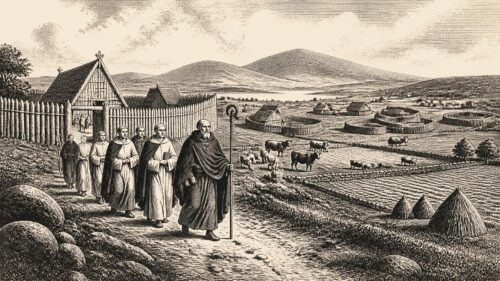
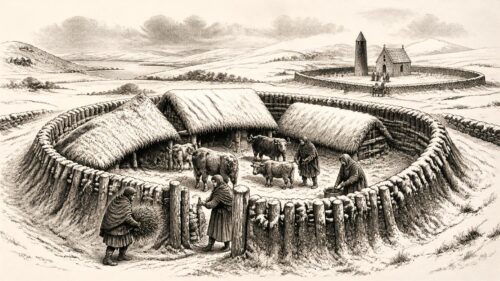
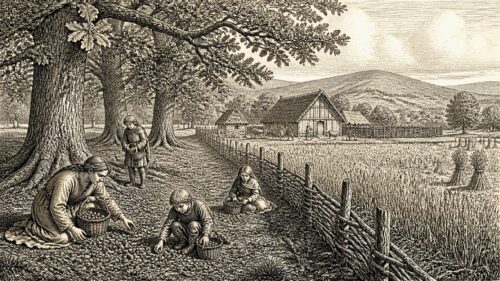
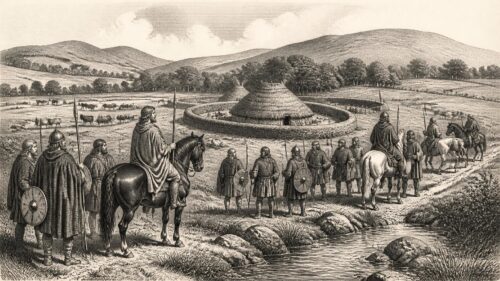
The annals’ concentration on rulers and church leaders should not obscure the much larger population sustaining their worlds. Most people in 768 lived in dispersed rural settlements rather than towns. Cattle remained fundamental to wealth, food and status, but archaeological and environmental research indicates that cereal cultivation was gaining greater importance from the eighth century onwards. Fields, grazing, dairying, grain processing, woodland resources and small-scale craft production underpinned the households that supplied kings and churches.
Monasteries participated fully in this economy. Communities such as Armagh, Clonmacnoise and Lismore required food, labour, timber, metalwork, manuscripts, clothing and transport. Their estates drew in renders and services; their churches and burial grounds attracted visitors; their learned personnel copied texts and maintained ties with other religious centres. The deaths of an abbot or senior cleric therefore mattered to tenants, dependants, clients and neighbouring rulers as well as to monks and priests.
None of this permits a claim that 768 was either prosperous or disastrous for Ireland as a whole. The record names a king’s fatal illness but provides no harvest report, weather notice or general famine for this year. The responsible picture is narrower: a rural, politically fragmented island in which several major religious institutions and one provincial kingship experienced a change of leadership.
A Battle Across the Sea
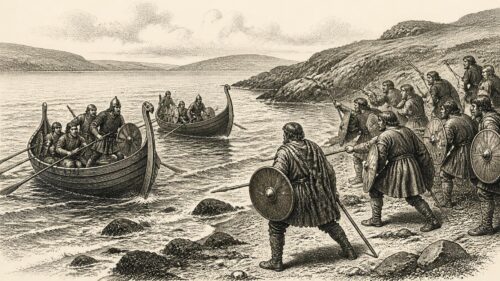
The Annals of Ulster also place a battle between Áed and Cinaed in Fortriu, in northern Britain. This was not an Irish battle, and its outcome is not supplied in the surviving notice. It belongs in an Irish year only because Irish ecclesiastical chroniclers monitored the neighbouring Gaelic and Pictish world across the sea. Religious communities, dynasties and travellers moved through an Irish Sea zone that connected Ireland, Dál Riata, Iona and Pictland. The entry is a reminder that Ireland’s learned observers did not imagine their island as isolated.
For Ireland itself, 768 was a year of transitions rather than a year with a single decisive national event. Dub Innrecht’s death unsettled Connacht’s kingship. Aedán, the grandson of Miannach, Fer dá Crích and Coibdenach left vacancies in religious leadership. Eithne’s obituary joined royal prestige to the language of penance and heaven. The surviving notices are sparse, but their very selectiveness reveals an Ireland in which dynastic rule and ecclesiastical institutions remained the principal frameworks through which public change was understood and recorded.
Primary Sources
- The Annals of Ulster: Year U768
- CELT Project: The Annals of Ulster
- The Annals of Inisfallen (MS. Rawlinson B. 503)
- Annals of the Four Masters: Part 60
- The Annals of the Four Masters
- CELT Project: Annals of Tigernach
- Chronicon Scotorum
- CELT Project: Chronicon Scotorum
- The Laud Synchronisms
- Chronological Synchronisation of the Irish Annals
- Donnchad Midi
- Fer-dá-Chrích
- Máel-Ruain
- Agriculture, Settlement and Society in Early Medieval Ireland
- The Economy of Early Medieval Ireland
- Early Medieval Ireland: Archaeological Excavations, 1930–2009
- Early Christian Irish Monasteries
- Ireland in the Middle Ages
- From Kingdom to Colony: Framing the English Conquest of Ireland
- Early Medieval Ireland, AD 400–1100: The Evidence from Archaeological Excavations
- Ciarán's Church and His Lands: A Study of the History and Development of Clonmacnoise
- The Economy and Industry of Early Medieval Clonmacnoise: A Preliminary View
- Exchange and Trade in Early Medieval Ireland
- Exploring the Irish Annals