Bangor’s Abbot, Connacht’s King705 CE
Dateline
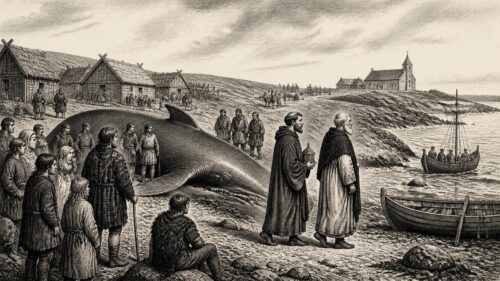
In 705 CE, Ireland’s surviving annalistic record presents a small but unusually revealing cluster of deaths, violence and political change. The notices are terse: the abbot Cenn Faelad of Bangor died; a battle was fought in Corcu Modruad, where Céilechair son of Comán fell; Cellach son of Rogallach, king of Connacht, died after entering clerical life; Conamail son of Canu was killed; and Congal Cenn Magair, son of Fergus of Fána, “begins to reign”. No contemporary narrative tells how these events unfolded. Yet, read alongside the preceding and following annals, they illuminate an Ireland in which monasteries, dynasties and local peoples were deeply entangled. The year should be treated with chronological care: the Annals of Tigernach and Chronicon Scotorum place this group under 705, while the corresponding Annals of Ulster entry is headed U705 but carries a calendar equation equivalent to 704. The events are therefore securely connected with the annalistic year 705, but no modern day or month can responsibly be assigned to them.
A Connacht King’s Final Withdrawal
The death of Cellach mac Rogallaig was the year’s most consequential Irish political notice. The annals style him king of Connacht and specify that he died post clericatum: after taking up clerical life. This is not evidence that he had become a monk in the later, narrowly institutional sense, nor does it name the church or community with which he was associated. It does show, however, that leaving secular rule for a religious status was intelligible and memorable enough to be recorded as part of a ruler’s identity.
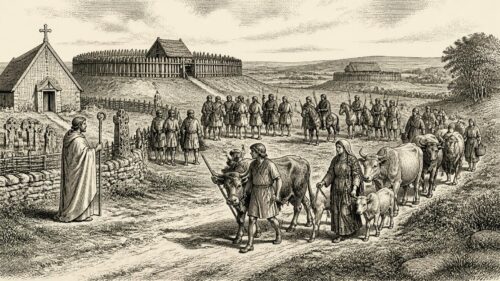
Cellach belonged to the Uí Briúin Aí, a leading Connacht dynasty centred in the fertile and politically important plain of Mag Aí in what is now central County Roscommon. His family had recently reasserted itself in regional politics. In the battle of Corann, recorded for 703 in the annals, Cellach and the Connachtmen defeated Loingsech mac Óengusso, the powerful Cenél Conaill ruler conventionally counted among the kings of Tara or Ireland. Loingsech, three of his sons and numerous subordinate leaders were killed. That victory had checked a northern intervention in Connacht at great cost to the invaders.
Thus Cellach’s death in 705 came only a short time after an exceptional triumph. It did not mean that Connacht’s internal disputes vanished. Later entries show another Connacht ruler, Indrechtach son of Dúnchad of Muirisc, killed in 707 by northern opponents. The rapid turnover should not be mistaken for the collapse of a united kingdom, because “Connacht” comprised several powerful kindreds with their own territories and interests. But it underlines the precarious character of overkingship. A king could win a major battle, retire into clerical life, and leave a political field still vulnerable to rival branches and outside pressure.
Conflict in Corcu Modruad
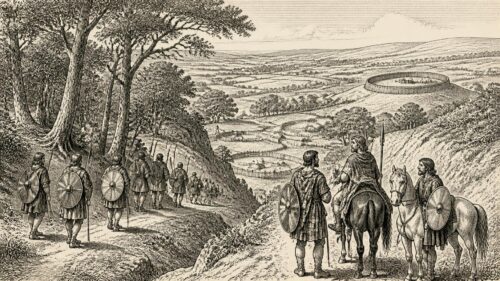
The battle of Corcu Modruad is recorded without victors, causes or troop numbers. Its one named casualty is Céilechair son of Comán. Corcu Modruad occupied the Burren region of north-west Munster, an area defined by limestone uplands, thin soils and a coastline facing the Atlantic. The place-name anchors the fighting in a local polity rather than in a conflict presented as an all-Ireland campaign. It is tempting to supply a story of succession, cattle-raiding or rivalry between Munster dynasties, but the record does not permit this.
What can be said is that warfare remained a regular instrument of politics at many scales. Annalists often recorded a battle because a king, nobleman or notable leader died, rather than because the fighting transformed a whole province. The death of Céilechair is therefore the firm fact; the size of the engagement is unknown. For communities in and around Corcu Modruad, even a limited clash could have had immediate consequences: armed men drawn from households and client groups, livestock moved or seized, obligations of compensation, and renewed bargaining over local authority. Such effects are historically plausible, but they must remain context rather than a documented sequence for 705 itself.
Bangor Loses an Abbot
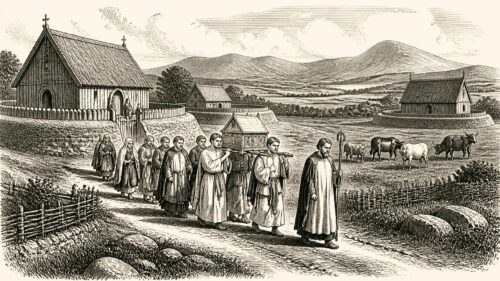
The death of Cenn Faelad grandson of Áed Brec, abbot of Bennchor or Bangor, is equally important. Bangor, on the southern shore of Belfast Lough in present-day County Down, was one of the best-known ecclesiastical communities in early medieval Ireland. Its prominence rested on religious practice, learning, landholding and connections with secular patrons, not on separation from the world around it. The death of its abbot therefore mattered beyond the immediate community, although the annals do not name Cenn Faelad’s successor or describe funeral rites, property or controversy.
An abbot’s role cannot be reduced to that of a modern parish priest. Early Irish churches were organised through numerous communities and federations, often tied to saints, kin-groups and royal territories. Bishops performed essential sacramental functions, but abbots could direct major establishments and command considerable influence. Bangor’s head would have overseen religious observance while also standing within a web of tenants, dependants, craftsmen, scholars and benefactors. The very fact that an annal copied and preserved Cenn Faelad’s death indicates Bangor’s recognised standing in the learned networks from which Irish historical writing emerged.
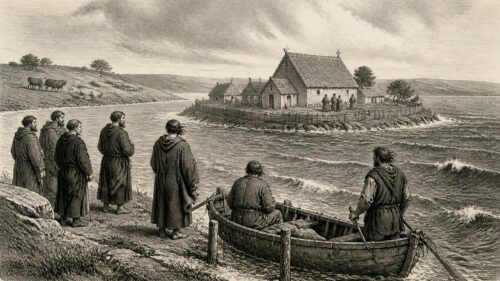
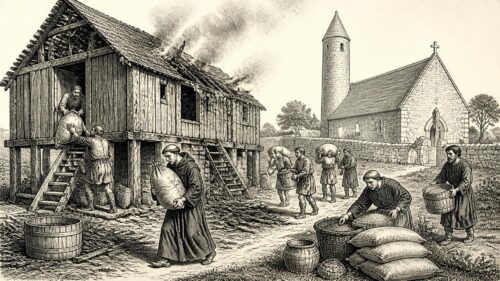
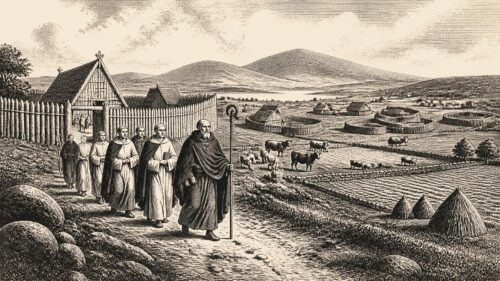
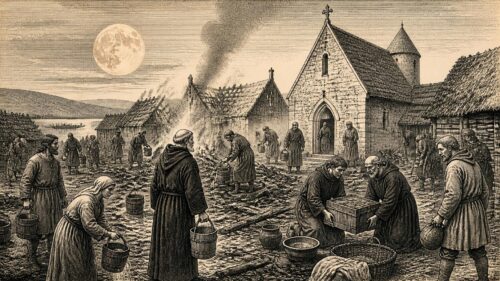
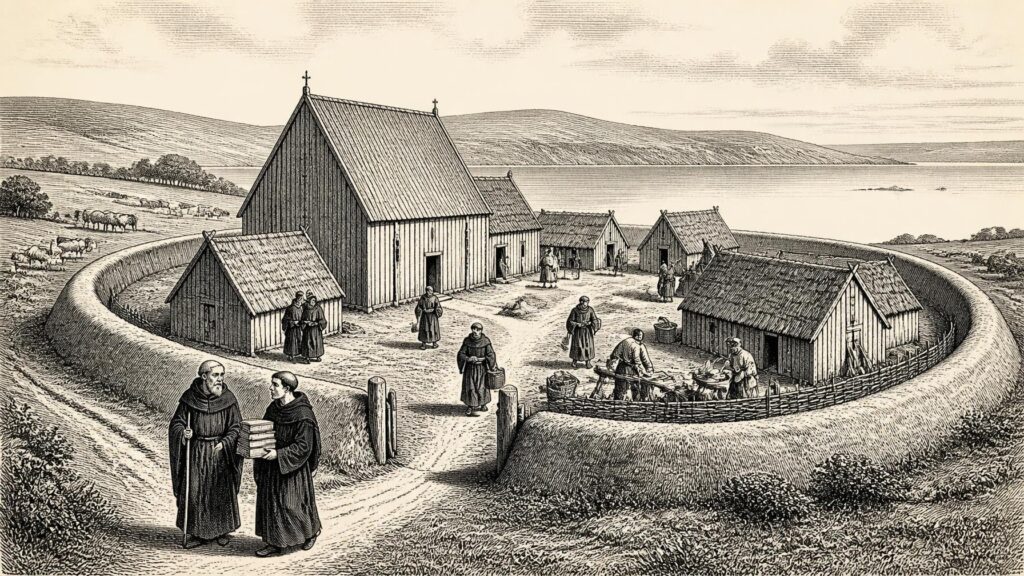
It would be wrong, however, to picture Bangor in 705 through the later stone ruins and round towers familiar to visitors today. Much of the built environment of Irish ecclesiastical settlements in this period was probably timber, earth and wattle, with buildings repaired and replaced over generations. Enclosures marked sacred and communal space; churches, dwellings, workshops, stores and burial grounds were parts of lived settlements. Monastic life also depended on fields, cattle, food processing and labour from people who were not necessarily vowed religious. Cenn Faelad’s obituary gives no description of those activities, but it belongs in this broader landscape of work as well as worship.
Congal’s Accession
The final notice, that Congal of Cenn Magair, son of Fergus of Fána, began to reign, records an accession but leaves its precise scope unstated. Other annalistic and regnal traditions associate Congal Cenn Magair with the northern Cenél Conaill, descendants of Niall in north-west Ireland. Later historical frameworks often classify him as a king of Ireland, but that language should be handled carefully. Early medieval Irish “high-kingship” was not a centrally administered monarchy with fixed borders, bureaucracy or automatic obedience. It was a claim expressed through ancestry, military capacity, alliances, assemblies, hostages and recognition by other rulers.
In 705, the most responsible formulation is simply that Congal’s reign was recorded as beginning. His emergence followed the death of Loingsech at Corann, a fellow member of the Cenél Conaill. The timing reveals that the northern dynasty had not disappeared after its Connacht defeat. Rather, its leadership was being reconstituted. Congal’s position was relevant to Ireland as a whole because northern Uí Néill rulers could project power far beyond their home territories, but no evidence allows us to describe a particular expedition, tribute settlement or diplomatic agreement by him during this calendar year.
Violence, Kin and Record
The killing of Conamail son of Canu receives only four words in the Latin annal. No place, killer or motive survives. Such notices are a warning against treating the annals as complete reports. They preserve selected names and events, not an even census of all deaths, disputes and settlements. The people behind them nevertheless belonged to a society in which kinship named status and responsibility. Genealogies could validate a ruler’s claim, while legal and social obligations linked households, clients and ecclesiastical communities. A violent death might initiate compensation, retaliation or a settlement; in Conamail’s case, the documentary trail stops before any of that can be demonstrated.
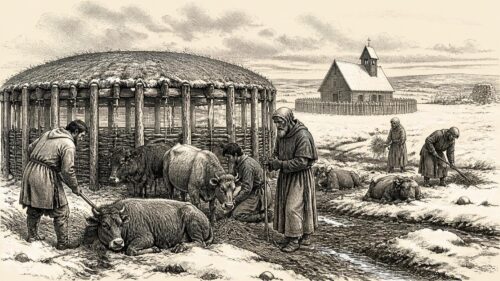
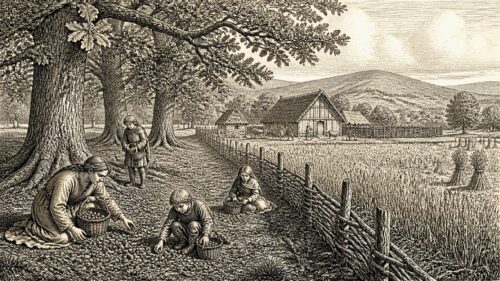
The same limits apply to everyday life. There is no securely dated report of harvest failure, epidemic, ship traffic, weather or building work in Ireland for 705. The absence of such a notice is not proof of calm or abundance. Most people lived in dispersed rural settlements, cultivating crops and raising cattle, sheep and pigs, while waterways and coastal routes connected regions more readily than many overland journeys. Ecclesiastical centres were places of prayer and literacy but also consumers, producers and recipients of gifts and renders. These are conditions of the early eighth-century Irish world, not events that can be assigned specifically to this year.
A Year of Transitions
705 CE is therefore best understood not as a year of one decisive national event, but as a moment of transition registered at several levels. In Connacht, the victorious Cellach died after clerical retirement. In the Burren, a local battle took the life of Céilechair. At Bangor, an abbot’s death marked a change in the leadership of a major religious community. In the north, Congal’s recorded accession signalled the renewal of Cenél Conaill authority after the disaster at Corann. The annals’ economy of words conceals much, yet their conjunction shows the central fact of Irish politics and society: religious office, dynastic succession and armed power were inseparable strands in the ordering of the island.
Primary Sources
- The Annals of Ulster, Year U705
- The Annals of Ulster, Year U705 (Latin text)
- The Annals of Ulster
- The Annals of Ulster, Year U703
- The Annals of Tigernach
- Navigator for the Annals of Tigernach
- Chronicon Scotorum
- Chronicon Scotorum, Annals CS704–CS707
- Annals of Inisfallen
- CELT Project: Annals of Inisfallen
- Egerton Annals: Mionannala, Annal 705
- Cellach
- Early Mechanisms of Abbatial Succession: The Case of Iona (563–704)
- Early Christian Monasteries
- Patrician and Early Christian Architecture
- Churches and Ecclesiastical Enclosures
- Clonmacnoise Monastic Site
- High Crosses
- Irish School of Illumination, c. 650–1100
- Christian Ireland, Fifth to Eighth Centuries
- Money in Early Christian Ireland According to the Irish Laws
- Saint Mullins Ecclesiastical Village
- Early Irish Monasticism
- Early Medieval Ireland: Population and Settlement Context