Diarmait of Mide Slain689 CE
The annals traditionally associated with 689 record the killing of Diarmait son of Airmedach Cáech, king of Mide, by Áed son of Dlúthach of Fir Chúl, illustrating rivalry among regional rulers. They also note Fínnechta Fledach’s return to kingship, without establishing a link between the events. Deaths of Bishop Iolán of Cenn Garad and other figures reflect the importance of ecclesiastical and kin networks. A notice of Adomnán recovering captives may duplicate an earlier record of his diplomacy with Northumbria. A solar eclipse, probably seen on 3 July 688, reveals chronological displacement in the annals.
Dateline
In 689 CE, Ireland’s surviving annalistic record preserves a compact but revealing cluster of political, ecclesiastical and celestial notices. It must, however, be read with unusual care. The material conventionally grouped under the annal-heading 689 is not securely tied to the modern calendar year: the Annals of Ulster label their corresponding entry “AD 688”, and a modern synchronism identifies the reported solar eclipse with 3 July 688. This article therefore treats the events as the evidence traditionally associated with 689 CE, while distinguishing that association from a firm modern date. The clearest political event is the killing of Diarmait, king of Mide, whose death exposed how precarious regional kingship could be in a country divided among numerous competing dynasties.
A King Killed in Mide
The annals record the killing of Diarmait son of Airmedach Cáech, described as king of Mide. The Annals of Tigernach add a crucial detail absent from the briefer Ulster entry: Diarmait was slain by Áed son of Dlúthach, king of Fir Chúl. That is a direct statement of lethal political conflict, not a vague report of a natural death. Yet the sources do not name a battlefield, explain the immediate cause, or tell us what settlement followed. It would be irresponsible to supply a succession crisis, a pitched campaign or a particular territorial objective from imagination.
Even so, the identification of both men as rulers tells us much about the structure of power. Mide, the central region later associated with Meath and parts of adjoining counties, contained routes, royal landscapes and ecclesiastical centres of exceptional importance. Its rulers were positioned amid the rivalry of Uí Néill kindreds and lesser kingdoms. Fir Chúl, from which Áed came, was itself a regional people rather than an outside state. Diarmait’s death is thus best understood as an episode within a densely layered Irish political order: kings contended not only across the island but with neighbouring branches of related dynasties, clients and rivals.
A king’s killing was never merely personal. His household, followers and dependent communities faced immediate uncertainty over cattle, food-renders, military service and protection. Kingship rested on relationships rather than an impersonal state apparatus. A successful ruler could exact tribute, distribute gifts, receive hostages and offer backing in disputes; a defeated dynasty risked losing access to these resources. The annals’ economy of words conceals those consequences, but it also reveals what their compilers thought worthy of permanent record: the removal of a king altered the political map.
Fínnechta’s Return
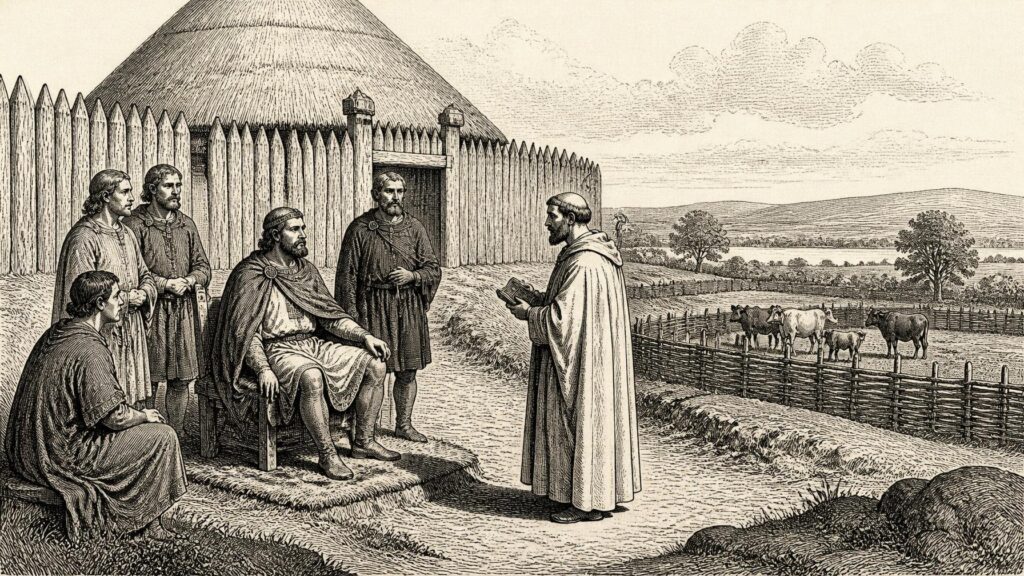
In the same annal-grouping, Fínnechta is said to have “returned to the kingship”. He is Fínnechta Fledach, a leading member of the southern Uí Néill and a ruler later remembered as king of Ireland. The wording implies an interruption: the preceding record says that he had entered clerical life, while this entry announces his resumption of rule. The bare notice is valuable precisely because it does not turn the transition into a neat constitutional story. Early Irish rulership was not inherited through an automatic rule of primogeniture. Eligibility within a royal kindred, military backing, patronage and the ability to command allies all mattered.
Fínnechta’s restoration should not be treated as proof that he controlled all Ireland in a modern territorial sense. Titles such as “king of Ireland” expressed a claim to pre-eminence and a capacity to receive submission from other rulers, but local kings remained powerful actors. The killing of Diarmait in Mide, and the return of Fínnechta in the same sequence, together show the volatility of the political world around the midlands. They do not demonstrate that one caused the other. The annals supply juxtaposition, not a stated causal connection.
Later narrative tradition attaches Fínnechta to the remission of the Bóroma, the cattle tribute associated with Leinster, and to encounters with the clerics Moling and Adomnán. Those stories are important evidence for how later generations imagined good and bad kingship: tribute, generosity, clerical counsel and salvation were inseparable themes. They should not, however, be used as a diary of 689 CE. Their fuller literary form belongs to a later textual tradition, even where it preserves older political memory.
Churchmen and Record-Keeping
The notices associated with this year also include the death of Iolán, bishop of Cenn Garad, called John in another translation. Other annalistic versions record deaths of Cathasach, grandson of Domnall Brec, Do-Chinne of Daire Brugais, Feradach son of Tuathalán, and Máel Dúin son of Conall Crannamna. The different lists and spellings are a reminder that Irish annals were copied, edited and arranged centuries after many of the events they report. Agreement across related chronicles strengthens confidence that such deaths were remembered; variation warns against claims of precision beyond the evidence.
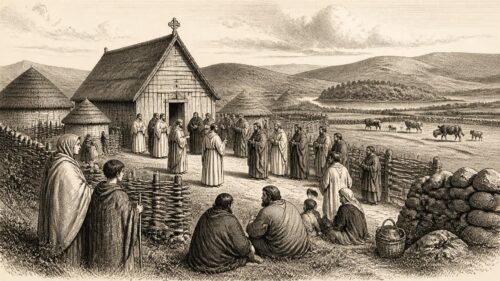
Iolán’s identification as a bishop is particularly significant. Seventh-century Irish Christianity did not operate through the later, tightly territorial parish-and-diocese system familiar from the high Middle Ages. Monastic communities, churches, bishops, learned clergy and secular patrons overlapped in a landscape of local kingdoms. A bishop’s death could matter to a religious community, to its lay protectors and to the kin-group from which its clergy were drawn. The annal does not describe Cenn Garad’s buildings, estates or congregation, so none should be invented. But the entry confirms the presence of an episcopal office within the interlocking religious and political networks of the period.
Writing itself was one of the great instruments of those networks. The short Latin and Irish notices ultimately preserved in the annals were not created for modern historians; they maintained institutional memory. They named rulers, churchmen, kin connections, battles and striking signs in the heavens. The survival of Diarmait’s patronymic and Cathasach’s extended ancestry shows the importance attached to descent. Such records could establish who belonged to a ruling line, who had died, and which communities possessed a past worth commemorating.
Adomnán and Captivity
The Annals of Tigernach also place a notice beside the events of 689: “Adamnán brought back captives to Ireland.” Adomnán, abbot of Iona from 679 until 704, was one of the most learned and influential churchmen of his generation. Yet this particular entry demands caution. The Annals of Ulster and Chronicon Scotorum record that he returned sixty former captives in an earlier annal, conventionally associated with 687 but itself affected by chronological displacement. Modern scholarship has therefore considered the Tigernach notice a possible duplicate, though a further journey cannot simply be ruled out.
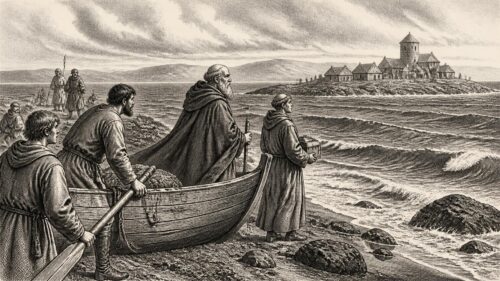
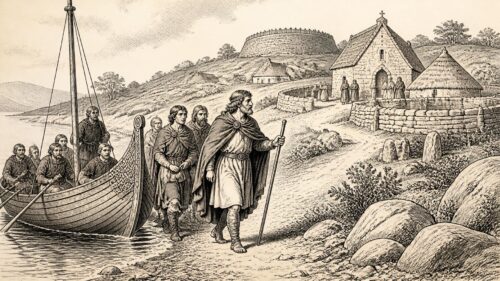
What can be said securely is that Adomnán’s diplomacy belonged to the political environment immediately surrounding this annal sequence. Irish captives had been taken in a Northumbrian raid on Brega in 685, and Adomnán negotiated with Aldfrith of Northumbria for their release. This was not charity detached from public affairs. Captives represented torn households, lost labour, damaged kin networks and political humiliation. Their return demonstrates that the Irish Sea linked Ireland, Iona and Northumbria by travel, warfare, diplomacy and scholarship. It also illuminates why a major abbot could act internationally: religious standing, kinship and royal connections gave him access that ordinary captives did not possess.
Adomnán’s later advocacy for protections in war, most famously associated with the Law of Innocents of 697, should not be projected backwards as if that law already governed events in 689. Nevertheless, the experience of negotiating for prisoners gives the captivity notice a powerful context. Whether the Tigernach entry records a second recovery or repeats the earlier mission, it preserves a concern that was real and pressing in the late seventh century: the human cost of raids across the Irish Sea.
An Obscured Sun
The annals also say that part of the sun was obscured. Unlike many brief entries, this one can be checked against astronomical calculation. The traditional annal placement is 689, but the eclipse is generally identified as the solar eclipse of 3 July 688. This is an unusually useful warning against treating every medieval year-heading as a modern calendar date. The observation is not thereby worthless; rather, it helps expose a one-year displacement in this stretch of the record.
For people who saw it, a partial darkening of the sun would have been alarming and memorable. Christian writers could interpret unusual skies as signs requiring reflection, but the annal merely records the phenomenon. It does not state that the eclipse foretold Diarmait’s death, validated Fínnechta’s return or caused any earthly event. Its restraint deserves respect. The modern reader can recognise an eclipse without forcing a political meaning upon it.
Life Beyond the Notices
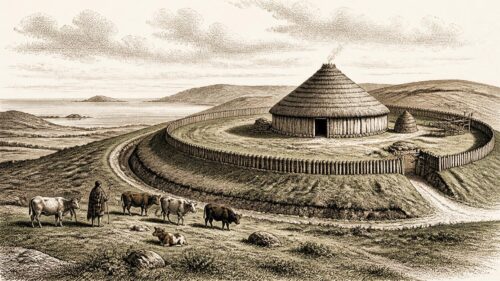
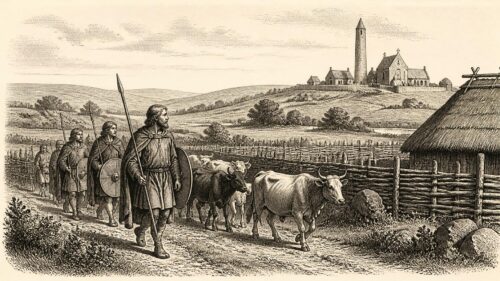
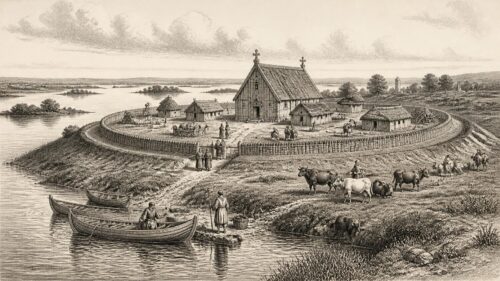
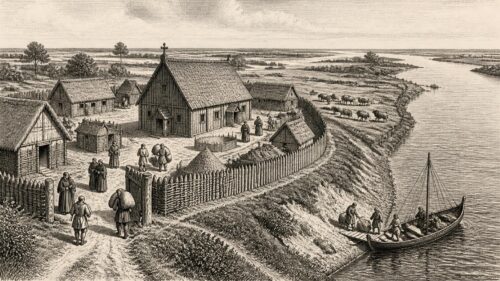
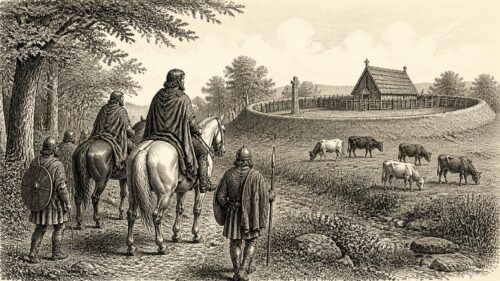
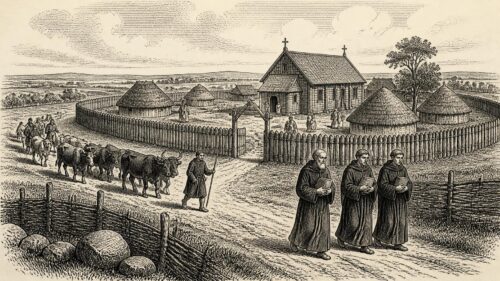
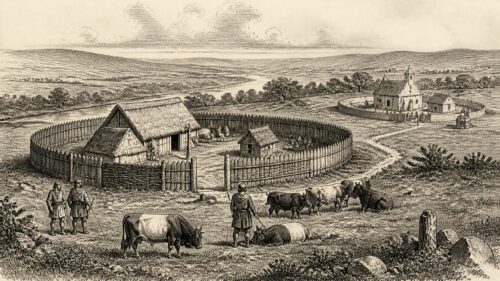
The annals centre rulers, clerics and exceptional occurrences, whereas most people in and around Mide spent their days in agriculture. Archaeology shows an overwhelmingly rural landscape of enclosed farmsteads, fields, trackways and, in some areas, crannogs. Ringforts enclosed the dwellings and working spaces of prosperous farmers and local lords; timber houses, byres, storage areas and fences required constant repair. Cattle were central to wealth, dairying and tribute, but households also managed pigs and sheep, grew cereals, ground grain, made dairy foods, spun wool and preserved food for winter.
These are broader conditions, not events that can be dated specifically to 689 CE. They matter because they explain the stakes of the year’s political notices. A change of king could affect the demands laid upon farmers and dependants, the safety of herds, and the flow of food and service to royal and ecclesiastical households. Likewise, the return of captives mattered because people were not abstract units of diplomacy: they were workers, relatives and members of communities already bound by obligation.
Thus the evidence associated with 689 CE presents no single island-wide turning point. Instead it offers a sharply focused view of early medieval Ireland: a king of Mide killed by another regional ruler; Fínnechta resuming power; a bishop and other notable figures entering institutional memory through death notices; Adomnán’s concern for captives across the sea; and a solar eclipse whose true date corrects the annals’ chronology. The record is brief, but it opens onto a society in which kinship, agriculture, learning, faith and force were inseparable.
Primary Sources
- The Annals of Tigernach, Part 11
- CELT Project: The Annals of Tigernach
- The Annals of Ulster, Part 259
- CELT Project: The Annals of Ulster
- Chronicon Scotorum
- Chronicon Scotorum, Part 68
- Fragmentary Annals of Ireland, Part 6
- CELT Project: Fragmentary Annals of Ireland
- Annals of the Four Masters, Part 52
- CELT Project: Annals of the Four Masters
- The Chronicle of Ireland: Synchronisms, 679–694
- Adomnán
- Bede, Ecclesiastical History of the English People, Book V
- The Archaeology of Livestock and Cereal Production in Early Medieval Ireland, AD 400–1100
- The Economy of Early Medieval Ireland
- Early Medieval Dwellings and Settlements in Ireland, AD 400–1100, Volume 1
- Early Medieval Ireland: Archaeological Excavations, 1930–2009
- Ringforts / Ráthanna
- Ordinary People in Early Christian Ireland
- High Crosses
- Exploring the Irish Annals
- The Church and the World in Early Christian Ireland
- The Idea of the Three Orders of Society and Social Stratification in Early Medieval Ireland
- Of Bede’s ‘Five Languages and Four Nations’: the Earliest Writing from Ireland, Scotland and Wales