Imlech Pich’s New Order688 CE
In 688, the battle of Imlech Pich reshaped power in Brega when Niall son of Cernach Sotal defeated Congalach son of Conaing. Two of Congalach’s allies, the kings of Ard Cianachta and Conaille Muirthemne, were killed, while Congalach escaped, leaving rival claims unresolved. The defeat probably reduced Ard Cianachta’s independence and strengthened southern Brega. Elegiac verse recalls the wider human and material losses of warfare. The annals also record high-king Fínnechta Fledach’s temporary entry into clerical life and the death of Ségéne of Armagh, illustrating the close interconnection of royal, ecclesiastical and regional authority.
Dateline
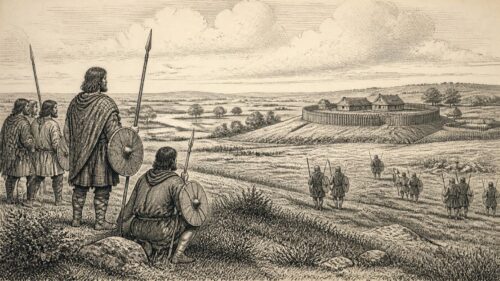
In 688 CE, a battle remembered as Imlech Pich exposed the fragility of power in Brega, the politically important plain north of the River Liffey. The early Irish annals agree on the core result: Niall son of Cernach Sotal defeated Congalach son of Conaing; Dub dá Inber, king of Ard Cianachta, and Uarchride, king of Conaille Muirthemne, were killed; Congalach escaped. They also record the death of Ségéne, bishop of Armagh, and state that the high-king Fínnechta Fledach entered clerical life. These are unusually consequential notices for one year, but they require careful handling. No annal supplies a day, a detailed battlefield narrative or a full explanation of motives. Moreover, early Irish annals use chronologies that do not always align perfectly: the relevant Annals of Ulster section is numbered U688 while its surviving heading gives AD 687. Chronicon Scotorum and the Fragmentary Annals place the principal events under 688. The year is therefore best understood through the convergence of the annalistic record, not through false precision.
A Battle in Brega
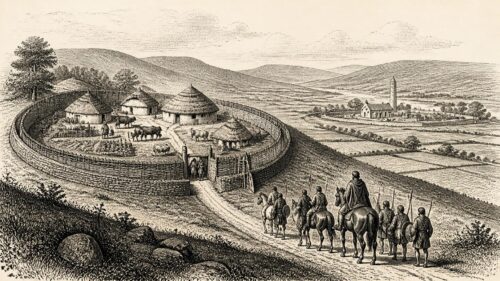
Imlech Pich was a contest within the dominant southern Uí Néill kindred, the Síl nÁedo Sláine, rather than a war between a united Ireland and an outside enemy. Brega was not a compact kingdom in the modern sense. It was a rich and heavily contested region whose ruling families controlled territories, client peoples and prestigious royal centres. Niall belonged to the Uí Chernaig of southern Brega, associated in later tradition with Loch Gabhair, or Lagore. Congalach belonged to the Uí Chonaing of northern Brega, associated with Cnogba, the great prehistoric complex at Knowth. Both drew legitimacy from descent within the same powerful dynasty, and both could seek allies beyond their immediate branch.
The battle’s place-name is generally connected with Emlagh in modern County Meath, but the annals themselves do not identify it with certainty on a modern map. What is secure is the political geography supplied by the named dead. Dub dá Inber ruled Ard Cianachta, a people of the lower Boyne region; Uarchride headed Conaille Muirthemne, whose territory lay farther north around Dundalk Bay. Their presence beside Congalach shows that the struggle reached beyond a quarrel between two Brega lineages. It involved alliances crossing local boundaries, and such alliances could decide who possessed land, tribute, hostages and influence after a victory.
Niall’s Victory, Congalach’s Escape
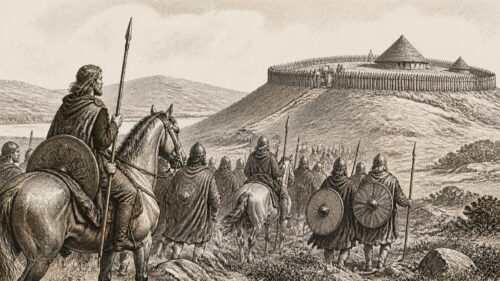
The terse formulation of the Annals of Ulster is revealing: Niall was victor, while Congalach escaped by flight. This was no annihilating conquest. Congalach survived with enough standing to remain a political actor, whereas two allied rulers did not. The Fragmentary Annals make the consequence still sharper, saying that the Cianachta were brought under outside rule and deprived of sovereignty. That judgement may preserve a later interpretation of the outcome, but it coheres with the loss of their king on the field. For Ard Cianachta, defeat was not simply a change in aristocratic rank; it meant a heightened risk that neighbouring powers would claim its revenues, cattle, labour obligations and strategic routes along the Boyne.
The result strengthened Niall’s branch in southern Brega, yet it should not be described as a permanent settlement of the whole region. Early medieval Irish kingship rested on personal lordship, kinship and the ability to maintain followers. A successful battle could alter the balance quickly, but it did not extinguish rival claims. Congalach’s escape mattered precisely because a defeated royal claimant, with living kinsmen and surviving clients, could recover. The later annals indeed continue to show fierce competition among branches of the Síl nÁedo Sláine. Imlech Pich was thus a decisive local victory, not the creation of a stable national monarchy.
Loss, Possession and Memory
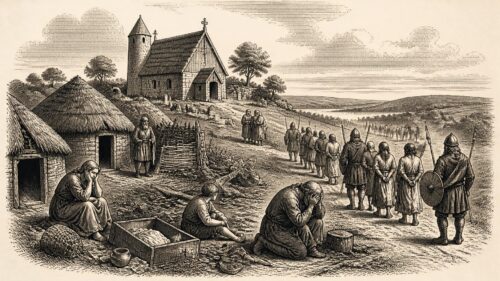
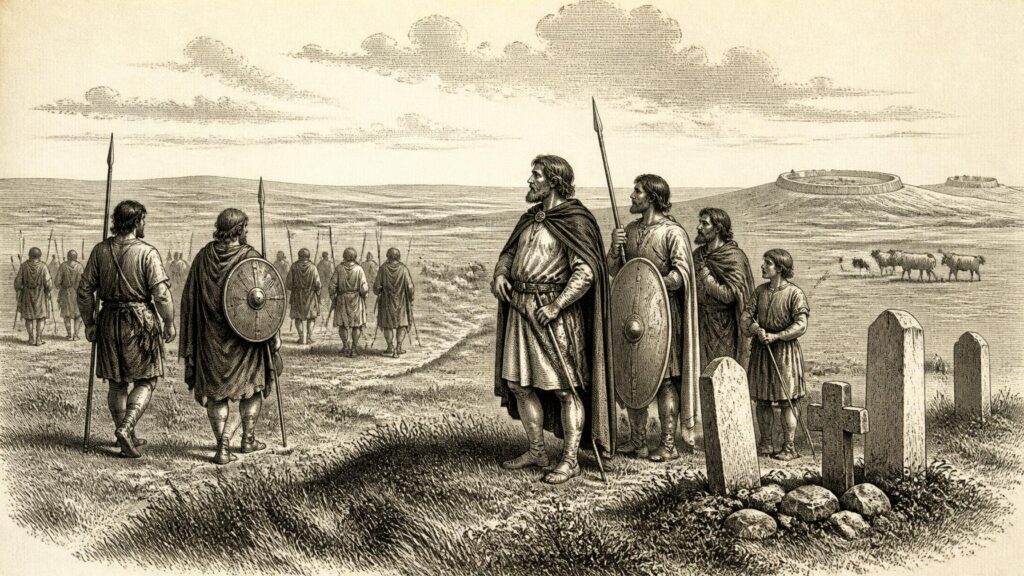
The annalists preserve more than a bare list of casualties. They attach a poem, attributed to Gabairchenn, mourning Uarchride and Dub dá Inber. Its survival is important because it catches the social aftermath that a conventional battle notice leaves unsaid. The poem imagines grieving people looking towards grave-markers and laments hounds, hunting-dogs and women now “in the possession of” enemies. This should not be treated as a literal inventory of everything seized at Imlech Pich. It is elegiac verse, designed to intensify bereavement. Yet its language accurately conveys the stakes of elite defeat: household dependants, animals, movable goods and status were bound up with political power, and victory could transfer control over them.
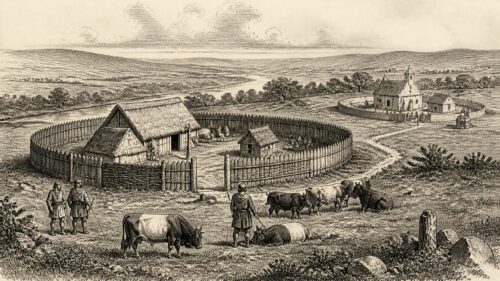
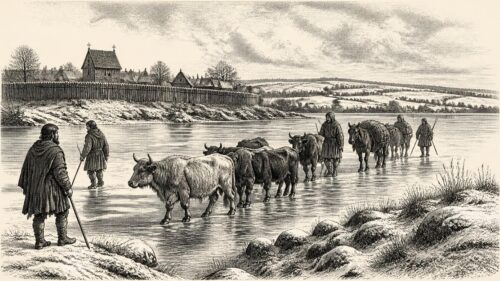
For ordinary people, the records offer no direct account of their experience in 688. They do not name farms burned, crops lost, market traffic interrupted or families displaced. It would be irresponsible to manufacture such details. Nevertheless, the poem’s concern with women, dogs and graves points to a world in which warfare entered households as well as royal halls. A king’s death could alter the claims made upon communities for food-renders, military service and hospitality. Cattle and other livestock were central stores of wealth, while hunting animals signalled aristocratic leisure and rank. The destruction or redistribution of these resources would have had effects far beyond the armed men who met in battle.
Fínnechta’s Clerical Turn
Alongside the battle, the annals record that Fínnechta Fledach “assumed clerical life”. Fínnechta was the foremost ruler of the Síl nÁedo Sláine and is conventionally counted among Ireland’s high-kings. The wording is firm about his religious change but sparse about its form. It does not say where he entered religious life, whether he received a particular ecclesiastical grade, or how authority was arranged during his withdrawal. Later annalistic evidence records his return to kingship in the following annal year. That sequence makes it reasonable to see 688 as a temporary break in his exercise of secular rule; it does not justify a detailed tale of abdication, monastery or private spiritual motive.
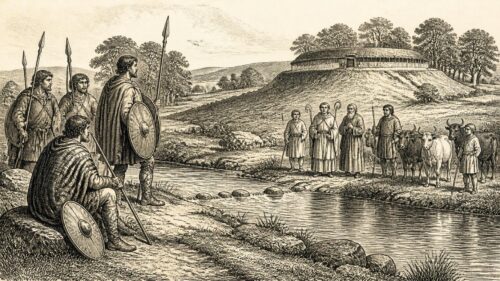
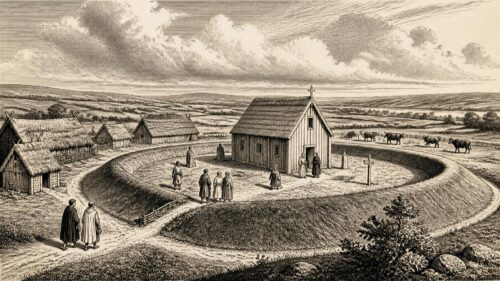
Even so, the notice is politically meaningful. In seventh-century Ireland, clerical and royal worlds overlapped without becoming identical. Churches and monasteries were centres of worship, learning, landholding, commemoration and negotiation; rulers patronised them, sought their prestige and could enter religious life. Fínnechta’s move occurred while his own wider dynasty was visibly divided in Brega. The coincidence does not prove that Imlech Pich caused his decision, nor that his clerical life was a calculated settlement. It does show how little sense it makes to separate “religion” from “politics” in this period. A king’s public religious status could affect claims to leadership just as a battlefield victory could.
Armagh Without Ségéne
The death of Ségéne, described as bishop of Ard Macha in the Annals of Ulster and as both bishop and abbot in the Fragmentary Annals, was another significant transition. Armagh was already a major ecclesiastical centre whose claims were linked to the memory and cult of Patrick. The variation in titles is not a contradiction to be casually resolved: it reflects an Irish church in which institutional leadership did not always fit later, sharply separated categories of bishop and abbot. What can safely be said is that Ségéne’s death removed a senior churchman at a centre of growing religious authority in the northern midlands.
Nothing in the surviving 688 entries identifies Ségéne’s successor or reports a synod, foundation, manuscript or new law at Armagh. Nor does the record permit a claim that his death transformed doctrine or ecclesiastical policy. The importance lies instead in continuity under pressure. The same annalistic year places a change at Armagh beside conflict in Brega and Fínnechta’s clerical turn. Such juxtaposition reflects the networks through which early Irish society was organised: royal kindreds, churches, local peoples and learned record-keepers all operated across the same landscape, sometimes cooperating and sometimes competing.
An Insular Record
A further notice records the killing of Canu son of Gartnaid. The annals give no explanation, and his name has been connected with the wider Gaelic and Pictish world across the Irish Sea rather than securely with a particular Irish political event. It should not be enlarged into an Irish campaign or diplomatic crisis. Its presence is nevertheless a reminder that Irish chroniclers did not write about an isolated island. Their records moved within an insular world of sea crossings, ecclesiastical contacts, dynastic marriages, warfare and shared learned traditions. The previous years had already seen Irish concern with captives taken in the Northumbrian raid on Brega; 688 belonged to a regionally connected, not self-contained, political culture.
There is no firmly dated Irish evidence for famine, plague, remarkable weather, a major building programme or a commercial transformation in 688. The absence is worth stating because the annals are selective, not comprehensive annual reports. What they do preserve is enough: a coalition defeated at Imlech Pich, the death of two regional rulers, the survival of a rival claimant, the temporary clerical withdrawal of a high-king and the passing of Armagh’s bishop. Together, these developments made 688 a year in which authority was redistributed rather than resolved. Niall’s victory shifted Brega’s internal balance, but the continued life of Congalach and the changing status of Fínnechta ensured that the political consequences would remain contested.
Primary Sources
- The Annals of Ulster, Year U688
- The Annals of Ulster, Year U689
- The Annals of Ulster: Irish and Latin Text, Year U688
- Chronicon Scotorum, Annals CS684–CS688
- Fragmentary Annals of Ireland, Annals FA90–FA100
- Annals of Inisfallen, Annals AI687–AI696
- Annals of the Four Masters, Annals M687–M689
- The Annals of Ulster
- Irish Texts at CELT
- Exploring the Irish Annals
- The Chronology and Sources of the Early Irish Annals
- Fín˙nechtae Fledach mac Dúnchada: (d. 695), High-King of Ireland
- An Ecclesiastical Institution in Medieval Munster: A Study of Emly to c. 1100
- Built to Last: The Uí Néill Dynastic Framework in Seventh-Century Ireland
- The Practice of Irish Kingship
- Imarcaigh Sund ar Gach Saídh: Irish Historical Persons and Places in Medieval Irish Literature
- Cath Almaine: Text and Translation
- The Annals of Clonmacnoise, Being Annals of Ireland from the Earliest Period to A.D. 1408
- The Annals of the Kingdom of Ireland
- The Early Old Irish Material in the Newly Published Würzburg Glosses
- The Admission of Former Slaves into Churches and Monasteries: Reaching Behind the Sources