Congal of Iarmumu Slain690 CE
In 690, Congal son of Máel Dúin, king of Iarmumu in western Munster, was killed, creating uncertainty over regional succession. Ailill son of Dúngal, associated with the Cruthin of Éilne, and Dúnchad son of Orc Doith were also recorded as killed. The annals note a fire at Armagh and the death of Do-Bécóc of Clonard. Dating differs among surviving chronicles, and motives, locations and perpetrators remain unknown. These notices reveal an Ireland divided among regional dynasties, churches and kin-groups, where authority depended on lineage, alliances and control of resources.
Dateline
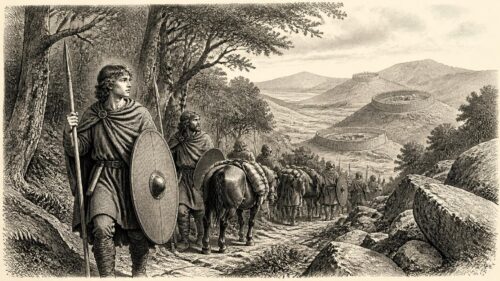
In 690 CE, Ireland’s surviving annalistic tradition places a cluster of violent deaths and ecclesiastical losses within a single, unsettled political landscape. The clearest event is the killing of Congal, son of Máel Dúin and grandson of Áed Bennán, whom the Annals of Ulster call king of Iarmumu, or western Munster. The same annal sequence also records the deaths of Ailill son of Dúngal, associated with Éilne among the Cruthin in the north, and of Dúnchad son of Orc Doith. These terse notices do not supply a battlefield, motive or victor. Yet their concentration is revealing: authority in Ireland rested in many regional kingships, and political change could be sudden, personal and lethal.
A Record of Killings
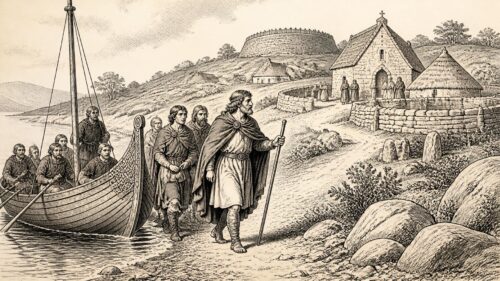
The death of Congal is the year’s most consequential Irish political notice. His pedigree mattered. By naming his father Máel Dúin and grandfather Áed Bennán, the annals located him within a ruling family whose standing in the western part of Munster was publicly understood. Such genealogies were not decorative additions. They identified a man’s entitlement to command clients, receive tribute, make alliances and compete for succession. Calling Congal “king of Iarmumu” does not mean that he ruled all Munster, still less all Ireland. It indicates a substantial regional kingship in a country where power was divided among numerous peoples and dynasties.
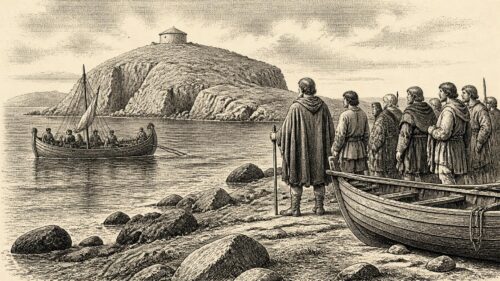
One version, the Chronicon Scotorum, adds a striking but difficult detail: Congal was killed by a scolasticus. The Latin term can denote a learned or ecclesiastically connected person, but the brief entry cannot safely be expanded into a full story of assassination by a monk, student or cleric. It is better treated as evidence that later annalists preserved a particular tradition about the killing, not as a solved mystery. No surviving source securely tells us where Congal died, who benefited, or whether his death followed open warfare, a raid or an internal dispute.
His killing nevertheless had immediate political implications. A king’s death placed dependants, rival kindreds, church allies and neighbouring rulers under pressure to recognise a successor. In early medieval Ireland, succession was normally negotiated or fought within a broad royal kin-group rather than automatically inherited by an eldest son. The removal of a recognised king in western Munster could therefore alter the balance not merely within Iarmumu but between that region and other Munster dynasties. The annals do not identify the next ruler for this particular moment, so 690 should not be presented as a documented change of dynasty. What can be said is that Congal’s death reopened a question that kingship never entirely settled: who possessed the strongest claim and sufficient support to rule.
North and South in the Same Annal
Ailill son of Dúngal was killed in the same recorded sequence. The Annals of Tigernach and Chronicon Scotorum identify him as king of the Cruthin, while the Annals of Ulster link him to Éilne. The Cruthin were an important northern people, represented in the sources through several competing ruling groups. Ailill’s death therefore reminds us that 690 was not solely a Munster affair. The annalists juxtaposed killings from widely separated regions because their history of Ireland was a history of interconnected elites: kings, churches and learned communities watched developments beyond their own localities.
Dúnchad son of Orc Doith is named among those killed, but without a title. The contrast is instructive. Annals preserve political rank unevenly. A king might be supplied with ancestry and territorial style; another victim could receive only a patronymic. Modern readers should resist filling that silence with imagined offices or campaigns. Even so, the inclusion of all three deaths suggests that the compilers, or the earlier records from which they drew, regarded them as significant enough to enter into the annual record.
Dating a Difficult Year
The year requires unusual care because the Irish annals do not always align neatly with a modern calendar. The related annalistic texts place Congal’s death under their entries for 690, and modern reference works generally date it to 690. Yet the surviving Annals of Ulster label the relevant notice “U690” while printing an AD equivalent of 689; the seventeenth-century Annals of the Four Masters place a comparable notice three years earlier. These differences are consequences of textual transmission and chronologies assembled long after the events, not proof that several separate deaths occurred.
For that reason, the killings of Congal, Ailill and Dúnchad can responsibly be connected with 690 CE, but no day, month or location should be claimed. The divergence also explains why other notices sometimes attached to this annal cluster must be handled cautiously. The Annals of Tigernach and Chronicon Scotorum record the death of Bran son of Conall, king of Leinster, in their 690 material, whereas another tradition presents Bran as beginning a reign. The evidence is too conflicted to make Bran’s death the firm centrepiece of this calendar-year account.
Armagh and Clonard
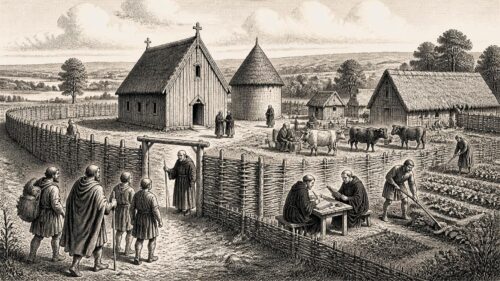
Two ecclesiastical notices belong to the same annalistic setting. The Annals of Ulster record the burning of Ard Macha, Armagh. The entry is stark: it does not specify whether a church, houses, stores or a wider enclosure burned, nor does it name an attacker or describe an accident. Fire was a grave hazard in settlements whose churches, dwellings, workshops and fences were often built of timber, wattle and thatch. The record establishes destruction at Armagh; it does not establish a siege, a deliberate raid, or the total ruin of the community.
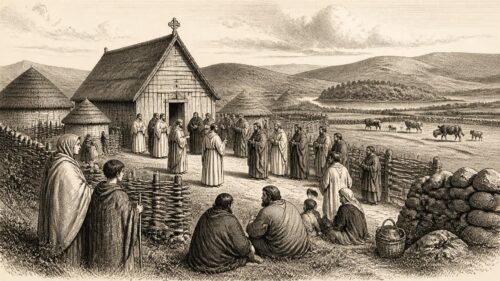
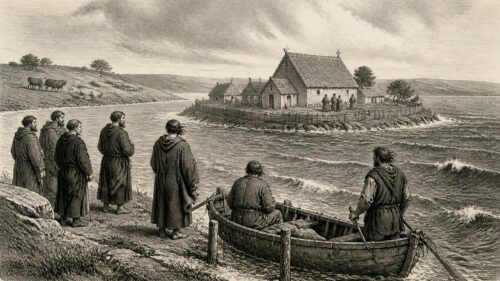
The same annal group notes the death or “rest” of Do-Bécóc of Cluain Aird, Clonard. Clonard was one of the better-known ecclesiastical places of the Irish midlands, and the notice shows how an annual chronicle could place the passing of a religious figure beside royal violence and fire. Such communities were not isolated retreats. They gathered clerics, students, labourers and dependants; they held land and livestock; and they helped maintain the learning required for Latin worship, legal culture and the calculation of the church calendar. A death at Clonard may have mattered within a network extending far beyond one enclosure, though the annal gives no detail about Do-Bécóc’s role.
Life Beyond the Annals
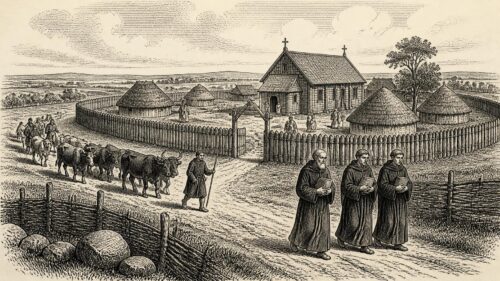
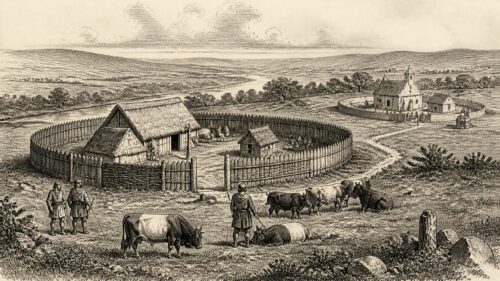
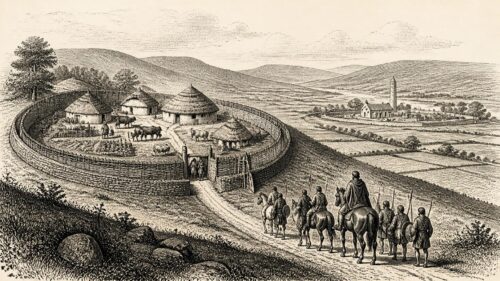
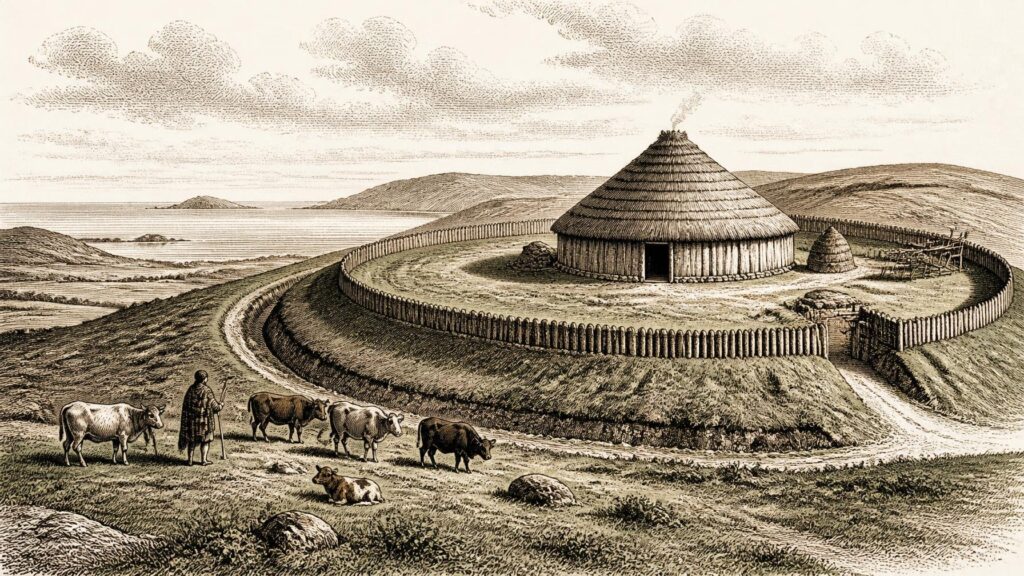
The year’s notices overwhelmingly concern high-status men and churches, not the majority who cultivated fields, tended animals, raised children and served households. Archaeology and early Irish legal material provide the wider setting. Much of the population lived in dispersed rural settlements, often in or near ringforts: enclosed farmsteads bounded by earthen banks and ditches, or by stone walls in suitable regions. Their buildings were generally of timber and other perishable materials. Lakes and marshes also contained crannógs, artificial or adapted island dwellings whose waterlogged remains can preserve materials otherwise lost.
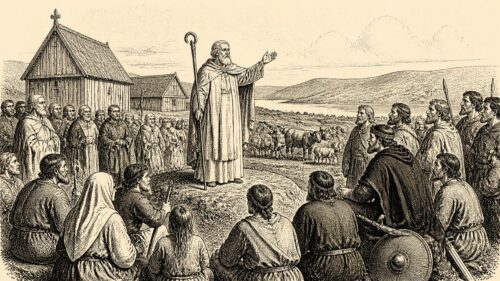
Cattle lay at the centre of wealth and social relations. Herds supplied milk and other dairy produce, helped define status, and could be transferred in payments, fosterage arrangements, marriage settlements and compensation. This did not make Ireland a land without crops: cereal cultivation and managed pasture were both essential. But cattle were unusually prominent in the organisation of land, labour and political obligation. A royal killing could therefore have practical effects for people who never appeared in a chronicle, since a change of ruler might alter demands for food-renders, hospitality, military service or the safeguarding of herds.
There is no reliable entry for a famine, epidemic, exceptional harvest or climatic disaster in Ireland in 690 itself. Nor is there evidence for a town-based commercial economy comparable to those of the former Roman world. Exchange existed, including movement along coasts, rivers and overland routes, but it was embedded chiefly in social and political relationships rather than organised around Irish towns or coinage. The absence of a recorded environmental crisis should not be mistaken for proof of an easy year; it simply marks the limits of the surviving evidence.
Power, Memory and Uncertainty
Fínshnechtae Fledach of Síl nÁedo Sláine remained the leading king of Tara in this period, although his position had recently been challenged and the political order of the midlands was far from static. His authority was important, but it did not erase the kingships of Munster, Leinster, Connacht, Ulaid or the north. The deaths recorded in 690 illustrate that Ireland was not a single centrally administered kingdom. It was a patchwork of lordships, churches and kin-groups, linked by marriage, rivalry, tribute, learning and violence.
That is why the annals are both precious and frustrating. They preserve Congal’s name, lineage and kingship; they record Ailill and Dúnchad; they remember a fire at Armagh and a death at Clonard. They do not supply a continuous narrative. A responsible history of 690 must leave those gaps visible. The securely connected development is not a grand national battle but a sequence of deaths and losses, centred on the killing of the king of Iarmumu, which exposes the precariousness of authority in seventh-century Ireland.
Primary Sources
- The Annals of Ulster: Year U690
- The Annals of Tigernach
- Chronicon Scotorum: Annal CS690
- Annals of Inisfallen: Annal AI690
- Fragmentary Annals of Ireland: Part 6
- Annals of the Four Masters: Part 52
- The chronology and sources of the early Irish annals
- Home Page for Dr Daniel P. McCarthy
- Chronological Synchronisation of the Irish Annals
- Fínshnechtae Fledach
- Fínnechtae Fledach mac Dúnchada: high-king of Ireland
- Irish Texts at CELT
- Early Christian Monasteries
- Early Monastic Churches
- Early Irish Monasticism
- Early Medieval Farmsteads
- Irish Field Monuments
- Changing Human-Cattle Relationships in Ireland: A 6000-Year Isotopic Perspective
- The Organization of Exchange in Early Christian Ireland
- Religion and Society in Ireland
- Transhumance and the Making of Ireland's Uplands, 1550–1900
- Marriage in Early Ireland
- Women and the Law in Early Ireland