Conall Cóel654 CE
In 654, Diarmait mac Áedo Sláine killed Conall Cóel of Cenél Conaill, strengthening the southern Uí Néill dynasty of Brega in its rivalry for pre-eminence. The annals, though brief and chronologically uncertain, also record dynastic killings in Connacht, where Uí Fiachrach Aidhne attacked rivals, and a Pictish victory over Dál Riata in Scotland. The deaths of two abbots at Clonard demonstrate the political and economic importance of major churches. These events reveal a fragmented Ireland shaped by competing kindreds, ecclesiastical institutions and Irish Sea connections, while farming communities supported the power of kings and churches.
Dateline
In 654 CE, a violent change at the summit of the Uí Néill reshaped the balance of power in Ireland. Conall Cóel, son of Máel Coba of Cenél Conaill, was killed by Diarmait mac Áedo Sláine. The notice is brief, but its implications were substantial: a northern claimant to the pre-eminent kingship had been removed by a member of the southern Uí Néill line rooted in Brega and associated with Tara. Other annalistic notices connected with this year record killings in Connacht, the deaths of senior clerics at Clonard, and a battle in northern Britain involving Dál Riata. Together they reveal an Irish Sea world in which dynastic rivalry, ecclesiastical institutions and seaborne connections closely overlapped.
A Year Recorded in Annals
The evidence for 654 is unusually concentrated but must be handled carefully. The principal Irish annals were compiled and copied long after the events they describe, drawing upon earlier chronicle material whose dating systems do not always agree. The Annals of Ulster, Annals of Tigernach and Chronicon Scotorum preserve related notices in slightly different chronological arrangements; the later Annals of the Four Masters supply further traditions. Modern historical dating conventionally places Conall’s death in 654, but the terse entries do not provide a narrative of the encounter, a location, or the numbers involved. They preserve outcomes—who died, who killed, who won—rather than the deliberations and experiences behind them.
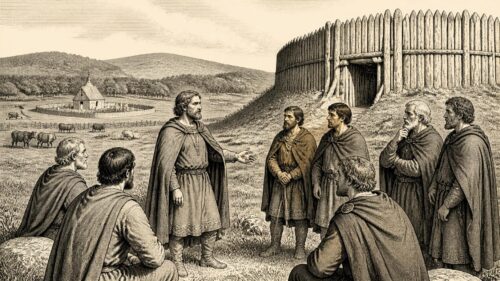
This limitation matters. It would be unsafe to imagine a single battle deciding the fate of all Ireland, or to portray a modern territorial state with a capital issuing commands across the island. Seventh-century Ireland consisted of many kingdoms, lordships and kindreds. Kingship was personal and negotiated, sustained through military followings, clientship, tribute, fosterage, marriage and the support of churches. The title often translated as “high king” indicated exceptional prestige and claims to overlordship, but it did not erase the authority of provincial and local rulers. Conall’s killing was therefore a major dynastic success, not the creation of a unified kingdom.
The Killing of Conall Cóel
Conall belonged to Cenél Conaill, a leading northern branch of the Uí Néill. His father Máel Coba had earlier held the kingship of Tara in the traditions of later king-lists, while Conall’s uncle Domnall mac Áedo had been a powerful ruler until his death in 642. After Domnall, the annals themselves admitted uncertainty over succession. One tradition described a “mingled rule” shared by Conall and his brother Cellach alongside Diarmait and Blathmac, sons of Áed Sláine. Such language is important: it suggests that contemporaries and later chroniclers struggled to express a political reality in which several exceptionally powerful men might exercise authority at once.
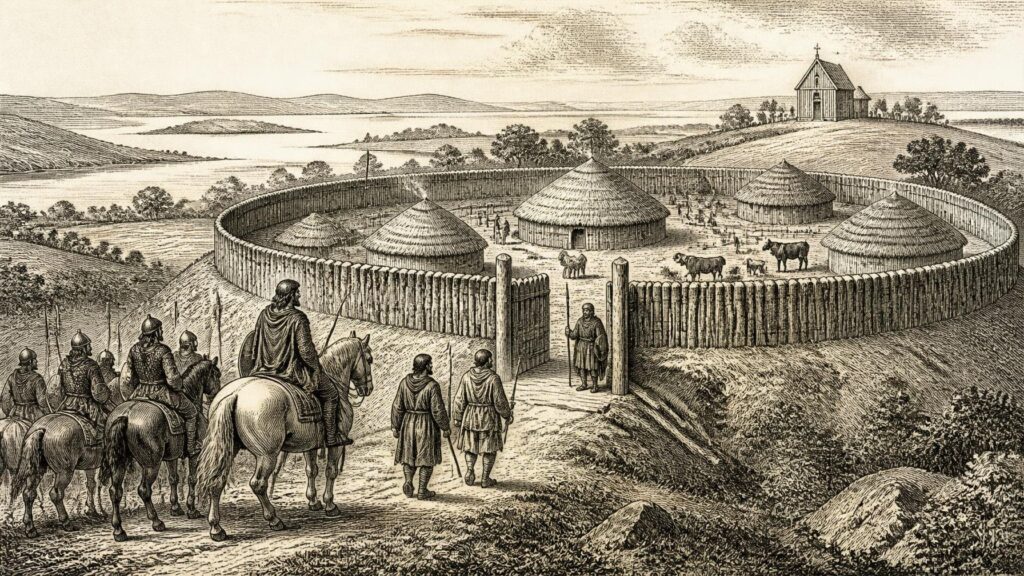
By 654 the balance had turned. The annals name Diarmait as Conall’s killer. Diarmait was of Síl nÁedo Sláine, the southern Uí Néill dynasty dominant in Brega, the fertile region between the Boyne and the Liffey. Its proximity to Tara and to the rich middle reaches of the Boyne gave it unusual political weight. Diarmait had already demonstrated military reach in the west, where tradition associated him with victory over Guaire Aidne at Carn Conaill in 649. Conall’s death removed a rival whose family possessed strong northern connections and a credible claim to pre-eminence.
The immediate result should not be overstated. Conall’s brother Cellach remained alive, and later accounts say that he was seized by Diarmait and died in captivity at Brú na Bóinne some years afterwards. Yet the killing of 654 marked a clear advance for Diarmait and, by extension, his brother Blathmac. Their prominence after Conall’s fall helps explain why later annalistic and king-list traditions treated the brothers as kings of Tara or of Ireland. What mattered was not an automatic hereditary succession but the practical elimination, submission or accommodation of rivals.
Killings in Connacht
The annals also place a cluster of deaths in the west under this year. Fergus son of Domnall, Fergus son of Rogallach, Áed Bethra son of Cumméne and another named man were killed by Uí Fiachrach Aidhne. The wording is starkly partisan in structure: it identifies the killers as a political kindred, the Uí Fiachrach of Aidhne, in the south of what is now County Galway, while identifying several victims through their fathers. Fergus son of Rogallach belonged to the Uí Briúin, a principal Connacht dynasty. His death points to rivalry not simply between “Connacht” and an outside enemy, but among the region’s competing royal lineages.
Nothing in the surviving notice establishes the place, cause or scale of the confrontation. It may represent a raid, an ambush, a local campaign or a wider contest whose details have disappeared. Nevertheless, it is a useful corrective to any account centred only on Tara. Political power in 654 was dispersed. A successful killing in Aidhne could alter the prospects of ruling families around the plains and lake systems of Connacht, even while Uí Néill rivals contended in the midlands.
Across the North Channel
Another entry records the battle of Sráith Ethairt, generally identified with Strathyre in central Scotland. Talarcan son of Enfret, king of the Picts, was victorious; Dúnchad son of Conaing and Congal son of Rónán fell. Dúnchad was a ruler of Dál Riata, the Gaelic-speaking kingdom spanning the sea routes between north-eastern Ireland and western Scotland. The battle occurred beyond Ireland, but it belongs directly in Irish history because Dál Riata’s ruling kindreds, ecclesiastical networks and maritime communications linked both shores.
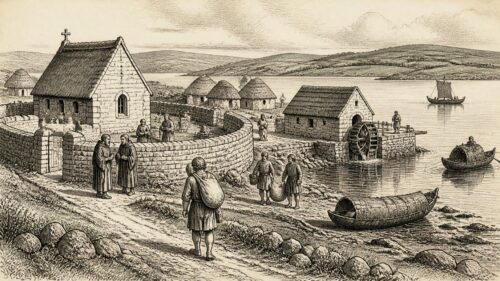
The annal does not explain why battle was joined, and proposals about invasion, dynastic ceremony or outside direction remain hypotheses rather than facts. What is certain is that a king of Dál Riata died in a Pictish victory. For people travelling between Ulster, the Hebrides and western Scotland, the consequences could have been immediate: political protection, access to harbours, obligations to rulers and the safety of sea passages all depended upon changing relationships among kings. The Irish Sea was no barrier at the edge of events; it was a route by which people, news, clerics and armed retinues moved.
Clonard and Ecclesiastical Authority
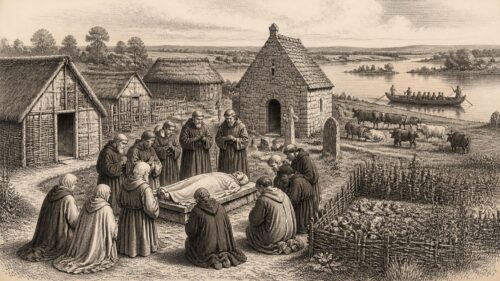
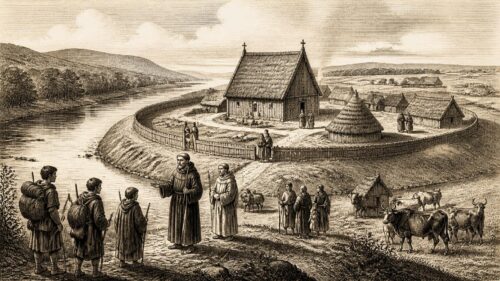
Religious institutions appear in the record through death notices. Colmán, described as a bishop of the moccu Telduib kindred, and Oiséne Fota, “Oiséne the Tall”, are named as two abbots of Clonard. Their deaths in the same annal-year underline the importance of Clonard as more than a place of prayer. Located in the Boyne valley zone, the monastery was part of the densely connected ecclesiastical landscape of the midlands, where churches possessed land, learning, dependants and relationships with ruling families.
The terms used for clerical office should not be read through a later diocesan model. In seventh-century Ireland, bishops, abbots and church founders could exercise distinct but overlapping forms of authority. An abbot might govern a religious community and its estates; a bishop carried sacramental functions; a great church could be bound to a lineage while also attracting clients and pilgrims from beyond it. The notice of two abbots does not reveal the internal arrangements of Clonard, but it suggests institutional depth rather than a solitary holy site. The annalists considered their deaths worth preserving alongside royal killings and battles.
Churches also connected Ireland to a wider Latin Christian culture. Clerics could travel, exchange books and letters, cultivate Latin learning and maintain links across the Irish Sea. Iona, founded by Columba from an Irish background, stood within this shared Gaelic world, even though it lay off the western coast of Scotland. The political violence of 654 did not halt such connections. Rather, kings and churches depended upon one another in unstable circumstances: rulers sought legitimacy, prayer and literate expertise, while ecclesiastical communities needed protection, land and recognition.
Ordinary Landscapes, Limited Evidence
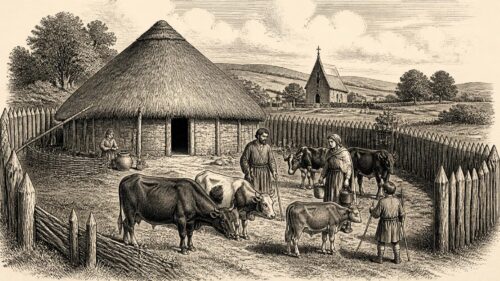
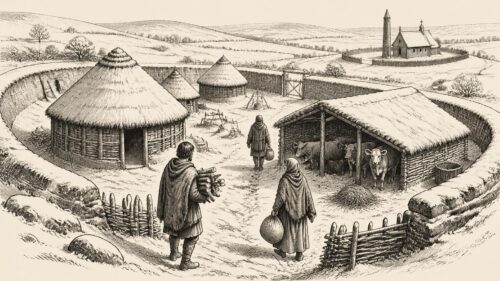
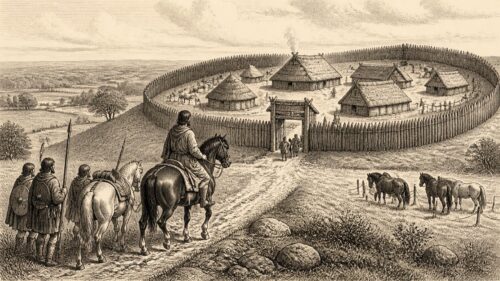
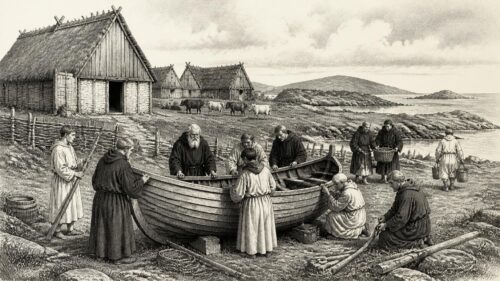
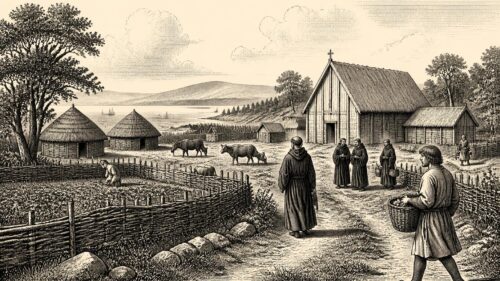
The annals name elites because they were designed to remember kings, churchmen, battles and extraordinary deaths. They say almost nothing directly about the majority who cultivated fields, tended cattle, raised children, made tools, brewed ale, spun wool or travelled with goods between settlements. Archaeology supplies the broader setting. Across Ireland, many households lived at enclosed farmsteads now called ringforts or raths, with circular banks, ditches or stone walls marking spaces for homes, storage and animals. Mixed farming—especially cattle husbandry alongside tillage—underpinned wealth and political obligation.
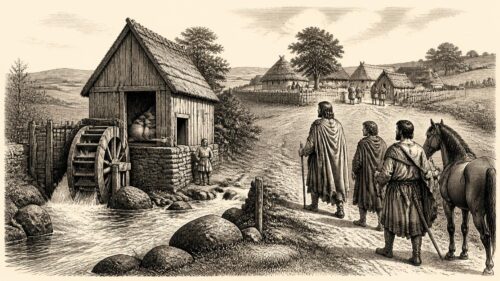
For most people, the great developments of 654 would have been felt indirectly. A new dominant king might demand food-renders, labour, military service or hostages from subordinate communities. Conflict could endanger herds and crops, interrupt travel, or bring armed men through a district. Conversely, a church’s estate might offer employment, hospitality, burial, religious observance and a market for produce or craftwork. There is no evidence for a general famine, epidemic or environmental catastrophe in Ireland specifically in 654, and none should be inserted merely to give the year dramatic colour.
A Shift Rather Than a Settlement
654 CE was therefore a hinge year, not a final settlement. Conall Cóel’s death strengthened Diarmait mac Áedo Sláine, but politics remained contingent, local and often violent. The killings in Connacht demonstrate that regional dynasties pursued their own struggles; the battle at Sráith Ethairt shows how Irish-connected kingship extended across the North Channel; and the obits at Clonard reveal the institutional standing of major churches. The year survives as a thin sequence of notices, yet those notices expose the structures beneath them: rival kindreds, mobile maritime worlds, influential monasteries and farming communities whose labour sustained both kings and churches.
Primary Sources
- The Annals of Ulster
- The Annals of Tigernach
- Chronicon Scotorum
- CELT project: Chronicon Scotorum
- Annals of the Four Masters, Part 48
- Annals of the Four Masters
- Annals of Inisfallen, Part 21
- Conall Cóel (‘the slender’)
- Regnal succession in early medieval Ireland
- The Battle of Carnn Chonaill
- Fragmentary Annals of Ireland
- Irish chronicles as sources for the history of northern Britain, A.D. 660–800
- Early mechanisms of abbatial succession: the case of Iona (563–704)
- A New Jerusalem ‘at the Ends of the Earth’: Interpreting Charles Thomas’s Excavations at Iona Abbey 1956–63
- ‘Through all the provinces of the islands of Ocean’: Iona and coastal monasticism in early medieval Britain
- Conflict in early medieval Ireland, Adomnán of Iona and the law of the Innocents (697 AD): an early Law of war
- Early Medieval Ireland: Archaeological Excavations 1930–2009
- Traditional Buildings of Irish Farms
- Rathbeagh Ringfort, Co Kilkenny
- Church of the Rath, Killeshandra, County Cavan
- Conall Cóel mac Máele Coba: (d. 654)
- The Annals of Tigernach: CELT Project Record
- List of Published Texts at CELT