Ségéne’s Death652 CE
Around 652, despite conflicting annalistic dates, Irish records note the deaths of prominent churchmen and a dynastic battle. Ségéne, abbot of Iona since 623, led an influential Columban network linking Ireland, Pictland and Northumbria. Aedlug of Clonmacnoise and Mainchéne of Min Droichit also died, illustrating the importance of both major monasteries and local religious communities. At Cúil Corra, Cuiléne, king of Uí Fhailge, was killed by rival forces, reflecting unstable regional kingship. These notices depict a rural, politically fragmented Ireland connected through kinship, river routes and ecclesiastical networks.
Dateline
In 652 CE, the Irish annalistic record conventionally places a striking cluster of deaths among leading churchmen alongside a local dynastic battle in the midlands. Yet this is also a year that demands unusual chronological care. The surviving Annals of Ulster group these notices under U652, but their own kalend entry identifies the year as AD 651; related chronicles and later compilations distribute some of the same material under different years. The safest conclusion is not that every event can be fixed to a modern 1 January–31 December 652, but that these events belong to the narrowly defined historical horizon around 652. What they reveal is nonetheless clear: monasteries at Iona, Clonmacnoise and elsewhere were institutions of wide consequence, while a killing in Uí Fhailge showed how sharply contested power remained within Ireland’s many small kingdoms.
A Year with Shifting Dates
The difficulty begins with the sources themselves. Irish annals preserve brief annual entries copied, rearranged and continued over centuries. Their year-headings are invaluable, but they are not infallible modern calendar labels. The Annals of Tigernach assign the deaths of Ségéne of Iona, Aedlug of Clonmacnoise and Mainchéne of Min Droichit, as well as the battle of Cúil Corra, to 652. Chronicon Scotorum does the same, although its editorial apparatus warns that its chronology in this period is displaced. The Annals of Ulster preserve the same core group under U652, explicitly marked AD 651. The seventeenth-century Annals of the Four Masters, by contrast, move Mainchéne and the battle back to 648, while placing Aedlug’s death in 651.
This is not a reason to discard the evidence. Rather, it defines the kind of history that can responsibly be written for the year. The coincidence of names and events across separate annalistic traditions makes the underlying notices substantial; the disagreement lies principally in the transmission of their chronological framework. It is therefore better to call them events recorded in the annalistic year 652, or in the early 650s, than to attach a falsely precise day or season. Caimín of Inis Celtra provides a further example: Tigernach includes his death in its 652 entries, but the Annals of Inisfallen place it in 654. His association with Holy Island in Lough Derg is secure; the exact calendar year is not.
Losses in the Columban World
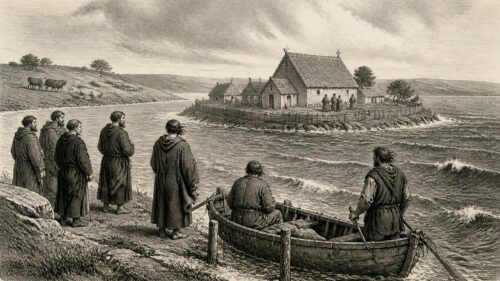
The most consequential obituary is that of Ségéne, son of Fiachna, abbot of Í, the Irish name for Iona. Iona lay off the west coast of what is now Scotland, but it was a foundation of Columba, or Colum Cille, and stood at the heart of an Irish Sea religious network. Ségéne had led the community from 623. He was kin to Columba and belonged to the generation that turned the founder’s remembered life into an enduring institutional inheritance. Later, Adomnán of Iona named him as a source for stories about Columba, preserving the impression of an abbot who gathered testimony from people still connected to the saint’s lifetime.
His authority reached far beyond the island. During Ségéne’s abbacy, Iona’s familia, or network of dependent and associated churches, extended through parts of Ireland, Pictland and Northumbria. Iona also had a prominent role in the debate over the calculation of Easter, an issue with practical and political as well as theological significance because it determined the shared ritual calendar of Christian communities. Ségéne supported the Columban reckoning. He was involved in sending Finán to succeed the Irish-trained bishop Aedán in Northumbria after Aedán’s death. Thus, when the annals record Ségéne’s death, they mark a change in leadership within an institution tied to religious life on both sides of the Irish Sea.
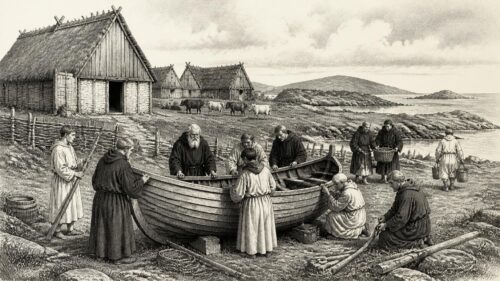
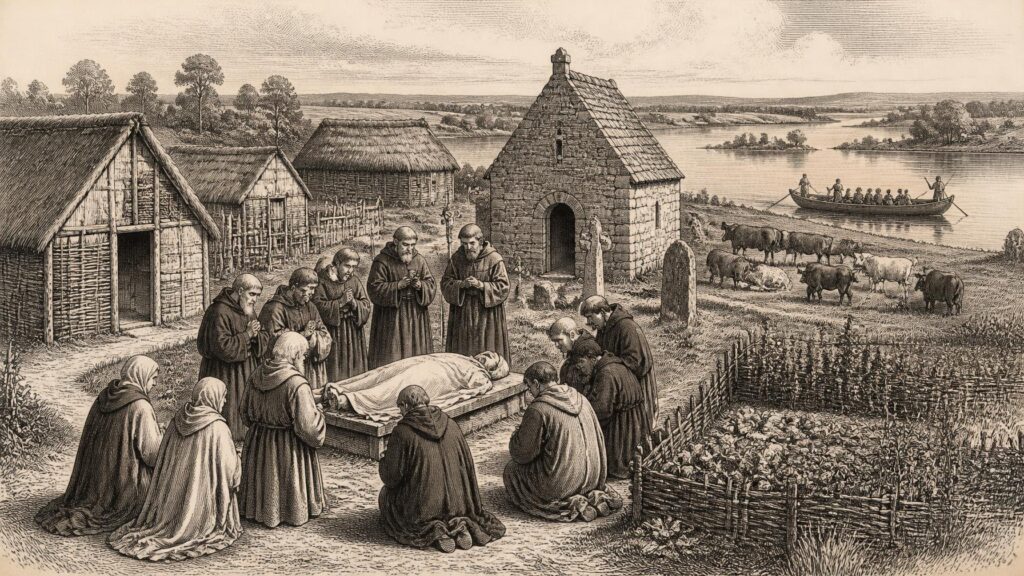
The annals do not describe a funeral, election or succession, and none should be invented. They do, however, show that an abbot’s death mattered sufficiently to enter a record otherwise dominated by kings, battles and major political changes. That prominence is evidence of the standing churches had acquired. Iona was not simply a retreat for ascetics. It was a centre of worship, education, manuscript culture, patronage and long-distance communication, sustained by communities of monks and lay workers and linked to aristocratic families.
Clonmacnoise and Local Communities
The same annalistic cluster records the death or “repose” of Aedlug, son of Camán, abbot of Clonmacnoise. The annals identify him as belonging to the Gailenga of Corann, a people associated with north Connacht and the Sligo region. This small genealogical detail matters. It suggests that the head of the Shannon monastery was connected to kin-groups beyond its immediate neighbourhood. Clonmacnoise occupied a strategic position on the east bank of the Shannon, where routeways across the island met a major waterway. Its later monuments should not be projected unchanged into 652, but the site was already a significant ecclesiastical settlement whose influence rested on location, patronage and religious reputation.
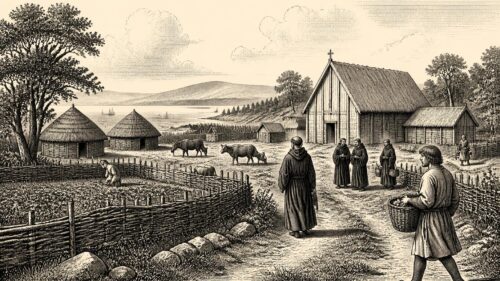
Aedlug’s death was accompanied by that of Mainchéne, abbot of Min Droichit, “the plain of the bridge”. The precise identification of Mainchéne’s church remains uncertain, and the annals give no account of his community. The bare notice is still revealing. It shows a landscape in which abbots of more than one rank of establishment were remembered by name. Religious authority in seventh-century Ireland was dispersed among numerous churches, monasteries and federations rather than organised through a later diocesan structure. Communities could be small, rural and strongly tied to local kindreds, but their leaders belonged to a wider learned and devotional world connected by travel, Latin literacy, exchange and shared cults.
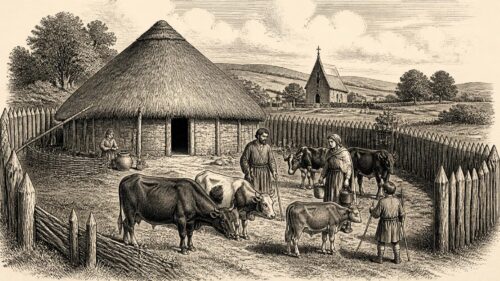
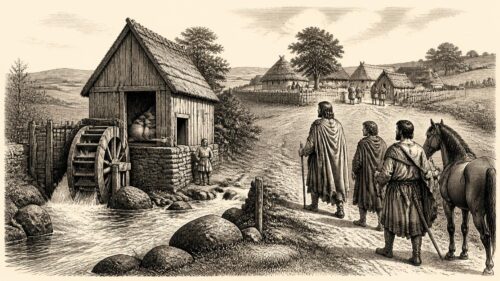
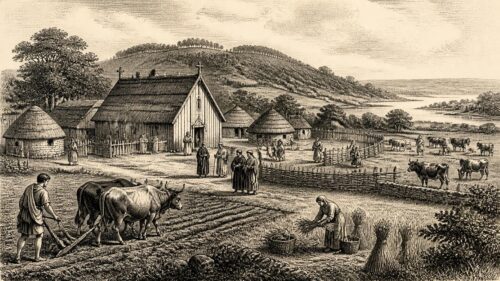
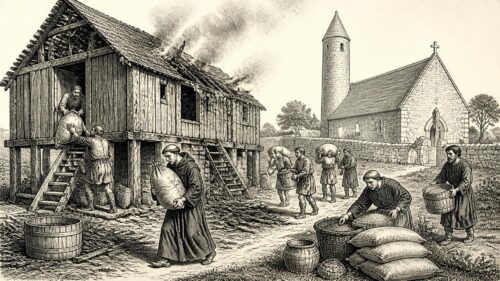
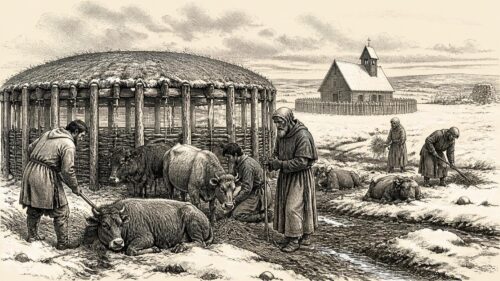
These religious settlements depended upon the labour and produce of their surrounding populations. Ireland in this period was overwhelmingly rural, with no coin-using urban economy comparable to former Roman cities. Cattle were especially important to status, food and exchange, while cereal cultivation, dairying, fishing, woodland resources and craftwork helped sustain households and ecclesiastical sites. Gifts, tribute, food-renders and service were more central than cash. The record for 652 contains no harvest report, weather event or trade voyage, so it cannot support claims of a particular famine, climate episode or commercial boom. But the named abbots point to communities whose daily routines—cultivation, animal husbandry, hospitality, prayer, teaching and perhaps copying—made institutional continuity possible.
Cúil Corra and Uí Fhailge
Against these ecclesiastical obituaries stands the conflict of Cúil Corra. The annals say that Cuiléne, son of Forannán, fell there, while Máel Deich—or Máel Dreith in another version—and Onchú were victorious. Chronicon Scotorum identifies Cuiléne as king of Uí Fhailge. This people gave its name to the later territory of Uíbh Fhailí and, ultimately, to County Offaly, though neither the medieval kingdom nor the modern county should be treated as identical in extent.
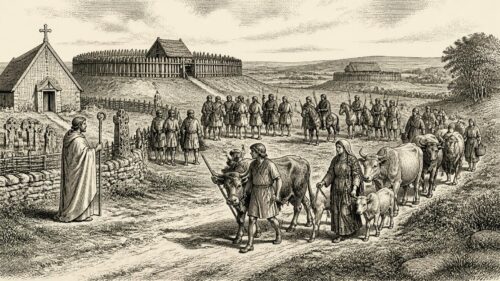
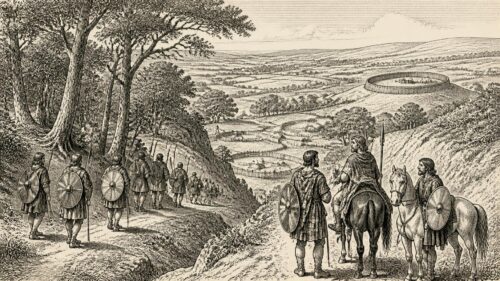
The annalists do not explain the causes of the encounter, name an outside invader, or provide numbers of combatants. It is therefore unwarranted to turn Cúil Corra into a national war or to claim certainty that it was an internal succession struggle, even if the opposing named victors make local rivalry plausible. Its importance lies in scale and setting. Ireland was divided among many túatha, petty kingdoms bound into larger, shifting overlordships by kinship, tribute, fosterage, alliance and force. Kingship was neither automatic inheritance nor a stable territorial office. A ruler’s death in battle could immediately open a contest among eligible relatives and allied lineages.
Uí Fhailge occupied a frontier zone between Leinster interests and the expanding power of the southern Uí Néill in Mide. Earlier losses of territory had constrained the kingdom, but it remained a significant component of the Leinster political world. Cuiléne’s fall is a reminder that political pressure did not only arrive from famous high-kings. It was experienced locally, in disputed places whose exact locations may now be difficult to recover, by communities whose cattle, labour, hostages and loyalties could be demanded by competing rulers.
What the Record Allows
The annals conventionally associated with 652 offer no securely dated royal assembly, treaty, overseas raid, plague or environmental disaster for Ireland. Silence is not proof that none occurred; it is simply a limit on the evidence. Nor do these brief notices permit a detailed portrait of ordinary individuals. Women, dependent labourers, craftspeople and most farmers appear only indirectly, although they were essential to both the monasteries and kingdoms recorded here.
Even so, the entries give the year a distinctive character. Ségéne’s death connected Ireland to Iona, Northumbria and the wider Columban world. Aedlug’s obituary illuminates Clonmacnoise as a strategically placed Irish religious centre, while Mainchéne’s notice points to a denser field of local communities than the famous foundations alone suggest. At Cúil Corra, Cuiléne’s death reveals the ever-present possibility that authority could be decided by violence within a regional dynasty. Read with due attention to their dating problems, the records around 652 show an Ireland neither isolated nor politically unified: a rural island of many lordships, held together by rivers, kinship and church networks, and shaped by the deaths of men whose names were thought worth remembering.
Primary Sources
- The Annals of Ulster, Year U652
- The Annals of Tigernach, Year T652
- Chronicon Scotorum, Annal CS652
- Annals of the Four Masters, Years M646–M656
- Annals of Inisfallen, Years AI644–AI655
- Chronicon Scotorum: Textual and Chronological Notes
- Annals of Tigernach: Document Details
- Exploring the Irish Annals
- Ségéne
- Caimín
- Life of St. Columba
- Life of St Columba by Adomnán: Manuscripts and Editions
- Inis Cealtra: Appendix 2, Detailed Support Material
- Clonmacnoise Monastic Site
- Húi Failgi Relations with the Húi Néill in the Century after the Loss of the Plain of Mide
- Ireland in the Seventh Century: A Tour
- Religion and Society in Ireland
- Ireland to 1170 (with Andrew Woods)
- Early Medieval Ireland, AD 400–1100: The Evidence from Archaeological Excavations
- Changing Human-Cattle Relationships in Ireland: A 6000-Year Isotopic Perspective
- Money in Early Christian Ireland According to the Irish Laws
- The Early Church in Offaly
- Early Medieval Ireland: Archaeological Excavations, 1930–2009