Annals 656656 CE
In 656, Irish annals recorded deaths, conflict and an unusual rural event, revealing Ireland’s interconnected early medieval world. Suibne moccu Urthrí, abbot of Iona, died, marking a change in Columban leadership, while Ultán of Ardbraccan and Cellcéne of Lothra were also commemorated. The battle of Deliu killed Máel Deith, son of Conall, though its circumstances remain unknown. The annals noted the death of Tolorgan, king of the Picts, reflecting links between Ireland and northern Britain. A cow at Láthair Briúin reportedly bore four calves, highlighting cattle’s importance in rural society.
Dateline
In 656 CE, the surviving Irish annals place a small but revealing cluster of deaths, a battle and an extraordinary report from the countryside within the year. None amounts to a narrative of a united Irish kingdom: Ireland was divided among many dynasties and petty kingdoms, while churches and monasteries exercised influence across political frontiers. Yet the entries for this year illuminate several connected worlds: the Columban community of Iona, the ecclesiastical landscape of Meath and Munster, local violence, cattle-centred rural life, and Ireland’s close relationship with northern Britain. The evidence is terse and must be handled cautiously, but it gives 656 an unusually varied human texture.
A Year in the Annals
The principal notice appears under what the Annals of Ulster label U657, but its accompanying calendrical information identifies the year as AD 656. This apparent mismatch is a useful warning. Irish annals were copied, rearranged and reconciled over centuries, and their year-headings cannot always be read as if they were modern dated records. The Annals of Tigernach and Chronicon Scotorum preserve closely related material, though individual names, dates and details sometimes differ. Firmly dated events are therefore best described as annalistic notices assigned to 656 in the reconstructed chronology, rather than as evidence for a fully documented calendar of events.
The Death of Iona’s Abbot
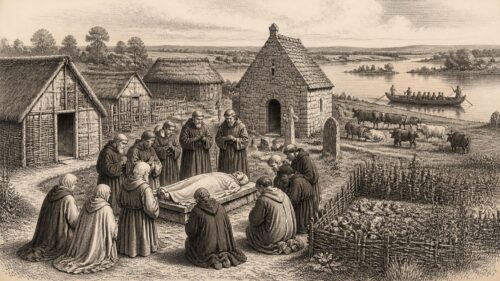
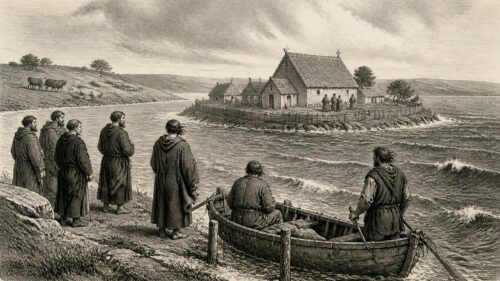
The most consequential Irish ecclesiastical notice is the death of Suibne moccu Urthrí, abbot of Í: Iona. Founded by Columba in the sixth century on an island off the west coast of what is now Scotland, Iona was nevertheless central to Irish history. Its community belonged to a Columban network that linked monasteries and churches in Ireland with those of western and northern Britain. Its abbot was not merely the superior of one island monastery, but the leading figure in a far-reaching religious familia whose lands, personnel, intellectual traditions and political connections crossed the sea.
Suibne’s abbacy had been brief, conventionally dated from 652 to 657. Modern research on Iona’s succession stresses how unusual his position was: unlike several neighbouring abbots in the Columban succession, he apparently lacked the strong Cenél Conaill genealogical connection commonly associated with the office. His death therefore mattered not simply as an obituary, but as the end of a distinctive experiment in leadership. The succeeding abbot, Cumméne, belongs to the following phase of the sequence. It would be wrong to invent the circumstances of the transition, but the annal confirms that Iona’s leadership was changing at a moment when its influence remained important on both sides of the Irish Sea.
Ultán of Ardbraccan
The same annal records the death of Ultán moccu Conchobair, generally identified with Ultán of Ard Breccáin, modern Ardbraccan in County Meath. Later tradition remembers him as a bishop, teacher and charitable holy man, and commemorates him on 4 September; the Annals of Tigernach likewise supplies a September day for his death. His reputation grew far beyond the bare annalistic record. He was associated in later learned tradition with writing and with material used by authors who shaped Patrician history and memory. Such attributions cannot tell us exactly what Ultán wrote in 656, or even whether every later story about him is historical. They do show, however, why his passing was worth preserving: Ardbraccan stood within the politically important midlands, where ecclesiastical communities, learned culture and aristocratic patronage were closely interwoven.
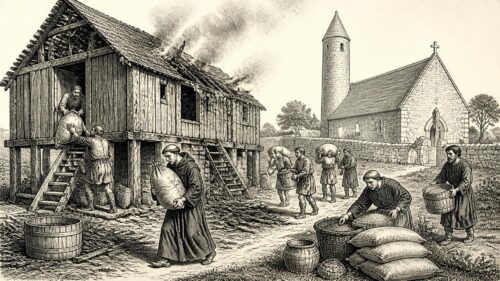
Ultán’s obituary also offers a corrective to any picture of seventh-century Ireland as culturally isolated. Religious communities sustained writing, commemoration and the transmission of genealogies and saints’ traditions. Their authority was rooted in local estates and kinship connections, but their intellectual horizons extended across Ireland and into Britain. A death at Ardbraccan could thus be meaningful both to its immediate community and to wider networks of clerics and patrons. The surviving evidence does not permit a reconstruction of his funeral or successor; it does establish that an important Meath churchman was remembered in the annalistic record for this year.
The Battle of Deliu
656 also contains a rare notice of violence: the battle of Deliu, in which Máel Deith, son of Conall, was killed. The entry is emphatically limited. It does not identify the site of Deliu with certainty, name the opposing force, explain the cause of the conflict or state who won. Chronicon Scotorum preserves variant forms of the dead man’s name and parentage, underlining the hazards of treating a brief medieval notice as a complete report. The responsible conclusion is simply that an armed encounter took place, or was remembered as taking place, and that the death of a named man was significant enough to be entered in the shared annalistic tradition.
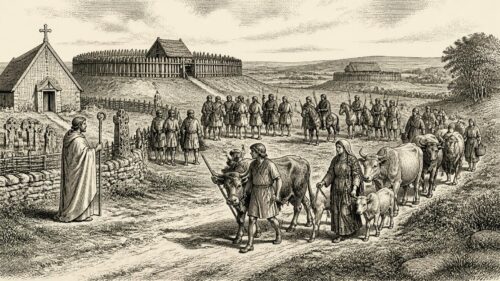
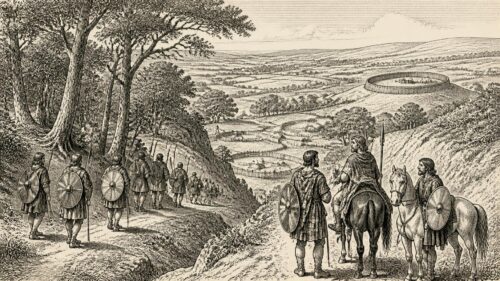
That modest conclusion is still historically valuable. Early medieval Irish politics worked through a dense hierarchy of kingships, kin-groups, clients and allied ecclesiastical houses rather than through a central state. Power rested on control of land, livestock, followers and military force, and succession within competing dynastic branches could be unstable. Many conflicts that were intensely important to those involved left no detailed explanation in surviving texts. Deliu is an example of the limits of the record: the annals preserve the fact of loss without allowing modern readers to manufacture a larger campaign around it.
A Pictish Death in an Irish Record
The death of Tolorgan, son of Ainfrith, king of the Picts, was also recorded in the Irish annals. This was directly relevant to Ireland because Iona, Dál Riata and Irish churchmen formed part of a shared Gaelic and northern British sphere. Tolorgan’s father is generally identified with Eanfrith of Bernicia, a Northumbrian prince who had lived in exile among the Picts; scholarship consequently regards Tolorgan’s claim to Pictish kingship as connected through a Pictish maternal line. The precise mechanics of Pictish succession remain disputed, but his death marked a change in the political order north of the Forth, close to regions with which Iona and the Gaelic world were deeply entangled.
Irish annalists did not record every foreign ruler who died. Tolorgan’s inclusion is therefore evidence of attention to the northern British political world, not proof that Ireland directed it. The notice should be read beside Suibne’s death. In the same annalistic year, Iona lost its abbot and Pictland its king: two distinct events, but ones situated within overlapping sea-routes, religious affiliations and aristocratic relationships. The Irish Sea was a channel of movement and communication rather than a hard frontier.
Churches, Cattle and Rural Life
Another obituary names Cellcéne of Lothra, usually associated with Lorrha in present-day County Tipperary. The annal gives no office, biography or explanation of why he was commemorated, so it cannot support an elaborate account of the community. Its significance lies in scale. Alongside the leading figures of Iona and Ardbraccan, the record preserved a death linked to a local ecclesiastical centre in the Shannon-side south. This is a reminder that Irish Christianity consisted not only of famous saints and major federations, but of numerous smaller churches rooted in particular territories and communities.
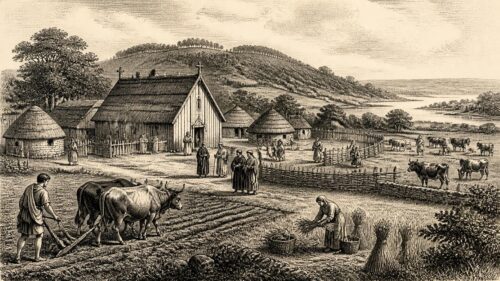
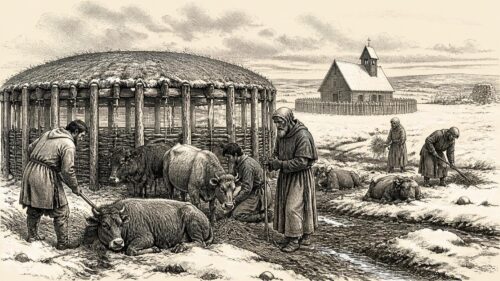
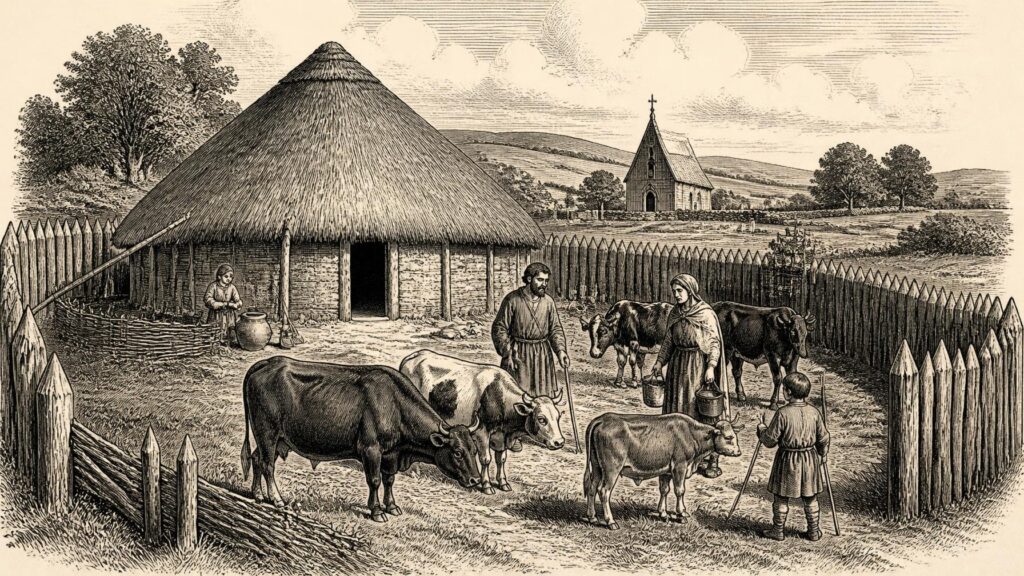
The most striking item for modern readers is not political or clerical at all: a cow at Láthair Briúin was said to have produced four calves. The annal offers no interpretation, and it should not be turned into evidence for famine, plenty, miracle-working or a named regional crisis. It was, however, unusual enough to be noticed. Cattle were central to early medieval Irish wealth, status and agricultural organisation. Archaeological and historical research shows a landscape strongly shaped by cattle husbandry, while ringforts commonly served as enclosed farmsteads where people and animals could be protected. In that setting, an exceptional birth among cattle was an event of practical as well as curious interest.
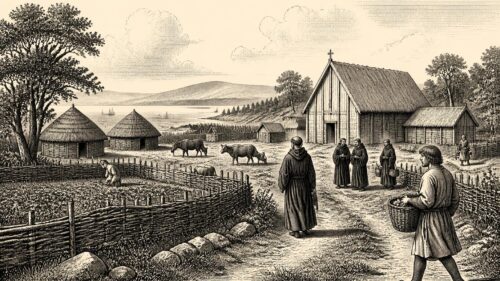
Most people in 656 lived beyond the annals’ named monasteries and battlefields. They occupied dispersed rural settlements, cultivated crops alongside pastoral farming, maintained kinship obligations and depended on cattle for food, dairy produce, exchange and social standing. They did not live in towns in the later medieval sense: Ireland remained overwhelmingly rural, structured around local túatha, households and estates. The four-calved cow offers only a fleeting glimpse, but it points towards the material world that supported kings, churches and learned communities alike.
What 656 Reveals
No single grand event defines 656 in Ireland. Its importance lies instead in the pattern created by the surviving notices. A Columban abbot died; an influential Meath churchman was commemorated; a battle claimed a named casualty; a Pictish king’s death was considered newsworthy; a southern ecclesiastic was remembered; and rural observers recorded an exceptional animal birth. Together these fragments reveal an island of local communities but extensive connections, in which monasteries preserved memory, dynastic conflict remained close at hand, and cattle still mattered enough for an unusual calving to enter history. The evidence is brief, but it places Ireland in 656 within a vividly interconnected early medieval world.

Primary Sources
- The Annals of Ulster, U657
- The Annals of Tigernach, Annal T656
- Chronicon Scotorum, Annal CS656
- CELT Project: The Annals of Tigernach
- Exploring the Irish Annals
- Early Mechanisms of Abbatial Succession: The Case of Iona (563–704)
- Ultán mac hUa Conchobair
- Saints in Scottish Place-Names: Ultán m. Crónáin of Ard Breccáin
- Royal Succession and Kingship among the Picts
- Bede, Ecclesiastical History, Book III
- Irish Society c. 700: I. Communities
- The Idea of the Three Orders of Society and Social Stratification in Early Medieval Ireland
- Religion and Society in Ireland
- Kingship, Society, and Sacrality: Rank, Power, and Ideology in Early Medieval Ireland
- Changing Human-Cattle Relationships in Ireland: A 6000-Year Isotopic Perspective
- Early Medieval Ireland, AD 400–1100: The Evidence from Archaeological Excavations
- Traditional Buildings on Irish Farms: The Rural Settlement Pattern
- Ordinary People in Early Christian Ireland
- Church of the Rath, Killeshandra, County Cavan
- Ways of Death: Cremation and Belief in First-Millennium AD Ireland