Archived: 12 November 2026
Abstract
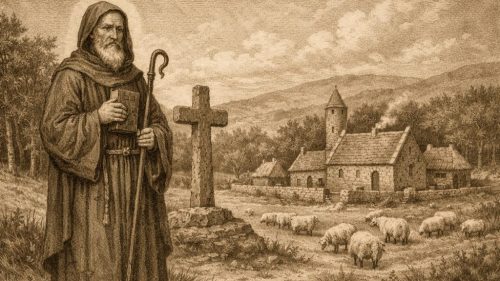
Saint Máedóc of Ferns is known through the Life of Maedoc of Ferns, a text that preserves a sequence of stories about his birth, early miracles, and foundation at Ferns. The surviving account presents him as a figure of Connaught by origin and of Ferns by association, with a life marked from the beginning by signs of divine favour. What remains is a traditional saint’s narrative, set out in episodes that explain how his holiness was understood in the sources.Birth SignsThe life says that a rich nobleman in Connaught named Sétna, son of Erc, had a wife named Eithne of
Read Article
Archived: 12 November 2026
Abstract
Year LabelsThe excerpts do not present 606 CE as a single, stable point across the annals. In Annals of Tigernach, the year labeled T606 includes the death of Fiachra the One-eyed son of Baetán and the repose of Eochaid. In the Annals of Ulster, the year labeled U606 includes the repose of Beóguin, the death of Aedán son of Gabrán, and a notice about Pope Gregory. The Annals of Inisfallen place a cluster of deaths under AI606, while the Annals of the Four Masters begin a separate entry under the Age of Christ 606.These headings also show that the same
Read Article
Archived: 12 November 2026
Abstract
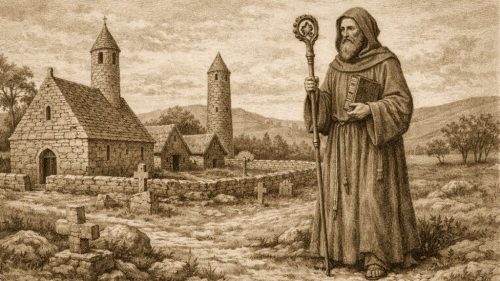
Saint Canice, also known in Irish tradition as Cainneach and in later English usage as Kenny, is remembered as an early Irish saint whose life belongs more to the world of ecclesiastical memory than to securely documented contemporary record. The surviving accounts place him in the sixth century, but the details of his birth, education, travels and death are not firmly established by modern historical standards. What can be said with confidence is that he became one of the best-known Irish saints associated with Ossory and Kilkenny, and that his name remained attached to churches, devotional traditions and local memory
Read Article
Archived: 12 November 2026
Abstract
Year RecordThe explicit year-entry for 603 in the Annals of Inisfallen is brief and unadorned. It records the repose of bishop Sillán and the repose of Cainnech moccu Dálann. The wording gives deaths, or the language of religious repose, rather than a battle, raid, eclipse, famine, or change of kingship. On this evidence alone, 603 is marked by two clerical obituary notices and nothing more specific.Nothing in that annal line adds a date beyond the year label itself, and nothing in it identifies a place, a ruler, or an immediate cause. The secure facts are limited to the two named
Read Article
Archived: 12 November 2026
Abstract
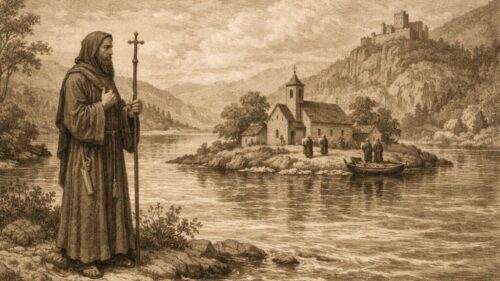
Saint Fridolin is remembered as an early medieval missionary and monastic founder associated above all with Säckingen on the Upper Rhine. Yet almost everything told about him comes from later hagiography rather than from contemporary evidence. The historical Fridolin, if he can be recovered at all, is therefore best approached as a figure at the boundary between memory, devotion, and regional identity.Origins TraditionLater tradition presents Fridolin as an Irishman, sometimes styled an Irish missionary who travelled among the Alamanni in the age of the Merovingians. The exact details of his birth are uncertain. Some modern ecclesiastical summaries place his birth
Read Article
Archived: 12 November 2026
Abstract
Year NoticeThe annalistic record for 604 CE is brief and clustered around deaths and slayings. In one version, the year is marked by the repose of Gregory of Rome, the repose of Saint Sinech, the death of king Suibne son of Colmán Mór, and the repose of Senach abbot of Cluain Ferta Brénainn. Another version places a different set of notices under the same chronological span, showing that the year is preserved through short annal entries rather than a continuous account.The same year is also represented in the Annals of Ulster as AD 603, where several deaths and slayings are
Read Article
Archived: 12 November 2026
Abstract
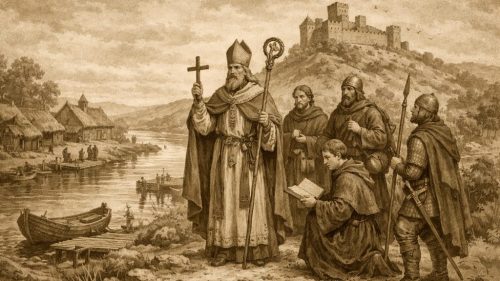
Saint Kilian, also known in tradition as the Apostle of Franconia, is remembered as an early Irish missionary bishop and martyr associated with Wfcrzburg. The surviving evidence is uneven and largely shaped by later hagiographical writing, so some details are best treated as traditional rather than fully secure. Even so, the main outline in the supplied sources is clear: Kilian was probably born about 640, likely in Ireland, and died at Wfcrzburg on 8 July, probably in 689.Irish OriginsThe supplied evidence identifies Kilian as an Irish bishop and missionary. Deutsche Biographie gives his place of birth as Mullagh in County
Read Article
Archived: 12 November 2026
Abstract
Year DatingThe evidence for 607 CE is not arranged identically across the annals. In the Annals of Tigernach, the entry numbered T607 records the slaying of Sechnusach son of Garbán by Domnall son of Aod and the death of Conall Redspear son of Daimine, with the rest of Lugaid following in the same entry. In Inisfallen, AI607 records the slaying of Aed Sláine, Aed Rón, and Aed Buide, then notes that Aed Allain held the kingship. The Ulster text places related material under a different year label.The notices around 607 are deaths and killings, but the year labels differ from
Read Article
Archived: 12 November 2026
Abstract
Saint Munchin is a shadowy early Irish saint whose historical outline is difficult to recover with confidence. The surviving evidence does not provide a secure contemporary biography, and no firm dates for his birth or death can be established from the sources available. What can be said with caution is that he belongs to the devotional history of Limerick, where his name has long been preserved in parish and institutional traditions.Historical MemoryIn the later history of Limerick, Saint Munchin became one of the city’s most familiar local saints. A parish in medieval Limerick bore his name, and the dedication continued
Read Article
Archived: 12 November 2026
Abstract
Saint Comgall of Bangor is remembered as an early Irish monastic founder associated with Bangor, in what is now County Down. The surviving evidence in the supplied sources places him in the sixth and early seventh centuries and links him especially with the monastery of Bangor, his death or repose being recorded in the annals. Because the evidence comes through annalistic notices, later saintly texts, and modern summaries, it is best to keep to what the sources directly support: Comgall was a monk, abbot, and founder remembered in connection with Bangor and with a wider network of Irish ecclesiastical memory.
Read Article
