

A Fragile Overkingship1021 CE
In 1021 Máel Sechnaill mac Domnaill’s restored overkingship remained active but fragile. He raided Dublin’s foreigners and Cenél nEógain, while Úgaire of Leinster defeated Sitriuc Silkbeard’s Dubliners near Delgany. Northern raids, killings and local conflicts exposed contested lordship around Airgialla. The murder of Áed, Máel Sechnaill’s heir, and other elite deaths weakened succession prospects in Mide. Amalgaid of Armagh made a politically significant visitation to Munster, asserting Patrician authority. Ecclesiastical deaths, Branacán’s drowning in Lough Ennell, and a reported shower of wheat in Osraige coloured annalistic memory. The year foreshadowed intensified struggle following Máel Sechnaill’s death in 1022 for Ireland.
Dateline
The surviving Irish annals make 1021 appear, at first glance, a year of short notices: a battle near the Wicklow coast, raids across the north, deaths among dynasts and churchmen, a Patrician visitation to Munster, and a strange report that wheat fell in Osraige. Read together, however, these entries show Ireland in the last full year of Máel Sechnaill mac Domnaill’s life, when the restored Uí Néill overking was still active but the political order around him was visibly strained.
Máel Sechnaill’s Late Authority
Máel Sechnaill, king of Mide and recognised in many sources as overking of Ireland after Brian Bóruma’s death in 1014, stood at the centre of the year’s politics. The annals do not record a national assembly or a peaceful settlement in 1021. They record movement, raiding and succession anxiety. The Annals of the Four Masters count this as the eighth year of Máel Sechnaill’s restored rule, a reckoning that reflects the years after Clontarf rather than the whole of his long career. That framing is important: he was an old ruler by contemporary standards, and his power rested not on a bureaucratic state but on the ability to take hostages, lead expeditions, protect favoured churches, reward clients and punish rivals.
Two notices attributed to 1021 present Máel Sechnaill in the familiar role of active war-leader. One says that he made a great predatory expedition against the “foreigners”, a term normally used in these annals for the Norse or Hiberno-Scandinavian communities of the Irish Sea towns, especially Dublin. Another says that he raided Cenél nEógain and drove them northwards over Sliab Fuait, the mountain barrier in south Armagh. These are not detailed campaign narratives. They do not name every ally or give a battlefield. Yet they show that the high king of Mide was still asserting authority both eastwards towards Dublin and northwards against the powerful northern Uí Néill.
Leinster Against Dublin
The clearest military event of the year was a defeat inflicted by Úgaire son of Dúnlaing, king of Leinster, on Sitriuc son of Amlaíb, king of Dublin. The Annals of Ulster place the encounter at In Deilgen Mo-Goróc; the Four Masters give the form Derge-Mogorog in Uí Briúin Cualann. This is usually associated with Delgany in north Wicklow, within the coastal and upland zone south of Dublin. The annalists agree on the essentials: the Leinster king defeated Sitriuc and the Dubliners, and one version emphasises heavy slaughter among the foreigners.
This was more than a border clash. Dublin remained a wealthy seaport and political force, ruled by Sitriuc Silkbeard, a survivor of the struggles around Brian Bóruma and Clontarf. Leinster, meanwhile, was not a passive hinterland. Its kings had long alternated between alliance, hostility and intermarriage with Dublin’s dynasty. Úgaire’s victory in 1021 suggests a Leinster kingship capable of resisting Dublin expansion or raiding in the Cualu-Wicklow region. The exact cause of the encounter is not securely recorded. Later local tradition links it with an attempted Dublin move towards Glendalough, but the annals themselves only allow the more cautious statement: in 1021, a Dublin force under Sitriuc was defeated by Leinster at or near Delgany.
Raids In The North
The northern entries are more compressed but no less revealing. The Annals of Ulster describe a raid by a son of Áed Ua Néill against the Uí Dorthain in Mag Itechta. The raiders were pursued by groups including the Uí Méith, Mugdorna, Saithne, men of Fernmag and Uí Dorthain, while other forces, including Uí Bresail and Uí Nialláin, waited at Aenach Macha, the assembly-place associated with Armagh. The account says that the raiding leader carried off his spoils despite being surrounded and having only twelve score warriors, but that many fell around Aenach Macha or Armagh.
This is the kind of episode that shaped everyday political life in eleventh-century Ireland. Raiding was not random banditry. It was a recognised instrument of lordship, intimidation and compensation. Cattle, captives and portable goods could be seized; reputations could be made or damaged; local kings were forced to display whether they could protect their people. The annalist’s interest in the number of warriors and the named peoples of Airgialla and neighbouring districts suggests a conflict remembered for tactical daring as well as bloodshed.
The same year also brought the killing of Cellach Ua Cathasaig, king of the Saithne, by Cenél nEógain. Since the Saithne belonged to the complex political landscape north of Brega and south of Airgialla, his death belongs to the same unsettled border world. These notices show northern politics in 1021 as a mesh of local rivalries and larger Uí Néill pressure, not simply a contest between “north” and “south”.
Succession Losses
The death with the greatest long-term significance was that of Áed, son of Flann, son of Máel Sechnaill. The annals style him heir-designate of Tara or even of Ireland, and say that he was killed by Ua Maigtechain of the Fir Bile. This notice is brief, but its implications are serious. A recognised royal heir in the Clann Cholmáin line had been removed only a year before Máel Sechnaill’s own death in 1022. The later weakness of Mide cannot be reduced to one killing, yet Áed’s death clearly narrowed the options for an orderly succession.
The Annals of Ulster also connect 1021 with the death of Domnall Ua Murchada, described as heir-designate of Ailech, though the surrounding annalistic traditions vary in phrasing. If correctly placed, this too points to instability among elite lineages. In a political culture where succession was contested among eligible adult males rather than automatically passing from father to eldest son, the killing of a tánaiste or royal heir could reshape alliances across whole provinces.
Another death touched both dynastic and diplomatic history: Máel Muire, daughter of Amlaíb, wife of Máel Sechnaill, died in 1021. She belonged to Dublin’s Norse-Gaelic royal house, being a daughter of Amlaíb Cuarán. Her marriage to Máel Sechnaill was part of the dense web of connections linking Mide, Dublin and the Irish Sea. Her death did not cause a recorded war, but it removed a living symbol of accommodation between the Uí Néill overking and the dynasty against which he had also fought.
Church Power And Visitation
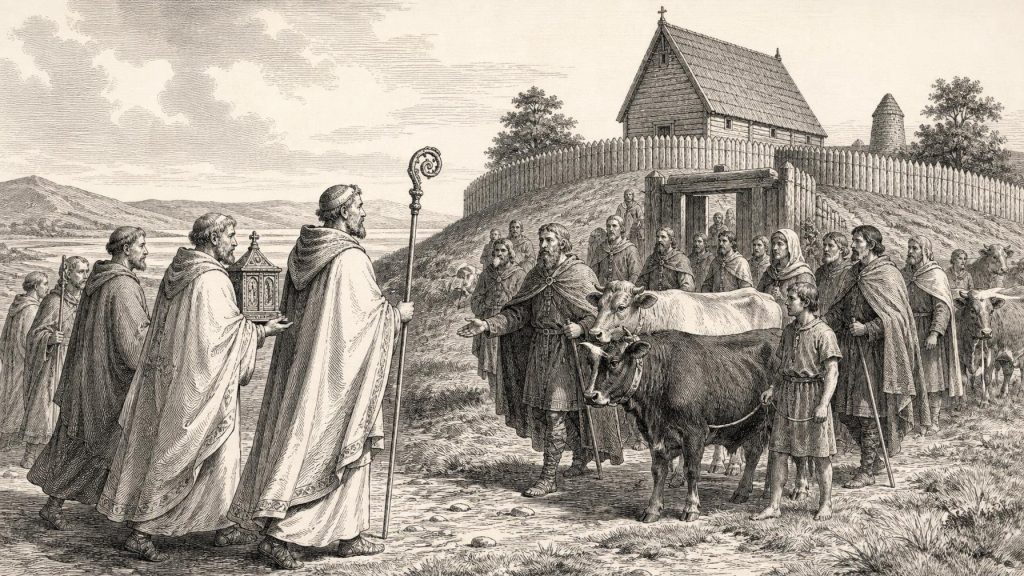
The most important ecclesiastical development firmly assigned to the year was the first Munster visitation of Amalgaid, successor of Patrick. He had succeeded Máel Muire son of Eochaid at Armagh in 1020, after a year in which Armagh suffered a devastating fire. The annals say that in 1021 Amalgaid went into Munster and made a great circuit. Such visitations were not merely devotional tours. The successor of Patrick claimed primatial prestige, collected dues, affirmed relationships with kings and churches, and made Armagh’s authority visible far beyond Ulster.
That Amalgaid’s first major recorded circuit was to Munster is significant in the post-Brian world. Munster had recently supplied a king who had challenged and briefly surpassed the older Uí Néill high-kingship. By 1021 Brian’s son Donnchad was still a force, though not yet a universally recognised king of Ireland. A Patrician visitation into Munster therefore carried political as well as religious meaning: it joined prayer, tribute, memory and diplomacy in a landscape still adjusting after Clontarf.
Other church notices are quieter but valuable. The Four Masters record the death of Maenach, priest and airchinnech of Lann Léire. The Chronicon Scotorum places in this year the repose of Longarg Ua Maíl Dúin, vice-abbot of Clonmacnoise. The Annals of Inisfallen note the death of Máel Muire Ua Gébennaig, an eminent priest of Dál Cais. These entries remind us that churches were also landed institutions, schools, burial places, keepers of relics and participants in regional politics. The title airchinnech, often rendered erenagh, points to a church office with responsibility for ecclesiastical lands and revenues.
Mide, Loch Ennell And Moral Memory
Branacán Ua Maeluidir, described as a tributary king, chief steward or royal official of Mide depending on the source, was drowned on May Day in Loch Ainnine, modern Lough Ennell. The agreement between several annals makes his death secure, although the details differ. The Four Masters add a moralising explanation: Branacán and Mac Conailligh, Máel Sechnaill’s chief lawgiver, had plundered the shrine of Ciarán and died within nine days. That detail should be treated carefully, since it is not equally prominent in all versions. It does, however, reveal how annalists and later compilers interpreted misfortune. To violate a saint’s shrine was to invite supernatural justice.
Lough Ennell itself lay in the heartland of Mide, close to royal and ecclesiastical routes. A drowning there on May Day may have been accidental, ceremonial, violent or remembered through a religious lens; the sources do not say enough to decide. What can be said is that the death of a high-ranking Mide official further darkened a year already marked by the killing of a royal heir.
Signs, Harvests And Daily Life
The annals also report that a shower of wheat fell in Osraige. Medieval annalists often recorded unusual natural phenomena, not as scientific observations in the modern sense but as signs worthy of memory. The phrase may describe an extraordinary weather event, a fall of grain-like matter, or a portent shaped by oral report. We should not build a false narrative of famine or abundance from it. Still, the notice is a reminder that rural life depended on crops, cattle and seasonal stability, and that anything strange in the sky or fields could be read as meaningful.
For most people in Ireland in 1021, the year was experienced through labour, dues, kinship and danger rather than through the titles of overkings. Farmers managed cattle and grain; tenants owed food-renders and services; craftspeople and traders supplied royal sites, monasteries and ports; clerics copied, taught and guarded relics; warriors followed lords on raids that could bring profit or death. Dublin’s merchants connected Ireland to the Irish Sea and beyond, while inland power still rested heavily on cattle wealth and control of routeways, churches and hostages.
Thus 1021 was not a year of one transforming event. It was a year of pressure before a turning point. Máel Sechnaill still campaigned; Leinster checked Dublin near Delgany; northern raiders cut through contested lands; Armagh renewed its claims in Munster; and Mide lost men close to the royal centre. Within a year, Máel Sechnaill would die at Lough Ennell, and Irish politics would enter a more open struggle for supremacy. The fragments from 1021 show the cracks already widening.
Primary Sources
- The Annals of Ulster: Year U1021
- Chronicon Scotorum: Annal CS1021
- Annals of the Four Masters: Annal M1021
- Annals of the Four Masters, Complete CELT Edition
- The Annals of Tigernach: Annal T1021
- CELT Project: Annals of Loch Cé
- Annals of Inisfallen: AI1021
- CELT Project: Annals of Inisfallen
- CELT Project: Chronicon Scotorum
- CELT Project: Annals of Tigernach
- CELT Project: Annals of the Four Masters
- Sitriuc Silkbeard (Sitric, Sigtryggr Ólafsson Silkiskeggi) | Dictionary of Irish Biography
- Amlaíb (Óláfr) Cuarán | Dictionary of Irish Biography
- Amalgaid | Dictionary of Irish Biography
- Augaire | Dictionary of Irish Biography
- Life After Brian: The High-Kingship | History Ireland
- Vikings in Early Medieval Ireland: Church-Raiding, Politics and Kingship | JSTOR
- The Heritage of Delgany, Co. Wicklow
- Delgany Townland, Co. Wicklow | Townlands.ie
- Book of Leinster, Formerly Lebar na Núachongbála: Part 26
- Chronological Synchronisation of the Irish Annals
- Armagh, Primatial See of | Encyclopedia.com
- Former Archbishops of Armagh | Archdiocese of Armagh