Raids and Pilgrims1031 CE
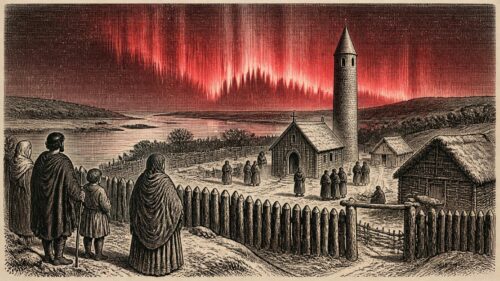
In 1031 Ireland remained politically fragmented after Brian Bóruma, as northern, southern and Hiberno-Norse rulers pursued power through raids, booty and captives. Flaithbertach Ua Néill returned from Rome while Aed Ua Néill campaigned against Cenél Conaill. Dublin’s Sitriuc Silkbeard was linked to Ardbraccan’s devastating plunder, and Waterford’s king was killed in Dublin. Churches at Ardbraccan, Swords, Kildare, Cell Chomair and Clonfert suffered burning, robbery or violence. Donnchad mac Briain raided Osraige but lost men; conflict also afflicted the Déisi. Obituaries emphasised learning, hospitality, piety and ecclesiastical office, revealing society’s religious resilience amid warfare, trade and local rivalry throughout Ireland alike.
Dateline
The surviving Irish annals make 1031 a year of hard edges: pilgrim kings returning from Rome, churches burned or plundered, cattle and captives driven away, and provincial rivalries pressed through sudden raids rather than set-piece conquest. The evidence is uneven. Some entries are firmly placed under 1031 in the Annals of Ulster, Chronicon Scotorum and Annals of Inisfallen, while the Annals of Tigernach and the later Annals of the Four Masters preserve additional notices that sometimes differ in wording or chronology. What can responsibly be said is that 1031 shows an Ireland still shaped by the aftermath of Brian Bóruma’s age, by the strength of Dublin and Waterford as Hiberno-Norse towns, and by the persistent vulnerability of churches that were both sacred places and stores of people, wealth and political authority.
Northern Power and Rome
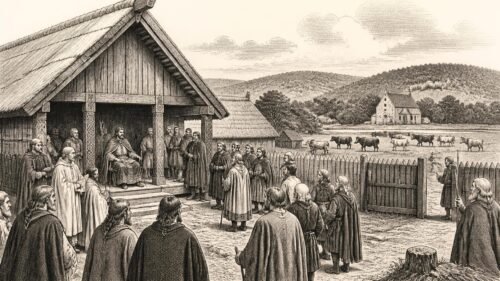
One of the clearest notices of the year is the return of Flaithbertach Ua Néill from Rome. Flaithbertach, former king of Ailech and a dominant figure among Cenél nEógain, had gone on pilgrimage in 1030. His return in 1031 did not remove him from politics. In the north, status, sanctity and military capacity were not separate worlds: a ruler could carry the prestige of pilgrimage and still be remembered by the annalists amid raiding and lordship.
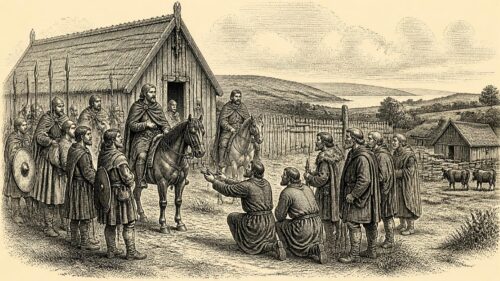
The northern record is violent. The Annals of Ulster place in this year a raid by Aed Ua Néill into Tír Conaill in snowy conditions, during which Ua Canannáin, king of Cenél Conaill, was killed. The phrase about snow is important because it suggests more than a routine cattle raid: movement in winter conditions could surprise enemies, but it also risked animals, servants and fighters. The later Four Masters put a similar “Prey of the Snow” close to this period, reminding us that annalistic year-headings are not always simple modern dates. Still, in the northern political landscape of 1031, the entry points to sustained pressure by the Uí Néill of Ailech upon Cenél Conaill.
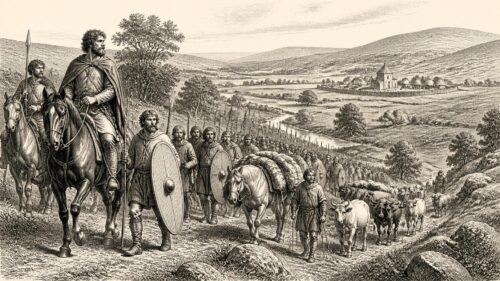
Another expedition involved a son of Eochaid, probably reflecting Ulster politics, moving towards Telach Ócc but achieving nothing. Aed Ua Néill then passed around him to the east and took an enormous booty: three thousand cows and twelve hundred captives. Such figures may be rounded or rhetorical, yet they show what chroniclers considered meaningful. Cattle represented wealth, food, rent, honour and bargaining power; captives represented labour, ransom, dependence and humiliation. Warfare was therefore not only a matter of killing opponents. It was a means of redistributing resources and forcing acknowledgement of authority.
Dublin, Ardbraccan and Captivity
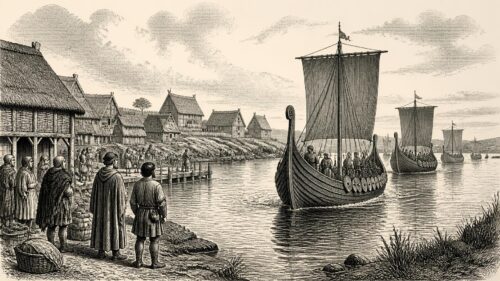
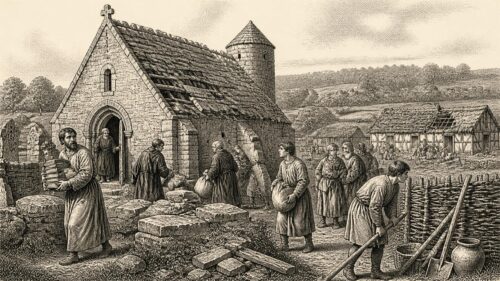
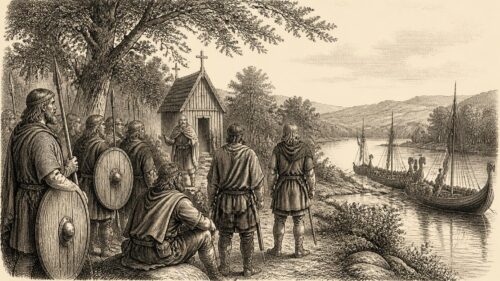
The most shocking event firmly assigned to 1031 is the plundering of Ard Brecáin, now Ardbraccan in Meath, by the foreigners of Áth Cliath. The annals say that two hundred people were burned in the stone church and another two hundred were carried away into captivity. The Annals of Tigernach name Sitriuc, that is Sitriuc Silkbeard of Dublin, in connection with the raid. Sitriuc had ruled Dublin through decades of alliance, defeat, survival and recovery. By 1031 his city was not an isolated Norse enclave but a major Irish Sea power, entangled with Gaelic dynasties through marriage, tribute, trade and war.
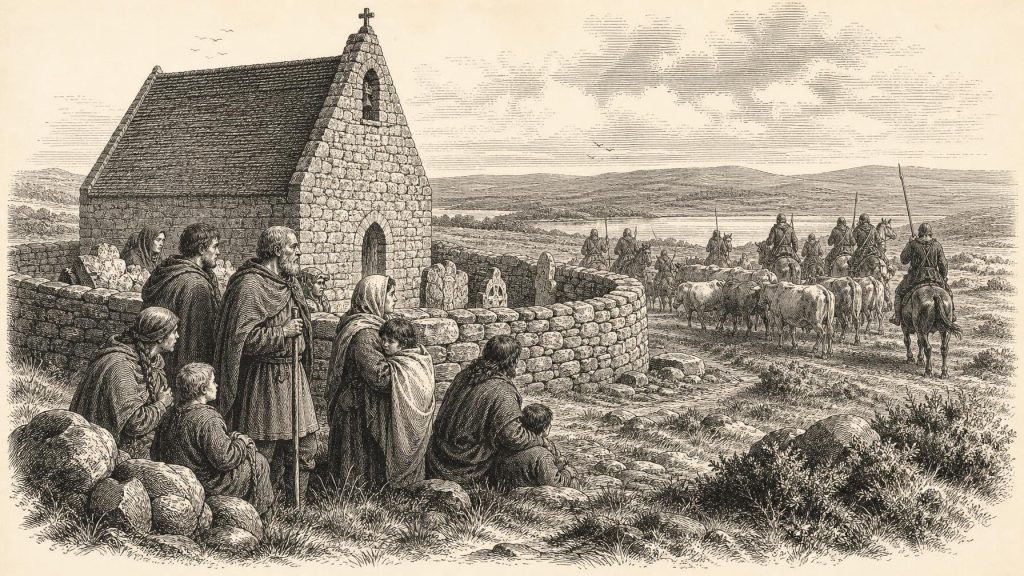
Ardbraccan’s fate demonstrates the double character of major ecclesiastical settlements. A stone church was a prestigious and protective building, but in a raid it could become a trap if people crowded inside it with valuables, relics or household goods. The annalists’ emphasis on burning and captivity also points to the grim economic underside of warfare. Captives could be ransomed, retained as dependants or sold into wider markets linked with the Irish Sea world. Dublin’s wealth rested partly on craft, silver, trade and maritime connections, but the events of 1031 show that raiding remained part of its political economy.
The eastern midlands appear repeatedly in the year’s notices. The Annals of Tigernach also place in 1031 a raid by Conchobar Ua Mael Sechnaill on Swords, where the church was burned and a large booty of captives and cattle was taken. Whether read alongside the Ardbraccan attack or as a related cycle of retaliation, the notice shows that ecclesiastical places north of Dublin were exposed not only to Hiberno-Norse force but also to Gaelic rivals using the same methods.
Churches Under Strain
The burning of Kildare is another firmly dated entry, though the sources differ in tone. The Annals of Ulster attribute the fire to the carelessness of “a wicked woman”, a phrase that tells us more about clerical blame and moralising than about the circumstances of the blaze. The Annals of Inisfallen simply report that Kildare and Waterford were burned. Kildare was one of Ireland’s most prestigious churches, associated with Brigit and with long-standing Leinster authority. A fire there was not merely local damage; it was a blow to a religious community, a store of manuscripts and metalwork, and a centre of patronage.
Other ecclesiastical injuries in 1031 were deliberate. The Annals of Ulster say that a son of Eochaid raided Uí Echach, burned Cell Chomair and its oratory, killed four clerics and took thirty captives. The killing of clerics was serious enough to be singled out. It reminds us that churches were not outside politics: they held lands, tenants and alliances, and they stood in the path of armies. Yet the annalists’ language shows that attacks on holy places were still treated as transgressions requiring notice.
The year also records punishment within the church. Cathasach, successor of Cóemgen of Glendalough, was blinded by Domnall son of Dúnlang. Chronicon Scotorum adds that this was an unusual act. Blinding was a political punishment because physical wholeness mattered for authority, but its use against the successor of a saintly founder was especially grave. The entry hints at rivalry over ecclesiastical office, property or Leinster politics, though the sources do not give the cause.
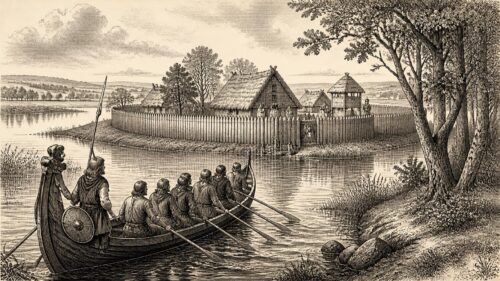
At Clonfert, a different kind of violation appears. Ua Ruairc, called “the Cock” in the Four Masters, plundered Cluain Ferta Brénainn. On the same day, according to Tigernach and the Four Masters, Donnchad mac Briain defeated him, with losses of men and vessels. Clonfert’s association with Brendan gave the attack spiritual weight; the mention of vessels may point to riverine or lake movement, reminding us that waterways were military routes as well as trade routes.
Munster, Osraige and the Déisi
In the south, Donnchad mac Briain, son of Brian Bóruma and king of Munster, remained an ambitious but contested ruler. The Annals of Inisfallen preserve the most detailed southern narrative. Gilla Pátraic’s son entered Munster, plundered Dún na Sciath and killed its steward. Donnchad then went into Osraige to avenge him, carried off great booty and cattle, but suffered repeated slaughter among the Munstermen. Among those killed were Mael Coluim of Caenraige and two royal heirs of Uí Chonaill Gabra.
This episode is valuable because it gives both motive and result. Donnchad acted as an avenger of an official attached to a fortress, asserting royal protection and honour. Yet the Osraige response shows the limits of Munster power. Osraige, positioned between Munster and Leinster, often exploited its frontier position; in 1031 it could absorb punishment and still inflict notable losses. The event also foreshadows the later rise of Osraige rulers, especially the Mac Gilla Pátraic dynasty, as major players in Leinster and Munster affairs.
The Déisi also appear in the year’s southern notices. The Annals of Inisfallen record a battle among the Déisi with great slaughter on both sides, while the Four Masters name Diarmaid son of Domnall son of Faelán, lord of the Déisi, as slain in the battle of Sliabh Cua. These entries point to internal conflict rather than outside invasion. In early eleventh-century Ireland, kingship was often contested within kindreds, and succession disputes could be as destructive as inter-provincial war.
Waterford and the Irish Sea
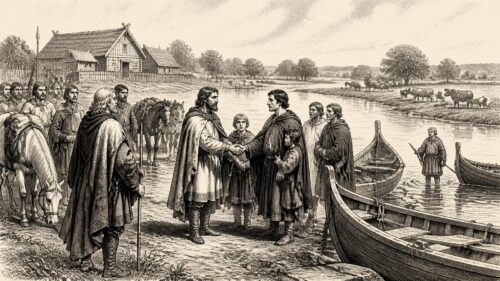
Waterford enters 1031 in two ways. The Annals of Inisfallen say that Port Láirge was burned, while the Annals of Tigernach record that Ragnall son of Ragnall, descendant of Ímar and king of Waterford, was treacherously killed in Dublin. These notices show the vulnerability and connectivity of the Hiberno-Norse towns. Waterford was not merely a coastal settlement; it was a royal and commercial centre with its own dynastic links. The killing of its king in Dublin suggests diplomacy, rivalry or betrayal within the network of Irish Sea rulers.
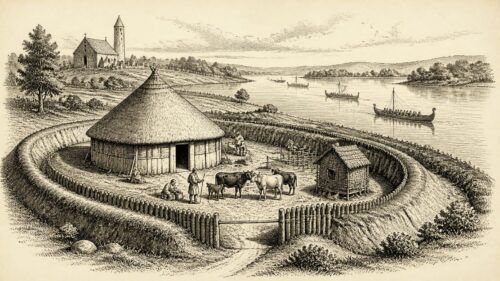
Dublin, Waterford, Limerick, Cork and Wexford had helped transform Ireland’s economy since the Viking Age by creating durable towns, mints, quays and craft quarters. By 1031, their inhabitants were often Christian and deeply interwoven with Gaelic politics. Yet the annals still call them “foreigners” in many contexts, especially when they appear as raiders. The year therefore captures a transitional Ireland: urban and maritime in its ports, overwhelmingly rural in its hinterlands, and politically bound together by cattle, hostages, church tribute, marriage and violence.
Learning, Piety and Everyday Life
The obituaries of 1031 are as revealing as the raids. The Annals of Inisfallen record the deaths of Mael Suthain, described as a venerable senior of Ireland, and Mac Uige the anchorite. The Four Masters add Conaing Ua Cearbhaill, erenagh of Glendalough and “head of the piety and charity” of the Gaels; Mac Finn, erenagh of the guest-house of Clonmacnoise; Mac Dealbaeth, successor of Crónán of Tuamgraney; and Conn na mBocht, associated with the poor and the Céilí Dé at Clonmacnoise. Some of these entries come from later compilation and must be used cautiously, but together they reveal what Irish chroniclers valued: learning, penitence, hospitality, care for the poor and continuity of sacred office.
These religious communities were not remote from ordinary life. Guest-houses fed travellers and dependants. Erenaghs managed church lands. Coarbs embodied the legal succession of saints. Anchorites represented withdrawal from the world, but their deaths were public events because their holiness strengthened the prestige of their churches. The notice that Mac Mara obtained a poetic gift after fasting against Brendan at Ardfert is harder to interpret, but it belongs to a world in which learning, poetry, ascetic practice and saintly power were understood as connected.
A Year of Fragmented Authority
No single ruler dominated Ireland in 1031. Donnchad mac Briain could raid Osraige but suffer losses. Sitriuc of Dublin could strike Ardbraccan but operated in a world of rival Gaelic powers. Flaithbertach Ua Néill returned from Rome into a north still shaped by raids, winter campaigns and dynastic rivalry. Local kings of Ara Tíre, Uí Maine, the Déisi, Cenél Conaill and Waterford could be killed by enemies, kinsmen or treachery.
The year’s pattern is therefore one of fragmented authority rather than collapse. Society continued through farming, trade, prayer, scholarship and local lordship, but the annals preserve the moments when order broke: a church burned, a successor blinded, a king killed, captives marched away, cattle driven across a border. In that sense 1031 is a revealing year. It shows Ireland not as a place paused between Brian Bóruma and the later reforming kings, but as a living political landscape in which sanctity, violence, commerce and ambition met every day.
Primary Sources
- The Annals of Ulster: Year U1031
- The Annals of Ulster
- Chronicon Scotorum
- Annals of Inisfallen
- Annals of Tigernach
- Annals of the Kingdom of Ireland by the Four Masters, Volume 2
- Sitriuc Silkbeard (Sitric, Sigtryggr Ólafsson Silkiskeggi) | Dictionary of Irish Biography
- Ua Néill, Flaithbertach | Dictionary of Irish Biography
- Brian Boru and the Book of Armagh | History Ireland
- See Rome and Die: The Burial-Place of Donnchad mac Briain | History Ireland
- The Viking Age in Ireland | National Museum of Ireland
- 950–1450: Vikings, Normans and Medieval Mints | National Museum of Ireland
- The City of Dublin | Viking Ship Museum
- Waterford | Viking Ship Museum
- Dublin, Part I, to 1610: Irish Historic Towns Atlas, No. 11 | Royal Irish Academy
- Irish Historic Towns Atlas | Digital Repository of Ireland
- Dublin City Urban Archaeology Survey 1988 | National Monuments Service
- County Waterford and Waterford City Urban Archaeology Survey 1989 | National Monuments Service
- Waterford Excavation Report 1988: Viking, Medieval and Later Settlement | Excavations.ie
- Agriculture, Settlement and Society in Early Medieval Ireland | Queen’s University Belfast
- Early Medieval Ireland: Archaeological Excavations 1930–2009 | University College Dublin
- Kingship, Society, and Sacrality: Rank, Power, and Ideology in Early Medieval Ireland | Cambridge Core
- Vikings in Early Medieval Ireland: Church-Raiding, Politics and Kingship | JSTOR
- Irish Historic Towns Atlas: City of Armagh | Ulster University