
Castlepook and Derryvree31901 BCE
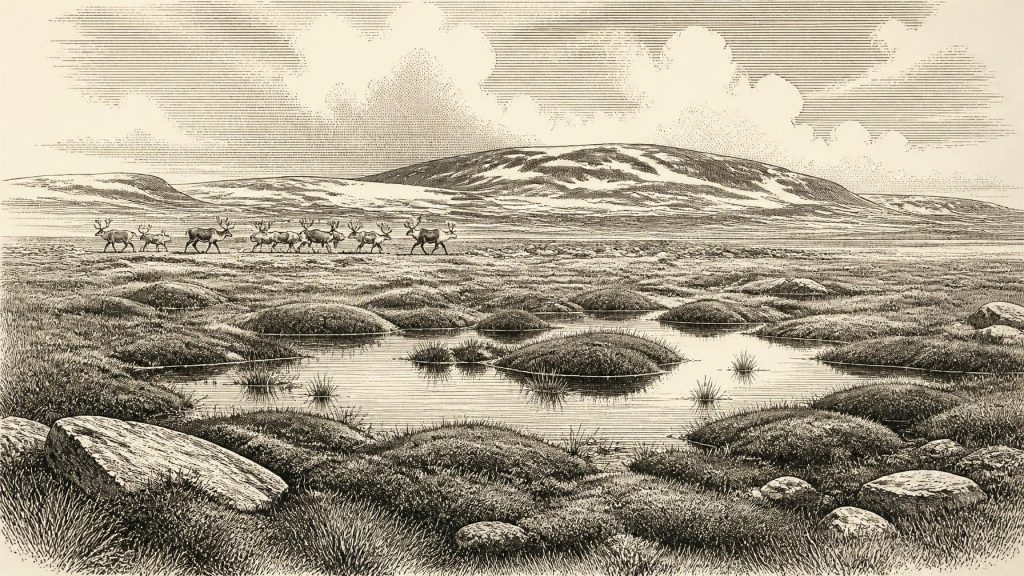
Circa 31,901 BCE, Ireland was a cold, seasonally varied Late Pleistocene landscape, not yet wholly covered by the expanding British-Irish Ice Sheet. Derryvree sediments in Fermanagh record open, treeless wetland vegetation, freshwater pools and cold-adapted insects during an ice-free interval, though dates remain broad. Castlepook Cave in Cork preserves mixed remains of mammoth, reindeer, giant deer, hyaena, wolf, Arctic fox and other fauna, accumulated over extended periods and partly modified by carnivores. A possibly butchered reindeer bone suggests fleeting human activity, but no secure settlement evidence exists. Together, the sites document environmental change, ecological connectivity and fragmentary survival of evidence.
Dateline
The label 31,901 BCE cannot identify a particular Irish event, season, leader or community. At this depth of time there are no written records, named populations or calendar-based chronologies. In archaeological terms, it is best treated as an approximate point around 33,850 calibrated years before present (cal BP, where “present” is 1950), within the Late Pleistocene and Marine Isotope Stage 3. Calibration curves, radiocarbon uncertainties and the disturbed character of many Irish deposits mean that modern year-by-year precision is unavailable. What can responsibly be described is the evidence for Ireland during a broad interval around this point: a cold landscape, not yet at the height of the Last Glacial Maximum, supporting a striking but thinly documented Ice Age fauna.
A Cold Interval Before Maximum Ice
Ireland was then part of the wider north-west European world of the last glacial cycle. It was not the uniformly ice-smothered island sometimes imagined from later phases of the Ice Age. The great British-Irish Ice Sheet would eventually expand dramatically, reaching its maximum extent on the Atlantic shelf roughly 26,000–24,000 cal BP and then retreating in stages. Around the equivalent of 31,901 BCE, however, evidence from beneath later glacial sediments indicates that at least some Irish regions had remained ice-free during earlier parts of the cycle. This does not mean that conditions were mild. It means that cold, seasonal and periglacial environments could exist beyond, between or before major ice advances.
The most useful evidence comes from deposits whose dates are ranges rather than annual observations. At Derryvree near Maguiresbridge, County Fermanagh, organic-rich freshwater sediments lie between an older till and a later glacial deposit. A conventional radiocarbon result of 30,500 ± 1,200 radiocarbon years BP has been calibrated to a broad range of approximately 36,900–31,700 cal BP. That range overlaps the chronological neighbourhood of 31,901 BCE, but it cannot prove that its plants and insects lived in that exact year. Greenagho, also in Fermanagh, has organic deposits beneath till with a reported age suggesting ice-free conditions before the later expansion of the Irish ice sheet, though the reliability and precise implications of legacy dates require caution.
Derryvree’s pollen, plant and insect evidence points to open, treeless ground with sedges, grasses, herbs, juniper and freshwater mosses. The insects indicate cold northern conditions, while the sediments suggest pools, wet mossy ground and abundant plant detritus: a muskeg-like environment rather than an unbroken desert of snow. Such terrain would have changed markedly with season, exposure and drainage. Wind, frost action, shallow water, sparse vegetation and patches of sheltered growth probably made a varied habitat across lowlands, slopes and river basins. It was harsh country, but not lifeless country.
Castlepook’s Ice-Age Fauna
For southern Ireland, Castlepook Cave near Doneraile in north County Cork is central. Excavations there in the late nineteenth and early twentieth centuries recovered a very large mixed collection of animal bones from cave deposits. The collection includes remains attributed to woolly mammoth, reindeer, giant deer, brown bear, wolf, Arctic fox, spotted hyaena and lemmings, alongside other animals. It establishes beyond reasonable doubt that Ireland was, during parts of the pre-Last Glacial Maximum, within the range of cold-adapted and open-country mammals.
Older radiocarbon measurements on a mammoth bone and a spotted-hyaena bone from Castlepook produced dates of about 33,500 ± 1,200 and 34,300 ± 1,800 radiocarbon years BP respectively. Later work has reconsidered the dating of southern Irish Marine Isotope Stage 3 faunas using improved pretreatment and accelerator dating. The principal lesson is not that every Castlepook specimen belongs to one brief moment. Rather, the cave preserves material accumulated across a long and complicated span, and some previously accepted dates have been revised substantially. Castlepook is therefore excellent evidence for a Pleistocene animal world in Ireland, but poor evidence for reconstructing a single year.
The cave’s contents also need taphonomic reading: bones do not arrive in caves only through human action. Spotted hyaenas are capable scavengers and bone accumulators, and many Castlepook bones bear damage consistent with carnivore activity. Animals may also have died naturally, been moved by water or slope processes, or been mixed when early excavators removed deposits. Mammoth and reindeer remains show that large herbivores entered or moved through the wider landscape; hyaena, wolf and Arctic fox show that predators and scavengers did too. Yet the relative abundance of bones in a cave cannot be converted simply into a census of animals outside it.
Recent sedimentary ancient-DNA research at Castlepook has added a new line of evidence, detecting a wider Late Pleistocene fauna in cave sediment and recovering mitochondrial information from Irish hyaena and mammoth. As a 2026 preprint, it remains developing research rather than a final peer-reviewed verdict. Even so, its findings are consistent with an important wider conclusion: Ireland’s large mammals were not necessarily isolated curiosities. They formed part of broader Eurasian populations and dispersal networks before the Last Glacial Maximum. The physical route or routes of those movements remain a matter for palaeogeographical investigation, not a licence to assume a permanent, easily crossed land bridge.
People: A Possibility, Not a Population
The human story must be told more cautiously still. A reindeer bone from the Castlepook collection has been reported as bearing marks consistent with stone-tool butchery, and it has been discussed as possible evidence for human activity around 33,000 years ago. If that interpretation is sustained by continued analysis, it would greatly extend the antiquity of human presence in Ireland. It would indicate at least a visit, encounter or episode of carcass processing during the wider Middle Upper Palaeolithic period.
But this is not evidence for a settled Irish population in 31,901 BCE. No securely dated house, hearth, stone-tool assemblage, burial, occupation surface or repeated camp sequence has yet been demonstrated for this age in Ireland. The relevant bone was recovered from an old cave collection rather than modern controlled excavation, and the distinction between human cut marks, trampling, carnivore damage and other surface modification demands rigorous microscopic study. The evidence permits a possibility of people; it does not support claims about their language, kin groups, numbers, route of arrival or permanent residence.
Accordingly, there can be no responsible account of Irish political affairs, diplomacy, leaders or organised warfare for this date. Nor is there evidence for Irish religious institutions, formal learning, art traditions or traded goods. If human visitors did reach the island, they would have belonged to mobile Upper Palaeolithic hunter-gatherer worlds known elsewhere in north-west Europe, for whom knowledge of animals, weather, stone and seasonal movement was essential. That is an informed regional comparison, not direct evidence from Ireland. It must not be mistaken for a recovered Irish society.
Subsistence Without an Economy
The landscape nevertheless had resources. Reindeer could provide meat, marrow, hide, sinew, antler and bone; mammoth carcasses, whether hunted elsewhere, scavenged or naturally dead, represented unusually large concentrations of usable food and raw material. Smaller mammals and birds, freshwater pools and plants would have contributed to a complex food web. For carnivores, a cave such as Castlepook might serve as shelter, den or a place where bones accumulated. For any human party, it might have been a temporary refuge or a risky place shared with predators, rather than a home.
It would be misleading to call this a trading economy. There is no evidence for exchange between Irish communities because no such communities have been identified. Nor can animal movement be called trade. What can be said is that the occurrence of mammoth, hyaena and reindeer demonstrates ecological connectivity: suitable habitats and movement corridors existed at intervals across the north-western fringe of Europe. Lower global sea levels altered coastlines and exposed parts of the continental shelf, but sea level, ice loading and local land movement created changing and uncertain barriers. The exact geography experienced by each animal population remains under investigation.
What This Date Can Mean
The most historically important development around the notional date of 31,901 BCE was environmental rather than political. Ireland was a cold, dynamic part of Pleistocene Europe, with open vegetation, freshwater wetlands and an assemblage of large mammals now absent from the island. Some areas had not yet been overridden by the expanding ice sheet that would later erase, bury and rearrange much of the evidence. The surviving record is patchy partly because subsequent glaciation, erosion, acidic soils and antiquarian excavation have all destroyed or confused deposits.
Castlepook Cave and Derryvree therefore stand not as monuments to a known year, but as archives of long intervals. Derryvree preserves environmental signals from a cold, ice-free phase in Fermanagh; Castlepook preserves fragments of an extraordinary southern fauna and a debated hint of human action. Together they show why Ireland’s deep past cannot be narrated as a blank before settlement, yet also why restraint is essential. Around this point in the Late Pleistocene, there may have been brief human contact with Ireland’s reindeer country. There is no evidence, however, for an Irish polity, village or continuous human history. The securely recoverable story is one of animals, climate, changing ice and the fragile survival of clues.
Primary Sources
- A Reconsideration of the Radiocarbon Dating of the Marine Isotope Stage 3 Fauna from Southern Ireland
- The Irish Quaternary Fauna Project
- A Middle Midlandian Freshwater Series at Derryvree, Maguiresbridge, County Fermanagh, Northern Ireland
- Early Midlandian–Middle Midlandian, Pleistocene, Northern Ireland
- Trimlines, Blockfields and the Vertical Extent of the Last Ice Sheet in Southern Ireland
- Growth and Retreat of the Last British–Irish Ice Sheet, 31,000 to 15,000 Years Ago: the BRITICE-CHRONO Reconstruction
- The Deglaciation of the Western Sector of the Irish Ice Sheet from the Inner Continental Shelf to its Terrestrial Margin
- Early Deglaciation of the British-Irish Ice Sheet on the Atlantic Shelf Northwest of Ireland Driven by Glacioisostatic Depression and High Relative Sea Level
- First Evidence of a Late Upper Palaeolithic Human Presence in Ireland
- New Insights on the Fauna of Ireland's Younger Dryas and Early Holocene from Alice & Gwendoline Cave
- The Problem of a Late Quaternary Landbridge Between Britain and Ireland
- Deglaciation, Earth Crustal Behaviour and Sea-Level Changes in the Determination of Insularity: A Perspective from Ireland
- Palaeogeographical Reconstructions of Possible Land-Bridges Between Ireland and Britain
- Sedimentary Ancient DNA Reveals Late Pleistocene Faunal Connectivity Between Ireland and Eurasia
- Pleistocene Vertebrates in the British Isles
- Irish Pleistocene Biostratigraphy
- Proceedings of the Royal Irish Academy: Castlepook Cave Exploration
- Investigating Seasonal Mobility in Irish Giant Deer (Megaloceros giganteus)
- Phylogeographic, Ancient DNA, Fossil and Morphometric Analyses Reveal Ancient and Modern Introductions of a Large Mammal: the Complex Case of Red Deer (Cervus elaphus) in Ireland
- Ireland: Submerged Prehistoric Sites and Landscapes