Hyaena Hall’s Bone Map31746 BCE
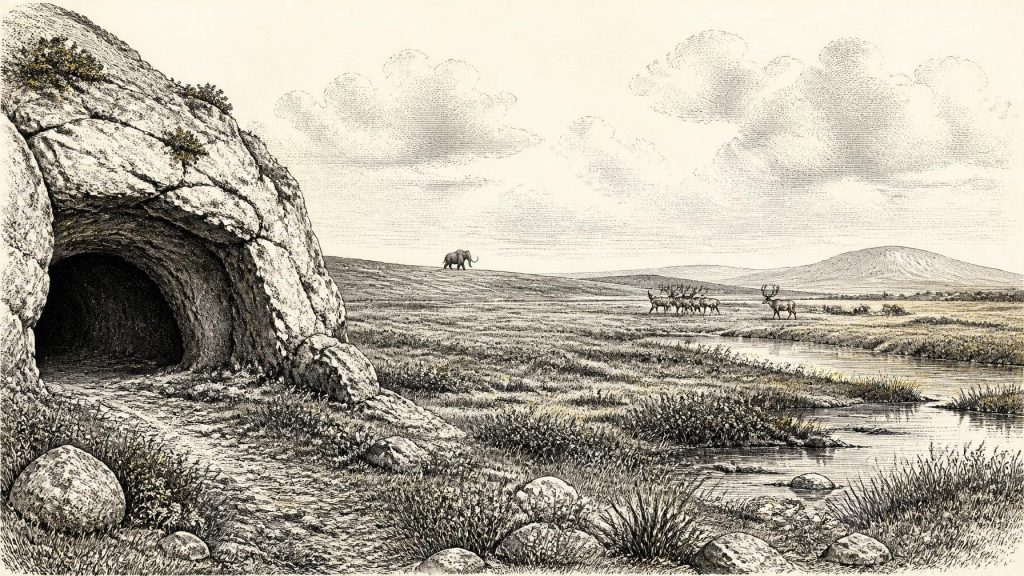
About 31,746 BCE, Ireland formed part of a climatically unstable MIS 3 Ice-Age landscape, with low sea levels, shifting ice margins and changing land connections. Castlepook Cave in County Cork preserves important, imperfect evidence: animal remains indicate open tundra-grassland habitats supporting mammoth, giant deer, reindeer, hyaena, wolves and Arctic species. These bones accumulated through natural processes as well as predators, while early excavation and revised dating limit certainty. A reindeer femur possibly bears a stone-tool cut mark, suggesting an exceptionally early human visit or carcass processing. It cannot prove settlement or continuity. Ireland’s evidence chiefly records fauna and environmental uncertainty.
Dateline
The label 31,746 BCE is useful only as a modern point of reference. No community in Ireland used a calendar at this time, and neither archaeology nor palaeoclimatology can identify an occurrence within this particular twelve-month span. Counted back from the conventional radiocarbon reference year of 1950, it lies about 33,695 calendar years ago. The responsible setting is the Late Pleistocene, broadly within Marine Isotope Stage 3 (MIS 3), a long, climatically unstable part of the last Ice Age. Evidence is normally expressed as laboratory radiocarbon ages and calibrated ranges, not as exact BCE years; calibration itself carries substantial uncertainty this far back.
A Cold-Stage Island, Not a Frozen Certainty
Ireland at this notional date was neither the familiar wooded island of later prehistory nor necessarily an island wholly buried beneath the final great ice sheet. The global Last Glacial Maximum is conventionally placed at about 26.5–19 thousand calendar years before present, later than 31,746 BCE. Research on the British–Irish Ice Sheet shows that its advance and retreat varied greatly from region to region; a single map cannot safely represent all of Ireland throughout MIS 3. Southern and western coastal deposits, caves and buried sediments instead preserve glimpses of changing local conditions before the ice sheet reached its later maximum.
The climate was cold, but ‘cold’ should not be mistaken for uniform. MIS 3 contained abrupt warmer and colder phases, and Ireland’s coastlines, rivers, vegetation cover and animal routes altered accordingly. Sea level was far lower than today because much water was stored in continental ice sheets. The Irish Sea and Atlantic shelf therefore looked very different, exposing broad areas now submerged and at times making movement between Ireland, Britain and the wider north-west European landmass easier than it would later become. Exactly where dry land ended and shallow water began around this one notional year remains a matter for reconstruction rather than direct observation.
Castlepook’s Uneven Archive
The most informative Irish evidence for this broad interval comes from Castlepook Cave, also called Mammoth Cave, near Doneraile in north County Cork. Excavated principally between 1904 and 1918 under the auspices of the Royal Irish Academy’s cave investigations, its narrow limestone passages and chambers produced more than 2,000 animal bones. Places given evocative names by the early excavators, including Hyaena Hall and Elephant Hall, are not archaeological settlements. They are parts of a cave system in which animals, carnivores, water, sediment movement and human excavation all helped create the surviving record.
This distinction matters. A bone in a cave does not automatically mean that the animal died there, that every species represented was contemporary, or that people occupied the cave. Some remains were brought in by predators and scavengers; some may have washed or fallen into fissures; and early excavations pre-dated modern standards of stratigraphic recording. Later reassessment has also shown that several old radiocarbon determinations from southern Irish caves were too young, owing to limitations in earlier sample treatment. Re-dating has placed important Castlepook fauna firmly in MIS 3, while making the site at once more significant and more difficult to narrate simply.
The evidence nevertheless establishes an important point. At intervals in the middle and later part of the Ice Age, southern Ireland supported, or was accessible to, a striking cold-stage mammal community. Castlepook’s recorded fauna includes woolly mammoth, giant deer, reindeer, brown bear, wolf, Arctic fox, mountain hare, lemmings and spotted hyaena. Not every animal need have lived on the landscape at precisely 31,746 BCE, and some identifications and dates continue to be tested. Yet the combined assemblage rules out any image of Ireland as an utterly lifeless periphery before the Last Glacial Maximum.
Open Ground and Seasonal Lives
The animals provide the strongest basis for reconstructing the wider environment. Reindeer, lemmings, Arctic fox and mountain hare point towards open, cold landscapes rather than closed woodland. Mammoth and giant deer required extensive feeding grounds, while wolves and spotted hyaenas depended upon prey and carrion. The plausible picture is of a patchwork of herb-rich grassland, sedge-rich wet places, exposed mineral ground and low tundra vegetation, with shrubs locally present when conditions allowed. It was a demanding but productive seasonal environment, not a blank expanse of snow.
Other Irish deposits add depth without providing a photograph of the same moment. Organic silts beneath glacial sediments at Derryvree near Maguiresbridge, County Fermanagh, have yielded mosses, plant macrofossils and poorly preserved pollen from an earlier ice-free or less severely glaciated interval. They demonstrate that wetland and tundra-like environments could develop in Ireland between phases of ice advance. Such sites are valuable warnings against treating glaciation as a single uninterrupted event. They cannot, however, be used to specify the weather, vegetation or shoreline in north Cork in 31,746 BCE.
There is no responsible basis for describing farms, permanent villages, fields, boats, trade goods or routine domestic life in Ireland at this date. There are no securely identified houses, hearths, lithic workshops, burials, ornaments, rock art or food stores from a contemporary Irish settlement. Nor is there evidence from which to infer political authority, diplomacy, named groups, language or organised religion. The absence is partly historical and partly geological: later ice repeatedly eroded, rearranged and buried older landscapes, while caves tend to preserve animal bone more readily than open-air camps.
The Reindeer Femur Question
One object makes this period unusually important for Irish prehistory: a reindeer femur from the Castlepook collection has been reported as bearing a deep incision consistent with a sharp stone tool used in carcass processing. A date of roughly 33,000 years ago has been associated with the specimen in public discussion, and County Cork heritage material places the relevant cold-stage fauna broadly around 30,000 BC. If the mark is genuinely anthropogenic and contemporary with the bone, it would be an exceptionally early trace of human action in Ireland, far earlier than the securely dated Late Upper Palaeolithic butchery evidence from a brown-bear bone at Alice and Gwendoline Cave, County Clare, dated to about 12,810–12,590 calibrated years BP.
That conditional wording is essential. A cut mark must be distinguished microscopically from damage caused by carnivore teeth, trampling, sediment abrasion, excavation tools or post-depositional breakage. A date on a bone estimates the death of the animal, not automatically the instant at which any mark was made. Moreover, the Castlepook femur derives from an old collection rather than a newly excavated, tightly sealed occupation layer. The most cautious conclusion is therefore modest: the bone raises a serious possibility that one or more people gained access to a reindeer carcass in Ice-Age Ireland and used a sharp edge upon it. It does not demonstrate a settlement, a population continuous through millennia, or an Irish society comparable to later hunter-gatherer communities.
People Beyond the Evidence
If people did visit, their lifeways would have depended on mobility, knowledge of animal behaviour, warm clothing, fire and effective stone technology. Those are reasonable general inferences from Upper Palaeolithic hunter-gatherers elsewhere in north-west Europe, but they are not finds from Castlepook. A single processed carcass could record a brief hunting stop, scavenging, or a small party passing through a landscape that was only periodically suitable. It cannot disclose kinship, leadership, ritual, exchange networks or a political map. At present, the faunal landscape is better evidenced than any human landscape.
For that reason, 31,746 BCE is best understood not as a year of recorded events but as a point within a difficult, revealing interval. Ireland lay within a fluctuating Ice-Age world of low seas, shifting ice margins and open-country mammals. In Hyaena Hall and the neighbouring chambers at Castlepook, fossils preserve the outline of that world: prey, predators, shelters and natural traps. The debated reindeer femur may add the faintest human trace. Continued excavation, improved dating, sediment analysis and careful study of bone surfaces may strengthen, qualify or overturn that interpretation. The uncertainty is not a failure of the evidence; it is the central historical fact of Ireland at this depth of time.
Primary Sources
- A Reconsideration of the Radiocarbon Dating of the Marine Isotope Stage 3 Fauna from Southern Ireland
- Castlepook Cave: County Geological Site Report
- The Archaeological Heritage of County Cork
- Spotted Hyena Skull
- Castlepook Cave, Castlepook South, County Cork: 2022 Excavation Report
- The Exploration of Castlepook Cave, Co. Cork
- The Irish Quaternary Fauna Project
- First Evidence of a Late Upper Palaeolithic Human Presence in Ireland
- New Insights on the Fauna of Ireland's Younger Dryas and Early Holocene from Alice & Gwendoline Cave
- The IntCal20 Northern Hemisphere Radiocarbon Age Calibration Curve (0–55 cal kBP)
- Composition and Consequences of the IntCal20 Radiocarbon Calibration Curve
- Marine20—The Marine Radiocarbon Age Calibration Curve (0–55,000 cal BP)
- Late Pleistocene Chronostratigraphy and Ice Sheet Limits, Southern Ireland
- Maximum Extent and Dynamic Behaviour of the Last British–Irish Ice Sheet West of Ireland
- Growth and Retreat of the Last British–Irish Ice Sheet, 31,000 to 15,000 Years Ago: the BRITICE-CHRONO Reconstruction
- Timing and Pace of Ice-Sheet Withdrawal Across the Marine–Terrestrial Transition West of Ireland During the Last Glaciation
- Trimlines, Blockfields and the Vertical Extent of the Last Ice Sheet in Southern Ireland
- Palaeoecology: Irish Quaternary Association Field Guide
- Quaternary Site Descriptions
- Phylogeographic, Ancient DNA, Fossil and Morphometric Analyses Reveal Ancient and Modern Introductions of a Large Mammal: the Complex Case of Red Deer (Cervus elaphus) in Ireland