Membership is completely free, giving members unlimited access to all available resources, services, features, and benefits without any restrictions or fees.
Welcome back. Sign in to continue enjoying unlimited access to all available resources, services, features, and member benefits at no cost.
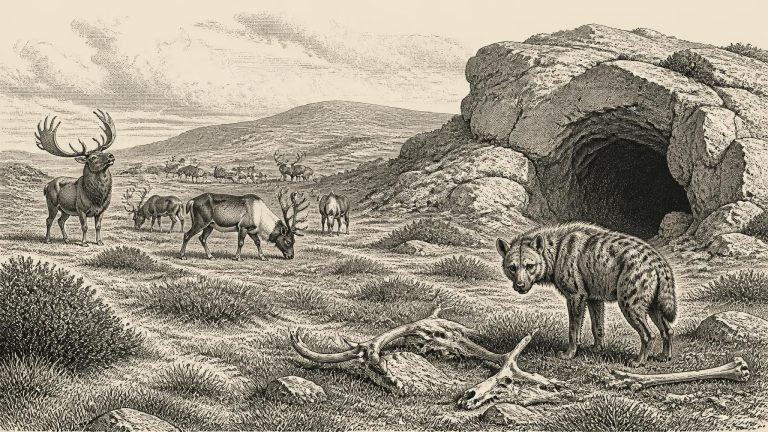
The date falls during the Midlandian, Ireland’s last major glacial stage. This was not a uniformly frozen era. Ice sheets advanced and retreated over long intervals, while local conditions changed with temperature, snowfall, sea level and the behaviour of glaciers. Research synthesising Irish evidence suggests that the island was still largely ice-free until about 32,000 calibrated years before present, before the ice sheet expanded towards its maximum extent. Thus 31,087 BCE should be imagined as close to a major environmental turning point, not as a time when the whole island can automatically be pictured beneath a single unbroken mass of ice.
Ireland at this notional date was neither the familiar wooded island of later prehistory nor necessarily an island wholly buried beneath the final great ice sheet. The global Last Glacial Maximum is conventionally placed at about 26.5–19 thousand calendar years before present, later than 31,746 BCE. Research on the British–Irish Ice Sheet shows that its advance and retreat varied greatly from region to region; a single map cannot safely represent all of Ireland throughout MIS 3. Southern and western coastal deposits, caves and buried sediments instead preserve glimpses of changing local conditions before the ice sheet reached its later maximum.
MIS 3 was not a uniformly frozen world. Across north-west Europe it was marked by abrupt climatic oscillations, sometimes over centuries or millennia: comparatively milder intervals alternated with colder, drier phases. Ireland lay at the Atlantic edge of that unstable climatic system. Its eventual coverage by the last British–Irish Ice Sheet is beyond doubt, but the extent, timing and thickness of ice varied substantially between regions and through time. The best recent ice-sheet reconstruction begins at 31,000 years ago—later than the nominal year considered here—and shows ice building rapidly over Ireland and Britain thereafter. It cannot responsibly be used to draw a hard ice margin for 31,903 BCE.