The Awbeg Reindeer Femur31747 BCE
Around 31,747 BCE, Ireland lay within the climatically unstable later Marine Isotope Stage 3, before the Last Glacial Maximum. Lower sea levels altered coasts and routes, but did not ensure a land bridge. Deposits at Derryvree indicate cold, open wetlands with seasonal plant life, while Castlepook Cave preserves diverse fauna, including reindeer, mammoth, giant deer, hyaena and wolf. A reindeer femur from Castlepook bears an incision possibly made by a stone tool, suggesting a brief Upper Palaeolithic human visit. However, disturbed cave deposits and absent campsites preclude evidence of settlement. Re-dating and palaeoecology instead reveal a dynamic Ice Age landscape.
Dateline
The label 31,747 BCE cannot be treated as a recoverable Irish calendar year. No written chronology, settlement sequence or archaeological layer can identify what happened in Ireland in that particular year. It is a modern conversion used to place a very remote point in time before the present era. In archaeological terms, it lies broadly around 33,700 calendar years before 1950, within the later part of Marine Isotope Stage 3 (MIS 3), a long and climatically unstable interval of the Last Glacial Period. The responsible history of Ireland at this date is therefore a history of environments, animal remains, sediments and a small number of tantalising but uncertain human traces.
A Landscape Before the Ice Maximum
This was well before the Last Glacial Maximum, conventionally dated in north-west Europe to roughly 26,000–19,000 calibrated years before present, when ice was at its greatest. It was also before the British–Irish Ice Sheet reached its overall maximum volume, reconstructed at about 23,000 years ago. That does not mean that the whole island enjoyed mild or stable conditions. Ice sheets and glaciers grew and retreated unevenly, while cold phases, windblown sediment, frozen ground and rapid climatic shifts repeatedly changed the terrain. Modern reconstructions indicate that the final great ice advance was underway on a regional scale over the following millennia, but its precise footprint at any one moment remains difficult to establish.
At this broad date, Ireland’s geography was not that of the familiar modern island. Global sea level was far lower because immense quantities of water were stored in northern ice sheets. Coastal plains now submerged beneath the Atlantic and Irish Sea would have been exposed or greatly altered, and crossings between Ireland, Britain and continental Europe were easier in some periods than they later became. Yet lower seas should not be simplified into a guaranteed dry land bridge. The changing seaways, ice margins, rivers and coastal lowlands of the western European shelf formed a complex, shifting borderland. Any movement of animals or people depended on conditions that changed over centuries and millennia, not on a fixed route.
Cold Ground, Pools and Open Vegetation
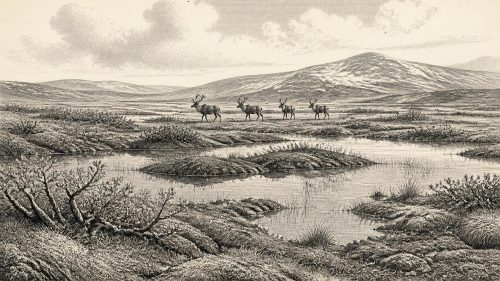
The best Irish environmental evidence for the wider period comes not from a single place but from scattered, exceptional deposits. Beneath drumlins at Derryvree near Maguiresbridge, County Fermanagh, organic layers survived between deposits left by separate ice advances. Their plant and insect remains describe a cold, open landscape with freshwater mosses, sedges, herbs, juniper and wet ground. Researchers have interpreted the setting as a treeless muskeg or tundra wetland: shallow pools and slow water surrounded by mossy, plant-rich ground, subject to severe winters and strong seasonality.
Derryvree must not be mistaken for a photograph of all Ireland in 31,747 BCE. Its deposits accumulated over an interval, their chronology has margins of uncertainty, and north-eastern lowland conditions cannot automatically stand for Cork limestone or western uplands. Nonetheless, they provide a valuable corrective to the idea of an eternally ice-covered or barren Ireland. In parts of the island during MIS 3, freshwater habitats and open vegetation existed between glacial episodes. Such ground could support grazing animals, predators and scavengers, even if it was harsh for much of the year.
This was not the wooded Ireland later familiar from Holocene pollen records. Trees were limited or absent in the colder landscapes represented by the Fermanagh evidence. Low shrubs, grasses, sedges and herbs would have offered seasonal food, while exposed soils and periglacial processes shaped the surface. Rivers carried sediment, frost disturbed the ground, and cave entrances could trap or receive material from outside. The climate’s most important political consequence, if the word can be used at all, was environmental: access to land, food and routes was governed by cold, ice and seasonality rather than by territories, rulers or borders.
Castlepook’s Animal Archive
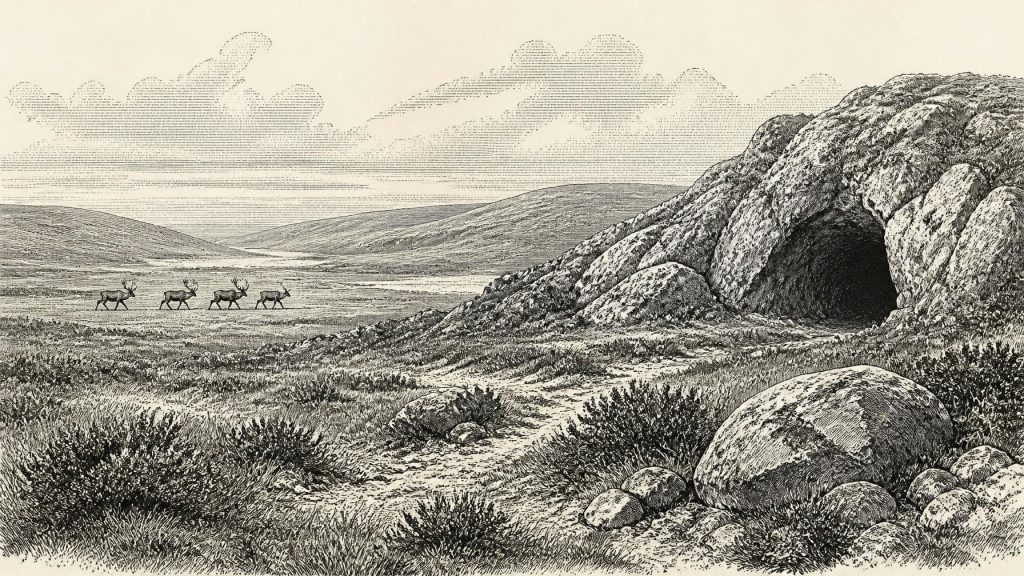
In north County Cork, Castlepook Cave near Doneraile, sometimes called Mammoth Cave, preserves the most important faunal archive for this article’s broad age. Antiquarian excavations between 1904 and 1912 recovered a remarkable collection of bones. Later work has identified remains associated with a varied Pleistocene fauna, including reindeer, woolly mammoth, giant deer, brown bear, wolf, fox, mountain hare, lemmings and spotted hyaena. Improved radiocarbon procedures have shown that some older dates from Irish cave collections were unreliable and that several Castlepook animals were substantially older than once thought. The cave is consequently central to understanding pre-Last Glacial Maximum Ireland.
The list of species should nevertheless be read carefully. It does not prove that every animal lived beside the Awbeg Valley at the same time, nor that they formed one stable local community. Cave deposits often combine bones accumulated in different episodes. Carnivores may drag prey or scavenged carcass parts underground; water, collapse and later excavation can move material; and early twentieth-century collecting did not meet modern standards of stratigraphic recording. Castlepook is therefore an archive of repeated encounters between animals, landscape and cave processes, not a neatly preserved Ice Age scene.
Even with that qualification, the fauna is significant. Reindeer point to open, cold-adapted grazing country and potentially seasonal movements across the wider region. Mammoth and giant deer demonstrate that Ireland could, in suitable phases, sustain large herbivores needing extensive plant resources. Hyaenas and wolves indicate predators and scavengers able to exploit those herbivores and their remains. A hyaena den is a plausible explanation for part of the assemblage: bones might have entered the cave through carnivore activity rather than human disposal. The evidence establishes an ecologically richer Pleistocene Ireland than the modern island’s fauna might suggest.
The Mark on a Reindeer Bone
One Castlepook object gives this date unusual historical interest: a fragment of reindeer femur, reported as about 33,000 years old and broadly presented by County Cork heritage publications as circa 31,000 BCE. Zooarchaeologist Ruth Carden identified a deep incision on the bone as consistent with a sharp stone tool used in carcass processing. If that assessment is correct, it may indicate that Upper Palaeolithic people handled a reindeer in Ireland during the wider period represented by this article. It would be a strikingly early sign of human activity, many millennia before the better-attested terminal Pleistocene and Mesolithic records.
That conditional wording matters. The femur derives from an older collection, not from a modern excavation of an intact occupation floor. There is no securely associated hearth, stone-tool assemblage, dwelling, burial, butchered animal concentration or dateable campsite at Castlepook. Radiocarbon dating establishes the age of the animal bone’s organic material; it does not independently date the incision, identify the person who made it, show where the reindeer was killed, or reveal how long any visitors remained. Distinguishing a stone-tool mark from damage made by carnivores, trampling, breakage, weathering or excavation requires specialist taphonomic analysis. The specimen is important evidence under continuing assessment, not a licence to invent an Irish hunting camp.
If people did reach Ireland around this broad date, the safest interpretation is modest. They may have been a very small, mobile Upper Palaeolithic party exploiting a reindeer carcass during a short incursion, rather than a resident population. Reindeer could have supplied meat, fat, hide, sinew, antler and bone, but none of those uses can be demonstrated from this individual femur alone. Their route may have involved exposed shelf landscapes, coastal crossings or changing connections to Britain and Europe; the Irish evidence cannot decide which. Nor can it tell us whether the people were travelling, hunting seasonally, scouting new ground or simply passing through.
What Cannot Be Recovered
There is no responsible evidence for named communities, leaders, kin groups, political institutions, warfare, diplomacy, languages or religious rites in Ireland at this point. There are no Irish houses, graves, artworks, hearths or toolkits securely dated to around 31,747 BCE. It would be equally unwarranted to assign a trade network, a ritual system or a settled economy to the possible makers of the Castlepook mark. Upper Palaeolithic societies elsewhere in Europe certainly possessed sophisticated social knowledge and practical skills, but that wider fact cannot fill the Irish record with details it does not preserve.
For the same reason, “economy” at this date means ecology more than commerce. The demonstrable resources are the plants and animals indicated by sediments and bones; the possible human economy is limited to inferred opportunistic hunting or scavenging. “Settlement” means no more than the possibility of brief visits. “Conflict” is visible only in the ordinary ecological sense of predator, prey and competition for carcasses. Cave hyenas, wolves and humans—if humans were present—may all have valued the same animal resources, but archaeology has not shown them meeting at Castlepook.
Evidence, Revision and Deep Time
The most important development around this date is thus not an event but a revision of possibility. Irish Pleistocene research has moved beyond a simple image of an empty, wholly frozen island before post-glacial settlement. Re-dating has made the Castlepook fauna older; palaeoecological deposits in Fermanagh show that cold but biologically productive environments existed in parts of Ireland; and renewed fieldwork seeks undisturbed cave sediments that may test old conclusions. Improved ultrafiltration in radiocarbon dating has also demonstrated why legacy dates must be revisited rather than accepted uncritically.
For 31,747 BCE, the clearest conclusion remains deliberately restrained. Ireland was part of a dynamic Ice Age world of open vegetation, wetlands, large herbivores and carnivores, with the great glacial maximum still ahead. Castlepook’s reindeer femur may preserve the earliest known sign that people entered that world. It does not yet demonstrate a settled Irish population. The distinction between those claims is not a weakness in the story; it is the central lesson of archaeology at deep time, where a single scored bone can widen history while still leaving most of it unknown.
Primary Sources
- A Reconsideration of the Radiocarbon Dating of the Marine Isotope Stage 3 Fauna from Southern Ireland
- The Irish Quaternary Fauna Project
- Occurrence of Mammalia Relicts at Site Castlepook Cave
- Heritage Artefacts of County Cork
- Archaeological Heritage of County Cork
- Early Midlandian–Middle Midlandian, Pleistocene, Northern Ireland
- Palaeoecology: Quaternary Research Association Field Guide
- Figure 6: The Subdivision of the Quaternary Period in Ireland
- Introduction to the Glacial Sand and Gravel Landscapes of Northern Ireland
- Growth and Retreat of the Last British–Irish Ice Sheet, 31,000 to 15,000 Years Ago: The BRITICE-CHRONO Reconstruction
- Growth and Retreat of the Last British-Irish Ice Sheet, 31,000 to 15,000 Years Ago: The BRITICE-CHRONO Reconstruction
- Pattern and Timing of Retreat of the Last British-Irish Ice Sheet
- Radiocarbon Constraints on the Age of the Maximum Advance of the British–Irish Ice Sheet in the Celtic Sea
- Maximum Extent and Dynamic Behaviour of the Last British–Irish Ice Sheet West of Ireland
- The Island of Ireland: Drowning the Myth of an Irish Land-Bridge?
- Ireland: Submerged Prehistoric Sites and Landscapes
- Anthropogenic Changes to the Holocene Nitrogen Cycle in Ireland
- First Evidence of a Late Upper Palaeolithic Human Presence in Ireland
- New Insights on the Fauna of Ireland's Younger Dryas and Early Holocene From Alice & Gwendoline Cave
- Investigating Seasonal Mobility in Irish Giant Deer Megaloceros giganteus Through Strontium Isotope Analysis
- Palaeolithic Ireland – New Evidence Emerges From the Emerald Isle
- Irish Palaeolithic Archaeology – Fleeting Footprints in a Frozen Land