Derryvree’s Greenland Six31685 BCE
Around 31,685 BCE, a notional date within Marine Isotope Stage 3, Ireland’s evidence records changing Ice Age environments rather than a datable event. Organic silts at Derryvree, Fermanagh, preserved between glacial tills, indicate an ice-free, cold, treeless wetland of grasses, sedges, herbs, mosses and pools, later overridden by ice. Ireland was approaching, not experiencing, the Last Glacial Maximum. Castlepook Cave’s mixed fauna demonstrates cold-stage animal diversity, but accumulated over separate periods. A possibly tool-marked reindeer femur may indicate an early human visit, yet lacks secure context. No settlement, culture or continuous population can be inferred; later glaciation further obscured evidence.
Dateline
The label 31,685 BCE is a modern chronological convenience, not a year that can be recovered from Ireland’s prehistoric record. There were no calendars, written accounts, named communities or annual environmental measurements on the island from which a discrete event could be dated. Converted to the archaeological convention of years before 1950, it falls at roughly 33,634 calibrated years before present (cal BP). That calculation is useful for orientation, but it must not create false precision. The responsible subject is a broad interval in the later Pleistocene, reconstructed from deposits, fossils, landforms and scientific dates that commonly carry uncertainties of centuries or millennia.
This notional year lies within Marine Isotope Stage 3, an unstable part of the last Ice Age. In the Greenland ice-core chronology it falls near the opening of Greenland Interstadial 6, conventionally dated at about 33.69–33.31 thousand years before present. That distant climatic sequence is a valuable framework, not a weather report for Ireland. Conditions in Ireland were shaped by Atlantic circulation, local relief, snow cover and the changing disposition of ice. The best Irish evidence near this horizon comes not from a camp or settlement but from a buried wetland at Derryvree, near Maguiresbridge in County Fermanagh, and from cave-bone assemblages in the south.
A Date Range, Not a Dated Event
Radiocarbon results are not calendar dates read directly from bone, peat or wood. Carbon-14 concentrations in the atmosphere changed through time, so laboratory measurements must be calibrated against independently dated records. At more than 30,000 years ago the resulting calendar ranges are wide. Stratigraphy matters equally: a bone can be moved by water, scavengers or excavation; organic sediment can be reworked; and a cave can preserve material accumulated in many separate episodes. Accordingly, a scientifically honest account of 31,685 BCE should use ranges and relative sequences rather than attach a hunt, migration or climatic episode to one imagined year.
Derryvree supplies the clearest local window. There, organic-rich silts lie between two glacial tills. The order of deposits establishes an important sequence: an earlier advance of ice, a period in which an ice-free freshwater or wetland environment developed, and a later return of glacier ice. A conventional radiocarbon result of 30,500 ± 1,200 radiocarbon years BP from the organic horizon has been calibrated broadly to approximately 36,900–31,700 cal BP. The nominal year considered here falls inside that wide interval. It does not identify the beginning or end of the wetland, still less a particular season in its history.
Water Beneath the Drumlins
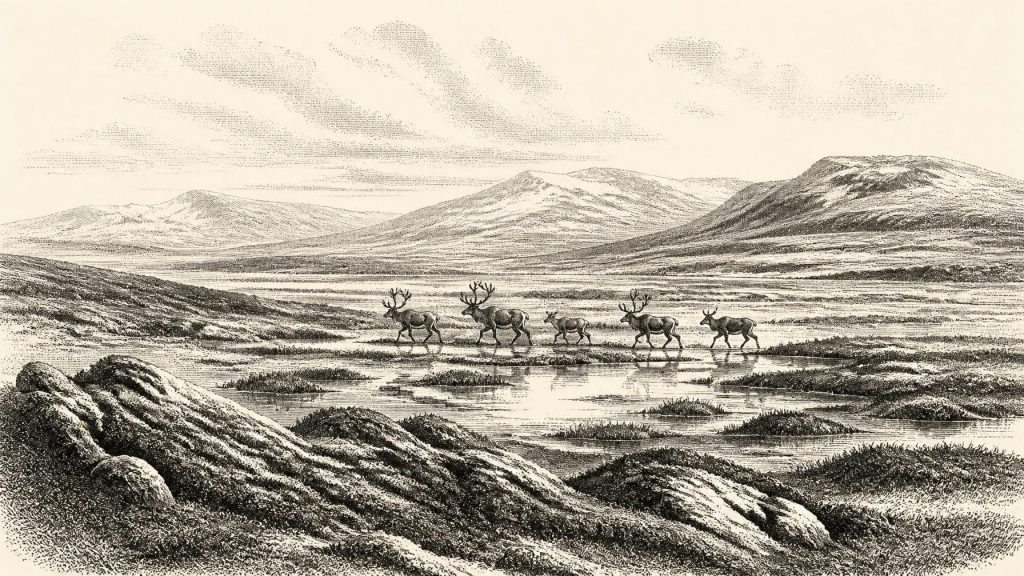
The biological remains in the Derryvree silts indicate an open, treeless, cold-stage setting rather than the familiar wooded Ireland of later millennia. Pollen, plant macrofossils and insects point to grasses, sedges, herbs, juniper and moss-rich vegetation, with wet ground and open pools. Finds cited from the deposit include bogbean and mountain avens, plants well suited to cool conditions. The insect evidence has been interpreted as a muskeg-like wetland: water, decaying plant material and mosses set within an exposed landscape. “Muskeg” should not be imagined as a modern Canadian scene transplanted whole to Fermanagh; it is a shorthand for the combination of wet, peaty ground and open pools inferred from the evidence.
This was therefore neither a timeless frozen desert nor a settled pastoral countryside. The landscape probably changed rapidly over generations as temperature, precipitation, vegetation cover and seasonal meltwater varied. A wet basin could sustain aquatic plants and insects while the surrounding ground remained largely without trees. The later tills that sealed Derryvree are themselves part of the lesson: this local environment did not endure. Ice-sheet growth eventually remade or buried many Irish landscapes, destroying and concealing much of the evidence that might otherwise have survived from the Palaeolithic.
Ice Building, But Not Yet at Its Maximum
At about 33.6 thousand cal BP, Ireland was approaching, rather than living through, the Last Glacial Maximum. Modern reconstructions place the greatest overall extent and volume of the British–Irish Ice Sheet later, principally around 26,500–19,000 years ago, with maximum ice volume near 23 ka. The island was not simply all ice or all open ground at the earlier date. Geological evidence and modelling suggest growing ice centres in northern and upland Ireland, while dated sub-till organic deposits show that parts of north-central Ireland retained ice-free ground until at least around 34 ka. The margins, thickness and timing of individual ice bodies remain reconstructed estimates rather than lines that can be drawn with certainty on a map for one year.
Sea level was substantially lower than today because large quantities of water were stored in global ice sheets. Coastlines and shallow seas consequently differed from modern ones, but the precise accessibility of Ireland changed through time and is not a licence to invent a simple, permanent land bridge. What can safely be said is that animal movement into Ireland occurred during suitable intervals, and that lower sea levels altered the geography through which such movement took place. The later expansion of ice across much of the island was a decisive regional development: it reshaped terrain, displaced habitats and greatly reduced the chances that fragile traces of earlier people would survive.
Castlepook’s Animal Archive
Castlepook Cave, near Doneraile in north County Cork, offers a complementary but very different record. It is Ireland’s richest known cave archive for Pleistocene vertebrates. Its wider assemblage includes woolly mammoth, giant deer, reindeer, brown bear, wolf, Arctic fox, lemmings and spotted hyaena. These species should not be assembled into a single illustrated scene for 31,685 BCE. The cave accumulated remains across a long span, individual specimens have differing ages, and some species may belong to separate environmental phases. Nevertheless, the assemblage establishes that Ireland could at various times before the glacial maximum support, or be reached by, a striking range of cold-stage mammals.
Spotted hyaena is especially significant, and especially cautionary. This was not evidence of a warm African-style landscape. Pleistocene spotted hyaenas ranged far beyond their present distribution and occupied open European environments. Hyaenas, wolves and other carnivores could drag carcass parts into caves, gnaw bones, scatter them and leave accumulations that later water and sediment disturbed. A cave bone is thus not automatically refuse from a human meal, and a break or groove is not automatically a tool mark. The Castlepook evidence illuminates food webs, animal dispersal and taphonomic processes before it can illuminate human society.
The Reindeer Question
A single reindeer femur from the historic Castlepook collection has made this period unusually important for Irish archaeology. It has been publicly reported as about 33,000 years old and as bearing a deep mark interpreted by zooarchaeologist Ruth Carden as having been made with a sharp stone tool while fresh bone was processed. County Cork heritage material presents the find as possible evidence that Upper Palaeolithic hunters handled reindeer in Ireland around 31,000 BCE. If the age, mark and relationship between them are confirmed through continued specialist assessment, the specimen would point to a human visit far earlier than Ireland’s long-established post-glacial archaeological record.
Its potential importance does not remove its limits. The femur derives from an old cave collection, not from a newly excavated, securely stratified occupation floor. It has no securely associated hearth, dwelling, lithic assemblage, human remains, burial or repeated food-processing deposit of comparable age. The date primarily concerns the animal bone; it cannot by itself establish the exact moment of marking, where the reindeer was killed, or how long people were present. The National Museum of Ireland still states that clear evidence of Palaeolithic human presence has not emerged. The difference between that institutional caution and the exciting Castlepook interpretation is not a problem to conceal: it is the present state of the evidence.
What Cannot Be Recovered
There is no basis for political history in Ireland at this date. No state, kingship, chiefdom, named people, diplomacy, treaty, organised warfare or legal institution can be identified. Nor can archaeology demonstrate an Irish language, a religion, formal learning, monument building, art tradition, long-distance trade network or permanent settlement around 31,685 BCE. If small groups of Homo sapiens did reach the island, they may have been highly mobile hunter-gatherers exploiting seasonal opportunities, as people elsewhere in Upper Palaeolithic Europe did. But that is a contextual possibility, not a demonstrated Castlepook culture or a continuous population ancestral to later inhabitants.
Everyday life is similarly elusive. The Derryvree deposits show environmental conditions, not households. The cave fauna shows animal presence and carcass accumulation, not a diet list for a resident community. The possible reindeer cut mark is evidence for one act of carcass processing only if its human interpretation holds. It cannot establish whether people hunted the animal, scavenged it, travelled with families, used a cave as shelter, or departed after a short visit. The later glaciation that crossed and remodelled much of Ireland helps explain why the evidence is so sparse, but erosion cannot be used to fill the silence with imaginary camps.
The most important development around this notional year was environmental. Ireland contained cold, open and locally wet habitats during an interval before the full expansion of the last ice sheet. Derryvree preserves a rare record of those conditions beneath later glacier deposits; Castlepook preserves an equally rare record of Ice Age animals, and perhaps a tantalising trace of people. Together they show that Ireland’s deep past was not empty, but also that it is fragmentary. Around 31,685 BCE, evidence supports an ice-age landscape in transition and a rich, changing animal world. It does not support a year-specific human story.
Primary Sources
- A reconsideration of the radiocarbon dating of the Marine Isotope Stage 3 fauna from southern Ireland
- The Irish Quaternary Fauna Project
- Red deer (Cervus elaphus L.) in Ireland: A comparative study of prehistoric and modern populations using ancient DNA and geometric morphometrics
- First evidence of a Late Upper Palaeolithic human presence in Ireland
- New insights on the fauna of Ireland's Younger Dryas and Early Holocene from Alice & Gwendoline Cave
- Growth and retreat of the last British–Irish Ice Sheet, 31,000 to 15,000 years ago: the BRITICE-CHRONO reconstruction
- Trimlines, blockfields and the vertical extent of the last ice sheet in southern Ireland
- Dimensions and chronology of the last ice sheet in Western Ireland
- Late Pleistocene chronostratigraphy and ice sheet limits, southern Ireland
- Marine geophysical evidence for Late Pleistocene ice sheet extent and recession off northwest Ireland
- Stratigraphic and palaeo-geomorphological evidence for the glacial-deglacial history of the last British-Irish Ice Sheet in the north-western Irish Sea
- Castlepook Cave
- Heritage Artefacts of County Cork
- Archaeological Heritage of County Cork
- Castlepook Cave, County Cork, 2022 excavation report
- Prehistoric Details
- Geology of Ireland
- Figure 6.— The subdivision of the Quaternary Period in Ireland
- Consistently dated Atlantic sediment cores over the last 40 thousand years
- Comprehensive uncertainty estimation of the timing of Greenland warmings in the Greenland ice core records
- Menyanthes trifoliata
- Dryas octopetala
- Cenozoic: Tertiary and Quaternary