

Mammoth Cave, Derryvree, and Ice31651 BCE
About 31,651 BCE, Ireland was not experiencing a datable historical year but a fluctuating Late Pleistocene interval within MIS 3. Organic deposits at Derryvree and Greenagho indicate local ice-free or withdrawn conditions before renewed glaciation, supporting cold open wetlands with grasses, sedges, juniper, mosses and insects. Castlepook Cave in Cork preserves remains of mammoth, reindeer, hyaena, bear and lemming, though accumulated deposits cannot define one ecosystem. A cut-marked reindeer femur may indicate Upper Palaeolithic carcass processing, but not settlement or permanent occupation. No evidence supports farming, monuments, political communities or regular trade. Expanding ice obscured this fragile, regionally varied landscape.
Dateline
The modern label 31,651 BCE cannot be treated as a year in the historical sense. No calendar was used in Ireland at this depth of time, and neither archaeology nor palaeoenvironmental science can identify an event, a person or a community in one particular annual interval. In conventional archaeological terms, the date falls roughly 33,600 years before AD 1950, within the later part of the Late Pleistocene and broadly within Marine Isotope Stage 3 (MIS 3), a climatically unstable phase of the last glacial period. The appropriate chronology is therefore a set of calibrated ranges and environmental phases, not a precise anniversary. Ireland at this point is known chiefly through sediments, fossils, caves and the traces left by advancing and retreating ice.
An Interval Rather Than a Year
The closest Irish evidence comes from local archives whose dates span centuries or millennia. At Derryvree, near Maguiresbridge in County Fermanagh, freshwater organic sediments lie between two layers of glacial till. The sequence records an interval when ice had withdrawn or was absent locally, before a later advance buried the deposits. A radiocarbon determination from Derryvree has been calibrated broadly to approximately 36,900–31,700 years before present. The notional date considered here sits within that wide range, but this does not make the deposit a record of conditions on one day, season or year. At Greenagho, also in Fermanagh, organic material beneath till has produced a calibrated range of roughly 37,200–35,700 years before present. Together, such deposits show that a simple picture of Ireland as continuously and uniformly ice-covered is untenable for this part of the last glacial period.
Even so, the evidence must not be stretched beyond its scale. Derryvree was a particular basin in the north of the island, not a weather station for every coast, valley and upland. Its plant and insect remains illuminate a local landscape, while cave bones from Cork offer another, separately dated glimpse of animal life. Ice margins and sea levels changed repeatedly, and the extent of the growing British–Irish Ice Sheet remains a subject of active reconstruction. What can responsibly be said is that the full Last Glacial Maximum, conventionally placed much later, around 26,500–19,000 years before present, had not yet reached its greatest extent. Ireland was approaching a harsher and more glaciated future, but its landscapes were still regionally varied.
Open Pools Beneath a Cold Sky
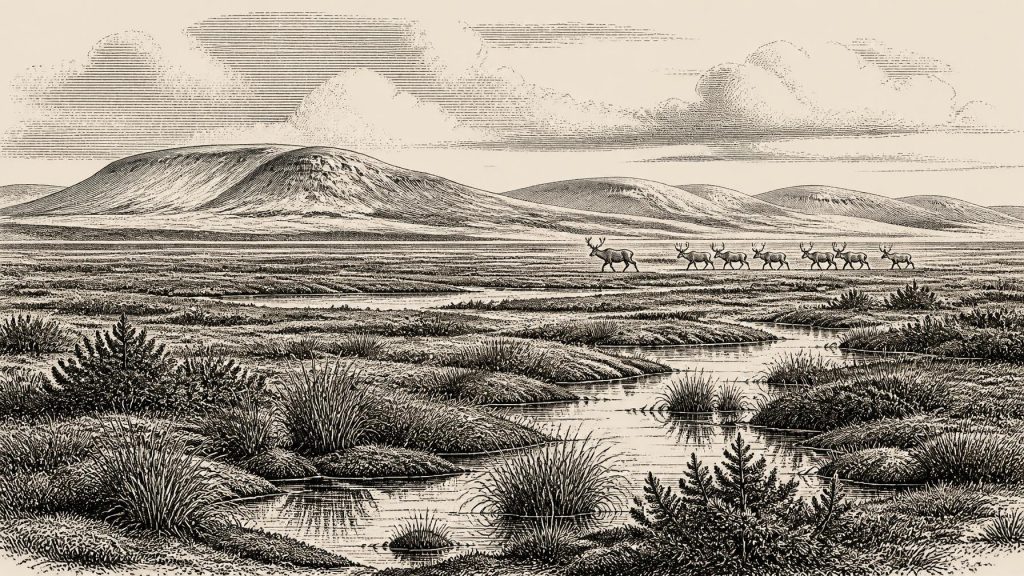
The Derryvree deposits suggest a cold, open tundra or muskeg environment rather than the familiar green, wooded Ireland of later millennia. Pollen and plant remains indicate grasses, sedges, juniper and herbs; mosses and insect evidence point to wet ground with pools rich in decaying vegetation. This was not necessarily a featureless, snowbound plain. In summer, shallow water, damp sedge beds and sheltered ground could have supported concentrated plant growth and insects. In winter, however, the evidence indicates severe cold. The local scene was likely marked by strong seasonality, exposed ground, frost action and a short growing season, with little or no tree cover.
Such evidence matters because it gives texture to an otherwise almost silent age. Rivers and meltwater channels would have shifted sediment; wet hollows could trap pollen, seeds and beetle remains; limestone caves could collect animal bones. The physical Ireland visible today still bears the much later and more extensive effects of glaciation: drumlins, eskers, altered drainage and glacial deposits. But these landforms cannot simply be projected backwards as a finished landscape. Around this date, the country’s surface was being repeatedly remade by cold-climate processes, and the ice sheet that would scour and bury much earlier evidence was still developing.
Animals at Castlepook
In north County Cork, Castlepook Cave, also called Mammoth Cave or Doneraile Cave, provides the most evocative evidence for the broad period. The cave has yielded Pleistocene remains including woolly mammoth, reindeer, spotted hyaena, brown bear and Arctic lemming. These animals do not demonstrate that every species lived together at precisely 31,651 BCE: cave deposits accumulated over long spans, and many were disturbed during early excavations. They do show that Ireland, at different times during the late Pleistocene, formed part of a wider north-west European world in which cold-adapted herbivores and predators could reach suitable habitats.
Reindeer were particularly well suited to open, cold country, while mammoths evoke the grass- and herb-rich environments often described as mammoth-steppe. Hyaenas are equally significant. A cave can be a den, a refuge, a trap, a place where water moves bone, or a deposit altered by later excavators; it is not automatically a human campsite. Carnivores may have carried carcass parts underground, gnawed them or mixed remains of differing dates. Consequently, Castlepook’s bones provide strong evidence of animal presence and ecological possibility, but weak evidence for a single, intact ancient landscape. The responsible picture is of mobile animals using an intermittently habitable Irish landmass, not of a stable prehistoric menagerie frozen in one moment.
The Reindeer Femur Question
A reindeer femur fragment from Castlepook has made this period central to the question of Ireland’s earliest people. The bone was reported in 2021 as bearing a deep incision interpreted as a mark made by a stone tool while fresh, and it has been presented as dating to about 33,000 years ago. If that interpretation is sustained, it is evidence that one or more Upper Palaeolithic people processed a reindeer carcass in Ireland during the broad later MIS 3 period. It would be an important indication of human activity far earlier than the island’s previously clearest traces.
Yet the qualification is essential. One marked bone is not a settlement. No securely associated hearth, stone-tool assemblage, dwelling floor, burial, human remains, ornament, cave art or food-processing area of this age has been identified in Ireland. Nor can the bone reveal whether people killed the animal, found it already dead, removed meat, hide, sinew or marrow, or remained in the district for hours, days or longer. The original cave investigations, led in the early twentieth century by Richard J. Ussher, removed much sediment, while subsequent work has emphasised the disturbed and fragmentary character of what survives. The femur is therefore best understood as a significant but limited clue: possible evidence of a visit or episode of carcass processing, not proof of a permanent population.
No Kingdoms, Farms or Monuments
There is no evidential basis for describing political institutions, named peoples, diplomacy, organised warfare, leaders, laws or territorial boundaries in Ireland at this date. There is likewise no basis for identifying formal religion, temples, graves, monuments, artistic traditions or systems of learning. Such absences are not merely gaps waiting to be filled with familiar later-Irish themes; they are the central historical fact of the evidence. If humans did reach the island, they left no known material record from which social rank, language, kinship, ritual or identity can be reconstructed.
The same restraint applies to economy and trade. There was no farming: cereal cultivation and livestock husbandry arrived in Ireland tens of millennia later, in the Neolithic. There is no evidence for exchange routes, boats, imported materials or regular commerce around 31,651 BCE. Lower sea levels changed the outlines of the surrounding shelf, but they do not license an assumption that Ireland was connected to Britain or continental Europe by an easy land bridge at this particular time. The sea, ice, exposed shelf, islands and changing channels formed a complex and shifting barrier. Any human arrival, if the Castlepook mark is correctly interpreted, would have required movement across a difficult north-west European landscape, but the route remains unknown.
A Fragile Human Horizon
The larger European context helps to explain why the Castlepook possibility matters without turning it into certainty. Elsewhere in Europe, Upper Palaeolithic hunter-gatherers possessed sophisticated stone technologies, mobile subsistence strategies and cultural traditions that sometimes included personal ornaments and cave art. None of those attributes can be assigned directly to Ireland from the present evidence. At most, the marked femur may suggest that Ireland lay occasionally within the far western reach of people accustomed to exploiting large animals in cold environments. It cannot identify a cultural label, demonstrate continuity with later Irish populations, or establish that the island was regularly occupied.
The most important development around this notional date was therefore environmental rather than political: Ireland was a cold, changing territory at the edge of an enlarging ice-sheet system, with local wetlands and open ground capable of supporting specialised flora and fauna. Derryvree preserves the environmental record of that world; Castlepook preserves its animals and a disputed hint of human action. In the following millennia, expanding ice would erase, rearrange and conceal much of the landscape and any fragile traces left upon it. For 31,651 BCE, Irish history is not a story of recorded events. It is a carefully bounded reconstruction of tundra pools, mobile herds, cave predators, intermittent ice and the possibility that people briefly entered a landscape on the threshold of profound glacial change.
Primary Sources
- The Irish quaternary fauna project
- Growth and retreat of the last British–Irish Ice Sheet, 31,000 to 15,000 years ago: the BRITICE‐CHRONO reconstruction
- Last Glacial Maximum cirque glaciation in Ireland and implications for reconstructions of the Irish Ice Sheet
- Trimlines, blockfields and the vertical extent of the last ice sheet in southern Ireland
- Radiocarbon constraints on the age of the maximum advance of the British-Irish Ice Sheet in the Celtic Sea
- Early deglaciation of the British-Irish Ice Sheet on the Atlantic shelf northwest of Ireland driven by glacioisostatic depression and high relative sea level
- Timing and pace of ice‐sheet withdrawal across the marine–terrestrial transition west of Ireland during the last glaciation
- Landscapes and environments of the last glacial-interglacial transition: a time of amazingly rapid change in Ireland
- The subdivision of the Quaternary Period in Ireland
- ESCR Site Summary: The Quaternary of Northern Ireland
- Quaternary
- An All-Ireland Quaternary Map
- Ireland Through Geological Time
- Heritage Artefacts of County Cork
- Mammoth Cave
- New insights on the fauna of Ireland's Younger Dryas and Early Holocene from Alice & Gwendoline Cave
- The Mesolithic in Ireland: when was it?
- Anthropogenic changes to the Holocene nitrogen cycle in Ireland
- The problem of a late quaternary landbridge between Britain and Ireland
- A critical review and re-investigation of the Pleistocene deposits between Cranfield Point and Kilkeel, Northern Ireland: Implications for regional sea-level models and glacial reconstructions of the northern Irish Sea basin
- Archaeological excavations at Killuragh Cave, Co. Limerick
- Reindeer bone found in Cork cave shows human activity in Ireland 33,000 years ago