
Maguirebridge’s Ice-Sealed Pools31560 BCE
At the notional date of 31,560 BCE, Ireland lay within the climatically unstable MIS 3 phase of the Late Pleistocene, not a recoverable historical year. Derryvree, County Fermanagh, preserves freshwater silts between glacial tills, revealing tundra wetland vegetation during an ice-free interval. Crag Cave records intermittent milder conditions, while southern caves, especially Castlepook, contain MIS 3 fauna including reindeer, mammoth, giant deer and predators. A possible cut-marked reindeer bone suggests, but does not prove, early human activity. No settlement evidence exists. Expanding ice later erased much evidence, leaving fragmentary records of shifting habitats, fauna and climate during this broad period.
Dateline
31,560 BCE is a modern chronological label, not a year that can be recovered from Ireland’s prehistoric evidence. There were no written calendars, named rulers or contemporary records on the island, and no excavated Irish deposit can responsibly be tied to a particular season or generation at this depth of time. The date falls approximately 33,500 calendar years before AD 1950, in the later part of the Late Pleistocene and within Marine Isotope Stage 3 (MIS 3), a climatically unstable phase of the last Ice Age. It is best treated as a point within broad, calibrated ranges rather than an anniversary.
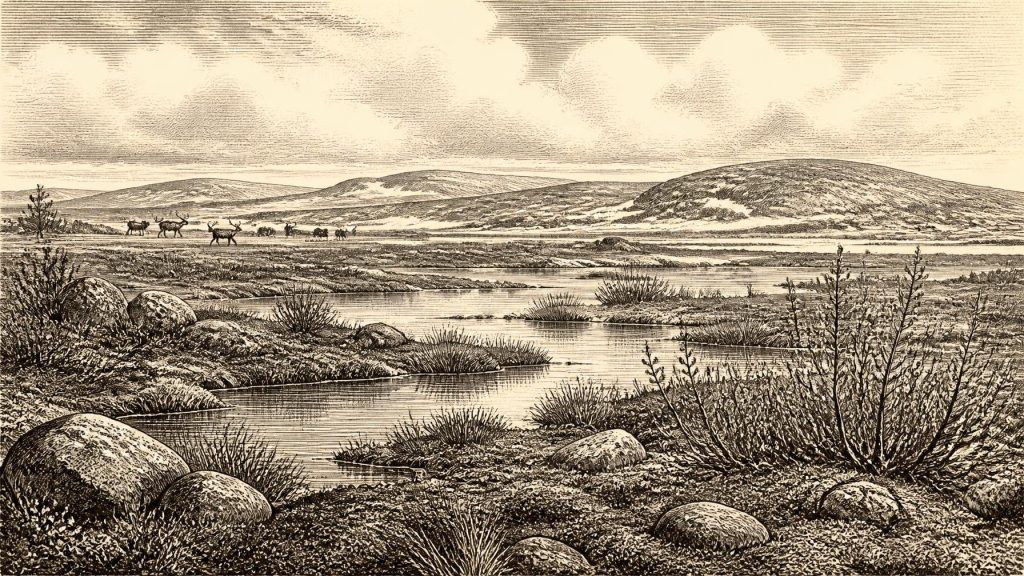
The closest securely relevant Irish environmental sequence is at Derryvree, near Maguiresbridge in County Fermanagh. Here, roadworks in 1969 exposed freshwater silts and fine sands buried between two thick layers of glacial till within a drumlin. Organic material from the deposit yielded a conventional radiocarbon age of 30,500 +1,170/−1,030 years BP, subsequently expressed as a broad calibrated interval of roughly 36,900–31,700 cal BP. The notional date of 31,560 BCE lies within that range, but this does not mean that the Derryvree wetland formed in that particular year. It identifies a precious, long-lived window into an Irish landscape of the general period.
A Wetland Between Ice Advances
Derryvree matters because its position between two tills preserves an environmental sequence that later ice did not wholly destroy. Till is the unsorted mixture of clay, stones and other debris deposited directly by glacier ice. The lower till shows that ice had previously reached the locality; the freshwater deposits show an interval when ice was absent from the site; and the upper till records a later return of glacial conditions. Rather than presenting a simple story of an island steadily freezing over, the deposits reveal a landscape repeatedly reshaped by advance, retreat and climatic fluctuation.
The plants and insects preserved in the silts point to a harsh but inhabited tundra wetland. Pollen, seeds, mosses and insect remains indicate sparse, treeless vegetation, with wet ground, open pools and plant-rich mossy margins: a muskeg-like setting rather than the oak woods, farmland or blanket bogs familiar in later Irish history. Published summaries identify cold-adapted flora including sedges, bogbean, dwarf willow, mountain avens and alpine clubmoss. These remains are evidence of local habitats, not a complete map of the island; nevertheless, they establish that part of northern Ireland supported freshwater life during a cold interlude before renewed glaciation.
Climate should not be imagined as uniformly frozen. MIS 3 was marked by abrupt shifts between colder stadials and relatively milder Greenland interstadials. At Crag Cave in County Kerry, uranium-thorium dating of broken and displaced calcite formations demonstrates episodes of speleothem growth through the last glacial period. Because calcite deposition in that shallow cave required liquid water and conditions above freezing on average, the sequence independently supports the conclusion that south-west Ireland experienced intermittent ameliorations. The Derryvree evidence cannot be matched to one exact Greenland event, but its broad age has been associated approximately with several interstadials, conventionally GI-8 to GI-5.
Animals in the Open Country
Southern Irish caves provide a complementary, though more difficult, record. Castlepook Cave near Doneraile, County Cork, produced the most important collection of pre-Last Glacial Maximum animal remains known from Ireland. Reassessment and improved radiocarbon pretreatment have shown that several earlier bone dates were too young. The revised work places a range of mammals in MIS 3, with some animals present in Ireland between at least about 45,000 and 20,000 years ago. Castlepook and related southern cave finds include reindeer, mammoth, giant deer, brown bear, hare, fox, wolf and spotted hyaena.
This is powerful evidence that Ireland was not biologically empty. Reindeer suggest open, cold country with seasonal grazing; hare and lemming belong to similarly exposed environments; while hyaenas, wolves and bears testify to predators and scavengers operating within wider food webs. Mammoth and giant deer make the prospect of an Ice Age landscape vivid, but cave assemblages must be read carefully. Bones may have entered caves through carnivore activity, natural deaths, water movement, collapse, excavation disturbance and later collection practices. The species list is therefore an accumulation across time, not proof that every animal stood together on one Fermanagh poolside or Cork hillside in 31,560 BCE.
Even so, the combined evidence permits a responsible picture of regional variation. In the north, Derryvree preserves a cold freshwater hollow bordered by low vegetation. In the south, limestone caves recorded the remains of large mammals and carnivores moving through an open landscape. Between them lay terrain repeatedly affected by frost, meltwater, vegetation change and advancing ice. Ireland’s modern political boundary, counties and road network are irrelevant to this world; the useful geographical units are cave, wetland, upland, drainage basin, coast and ice margin.
The Human Question
This date has special importance because Castlepook has also raised the possibility of a much earlier human visit to Ireland than was once accepted. A reindeer femur from the cave has been interpreted as bearing a deep mark made by a sharp stone edge during the processing of fresh bone. If that interpretation, the bone’s date and its archaeological context are ultimately sustained, it may represent Upper Palaeolithic butchery at around the broad horizon considered here. It would be a remarkable trace of human activity at the north-western edge of European hunter-gatherer ranges.
It is not, however, evidence for a settled population, a camp at Castlepook, a hunting territory or a continuous Irish occupation. No securely associated stone-tool assemblage, hearth, dwelling floor, burial or human skeleton of this age has been recovered in Ireland. Recent excavation at Castlepook confirmed that potentially important Pleistocene sediments survive, but recovered no cultural artefacts. The old cave collections are invaluable, yet their disturbed histories mean that fresh excavation, micromorphology and direct dating remain essential. The clearest published evidence for a human incursion into Ireland currently remains the much later cut-marked brown-bear bone from Alice and Gwendoline Cave, County Clare, dated to about 12,810–12,590 cal BP.
The proper conclusion is therefore cautious. It is possible that small Upper Palaeolithic parties reached Ireland during suitable climatic intervals, perhaps following animal movements or exploiting coastal and riverine routes. Lower sea levels altered the geography of the Irish Sea basin, but they did not automatically create an easy, permanent land bridge, and ice-sheet extent as well as sea level changed through time. The evidence cannot tell us whether a possible visitor arrived from Britain, continental Europe, or by some combination of short crossings and exposed terrain. It tells us only that the question is now worth testing rather than dismissing.
No Polities, No Proven Trade
There is no evidence from Ireland around this horizon for political institutions, diplomacy, warfare between organised communities, formal religious practice, monuments, art, writing or learned traditions. Nor is there evidence for agriculture, domestic animals, exchange networks or trade in the historical sense. These are not omissions to be filled with imaginative reconstruction. If people did visit, their subsistence may plausibly have involved hunting, scavenging and the use of mobile knowledge of animals, weather and terrain, as among Upper Palaeolithic groups elsewhere in Europe. Yet that is comparative interpretation, not an observed Irish settlement pattern.
The same restraint applies to everyday life. A reindeer bone bearing a possible cut mark can suggest carcass processing; it cannot reveal the language, kinship system, beliefs, gender roles, population size or seasonal round of those who may have made it. Derryvree’s plants show what conditions could support, not what people gathered. Cave bones show animals reached Ireland, not that humans hunted every species represented. In a period where evidence survives in fragments, uncertainty is itself a central historical fact.
Approaching the Glacial Maximum
The larger development was environmental transformation. The British–Irish Ice Sheet was dynamic before and during the Last Glacial Maximum, and its precise early extent remains debated. New syntheses distinguish strong evidence for the well-dated MIS 2 ice sheet from more circumstantial evidence for earlier, substantial glaciation during MIS 4 and MIS 3. For the period after 31,000 years BP, the BRITICE-CHRONO reconstruction charts major growth and later retreat using extensive marine, terrestrial and geochronological evidence. Around the horizon represented by 31,560 BCE, then, Ireland was entering an era in which habitable patches could narrow, disappear and later be scoured by ice.
That later glaciation helps explain why the record is so thin. Ice eroded older surfaces, redeposited sediment and removed or buried many traces that people and animals might once have left. Derryvree survived because its freshwater silts were sealed; Castlepook survived because caves can trap bones; Crag Cave survived because calcite retained a climatic signal. The history of Ireland around 31,560 BCE is consequently not a narrative of chiefs, battles or settlements. It is a history of resilient wetland life, wandering Ice Age fauna, unstable climate and a tantalising but unresolved possibility that people briefly entered this changing northern landscape.
Primary Sources
- A Middle Midlandian Freshwater Series at Derryvree, Maguiresbridge, County Fermanagh, Northern Ireland
- A reconsideration of the radiocarbon dating of the Marine Isotope Stage 3 fauna from southern Ireland
- The Irish Quaternary Fauna Project
- Episodic speleothem deposition tracks the terrestrial impact of millennial-scale last glacial climate variability in SW Ireland
- The IntCal20 Northern Hemisphere Radiocarbon Age Calibration Curve (0–55 cal kBP)
- The timing and magnitude of the British–Irish Ice Sheet between Marine Isotope Stages 5d and 2: implications for glacio-isostatic adjustment, high relative sea levels and ‘giant erratic’ emplacement
- Growth and retreat of the last British–Irish Ice Sheet, 31,000 to 15,000 years ago: the BRITICE-CHRONO reconstruction
- Exploring controls of the early and stepped deglaciation on the western margin of the British Irish Ice Sheet
- Maximum extent and dynamic behaviour of the last British–Irish Ice Sheet west of Ireland
- New age constraints for the maximum extent of the last British-Irish Ice Sheet (NW sector)
- First evidence of a Late Upper Palaeolithic human presence in Ireland
- First evidence of a Late Upper Palaeolithic human presence in Ireland
- Ireland: Submerged Prehistoric Sites and Landscapes
- 32564: Castlepook Cave, Castlepook South, County Cork
- The Mesolithic in Ireland: when was it?
- Archaeological Heritage of County Cork: A Guide
- UCD School of Archaeology Research Day 2022
- Ireland Through Geological Time
- Quaternary
- Introduction to the Glacial Sand and Gravel Landscapes of Northern Ireland