
Mammoth Cave’s Open Country31561 BCE
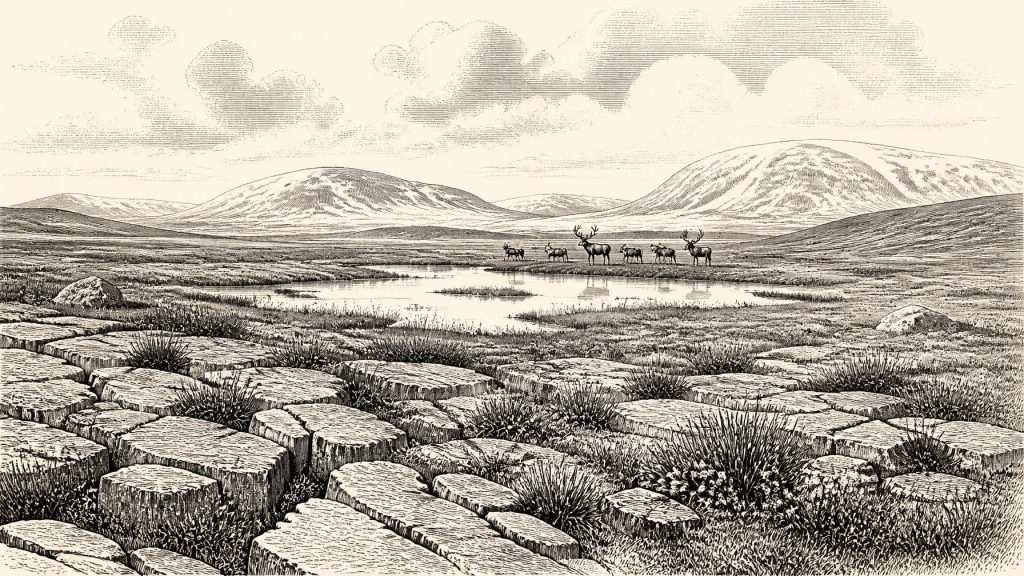
Around 31,561 BCE, Ireland was a cold, environmentally unstable Pleistocene landscape, increasingly affected by expanding ice but not wholly glaciated. Lower sea levels exposed or altered surrounding seas, allowing intermittent animal and potentially human movement. Fermanagh’s Derryvree deposits indicate open tundra-steppe with freshwater habitats and seasonal vegetation. Castlepook Cave in Cork preserves cold-adapted fauna, including mammoth, reindeer, bear, wolf and hyaena, demonstrating links with wider Ice Age Europe. A possibly butchered, approximately 33,000-year-old reindeer femur may represent Ireland’s earliest human activity, but lacks secure archaeological context. Later glaciation and rising seas destroyed evidence, precluding claims for permanent settlement or society.
Dateline
The label 31,561 BCE is useful only as a modern filing point. No Irish community recorded a year, season or event at this distance in time, and archaeological dating cannot deliver calendar-year precision for it. In radiocarbon and ice-core terms, the appropriate setting is roughly 33,500 calibrated years before present, within the later part of Marine Isotope Stage 3, a long Ice Age interval marked by abrupt climatic swings. Greenland’s finely dated ice cores place this notional point close to the end of Greenland Interstadial 6 and the onset of a colder stadial phase around 33.31 thousand calibrated years before present. That framework helps organise the evidence, but it does not mean that Ireland’s weather changed everywhere on the same day, or that a dated bone can be assigned to this numbered BCE year.
A Country in Transition
Ireland was not yet the wholly ice-covered landscape associated with the Last Glacial Maximum. The British–Irish Ice Sheet was developing unevenly, expanding from upland and northern centres over many millennia rather than descending across the island in one single advance. Reconstructions beginning at about 31,000 years ago show substantial ice accumulation in the north-west, including the Derryveagh and Sperrin uplands, with smaller mountain ice fields or glaciers in several other ranges. For the slightly earlier horizon represented by 31,561 BCE, the margins and thickness of Irish ice remain less securely known. This uncertainty is important: the evidence supports a cold, unstable and increasingly glacial Ireland, not a simple image of the entire island buried beneath one unchanging white sheet.
Lower global sea level altered the shape of the country. Today’s coastlines did not exist. Broad areas now forming the Irish and Celtic Seas were exposed, shallow, or transformed by ice and changing shorelines. Ireland was consequently less isolated than it is now, although the precise routes across the surrounding lowlands varied with local ice, rivers, marshes and sea level. Animals could disperse into and out of the region during favourable intervals. Human movement was physically possible in principle, but possibility is not evidence of regular travel, settlement or a land route that was easy in every season.
Open Ground and Cold Water
The most valuable Irish environmental sequence for this broad period lies at Derryvree near Maguiresbridge in County Fermanagh. There, organic silts and moss-rich freshwater deposits were found between two tills: sediment laid down by an earlier glacier beneath, deposits accumulated during an ice-free or locally non-glacial interval in the middle, and later glacial material above. A conventional radiocarbon determination of about 30,500 radiocarbon years before present, with a large uncertainty and an older laboratory methodology, cannot pin the deposit to 31,561 BCE. Yet the sequence remains powerful evidence for the sort of landscape that could occur in Ice Age Ireland before later ice advances sealed and reshaped it.
Its plant and animal remains point to open tundra or tundra-steppe rather than forest. Mosses, sedges and aquatic plants occupied wet hollows and pools; fossil evidence includes bogbean (Menyanthes trifoliata) and mountain avens (Dryas octopetala), species able to flourish in cold, exposed settings. This was not a featureless frozen waste. Water persisted in places, vegetation grew during short productive seasons, and the terrain contained contrasts of gravelly ground, shallow basins, streams, marshes and wind-exposed slopes. The term ‘periglacial’ captures this world of intense freezing and thawing beside or beyond glaciers. It does not require permanent ground ice everywhere, nor does it imply that every part of Ireland shared precisely the same ecology.
Such vegetation could sustain grazing and browsing animals, but the plant record cannot reconstruct a complete food web. It is best read alongside cave faunas, especially those from southern Ireland. Caves are selective archives: they may collect animals that died naturally, were dragged in by carnivores, fell through openings, were washed in with sediment, or were deposited by people. Their bones show that the island formed part of a wider north-west European cold-climate faunal zone, while also warning against turning any cave assemblage into a literal census of creatures grazing outside its entrance on one particular day.
The Castlepook Evidence
Castlepook Cave near Doneraile, County Cork—long also known as Mammoth Cave—is central to this period because its old collections contain remains of woolly mammoth, reindeer, giant deer, brown bear, wolf, Arctic fox, Arctic lemming and spotted hyaena. Revised radiocarbon work has shown that several earlier dates from Irish cave collections required reassessment, particularly where older chemical pretreatments had left samples vulnerable to contamination. Modern redating at Castlepook produced markedly older results for some specimens and confirmed that elements of its fauna belong to Marine Isotope Stage 3, before the Last Glacial Maximum. This is a major change in understanding, but it also makes careful chronology more necessary, not less.
For 31,561 BCE, reindeer are the most evocative animals. They were mobile grazers, well adapted to open, cold country and capable of using seasonally variable pasture. A reindeer femur from Castlepook, reported as approximately 33,000 years old, bears a deep incision interpreted by zooarchaeologist Ruth Carden as a possible stone-tool cut made during butchery. If that interpretation is upheld, it is potentially the earliest indication of human activity in Ireland, dramatically earlier than the securely documented Late Upper Palaeolithic evidence from County Clare around 12,800–12,600 calibrated years before present.
But the qualification is inseparable from the discovery. The Castlepook femur came from an antiquarian cave collection rather than a modern excavation of an intact occupation surface. The bone’s date records the animal’s death, not necessarily the moment of marking; the mark’s cause must be assessed independently; and no securely associated hearth, dwelling, stone-tool assemblage, human burial or repeatedly used butchery floor of comparable age has yet been recovered there. The responsible conclusion is therefore neither that Ireland was certainly uninhabited nor that it possessed a settled Palaeolithic population. It is that a single, important but contextually limited specimen may preserve evidence of people processing reindeer in southern Ireland during this broad climatic phase.
People, If Present
No political order can be reconstructed for Ireland at this date. There are no named peoples, leaders, territories, diplomatic exchanges or evidence of warfare. Likewise, there is no basis for describing religion, language, teaching, art or customary law in specifically Irish terms. Even the word ‘Ireland’ is geographical shorthand for a Pleistocene landscape whose coast and connections differed greatly from those of the modern island. To invent clans, migrations, ritual practices or conflicts from silence would give false solidity to an exceptionally sparse record.
If the Castlepook modification proves anthropogenic, it would imply a small, mobile party rather than a village, state or enduring colony. Across contemporary Europe, Upper Palaeolithic foragers used stone tools, fire, animal foods, hides, bone and antler, and organised their movements around terrain, season and prey. Those wider comparisons can suggest what was possible, but they cannot establish that any particular practice occurred at Castlepook. The femur itself may show only brief access to meat, marrow, hide or other usable materials. It cannot reveal the number of visitors, their origin, the length of their stay, whether they hunted the animal or encountered a carcass, or whether they returned.
Accordingly, there is no demonstrable Irish economy or trade network to describe. A temporary foraging visit would have depended chiefly on local animal and plant resources, while travellers could have carried stone tools or raw materials across the wider exposed and partly glaciated region. Yet no lithic source, exchange route or cargo has been tied to Ireland at this date. Nor is there evidence for permanent houses, cultivated land, livestock, pottery, boats or managed herds. The later Mesolithic settlement of Ireland belongs to a far different post-glacial world and must not be projected backwards into this one.
What Survived
Paradoxically, later glaciation is one reason the human story is so elusive. Advancing ice eroded bedrock, remobilised sediment and destroyed or buried many landscapes where camps might once have stood. Rising seas then drowned large tracts of former lowland. Caves and sealed inter-till deposits survive because they are unusual traps and archives, not because they were necessarily the principal places where animals or people lived. Their survival makes Cork and Fermanagh disproportionately visible in a national history whose original evidence was likely scattered across landscapes now altered beyond recognition.
The most important development around this notional year was therefore environmental, not political: Ireland was entering the build-up towards a more extensive glaciation while retaining patches of open, life-supporting ground. Freshwater plants in Fermanagh and cold-adapted mammals in southern caves show that the island was ecologically connected to Ice Age Europe. Castlepook supplies a tantalising possibility that people shared that landscape, perhaps briefly, with reindeer and other large mammals. The evidence is enough to replace the old assumption of an empty pre-glacial Ireland with a more interesting question. It is not enough to claim a continuous population, a first settlement, or an Irish society at 31,561 BCE.
Primary Sources
- A reconsideration of the radiocarbon dating of the Marine Isotope Stage 3 fauna from southern Ireland
- The Irish Quaternary Fauna Project
- Growth and retreat of the last British–Irish Ice Sheet, 31,000 to 15,000 years ago: the BRITICE-CHRONO reconstruction
- The timing and magnitude of the British–Irish Ice Sheet between Marine Isotope Stages 5d and 2: implications for glacio-isostatic adjustment, high relative sea levels and ‘giant erratic’ emplacement
- Dimensions and chronology of the last ice sheet in Western Ireland
- Maximum extent and dynamic behaviour of the last British–Irish Ice Sheet west of Ireland
- Character of advance and retreat of the southwest sector of the British-Irish Ice Sheet during the last glaciation
- The deglaciation of the western sector of the Irish Ice Sheet from the inner continental shelf to its terrestrial margin
- A stratigraphic investigation of the Celtic Sea megaridges based on seismic and core data from the Irish-UK sectors
- The colonization of Ireland: A human ecology perspective
- First evidence of a Late Upper Palaeolithic human presence in Ireland
- New insights on the fauna of Ireland's Younger Dryas and Early Holocene from Alice & Gwendoline Cave
- Red deer in Ireland: from the Mesolithic to the present
- A Middle Midlandian freshwater series at Derryvree, Maguiresbridge, County Fermanagh, Northern Ireland
- IQUA Guide No. 16: Quaternary of Fermanagh and Tyrone
- Menyanthes trifoliata
- Dryas octopetala
- Heritage Artefacts of County Cork
- Archaeological Heritage of County Cork
- A stratigraphic framework for abrupt climatic changes during the Last Glacial period based on three synchronized Greenland ice-core records: refining and extending the INTIMATE event stratigraphy