

Crag Cave’s Interstadial Dripstone31454 BCE
31,454 BCE is a modern label for later Marine Isotope Stage 3, not a dateable Irish event. Buried sediments at Derryvree, Fermanagh, indicate an ice-free interval between glacial advances, with treeless tundra, wetlands and cold-adapted life. Crag Cave, Kerry, preserves dripstone formed during episodic milder conditions, confirming climatic instability. Castlepook Cave, Cork, contains reindeer, mammoth, hyaena and other fauna accumulated over long periods, demonstrating links with north-west European ecosystems. A cut-marked reindeer bone may indicate Upper Palaeolithic human activity, but cannot prove settlement. Evidence reveals a changing Ice-Age landscape, not societies, monuments or historical communities across a fluctuating glacial margin.
Dateline
The label 31,454 BCE gives a useful point of orientation for a modern archive, but it cannot identify a historical year in the ordinary sense. No community in Ireland counted time by this calendar, and neither radiocarbon dating nor glacial stratigraphy can isolate a particular season, person or event so far back. In approximate present-day terms, the label falls around 33,400 calendar years before 1950. The responsible subject is therefore Ireland during the later part of Marine Isotope Stage 3 (MIS 3), a fluctuating phase of the last Ice Age before the Last Glacial Maximum.
The evidence is sparse, uneven and regional. It consists chiefly of sediments protected beneath later glacial deposits, cave bones accumulated over long intervals, and mineral deposits in caves. These records show that parts of Ireland could support tundra and wetland environments, as well as large mammals, during episodes before the island was extensively affected by the later expansion of the British–Irish Ice Sheet. They do not supply an annual chronicle, a map of a single political landscape, or proof that all parts of Ireland looked alike at once.
Dating a Landscape, Not a Year
The closest securely relevant Irish environmental sequence comes from Derryvree, near Maguiresbridge in County Fermanagh. Roadworks exposed organic freshwater silts and fine sands sealed between two tills: unsorted debris left by separate advances of glacier ice. The stratigraphic order is powerful evidence. Ice laid down a lower till; an interval without local glacier cover allowed water, sediment and organic matter to collect; then a later ice advance buried the deposit beneath fresh till.
Organic material from the Derryvree freshwater series produced a conventional radiocarbon result of about 30,500 ± 1,100 radiocarbon years BP. Published calibrations have placed it broadly at about 36,900–31,700 calibrated years BP, roughly 34,950–29,750 BCE. That wide range encompasses the archive’s modern date label, but it cannot locate 31,454 BCE within a particular layer, still less identify what occurred then. Calibration is essential because radiocarbon years are not identical to calendar years, and uncertainties become especially substantial at this antiquity.
Derryvree nevertheless establishes something important. It shows that north-central Ireland was ice-free for at least part of later MIS 3, before a later phase of ice-sheet growth. Other buried organic deposits in Fermanagh, notably at Greenagho, likewise indicate ice-free conditions before the major advances of the last glaciation. This is regional evidence, not a licence to describe the entire island as uniformly open, hospitable or free of ice. Upland glaciers, local ice masses, changing coasts and different climatic conditions could have made Ireland a mosaic.
A Cold, Wet Open Country
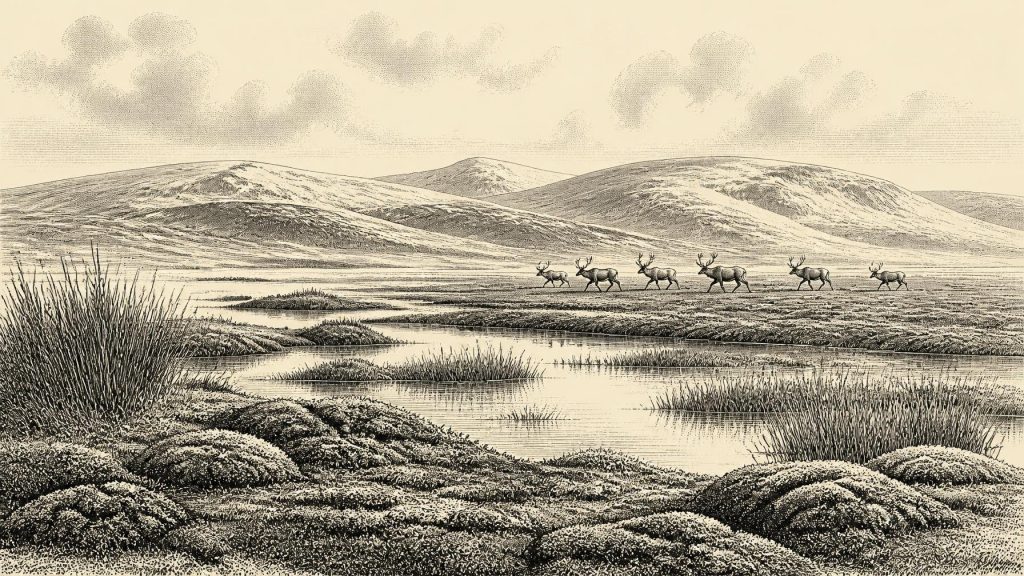
The plants, insects and other biological remains in the Derryvree beds point to a full-glacial, periglacial setting. Rather than later Irish woodland, the landscape included treeless tundra and muskeg: wet, peaty ground with shallow pools, sedge-rich margins and low-growing cold-adapted vegetation. Mosses and aquatic or waterside plants survived in sheltered wet places, while frost action, seasonal thaw and waterlogging shaped the surface beyond them. This was not a featureless white wilderness. In the short growing season, wet hollows could be biologically productive even while exposed ground remained cold, windy and vulnerable to freezing.
The word ‘tundra’ should not conceal change. MIS 3 climate was marked by abrupt shifts on millennial scales, familiar from Greenland ice-core records as stadials and interstadials. Irish evidence from Crag Cave in County Kerry gives this wider climate story a local dimension. Uranium-thorium dates on cave calcite show that stalagmites formed episodically during warmer intervals of the last glacial cycle. In a shallow cave, dripstone generally requires liquid water and conditions sufficiently mild for water to circulate through soil and limestone. Its formation is therefore evidence of episodes of amelioration, not proof of a warm, forested Ireland.
The precise alignment of any Irish deposit with a numbered Greenland interstadial remains interpretative, especially where older radiocarbon dates have broad calibrated ranges. The central conclusion is firmer: the Irish climate was not static. Around this broad period, cold open terrain, wetlands and occasional milder phases succeeded one another, while ice expanded and contracted across neighbouring sectors of the North Atlantic world.
Animals in the Cave Record
Castlepook Cave, also known historically as Mammoth Cave, near Doneraile in north County Cork, provides Ireland’s richest known pre-Last Glacial Maximum vertebrate archive. Antiquarian excavations recovered a very large collection of bones, and more recent fieldwork has sought surviving deposits in parts of the cave not emptied by earlier digging. The fauna includes reindeer, woolly mammoth, spotted hyaena, brown bear, foxes, hare and small cold-climate mammals. Together these remains demonstrate that Ireland was connected to the wider Late Pleistocene faunal world of north-western Europe during at least some intervals.
They must not, however, be compressed into one imagined herd moving across Cork in 31,454 BCE. Cave deposits can accumulate through carnivore activity, natural deaths, water transport, disturbance and excavation over many thousands of years. Published radiocarbon determinations from Castlepook cover a broad span, while recent sedimentary ancient-DNA research reinforces the cave’s value as a record of a diverse fauna rather than a single moment. A mammoth bone, for example, records that mammoths reached the region; it does not show that mammoths and every other animal represented in the collection were contemporaries.
Reindeer were especially suited to open cold landscapes, and their presence is consistent with the Derryvree evidence for tundra-like habitats. Spotted hyaena adds a different lesson. It was a powerful scavenger and hunter able to accumulate or modify bones in caves. Castlepook was therefore part of an animal landscape of predation, scavenging, shelter-seeking and carcass transport. Such ecological pressures were real, but they are not evidence for human warfare, organised hunting parties or territorial politics.
The Human Question
One Castlepook reindeer femur has attracted justified attention because it bears a deep mark interpreted as consistent with cutting or chopping on fresh bone by a sharp stone implement. It has been reported as dating to roughly 33,000 years ago. If that interpretation is sustained by further analysis, it would indicate that one or more people processed an animal in Ireland during the Upper Palaeolithic, much earlier than the island’s formerly accepted archaeological record.
Its importance makes caution indispensable. The specimen is a single modified bone from a cave whose original deposits were extensively excavated more than a century ago. It is not accompanied by a securely excavated stone-tool assemblage, hearth, dwelling floor, burial or repeated sequence of occupation. Recent excavation has found valuable Pleistocene faunal deposits, but no artefacts that turn the cave into a demonstrated settlement of this age. The responsible conclusion is that Castlepook presents a potentially transformative trace of human activity, not a basis for claiming a permanent population or naming Ireland’s ‘first settlers’.
If people did reach the island in this period, they were probably highly mobile hunter-gatherers making short-lived use of a landscape also occupied by dangerous carnivores. Their practical knowledge would have included carcass processing, the selection and use of stone edges, fire and shelter where circumstances allowed. Those are reasonable inferences from Upper Palaeolithic lifeways elsewhere, but they remain inferences: no Irish campsite, tool kit or domestic refuse can presently document them for this particular phase.
No Polities, No Monuments
There is no evidence for political authorities, diplomacy, warfare between communities, formal religion, long-distance trade networks, monuments, art or written learning in Ireland at this date. Nor is there evidence from which to reconstruct household size, language, kinship systems or routine settlement patterns. It would be misleading to fill these silences with later Irish traditions, Celtic identities or familiar images of prehistoric tribal life; all belong to vastly later worlds.
Economy, insofar as the evidence permits the word, was ecological rather than institutional. Animals moved through a changing landscape of grazing, browsing, water and shelter. Any people present may have obtained meat, marrow, hides, sinew and bone from hunted or scavenged game, but even that cannot be demonstrated beyond the disputed implications of the marked reindeer bone. Exchange across the Irish Sea is equally unproven. Lower sea levels altered shorelines and distances, but the exact routes, crossings and barriers available at any one time remain uncertain.
The principal story of Ireland around this notional date is thus not one of kings or communities but of survival in an unstable Ice-Age margin. Beneath a Fermanagh drumlin, freshwater sediments preserve an interval when wet tundra existed between glacier advances. In Cork, cave deposits preserve the animals that ranged through portions of that wider world and a possible, still closely scrutinised sign of people. Crag Cave’s ancient dripstone adds evidence that cold conditions were interrupted by milder pulses. These fragments are limited, but together they show an Ireland repeatedly remade by climate, ice, water and animal movement long before historical time.
Primary Sources
- A Middle Midlandian Freshwater Series at Derryvree, Maguiresbridge, County Fermanagh, Northern Ireland
- Irish Pleistocene Biostratigraphy
- Figure 6.— The Subdivision of the Quaternary Period in Ireland
- The Irish Quaternary Fauna Project
- Trimlines, Blockfields and the Vertical Extent of the Last Ice Sheet in Southern Ireland
- Exploring Controls of the Early and Stepped Deglaciation on the Western Margin of the British-Irish Ice Sheet
- Episodic Speleothem Deposition Tracks the Terrestrial Impact of Millennial-Scale Last Glacial Climate Variability in SW Ireland
- The IntCal20 Northern Hemisphere Radiocarbon Age Calibration Curve (0–55 cal kBP)
- Pattern and Timing of Retreat of the Last British-Irish Ice Sheet
- Maximum Extent and Dynamic Behaviour of the Last British–Irish Ice Sheet West of Ireland
- Deglaciation Chronology of the Donegal Ice Centre, North-West Ireland
- Stratigraphic and Palaeo-Geomorphological Evidence for the Glacial-Deglacial History of the Last British-Irish Ice Sheet in the North-Western Irish Sea
- The Exploration of Castlepook Cave, Co. Cork. With 3 Plates.
- Proceedings of the Royal Irish Academy, Volume XXXIV
- 2022:564 – Castlepook Cave, Castlepook South, Cork
- Archaeological Heritage of County Cork
- Areas of Scientific Interest in County Cork
- Sedimentary Ancient DNA Reveals Late Pleistocene Faunal Connectivity Between Ireland and Eurasia
- New Insights on the Fauna of Ireland's Younger Dryas and Early Holocene from Alice & Gwendoline Cave
- The Mesolithic in Ireland: When Was It?
- Ireland's Palaeolithic Archaeology – Fleeting Footprints in a Frozen Land
- Geological Time, the Transformation of Earth, and What Rocks Can Tell Us About Climate Change
- The Irish Caves Database: Mammoth Cave