
Fermanagh’s Ice-Free Window31293 BCE
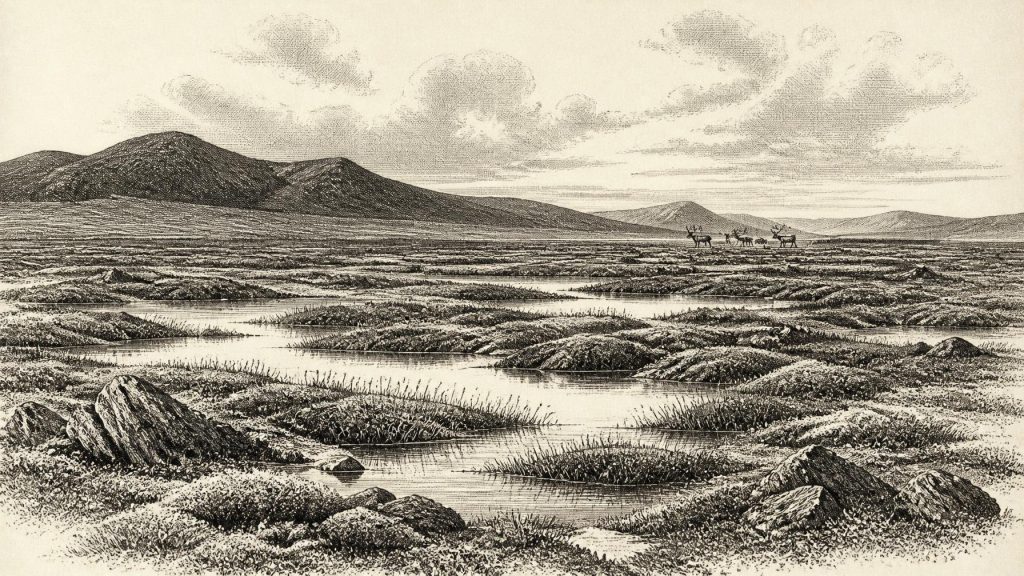
Around 33,000 years ago, later Marine Isotope Stage 3 Ireland experienced an unstable transition towards wider glaciation, not a precisely datable historical year. At Derryvree, County Fermanagh, freshwater deposits beneath glacial sediments show a locally ice-free periglacial landscape of tundra, wetlands, mosses, sedges and shallow pools. Ice expanded unevenly, with the British-Irish Ice Sheet reaching its maximum only later. Castlepook Cave, County Cork, preserves varied fauna, including mammoth, reindeer, giant deer, bears, wolves, foxes, lemmings and hyenas, demonstrating episodic ecological connectivity. A possibly tool-marked reindeer bone may indicate brief human presence, but no evidence establishes settlement, chronology, or resident communities.
Dateline
Modern calendar-year precision cannot be applied to this point in Ireland’s past. “31,293 BCE” is a useful modern label, not a date recorded by contemporaries or an archaeological horizon that can be isolated to a single year. In the convention of counting backwards from AD 1950, it falls roughly 33,240 calendar years before present. The evidence available for Ireland belongs instead to broad calibrated ranges, often spanning centuries or millennia. It concerns the later part of Marine Isotope Stage 3, within the Midlandian cold stage: an unstable interval before the fullest expansion of the last British–Irish Ice Sheet. No named event, ruler, community or exact human action can responsibly be assigned to this year.
A Buried Fermanagh Landscape
The closest Irish environmental evidence comes from Derryvree, near Maguiresbridge in County Fermanagh. In 1969, a road cutting through a drumlin exposed freshwater silts and fine sands trapped between two thick layers of glacial sediment. The organic deposit, catalogued as BIRM-166, produced a conventional radiocarbon determination of 30,500 ± 1,100 radiocarbon years BP. Calibrated estimates place its formation broadly within about 36,900–31,700 calendar years BP. That broad interval encompasses the modern label 31,293 BCE, though it emphatically does not prove that the deposit formed in that precise year.
The Derryvree sediments show that southern Fermanagh was ice-free when the freshwater material accumulated. Plant remains, pollen and insect evidence point to an open, cold landscape rather than woodland: a periglacial mosaic of sparse tundra vegetation, wet ground, mosses, sedges and shallow pools. Among the recovered plant macrofossils were species associated with severe northern conditions. Dry ground may have supported only scattered herbs and dwarf shrubs, while waterlogged hollows sustained richer local plant life. This was not a featureless white wilderness. Even under a cold climate, small differences of drainage, shelter and season created distinct habitats.
That evidence is especially valuable because Ireland’s later ice sheets removed, mixed or buried much older soils and open-air surfaces. A surviving wetland lens beneath a drumlin is therefore an exceptional archive. Yet its lesson has limits. Derryvree illuminates one landscape in what is now County Fermanagh during a dated interval; it cannot supply a weather report for the entire island, still less a chronology of year-by-year changes. The proper conclusion is local but important: parts of Ireland retained cold terrestrial and freshwater environments before being overridden by later ice.
Ice Was Growing Unevenly
At roughly 33,000 calendar years ago, the last glacial cycle was intensifying, but Ireland was not simply an island already sealed beneath one uniform ice cap. Ice-sheet growth across Britain and Ireland was regionally asynchronous. BRITICE-CHRONO research identifies major advance in the north Minch around 32,000–31,000 years ago, while other sectors reached their maximum extent later. Evidence from the continental shelf north-west of Ireland suggests advance to the shelf edge at about 29,000–27,000 calendar years BP; southern and western sectors also have their own histories of advance and retreat.
Accordingly, 31,293 BCE should be understood as a threshold within a long glacial transformation, not as the beginning of the Last Glacial Maximum itself. The maximum ice volume of the British–Irish Ice Sheet came later, around 23,000 years ago, though local margins had different timings. Some uplands may have stood above warm-based erosive ice, or carried cold-based ice that left older surface material comparatively intact; other lowlands were eventually deeply reshaped by moving ice. The drumlins, scoured rock, tills and offshore moraines visible in Ireland today are products of those successive episodes rather than a single frozen moment.
Sea level was far lower than it is now because enormous volumes of water were held in continental ice sheets. Ireland’s connections with Britain and the wider north-west European landmass consequently changed as sea level, ice margins and local topography changed. This helps explain how animals could have reached Ireland during favourable intervals. It does not mean that a single, permanent and easily traversed land bridge existed everywhere, or that any particular route was open in the modern calendar year under discussion. Recent sedimentary ancient-DNA work from Castlepook Cave supports wider Late Pleistocene faunal connectivity, but it remains a preprint and should be treated as developing evidence rather than a final map of migration routes.
Castlepook’s Animal World
The best-known Irish mammal archive for this broad period lies far to the south-west at Castlepook Cave, also known as Mammoth Cave, near Doneraile in north County Cork. Excavations in the early twentieth century recovered a remarkable collection of bones and teeth. The assemblage includes woolly mammoth, reindeer, giant deer, brown bear, wolf, foxes, Arctic fox, mountain hare, lemmings and spotted hyena. A spotted-hyena skull in the National Museum of Ireland’s collection is a vivid reminder that predators now absent from Ireland once formed part of its Pleistocene fauna.
This is strong evidence that cold-adapted animals reached Ireland during portions of the later Pleistocene. It suggests open country capable of supporting grazing and browsing herbivores, together with carnivores that hunted, scavenged or used caves as dens. Mammoth and reindeer should not, however, be imagined as a permanently stable “Irish mammoth steppe”. A cave bone accumulation may combine animals brought in by carnivores, animals dying naturally, material moved by water, and finds from deposits of different ages. The original excavations also disturbed contexts and removed much material with recording standards far below those expected today. Castlepook is an indispensable archive, but it is not a single undisturbed campsite or a single season’s kill.
Radiocarbon reassessment has reinforced the need for caution. Earlier measurements on Irish cave bones have sometimes proved misleading when re-tested using improved pretreatment methods, and some Castlepook animals appear to pre-date the full Last Glacial Maximum by a substantial margin. The most defensible use of the site is therefore to establish a broad ecological setting: Ireland supported a more varied large-mammal community during parts of Marine Isotope Stage 3 than its much later fauna would suggest. It cannot demonstrate that every listed species stood together in County Cork in 31,293 BCE.
The Question of People
Castlepook also raises Ireland’s most intriguing human question for this era. A reindeer femur fragment from the cave has been reported as bearing a deep mark interpreted as damage from a stone tool during carcass processing. If that identification and broad age are sustained, it may be evidence that one or more Upper Palaeolithic people handled a reindeer in Ireland around 33,000 years ago. Such a discovery would greatly extend the island’s archaeological human story beyond the later, better-established record.
But a possible cut-marked bone is not a settlement. It does not identify the people involved, establish whether they hunted or scavenged the animal, reveal how many companions were present, or show whether they remained for hours, weeks or generations. No securely associated dwelling surface, hearth, stone-tool assemblage, burial, ornament, art or human bone has yet demonstrated a resident population in Ireland at this date. Nor can an animal-bone date necessarily date the moment at which a mark was made. The evidence permits the possibility of a brief human visit; it does not permit a confident narrative of colonisation.
For that reason, the usual categories of annual history have almost no direct application. There is no evidence from Ireland for political institutions, leaders, territorial states, diplomacy, organised warfare, written learning, religious monuments or trade networks in this period. It would be equally unwarranted to deny that visitors had social relationships, skills, stories or beliefs: people in Upper Palaeolithic Europe certainly possessed complex cultural capacities. The point is evidential. Ireland has not yielded the material record that would allow those capacities to be described here in an Irish setting.
Movement Rather Than Settlement
If people did reach Ireland during this broad interval, their lives were likely shaped by mobility, seasonality and knowledge of animals, weather and terrain. That is an interpretation drawn from the wider Upper Palaeolithic world and from the demanding Irish setting, not a fact documented by an Irish camp. Reindeer could have offered meat, hide, sinew, marrow and bone; caves could have offered shelter or hazards, especially where hyenas and other carnivores used them. But neither hunting strategy nor diet can be reconstructed from the present Irish evidence alone.
The more secure story is one of regional change. Fermanagh’s buried wetlands record an ice-free cold landscape in the north. Castlepook preserves signs of a southern fauna that included both herbivores and formidable predators. Offshore and upland evidence charts an ice sheet expanding unevenly across the surrounding seas and the island itself. In later millennia, advancing ice would scour and mantle much of the land, alter drainage and eliminate many habitats that had briefly supported this Pleistocene ecosystem.
Thus the Ireland of 31,293 BCE was not yet the familiar green, wooded island of later prehistory, nor can it be described as a settled country. It was a changing northern landscape at the edge of an enlarging ice-sheet system: open tundra and wet hollows in some places, animal corridors in others, and perhaps the scene of a fleeting human encounter whose possible trace survives only as a mark on a reindeer bone. The uncertainty is not a gap to be filled with invention. It is the central historical fact of this deep time.
Primary Sources
- The Exploration of Castlepook Cave, County Cork
- The Irish Quaternary Fauna Project
- A Reconsideration of the Radiocarbon Dating of the Marine Isotope Stage 3 Fauna from Southern Ireland
- Growth and Retreat of the Last British–Irish Ice Sheet, 31,000 to 15,000 Years Ago: The BRITICE-CHRONO Reconstruction
- Growth and Retreat of the Last British–Irish Ice Sheet, 31,000 to 15,000 Years Ago: The BRITICE-CHRONO Reconstruction
- Trimlines, Blockfields and the Vertical Extent of the Last Ice Sheet in Southern Ireland
- Dimensions and Chronology of the Last Ice Sheet in Western Ireland
- Marine Geophysical Evidence for Late Pleistocene Ice Sheet Extent and Recession off Northwest Ireland
- Late Pleistocene Chronostratigraphy and Ice Sheet Limits, Southern Ireland
- Radiocarbon Constraints on the Age of the Maximum Advance of the British-Irish Ice Sheet in the Celtic Sea
- Oscillating Retreat of the Last British-Irish Ice Sheet on the Continental Shelf Offshore Galway Bay, Western Ireland
- Character of Advance and Retreat of the Southwest Sector of the British-Irish Ice Sheet During the Last Glaciation
- The Timing and Magnitude of the British–Irish Ice Sheet Between Marine Isotope Stages 5d and 2
- Palaeoecology
- The Mesolithic in Ireland: When Was It?
- Spotted Hyena Skull
- Occurrence of Mammalia Relicts at Site Castlepook Cave
- Pleistocene Vertebrates in the British Isles
- Origin of British and Irish Mammals: Disparate Post-Glacial Colonisation and Species Introductions
- New Insights on the Fauna of Ireland's Younger Dryas and Early Holocene from Alice & Gwendoline Cave
- 2022:564 – Castlepook Cave, Castlepook South, Cork
- Sedimentary Ancient DNA Reveals Late Pleistocene Faunal Connectivity Between Ireland and Eurasia
- Reindeer Bone Found in Cork Cave Shows Human Activity in Ireland 33,000 Years Ago