
Doneraile’s Palaeolithic Question31294 BCE
31,294 BCE is best treated as an approximate point within Ireland’s late Marine Isotope Stage 3, not a recoverable historical year. Cold, changing landscapes, lowered seas and expanding ice shaped an uncertain geography. Castlepook Cave, County Cork, preserves fauna including mammoth, giant deer, reindeer, bear and spotted hyena, demonstrating links with wider northern European ecosystems over millennia. A reindeer femur dated about 31,000 BC bears a possible stone-tool cut mark, suggesting brief Upper Palaeolithic human activity. However, no associated tools, hearths or settlements exist. Excavation disturbed evidence, but renewed dating, analyses and fieldwork may identify intact deposits, clarifying human presence.
Dateline
The label 31,294 BCE is not a year that can be recovered from Ireland’s archaeological record. No calendar, written account or dated occupation surface permits events to be fixed to that modern year. In conventional arithmetic it points to roughly 33,243 years before AD 1950, the reference point used for ‘BP’ dates, but that conversion is only a chronological signpost. Radiocarbon results require calibration and normally yield ranges rather than a single year; deposits may also contain material accumulated over long periods. The responsible subject is therefore Ireland in the later part of Marine Isotope Stage 3 (MIS 3), broadly around 33,000 calibrated years ago, rather than an imagined episode on a particular day.
An Island in a Changing Ice Age
This was a cold phase of the Late Pleistocene, but it was not yet the uniform, island-wide maximum of the last British–Irish Ice Sheet. The fullest expansion of that ice sheet belongs principally to later millennia. Recent reconstructions show particularly rapid growth after about 31,000 years BP, with ice dynamics varying greatly by region and with no single moment when every sector reached a maximum together. At the date represented by 31,294 BCE, it is unsafe to draw an exact ice margin across Ireland or to describe every district as either habitable ground or permanent ice.
That uncertainty matters because Ireland’s geography was being remade. Colder global conditions lowered sea level and enlarged the continental shelves now submerged around the island. Coastlines, estuaries and passages were consequently unlike those of today. Yet lower seas do not by themselves demonstrate a continuous land bridge, a particular route from Britain, or a human crossing. The evidence supports changing land-and-sea configurations in north-west Europe; it does not supply a map of a journey to Ireland at this exact point.
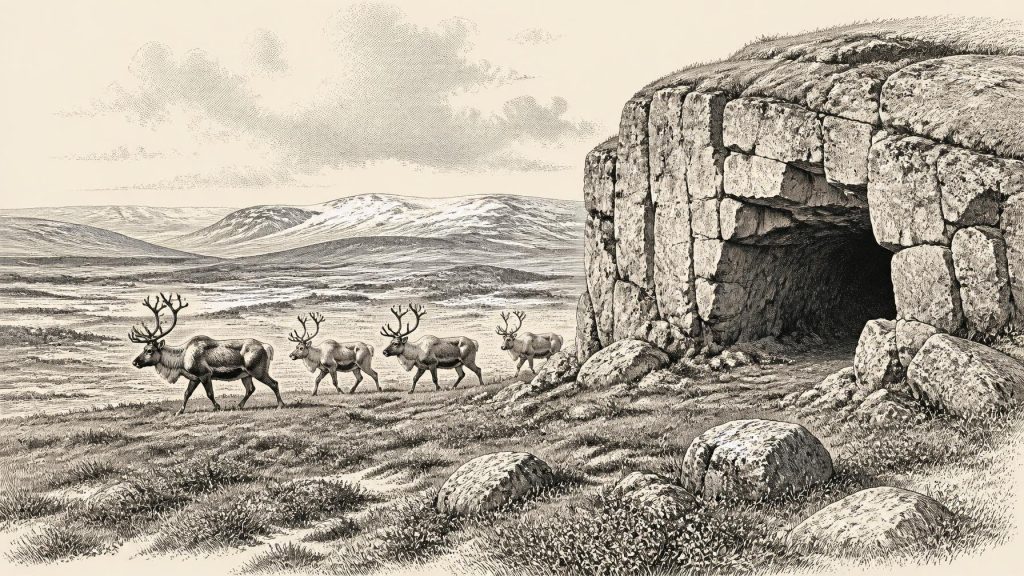
The terrain available between and beyond ice masses was likely a harsh, open mosaic rather than the wooded Ireland familiar today: grasslands and herb-rich ground, patches of sparse shrub vegetation, exposed mineral soils, wetlands and river corridors. Such reconstructions combine animal remains, plant and insect evidence from Irish Quaternary sequences, and wider north-west European palaeoenvironmental records. They are useful models of the habitat, not photographs of a single Irish valley in 31,294 BCE. Weather and seasons could have shifted sharply, while the survival of evidence has been reduced by later glacial erosion, water movement and the great age of the deposits.
Castlepook Cave’s Long Archive
The strongest Irish evidence close to this broad horizon comes from Castlepook Cave, also known as Mammoth Cave or Doneraile Cave, in north County Cork. Beneath lowland farmland near Doneraile, its limestone passages preserved one of Ireland’s most important collections of Pleistocene vertebrate remains. Early twentieth-century excavators named chambers such as Hyenahall and Elephant Hall; their discoveries eventually entered the National Museum of Ireland. Modern assessment has made Castlepook central not because it offers a neat prehistoric campsite, but because it records the repeated presence of animals before the Last Glacial Maximum.
The cave’s fauna includes woolly mammoth, giant deer, reindeer, brown bear and spotted hyena, while other deposits include wolf, Arctic fox, mountain hare and lemmings. This assemblage establishes that Ireland was at intervals part of a wider northern European ecological world in which large grazers and browsers, scavengers and predators could reach the island. Spotted hyena is especially striking: Castlepook is Ireland’s key evidence for the species. Its presence also explains why a cave full of bones must not automatically be treated as a human larder. Hyenas could carry carcass parts into dens, gnaw them, and contribute to bone accumulations alongside natural deaths, falls, water transport and later disturbance.
Dates from Castlepook span a very long interval. Geological Survey Ireland summarises radiocarbon evidence for individual bones between about 45,700 and 19,950 BP, while re-dating has shown that some earlier determinations were substantially too young. A 2020 reassessment placed parts of the southern Irish fauna securely in MIS 3 and suggested that giant deer and spotted hyena may have disappeared locally before roughly 40,000 calibrated years BP. Such ranges are more informative than pretending that mammoths, reindeer and hyenas all stood together outside the cave in one nominated year. The fossils show a changing fauna over thousands of years, not a single momentary census.
The Reindeer Femur
One object gives 31,294 BCE particular importance: a fragment of reindeer femur from Castlepook, publicised by zooarchaeologist Ruth Carden and County Cork heritage publications as dating to about 31,000 BC. It bears a deep linear mark interpreted as having been made on fresh bone by a sharp stone tool during carcass processing. If that diagnosis is sustained, it is remarkable evidence that people handled a reindeer in Ireland during the Upper Palaeolithic, long before the well-established Mesolithic settlement record after the final retreat of the ice.
Its limits are as important as its promise. The dated bone is evidence for the age of the animal; the interpretation of the mark as a tool cut is a separate taphonomic judgement. Nor does one modified femur establish where the animal was killed, whether people entered the cave, how many individuals were involved, or whether they lived in Ireland year-round. A butchered remnant could have been left elsewhere before a scavenger or other natural process brought it into the cave. No securely associated stone-tool assemblage, hearth, dwelling, burial, human bone or repeatedly occupied surface of comparable age has been recovered in Ireland.
Accordingly, the phrase ‘human activity’ is safer than ‘settlement’. It allows for a brief visit by mobile foragers without turning a fragmentary trace into a village, a population or an origin story. In Upper Palaeolithic Europe beyond Ireland, people made sophisticated stone tools, practised varied hunting strategies and created symbolic works. None of those cultural achievements can responsibly be assigned to Ireland around this date without Irish artefacts or contexts to support the claim. The Castlepook femur may alter the scale of Ireland’s earliest human history; it does not yet fill in its social detail.
Life Beyond the Evidence
If people did reach Ireland in this period, reindeer would have offered meat, marrow, hide, sinew and bone, resources valuable to highly mobile hunter-gatherers in cold country. That is a reasonable inference from the animal and from comparative Upper Palaeolithic practices, not direct evidence of an Irish camp. There is no basis for describing local households, clothing styles, language, kinship rules, leadership or seasonal meeting places. Equally, there is no evidence for farming, animal husbandry, metalworking, pottery, monuments, permanent fields, formal trade networks or maritime commerce. These belong to vastly later phases of Irish prehistory.
Political affairs, diplomacy and warfare leave no identifiable record at this horizon. It would be anachronistic to imagine tribes, territories or chiefs in the later historic Irish sense. Even the scale of any human presence is unresolved. The better-attested realities are ecological: large animals moved through suitable landscapes; carnivores used caves and competed within food webs; and climatic deterioration was increasingly reshaping the region. Any people present would have faced those conditions rather than governed a recognisable polity.
Religion, art, learning and ritual are likewise beyond direct recovery here. Caves elsewhere in Europe can preserve art, hearths and structured deposits, but Castlepook has not produced comparable evidence securely tied to this period. The cave’s evocative gallery names are modern labels, not signs of prehistoric ceremony. The absence of evidence is partly an archaeological fact and partly a preservation problem: later ice, sediment movement and nineteenth- and twentieth-century excavation practices obscured original relationships between many bones and layers.
What Research Can Still Recover
The history of the evidence is itself consequential. Much of Castlepook was excavated before modern standards of stratigraphic recording, and estimates suggest that many thousands of bones were removed. Surviving material therefore demands cautious re-examination rather than simple repetition of old conclusions. Re-dating programmes, zooarchaeology, microscopic study of surface modifications, ancient biomolecular methods and improved understanding of radiocarbon calibration have already changed the chronology. They demonstrate why a museum drawer or old cave collection can remain scientifically active long after excavation.
Fieldwork in 2022, supported by the Royal Irish Academy and undertaken by a team including Richard Jennings, Helen Lewis, Ruth Carden and Patrick Randolph-Quinney, located surviving cave sediments and areas of Pleistocene potential in Castlepook’s upper system. The project was designed to determine whether undisturbed deposits remained after earlier digging. Its importance lies in the possibility of finding securely stratified material: bones with recorded positions, sediments that can reveal how they accumulated, and perhaps artefacts that would test the interpretation of the reindeer femur.
For now, 31,294 BCE should be understood as a point within a deep and uncertain interval. Ireland was experiencing Late Pleistocene environmental change, with cold-adapted fauna documented in the south and expanding ice systems altering the wider archipelago. Castlepook offers powerful proof of that animal world and a tantalising, still limited indication of human contact with it. The proper history of this date is not a fabricated episode of Ice Age Irish life, but the disciplined effort to distinguish a dated bone, a marked surface, a cave formed by carnivores and water, and the larger possibilities they may eventually illuminate.
Primary Sources
- A reconsideration of the radiocarbon dating of the Marine Isotope Stage 3 fauna from southern Ireland
- The Irish Quaternary Fauna Project
- Castlepook Cave, County Geological Site Report CK032
- Spotted Hyena Skull
- The Exploration of Castlepook Cave, Co. Cork. With 3 plates.
- First evidence of a Late Upper Palaeolithic human presence in Ireland
- New insights on the fauna of Ireland's Younger Dryas and Early Holocene from Alice & Gwendoline Cave
- Growth and retreat of the last British–Irish Ice Sheet, 31,000 to 15,000 years ago: the BRITICE-CHRONO reconstruction
- The timing and magnitude of the British–Irish Ice Sheet between Marine Isotope Stages 5d and 2: implications for glacio-isostatic adjustment, high relative sea levels and ‘giant erratic’ emplacement
- Character of advance and retreat of the southwest sector of the British-Irish Ice Sheet during the last glaciation
- Stratigraphic and palaeo-geomorphological evidence for the glacial-deglacial history of the last British-Irish Ice Sheet in the north-western Irish Sea
- Timing and pace of ice-sheet withdrawal across the marine–terrestrial transition west of Ireland during the last glaciation
- Exploring controls of the early and stepped deglaciation on the western margin of the British Irish Ice Sheet
- Trimlines, blockfields and the vertical extent of the last ice sheet in southern Ireland
- Phylogeographic, ancient DNA, fossil and morphometric analyses reveal ancient and modern introductions of a large mammal: the complex case of red deer (Cervus elaphus) in Ireland
- 2022:564 – Castlepook Cave, Castlepook South, Cork
- Archaeology Research Excavation Grant 2022
- Quaternary Site Descriptions
- The IntCal20 Northern Hemisphere radiocarbon age calibration curve (0-55 kcal BP)
- Prehistoric Details
- Pattern, style and timing of British–Irish Ice Sheet advance and retreat over the last 45,000 years: evidence from NW Scotland and the adjacent continental shelf
- Heritage Artefacts of County Cork 2021