

The Castlepook Chop Mark31218 BCE
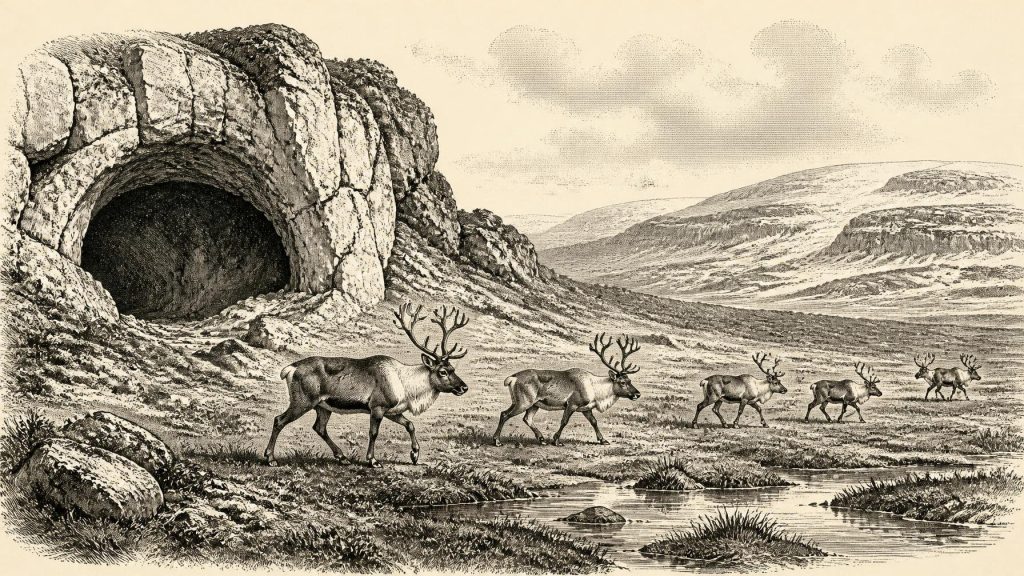
Around 31,218 BCE, Ireland was a changing Late Pleistocene frontier rather than a stable, fully glaciated island. Ice margins, sea levels and open tundra-like habitats shifted repeatedly. Wetland deposits at Derryvree, County Fermanagh, preserve evidence of sedges, mosses, insects and cold-adapted plants between glacial episodes. Castlepook Cave, County Cork, yielded mixed remains of mammoth, reindeer, giant deer, hyaena, wolves and other fauna, though their dates and associations remain uncertain. A marked reindeer femur may indicate human butchery around 33,000 years ago, suggesting brief visits rather than proven settlement. The fragmentary record demands cautious interpretation of Ireland’s earliest possible human presence.
Dateline
31,218 BCE is not a year that can be recovered from the Irish archaeological record in the ordinary historical sense. No event, settlement, ruler or journey can be assigned to it, and modern calendar-year precision is unavailable at this depth of time. As a piece of calendar arithmetic, it falls roughly 33,167 years before AD 1950, the reference point used for “before present” (BP), but that conversion is not a scientific date for an occurrence in Ireland. Radiocarbon ages must be calibrated, and at this age their ranges commonly span centuries or more. The responsible subject is therefore Ireland in the later part of the last Ice Age: a changing Late Pleistocene landscape, broadly within Marine Isotope Stage 3, represented by scattered animal bones, cave sediments, wetland deposits and glacial landforms.
A Landscape Before the Maximum
This was before the clearest, best-dated maximum of the last British–Irish Ice Sheet, generally placed around 27,000–23,000 calibrated years BP, although ice grew and retreated unevenly across the islands. It would be misleading to picture a single, stable Ireland at 31,218 BCE. Research on the British–Irish Ice Sheet shows a complex history in which ice masses, sea level, coastlines and climates altered markedly through Marine Isotope Stages 4 and 3. Some parts of Ireland may have supported substantial ice at earlier moments; other areas were exposed during colder but non-glacial intervals. The evidence does not allow a map of the island for this particular nominal year.
What is clear is that Ireland was part of a northern Atlantic world subject to abrupt climatic shifts. It was not the later, familiar green island of woodland, farms and bogs. In suitable ice-free areas, open vegetation could develop: grasses, sedges, herbs, mosses and low shrubs rather than closed forest. Winters were severe, growing seasons short, and wind, frost and seasonal waterlogging mattered greatly. Yet “Ice Age” should not be equated automatically with uniform, lifeless ice. The surviving geological and biological evidence instead points to a patchwork of ice margins, exposed ground, shallow pools, wet hollows, river channels and open grazing land, changing over long periods.
Fermanagh’s Buried Wetland
The most illuminating environmental evidence comes from deposits at Derryvree near Maguiresbridge in County Fermanagh. There, organic silts and moss-rich sediments were preserved between bodies of glacial till. Their position is important: they record an interval when a wetland existed between episodes of ice-related deposition, rather than a landscape that can be assumed to represent all Ireland at once. A radiocarbon determination historically associated with the deposits is about 30,500 radiocarbon years BP. Calibration and later revisions to Irish glacial chronologies mean that it should not be treated as an exact match for 31,218 BCE. It nevertheless provides a closely relevant window into the kind of cold-stage environment that could occur in Ireland during this broad era.
Plant macrofossils, pollen and insects from such deposits have been interpreted as evidence for treeless, tundra-like muskeg: a waterlogged mosaic with sedges, mosses, open pools and sparse cold-tolerant plants, including taxa such as bogbean and mountain-avens in the wider Fermanagh record. Insects and mosses are particularly valuable because they can reveal conditions underrepresented by larger fossils. The interpretation is not that every Irish valley was a clone of Derryvree. Rather, the site demonstrates that, during a cold interval bracketed by glacial deposits, life persisted in wet, open habitats. These deposits also show why environmental history is central to this period: vegetation and hydrology, not written testimony, provide the closest thing to a contemporary account.
The Cave at Castlepook
For southern Ireland, Castlepook Cave near Doneraile, County Cork, is indispensable. Also known as Mammoth Cave, it produced a remarkable assemblage during excavations in the early twentieth century. The National Museum of Ireland preserves material from the cave, including spotted hyaena remains. Across its passages and collections, researchers have identified bones of mammoth, reindeer, giant deer, brown bear, wolf, fox, mountain hare, Arctic fox, lemmings and spotted hyaena. This is compelling proof that parts of Ireland were available to a varied cold-stage fauna during portions of the Late Pleistocene.
It is not, however, a census taken in one season. Cave deposits are difficult archives. Carnivores may drag in prey or scavenged bones; water can move sediment; bones from different periods can become mixed; and the earliest excavations lacked the stratigraphic methods expected today. Direct dating has improved the picture but also demonstrated its complications. A reassessment of several Castlepook specimens using improved sample preparation found dates substantially older than some earlier results. It suggested that spotted hyaena and giant deer may have disappeared locally before about 40,000 calibrated years BP. Thus, the long faunal list should not be used to place mammoths, hyaenas, reindeer and giant deer together on a single morning in 31,218 BCE.
Even so, the cave gives this period a vivid ecological frame. Reindeer imply extensive seasonal grazing landscapes; lemmings and Arctic fox signal cold conditions; mammoth and giant deer indicate that, at relevant times, the island could sustain large herbivores; hyaenas and wolves demonstrate predator and scavenger guilds. The animals would have occupied a landscape connected, intermittently and in ways still debated, with western Britain and continental north-west Europe. Lower sea levels and changing ice margins altered those connections. Fossils show that animals reached Ireland; they do not by themselves settle whether every movement used dry land, sea ice, short crossings, or routes available only at particular stages.
A Reindeer Bone and a Human Question
The closest possible evidence for people in this broad period is a fragment of reindeer femur from Castlepook. Publicly reported research dates the bone to about 33,000 years ago and identifies a deep mark as consistent with cutting or chopping fresh bone with a sharp stone tool. If that interpretation is sustained, the mark is evidence that humans processed a reindeer in Ireland far earlier than the previously recognised terminal-Pleistocene evidence. It would be exceptionally important: a small physical trace of an encounter between people, animal and landscape at the edge of north-western Europe.
The distinction between evidence and interpretation is essential. The dated object is an animal bone, not a human skeleton, hearth, stone-tool assemblage or house floor. The proposed tool mark is a strong and plausible zooarchaeological observation, but Castlepook is an old and disturbed cave collection rather than a modernly excavated, sealed camp. The bone cannot tell us how many people were present, their language, sex, age, origin, technology beyond the possible use of a sharp implement, or whether they returned. Nor does it securely identify a cultural tradition. Although Upper Palaeolithic groups lived elsewhere in Europe at this time, assigning a Gravettian or any other label to Ireland without diagnostic artefacts would go beyond the evidence.
The modest claim is also the significant one: people may have reached and exploited Ireland during this cold-stage interval. This need not mean permanent occupation. A small, mobile party could have arrived during a window of environmental opportunity, followed animals, used a cave or its vicinity briefly, and left almost no durable trace. Subsequent glaciation, erosion, rising seas and the scarcity of systematic cave investigation all reduce the odds of recovery. The absence of known dwellings or tools is therefore not proof of absence, but neither does the marked femur justify a detailed story of an established Irish population.
Life Without a Chronicle
There is no responsible basis for discussing political affairs, diplomacy, law, named communities or warfare in Ireland at this date. There are no monuments, burials, villages or weapon assemblages from which to reconstruct authority or conflict. Similarly, religion, art, formal learning and language remain invisible. Caves should not automatically be called ritual sites merely because bones were found in them: at Castlepook, carnivore activity and natural deposition are major parts of the explanation.
Economy can be discussed only at the narrowest level. If the Castlepook mark was made by people, it indicates carcass processing: the removal of meat, marrow or other useful tissues from a reindeer limb. That is evidence of subsistence behaviour, not of farming, property, markets or trade. There is no basis for claiming exchange networks in Ireland itself. Reindeer, mammoth and other animal remains demonstrate resources in the landscape, while the cave record hints at the hazards of sharing it with large carnivores. Any human life here would have depended on mobility, detailed environmental knowledge, shelter, fire and perishable equipment, but those practical necessities are general inferences from Palaeolithic lifeways, not objects recovered from a securely dated Irish campsite.
Settlement, therefore, is best described as unproven. The Irish evidence around this time consists chiefly of fossils and sediments, not settled places. The most meaningful regional contrast is between Fermanagh’s preserved wetland archive and Cork’s limestone cave archive: one records plants, insects and waterlogged ground, the other a time-averaged animal assemblage shaped partly by carnivores. Together they overturn an older image of an entirely empty Ireland before the Last Glacial Maximum. They do not produce an annual narrative.
What This Date Can Mean
31,218 BCE is best used as a waypoint, not an anniversary. Around this point in the long Late Pleistocene, Ireland was environmentally dynamic and at times biologically connected to neighbouring lands. Cold-open habitats supported specialised plants and animals; wetland pockets formed during intervals between glacial advances; and Castlepook preserves evidence for a rich, if chronologically mixed, fauna. The reindeer femur offers a tantalising possible sign of human butchery, but it must remain a carefully bounded conclusion until corroborated by further securely excavated evidence.
The period’s real historical importance lies in that balance of discovery and restraint. Ireland was neither a timeless ice sheet nor a populated country awaiting later written history. It was a changing frontier of ice, water, open ground, animals and perhaps brief human visits. Its record survives only in fragments, and the fragments demand that archaeological uncertainty be treated not as a failure of history, but as part of the history itself.
Primary Sources
- A reconsideration of the radiocarbon dating of the Marine Isotope Stage 3 fauna from southern Ireland
- The Irish Quaternary Fauna Project
- Quaternary deposits and glacial stratigraphy in Ireland
- Irish Pleistocene biostratigraphy
- Figure 6.— The subdivision of the Quaternary Period in Ireland
- South Fermanagh, Northern Ireland: Irish Quaternary Association Field Guide 16
- Spotted Hyena Skull
- Archaeological Heritage of County Cork
- Heritage Artefacts of County Cork
- The timing and magnitude of the British–Irish Ice Sheet between Marine Isotope Stages 5d and 2: implications for glacio-isostatic adjustment, high relative sea levels and ‘giant erratic’ emplacement
- Response of the Irish Ice Sheet to abrupt climate change during the last deglaciation
- Growth and retreat of the last British–Irish Ice Sheet, 31,000 to 15,000 years ago: the BRITICE-CHRONO reconstruction
- Growth and retreat of the last British–Irish Ice Sheet, 31,000 to 15,000 years ago: the BRITICE-CHRONO reconstruction
- Stratigraphic and palaeo-geomorphological evidence for the glacial-deglacial history of the last British-Irish Ice Sheet in the north-western Irish Sea
- Maximum extent and dynamic behaviour of the last British–Irish Ice Sheet west of Ireland
- New data for the Last Glacial Maximum in Great Britain and Ireland
- First evidence of a Late Upper Palaeolithic human presence in Ireland
- First evidence of a Late Upper Palaeolithic human presence in Ireland
- New insights on the fauna of Ireland's Younger Dryas and Early Holocene from Alice & Gwendoline Cave
- The IntCal20 Northern Hemisphere Radiocarbon Age Calibration Curve (0–55 cal kBP)
- IntCal20 Northern Hemisphere Radiocarbon Age Calibration Curve (0–55 cal kBP)
- IntCal: History
- The Mesolithic in Ireland: when was it?
- Outreach and Education Resources