Fermanagh’s Silt Chronometer30230 BCE
Modern date 30,230 BCE is only a filing label; Derryvree’s radiocarbon-dated organic silts instead represent a broad interval around 34,950–29,750 BCE. Exposed between lower and upper glacial tills, they record an ice-free Fermanagh basin with freshwater, tundra vegetation and intensely seasonal conditions during MIS 3. Plants indicate wetlands, shallow pools and treeless cold-country mosaics. Castlepook Cave preserves a time-depth fauna including mammoth, reindeer, giant deer, predators and lemmings, showing varied cold-stage habitats. A possibly butchered reindeer bone suggests episodic human visitation, but lacks secure associated tools or occupation. Later ice buried and reshaped such landscapes; Derryvree remains an environmental archive.
Dateline
“30,230 BCE” is a useful modern filing date, not a year that can be observed in Ireland’s archaeological record. No written calendar existed, and the evidence cannot isolate a particular season, event or generation. The responsible setting is the later Middle Midlandian cold phase of the Late Pleistocene, within Marine Isotope Stage 3. Ireland was then undergoing profound climatic instability long before the Last Glacial Maximum. The strongest Irish evidence relevant to this point comes not from houses, graves or tools, but from a buried freshwater deposit at Derryvree near Maguiresbridge, County Fermanagh, and from scattered animal remains in caves, especially Castlepook Cave in north Cork.
The date label nevertheless falls within an important broad interval. Organic silts at Derryvree produced the radiocarbon measurement BIRM-166, reported as 30,500 radiocarbon years before present, with a large uncertainty. Radiocarbon years are not calendar years: calibration against changing atmospheric carbon levels places the deposit broadly at about 36,900–31,700 calibrated years before present, approximately 34,950–29,750 BCE. That range, rather than a single numbered year, is the proper chronological frame. It tells us that at some point in this long span an ice-free Fermanagh basin sustained cold-climate freshwater and tundra life, before later ice overrode and sealed its sediments.
A Wetland Between Ice Advances
Derryvree was exposed during road works in 1969, when a cutting through a drumlin revealed a remarkable sequence: thick glacial till below, freshwater sands and organic silts in the middle, and another substantial till sheet above. The arrangement is decisive. It records a landscape that was free of local ice long enough for water, sediment, plants and small animals to accumulate, followed by a renewed glacial advance. The deposit is therefore not simply evidence of cold weather. It is evidence of environmental change: a habitable, if severe, interval between phases of glaciation.
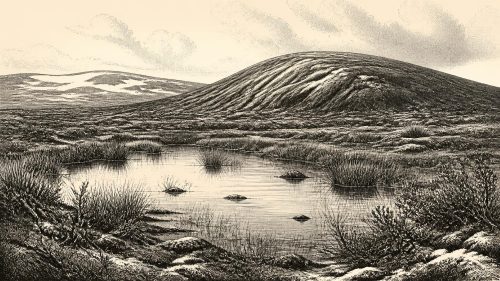
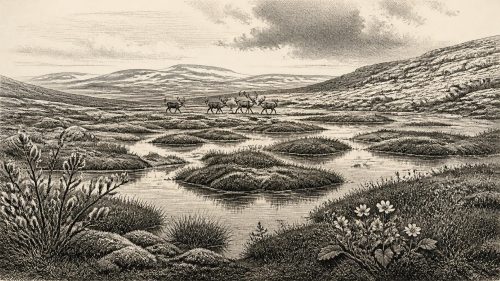
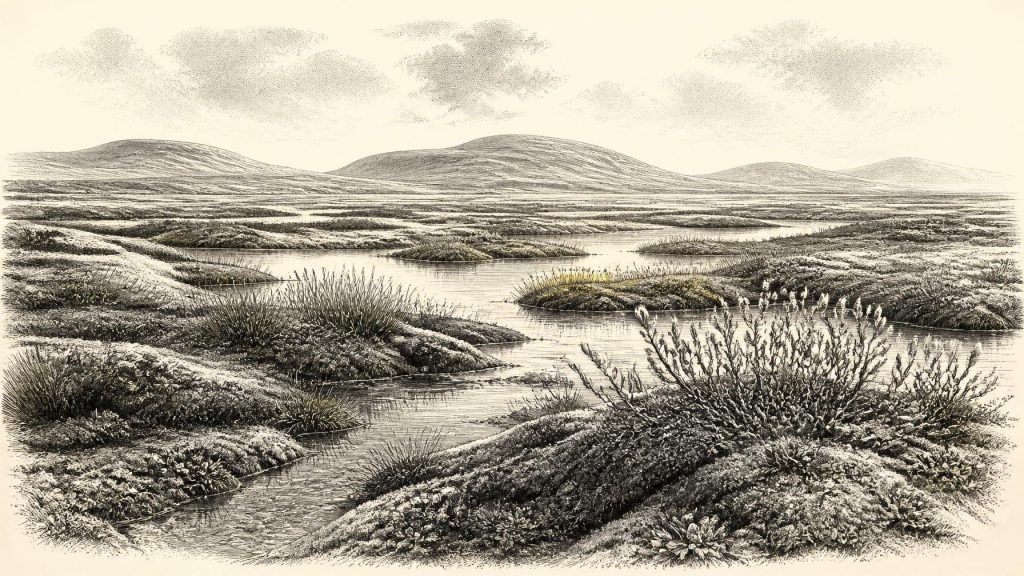
The fossil assemblage indicates open tundra rather than forest. Grasses and sedges grew with mosses, dwarf shrubs and herbs; published descriptions include dwarf willow, juniper, mountain avens, lesser clubmoss, bogbean and water-milfoil. Such species do not reconstruct a uniform plain. They suggest wet hollows, sedge margins, mossy ground and shallow pools set within largely treeless country. The old term muskeg, used by the original investigators, conveys a waterlogged moss-and-sedge environment, but the scene would also have included drier, frost-affected patches of mineral ground.
Insects and plant macrofossils make this reconstruction more precise. Freshwater plants imply persistent open water rather than a transient melt puddle, while mosses and tundra herbs point to a short growing season, cold winters and periglacial conditions. Permafrost cannot be demonstrated everywhere from one exposure, yet seasonal freezing and thawing were probably important forces in the landscape. Solifluction, frost heave, wind and snowmelt would have disturbed exposed soils. Drainage channels and ponds could shift rapidly as ground ice formed or melted. The landscape around the Fermanagh basin was therefore biologically active, but fragile and intensely seasonal.
Animals in a Cold Mosaic
Derryvree itself is principally an environmental archive, not a large-mammal hunting site. For the broader Irish fauna of this period, Castlepook Cave near Doneraile is central. Its deposits have yielded remains attributed to woolly mammoth, reindeer, giant deer, brown bear, wolf, foxes, mountain hare, stoat, collared lemming, Norwegian lemming and spotted hyaena. Not every bone belongs to the same moment: cave sediments were accumulated and disturbed over long periods by carnivores, water, collapse and early excavations. Later radiocarbon work has also shown that some older measurements needed revision. Castlepook must therefore be read as a time-depth assemblage, not as a single neatly dated community.
Even with that caution, the animals establish that parts of Ireland could support a varied cold-stage fauna before the ice sheet reached its later maximum. Reindeer and lemmings accord with open, cold environments. Mammoth and giant deer indicate that sufficient grazing and browsing resources existed somewhere in the wider landscape, although fossil occurrence alone cannot tell us herd sizes, routes or population continuity. Spotted hyaena and wolves show that predators could exploit these herbivores and that caves might serve as dens or scavenging places. A cave bone assemblage is consequently evidence both for animals on the landscape and for the natural processes that concentrated their remains underground.
There was no simple modern equivalent to this Irish ecology. It combined species now associated with very different regions, while the vegetation was structured by repeated climatic oscillations. The phrase “mammoth steppe” can be helpful as a continental comparison, but it should not erase local wetlands, limestone caves, uplands or coastal differences. Ireland at this date was neither a permanent white wilderness nor a settled green island. It was a changing northern landscape in which ice-free terrain, frozen ground, watery basins and animal corridors varied across time and place.
The Human Question
Human presence is the most intriguing issue, and the one requiring the greatest restraint. A reindeer femur from Castlepook has been reported as bearing a deep mark interpreted as fresh-bone butchery with a sharp stone tool, and its age has been publicised as about 33,000 years old. If that interpretation is confirmed, it would indicate that a person or small group handled a reindeer in Ireland during the broader pre-Last Glacial Maximum period. It would not, by itself, demonstrate a permanent population, a camp, a named archaeological culture or an ancestral connection to later inhabitants.
The limits of the evidence matter. The bone derives from a cave complex whose deposits were affected by carnivores and by early twentieth-century excavation, and no securely stratified contemporary tool assemblage, hearth, dwelling, human bone or occupation surface has yet been demonstrated for Ireland around this date. Surface modifications on ancient bone must be distinguished carefully from damage caused by carnivore teeth, trampling, sediment movement, excavation and weathering. More secure evidence for human activity in Ireland presently belongs much later, in the terminal Pleistocene, where a cut-marked brown-bear patella from Alice and Gwendoline Cave in County Clare has been directly dated to roughly 12,810–12,590 calibrated years before present.
Thus the cautious conclusion for around 30,230 BCE is not that Ireland was certainly inhabited, but that episodic human visitation is a serious hypothesis raised by one exceptional find. At that time, Homo sapiens were well established elsewhere in north-west Europe. Low sea levels altered coastlines and geographical connections, but no Irish evidence demonstrates a particular crossing route, boat journey or land bridge used by people. The apparent proximity of Britain or continental Europe on a map cannot substitute for archaeological proof of movement.
No Polities, No Proven Settlements
There is no evidence from Ireland at this date for political communities, leaders, warfare, diplomacy, territories or law. Nor is there evidence for exchange networks, farming, herding, metalworking, monuments, formal burial rites, art or written learning. These are not missing details awaiting recovery from a historical chronicle; they are questions beyond the scale of the surviving Irish record. It would be misleading to invent a social order from the presence of reindeer or a wetland plant.
If people did reach the island during the broad Derryvree interval, the likely economic setting would have been mobile hunter-gatherer subsistence, using animal and plant resources in a seasonal landscape. That is an inference from the wider European Upper Palaeolithic, not a directly demonstrated Irish way of life. There is no basis for identifying particular languages, ethnic labels, kinship systems, beliefs or trade goods. The difference between a passing hunting party, a brief cave visit and a resident population is enormous, and the current evidence cannot decide between them.
Before the Great Expansion of Ice
The principal historical development illuminated by this date is environmental rather than human. Derryvree shows that ice-free ground and freshwater habitats existed in at least part of Ireland during a cold phase of MIS 3. Yet the future of that landscape was precarious. Research on the British–Irish Ice Sheet places major build-up after roughly 35,000–32,000 years ago, with its broad maximum later, around 27,000–21,000 years ago, although timing differed between sectors. In Ireland, later ice reshaped terrain, deposited till, scoured older surfaces and destroyed or buried much of the evidence that might once have recorded plants, animals and people.
This is why the Fermanagh silts have such importance. Their value lies not in supplying a story for one calendar year, but in preserving a rare environmental window between two glacial episodes. Around the modern label 30,230 BCE, Ireland can responsibly be envisaged as a severe but living land of tundra vegetation, shallow freshwater, seasonal frost and large mammals. Whether humans were present remains unresolved. The buried wetland and the cave bones do not yield a conventional narrative of Irish society; they reveal the deeper preconditions from which Ireland’s much later human history eventually emerged.
Primary Sources
- Middle Midlandian Freshwater Series at Derryvree, Maguiresbridge, County Fermanagh, Northern Ireland
- A Reconsideration of the Radiocarbon Dating of the Marine Isotope Stage 3 Fauna from Southern Ireland
- The Irish Quaternary Fauna Project
- Irish Pleistocene Biostratigraphy
- Figure 6.— The Subdivision of the Quaternary Period in Ireland
- Pleistocene Glaciations in Ireland
- Early Midlandian–Middle Midlandian, Pleistocene, Northern Ireland
- The Geology of Ireland: Cenozoic—Tertiary and Quaternary
- Extent and Timing of the Last Glacial Maximum (LGM) in Britain and Ireland: A Review
- Growth and Retreat of the Last British–Irish Ice Sheet, 31,000 to 15,000 Years Ago: the BRITICE-CHRONO Reconstruction
- Pattern and Timing of Retreat of the Last British-Irish Ice Sheet
- New Age Constraints for the Maximum Extent of the Last British-Irish Ice Sheet (NW Sector)
- The IntCal20 Northern Hemisphere Radiocarbon Age Calibration Curve (0–55 cal kBP)
- IntCal – History
- The Exploration of Castlepook Cave, Co. Cork. With 3 Plates.
- Castlepook Cave, Castlepook South, County Cork: Excavation Report 2022
- Mammoth Cave (Castlepook Cave), County Cork
- Pleistocene Vertebrates in the British Isles
- New Insights on the Fauna of Ireland's Younger Dryas and Early Holocene from Alice & Gwendoline Cave
- The Irish Elk: When and Why Did This Giant Deer Go Extinct and What Did It Look Like?
- Mammals: National Museum of Ireland Natural History Collections