Elephant Hall’s Cold-Stage Fauna30221 BCE
Labelled 30,221 BCE, this poorly dated horizon belongs to the unstable later Marine Isotope Stage 3, before the Last Glacial Maximum. Ireland experienced variable cold conditions, lower seas and changing ice-sheet limits, not uniform glaciation. Cave faunas, particularly from Castlepook, indicate open steppe-tundra landscapes supporting mammoth, giant deer, reindeer, hyaena, Arctic fox, lemmings and other mobile animals; red deer demonstrate ecological variation. A possibly cut-marked reindeer bone suggests, but cannot confirm, early human carcass processing. No secure settlement, tools, society, trade, beliefs or polity can be reconstructed. Subsequent ice expansion probably erased or buried much evidence, leaving cautious investigation essential.
Dateline
“30,221 BCE” is a useful modern label for this entry, not a date that people in prehistoric Ireland could have recognised. No event can responsibly be assigned to that individual year. At this depth of time, archaeologists and Quaternary scientists work with radiocarbon determinations, stratigraphy, animal remains, pollen, sediments and ice-sheet landforms. A mechanical conversion places the label broadly around 32,200 calibrated years before present (cal BP, where “present” is AD 1950), but even that should not be mistaken for calendar-year precision. The appropriate setting is the later part of Marine Isotope Stage 3, a climatically unstable stretch of the last Ice Age before the better-defined Last Glacial Maximum.
A Date Range, Not a Diary Entry
Radiocarbon dating does not produce an ancient calendar date. It measures remaining radiocarbon in once-living material; the result must then be calibrated against long-term changes in atmospheric radiocarbon. At around 32,000 years ago, the resulting calibrated ranges can be broad, and an animal bone dates the death of the animal rather than every later action or disturbance associated with it. Ireland therefore has no documentary, political or archaeological record from which to reconstruct a particular year in the thirty-first millennium BCE.
What can be said is more modest, but still important. Ireland lay on the north-western edge of Europe during a cold stage in which climate repeatedly shifted, sea level was lower than today, and the growth and movement of the British–Irish Ice Sheet were transforming surrounding seas and landscapes. The island’s later, widely familiar prehistoric sequence—Mesolithic camps, Neolithic farms, megalithic tombs, metalworking and named historic peoples—was still tens of millennia away.
An Unstable Ice-Age Ireland
This was not yet the Last Glacial Maximum, when ice spread over all or almost all Irish low ground, conventionally dated to about 26,000–21,000 years ago. Research on the British–Irish Ice Sheet shows that ice growth before that maximum was neither simple nor uniform. There is evidence for earlier growth and retreat during Marine Isotope Stage 3, but the precise extent of ice across Ireland at any one moment remains uncertain. In the Irish Sea sector, the more securely reconstructed major build-up occurred from about 30,000 to 26,000 years ago. The date represented here sits just before that well-constrained expansion.
It would therefore be wrong to picture the whole island either as a continuous white ice cap or as a reliably ice-free plain. Conditions differed between uplands, lowlands, coasts and the Irish Sea basin, and changed through time. Earlier and later ice advances could erode, bury or redeposit evidence. That destruction of older surfaces is one reason why the archaeological record is so thin. The scarcity of finds does not demonstrate that no person ever reached Ireland; equally, it cannot be turned into proof of enduring occupation.
Open Ground and Mobile Animals
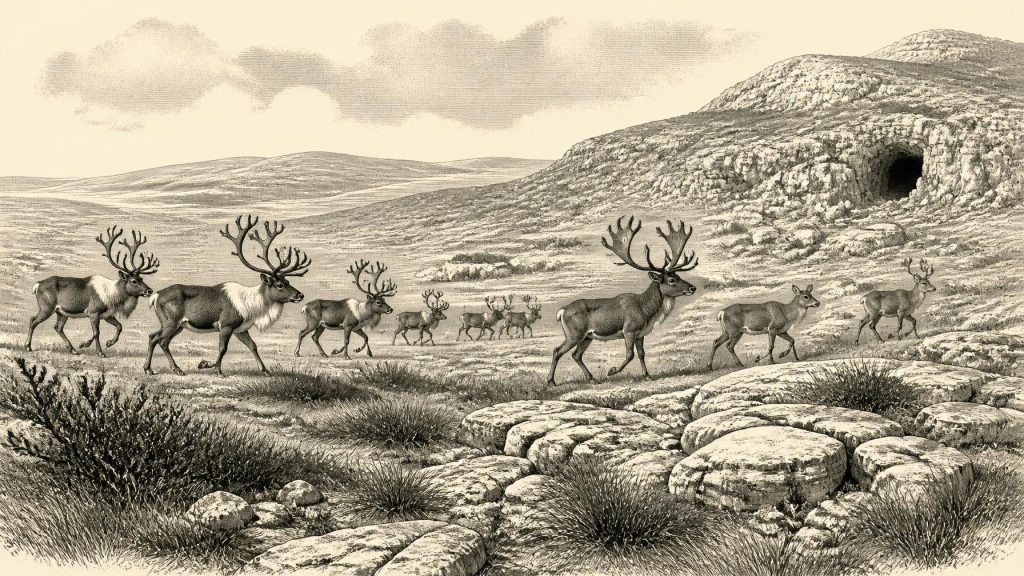
The clearest evidence for the Irish environment comes from cave deposits and animal bones, especially in the south. Castlepook Cave, near Doneraile in north County Cork, is Ireland’s richest known vertebrate archive for the period leading towards the Last Glacial Maximum. Its old excavations recovered bones of woolly mammoth, giant deer, reindeer, brown bear and spotted hyaena, alongside remains attributed to wolf, Arctic fox, mountain hare and lemmings. The cave contains material accumulated over a very long interval, rather than a single intact occupation surface. These animals were not necessarily contemporaries, and their presence cannot be reduced to one frozen scene.
Nevertheless, the assemblage strongly indicates that parts of Ireland could support cold-stage animal communities. Reindeer, lemmings and Arctic fox point towards open, cold environments; mammoth and giant deer evoke extensive forage landscapes rather than closed Atlantic woodland. Such country is often described as steppe-tundra or tundra-steppe: a patchwork of grasses, sedges, herbs, mosses, bare ground, wetlands and scattered low shrubs, its exact appearance varying with local soils, season and climate. It was not an empty wasteland. It was a demanding but productive landscape for animals adapted to cold and mobility.
Directly dated animal evidence also warns against treating the fauna as wholly Arctic. Two pre-Last Glacial Maximum red-deer specimens from Waterford caves have calibrated ranges of about 32,930–31,280 cal BP and 30,297–29,594 cal BP. The earlier range overlaps the broad horizon represented by 30,221 BCE. Red deer were not proof of a mild, wooded Ireland; they do show that faunal composition and habitat were more varied than a simple image of unbroken polar desert allows.
Castlepook and the Human Question
Castlepook is especially important because it raises, rather than settles, the question of a much earlier human presence in Ireland. A fragment of reindeer femur from the historic cave collection has been reported as bearing a deep modification interpreted as a stone-tool cut or chop made while fresh bone was being processed. Public reporting associated the bone with an age of roughly 33,000 years. If that interpretation is confirmed, it would be evidence that humans handled a reindeer carcass in Ireland during the Middle Palaeolithic-to-Upper Palaeolithic transition of the wider north-west European record—far earlier than the previously accepted terminal-Pleistocene traces.
Its evidential limits matter. The fragment does not identify a named group, demonstrate a settlement, provide a stone-tool assemblage, or establish a continuous population. Castlepook’s deposits were affected by carnivores, water movement, antiquarian excavation and later disturbance. Spotted hyaenas themselves used the cave and could transport or damage bones. A radiocarbon date applies to the animal bone, while identifying a deliberate human mark is a separate zooarchaeological judgement. New work in the cave has located surviving sediments, but it has not yet produced a securely stratified camp comparable to the rich Upper Palaeolithic sites of continental Europe.
People, Society and Daily Life
Accordingly, there is no responsible basis for describing houses, clothing, family organisation, food-sharing rules or seasonal routes in Ireland in this particular year. There is no secure Irish hearth, dwelling floor, burial, decorated object or lithic workshop of this age from which to reconstruct everyday life. The reindeer femur allows only a narrow possibility: if its mark is anthropogenic, someone used a sharp stone implement on fresh bone, probably in carcass processing. That would imply practical knowledge of cutting tools and animal anatomy, but not the scale or duration of human activity.
Comparison with better documented Upper Palaeolithic communities elsewhere in Europe can suggest possibilities—small mobile groups, hunting and scavenging, careful use of hides, bone, meat and fat, and seasonal responses to animal movement—but those are comparisons, not facts demonstrated for Ireland. The Irish evidence is too slight to decide whether visitors crossed briefly, returned intermittently, or tried to live on the island. Nor can it establish whether people arrived by sea, over seasonal ice, or by another changing route through the glacial seaways.
No Polities, No Trade Networks
There were no known Irish polities, chiefs, diplomatic relations, territorial boundaries or organised wars that can be dated to this horizon. Such language would impose later historical categories on a record that does not support them. Equally absent are demonstrable trade networks: no imported stone-tool source, exchange good, metal, pottery or monument links this Irish landscape to a particular mainland community. Animal movement proves ecological connectivity, not commerce.
Religion, language, art and formal learning are also beyond recovery here. Caves can later acquire powerful cultural meanings, but Castlepook’s Pleistocene animal deposits are not evidence of sanctuary use, ritual or cave art. The appropriate cultural history is one of preservation and investigation: bones collected in early twentieth-century excavations, museum collections revisited with improved dating and identification techniques, and cautious modern excavation aimed at recovering undisturbed contexts.
A Landscape on the Edge of Change
The largest development relevant to Ireland around this broad date was environmental, not political: the approach towards a more extensive phase of glaciation. Over subsequent millennia the British–Irish Ice Sheet expanded dramatically, reshaping the Irish Sea and much of Ireland’s land surface. That advance would erase or seal many earlier traces, while later retreat would create the terrain inherited by post-glacial plants, animals and eventually people.
For 30,221 BCE, then, Ireland is best understood as a cold, regionally varied and poorly preserved Ice-Age world. Cave faunas show that large mammals and cold-adapted species reached parts of the island. A marked reindeer bone from Castlepook offers a significant but still limited possible indication of human activity. Everything larger—society, belief, conflict, settlement and exchange—remains unknown. The discipline of this conclusion is not a failure of history. It is what the surviving evidence can honestly bear.
Primary Sources
- Castlepook Cave: County Geological Site Report
- A reconsideration of the radiocarbon dating of the Marine Isotope Stage 3 fauna from southern Ireland
- The timing and magnitude of the British–Irish Ice Sheet between Marine Isotope Stages 5d and 2: implications for glacio-isostatic adjustment, high relative sea levels and ‘giant erratic’ emplacement
- Maximum extent and readvance dynamics of the Irish Sea Ice Stream and Irish Sea Glacier since the Last Glacial Maximum
- Extent and deglacial chronology of the last British–Irish Ice Sheet: implications of exposure dating using cosmogenic isotopes
- Dimensions and chronology of the last ice sheet in Western Ireland
- Late Pleistocene chronostratigraphy and ice sheet limits, southern Ireland
- Radiocarbon constraints on the age of the maximum advance of the British–Irish Ice Sheet in the Celtic Sea
- Trimlines, blockfields and the vertical extent of the last ice sheet in southern Ireland
- The deglaciation of the western sector of the Irish Ice Sheet from the inner continental shelf to its terrestrial margin
- Oscillating retreat of the last British-Irish Ice Sheet on the continental shelf offshore Galway Bay, western Ireland
- Pattern and timing of retreat of the last British-Irish Ice Sheet
- The evolution of the terrestrial-terminating Irish Sea glacier during the last glaciation
- The problem of a late quaternary landbridge between Britain and Ireland
- The Irish Quaternary Fauna Project
- The impact of Neolithic and later cultural activity on an imported and known invasive species, the red deer (Cervus elaphus), in Ireland
- New insights on the fauna of Ireland’s Younger Dryas
- 32564: Castlepook Cave, Castlepook South, County Cork
- The IntCal20 Northern Hemisphere Radiocarbon Age Calibration Curve (0–55 cal kBP)
- The Mesolithic in Ireland: when was it?