Ireland’s Ice-Sheet Build-Up31170 BCE
At 31,170 BCE, Ireland lay in the climatically unstable later Marine Isotope Stage 3, approaching expansion of the British–Irish Ice Sheet. Precise local conditions cannot be reconstructed: radiocarbon dating provides calibrated ranges, while glaciation erased much earlier evidence. Models suggest regional ice development, becoming extensive later. Southern caves, especially Castlepook, preserve remains of fauna including reindeer, mammoth and hyaena, but mixed deposits and revised dates prevent their attribution to one year. Possible tool damage on a reindeer bone is inconclusive evidence of early people. Secure human evidence is far later, leaving environmental change and uncertainty as this period’s principal record.
Dateline
31,170 BCE is a useful modern label, not a date at which Ireland can be described with the precision of a chronicle. No written record, calendar, named ruler, settlement sequence or securely dated human camp allows historians to isolate a single year so deep in the Pleistocene. In calendar terms the label lies roughly 33,100 years before AD 1950, but archaeological and environmental evidence must be expressed in calibrated ranges, often extending across centuries or millennia. The responsible subject is therefore Ireland during the later part of Marine Isotope Stage 3: a cold, unstable phase of the last Ice Age, shortly before the main expansion of the British–Irish Ice Sheet.
A Date Without Annals
This was not a historical Ireland of kingdoms, borders or remembered ancestors. There is no evidence from around 33,100 calibrated years before present for political communities, diplomacy, warfare, formal religion, literacy, monuments or a settled population on the island. Nor can archaeology identify an Irish language, ethnicity or social group at this depth of time. Such absences matter. They are not gaps to be filled by imagination, but the defining condition of the evidence.
Even the chronological vocabulary needs care. Radiocarbon ages are measured in years before present, conventionally before AD 1950, and are not identical to calendar ages. They must be calibrated against changing levels of atmospheric carbon-14. IntCal20, the standard Northern Hemisphere calibration curve, reaches back to 55,000 calibrated years before present, but its use does not turn one ancient measurement into an exact calendar year. A date range also represents the age of a sampled bone, charcoal fragment or sediment horizon—not automatically the date of a human visit, an animal death elsewhere, or a whole landscape.
Before Full Glaciation
At this broad horizon Ireland stood near an important climatic threshold. Marine Isotope Stage 3, conventionally dated from about 57,000 to 29,000 years ago, contained abrupt swings between colder stadials and comparatively milder interstadials. Conditions could change dramatically on timescales far shorter than later prehistoric periods. The later Last Glacial Maximum was still ahead: the most extensive phase of the last British–Irish Ice Sheet is generally placed between roughly 29,000 and 20,000 years ago, though its margins advanced and retreated at different dates in different regions.
The best recent ice-sheet synthesis begins its reconstruction at 31,000 years before present because earlier constraints are sparse. It depicts ice building over parts of Ireland and Britain between 31,000 and 26,000 years ago, with expansion especially difficult to date in Ireland. By 30,000 years before present, its reconstruction infers major ice growth in northern and central Ireland and smaller ice caps in the south-west, including the Kerry–Cork region; by 28,000 years ago, Ireland was almost wholly ice-covered in the model. These are regional reconstructions, based on landforms, sediments, offshore cores and modelling, not observations made at 31,170 BCE itself. The precise extent of ice over any particular Irish valley at the requested date remains uncertain.
That uncertainty changes the safest picture of the island. Ireland should not be imagined simply as a frozen white block, nor as an unchanging open tundra. Its climate, snow cover, sea margins and available ground altered repeatedly. The land lay within a North Atlantic system in which growing ice, sea-level change, ocean circulation and shifting storm tracks all mattered. Later glaciation also eroded, buried and rearranged earlier surfaces. This helps explain why campsites and tracks, if they ever existed, are so elusive: an advancing ice sheet is an exceptionally efficient destroyer and recycler of landscape evidence.
Caves, Bones and a Lost Ecosystem
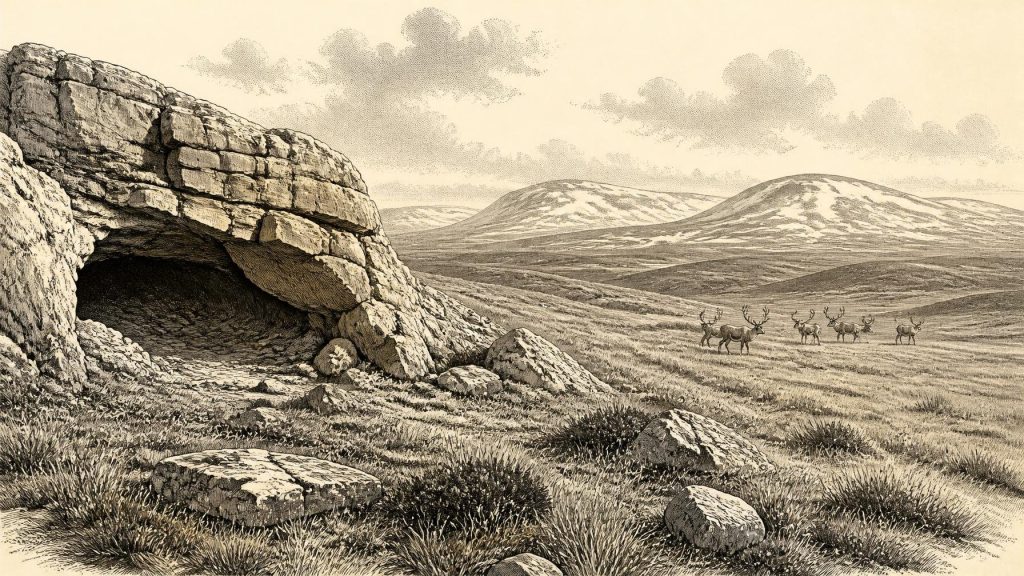
Southern Irish caves, above all Castlepook Cave near Doneraile in County Cork, offer the most vivid evidence for Ireland’s wider Middle Palaeolithic and Upper Palaeolithic-age environment. Excavations undertaken in the early twentieth century recovered remains attributed to reindeer, mammoth, giant deer, brown bear, wolf, Arctic fox, mountain hare, lemmings and spotted hyaena. Taken together, such finds establish that Ireland was at times part of a cold-adapted north-west European fauna. Reindeer and lemmings point towards open, severe conditions; mammoth and giant deer evoke extensive grazing country; hyaenas and wolves show that large predators and scavengers were also present.
But this impressive list must not be treated as a census for one year. Cave deposits form through many processes. Carnivores carry carcass parts into dens; animals die in fissures; water and sediment move bones; later excavation can mix or remove layers. The Castlepook assemblage was accumulated over a long period rather than during a single season, and the original investigations pre-dated modern excavation, sampling and recording standards. It can illuminate the kinds of animals that reached Ireland during portions of the late Pleistocene, but cannot prove that every listed species lived side by side at 31,170 BCE.
Recent re-dating makes the caution still sharper. Improved pre-treatment and radiocarbon measurement of bones from Castlepook, Foley Cave and Shandon Cave produced Castlepook ages between about 5,000 and 12,000 radiocarbon years older than previous results. The revised work suggests that some southern Irish Marine Isotope Stage 3 fauna, including giant deer and spotted hyaena, may have disappeared locally before about 40,000 calibrated years before present—well before the later full glaciation. Thus Castlepook remains central to understanding Ice Age Ireland, but it cannot responsibly be used to proclaim a precisely dated ‘reindeer year’ in 31,170 BCE.
The Human Question
The same distinction between evidence and interpretation is essential for people. A reindeer femur from Castlepook has a deep linear mark interpreted by some investigators as damage made by a sharp stone tool while fresh bone was being processed. If that interpretation is confirmed, it would be extraordinarily important: it would indicate a very early, probably brief human presence in Ireland during the broader late Pleistocene. Yet no securely associated Palaeolithic stone-tool assemblage, hearth, dwelling, human skeleton or repeatedly occupied campsite has been found in Ireland for this period. The National Museum of Ireland therefore continues to state that clear evidence for human presence during the Irish Palaeolithic has not emerged.
The securely dated terminal-Pleistocene evidence is much later. At Alice and Gwendoline Cave in County Clare, a cut-marked brown-bear kneecap has yielded calibrated ranges of 12,810–12,590 and 12,810–12,685 years before present. That find has been presented as evidence of Late Upper Palaeolithic human activity, although debate continues over how confidently a single butchered bone can demonstrate occupation. Its importance here is methodological: it is a direct-dated object, with observable modification, but still does not licence a story of a permanent community. By comparison, a human presence in Ireland at about 33,100 calibrated years ago remains possible only in the broadest sense, not demonstrated.
Life, If People Reached the Island
If small groups did enter Ireland during a milder interval of this era, they would have been highly mobile hunter-gatherers, not farmers or village builders. Their subsistence would have depended upon seasonal knowledge, animal movement, weather and access to fuel, stone and shelter. Reindeer are often imagined as the obvious quarry, but there is no Irish kill-site or tool kit from this date to establish a particular hunting strategy. Likewise, no evidence identifies clothing, boats, kinship rules, ritual practice, music or visual art in Ireland. Comparisons with better-known Upper Palaeolithic societies in Britain and continental Europe can suggest possibilities, but they cannot substitute for Irish finds.
There is equally no basis for describing trade or diplomacy. Lower global sea levels changed the outlines of the north-west European shelf, but the route between Ireland, Britain and the continent, and the availability of usable crossings, varied with ice, water and terrain. No imported tool, raw-material trail or exchange network has been securely tied to this horizon in Ireland. Any visitors would have faced a landscape in which survival, rather than political organisation, is the only plausible historical question—yet even that is an inference from ecological context, not a recovered Irish camp.
What This Year Can Mean
The strongest history of 31,170 BCE is therefore environmental and evidential. Ireland was entering the build-up to major glaciation. Faunal caves in Cork preserve fragments of an older Ice Age world, while their re-dating demonstrates how rapidly accepted narratives can change when museum collections are re-examined. Glacial deposits, offshore landforms and ice-sheet models reveal a developing physical transformation on a vast scale, but leave local conditions imperfectly resolved.
Rather than a year of named events, this is a point within a long interval in which Ireland’s future archaeological record was being both created and erased. Caves retained bones; ice later overran much of the country; and the absence of indisputable human sites remained as historically significant as the tantalising marks on a reindeer bone. For this date, humility is not a failure of history. It is the principal result of the evidence.
Primary Sources
- A reconsideration of the radiocarbon dating of the Marine Isotope Stage 3 fauna from southern Ireland
- Growth and retreat of the last British–Irish Ice Sheet, 31,000 to 15,000 years ago: the BRITICE-CHRONO reconstruction
- The Irish Quaternary Fauna Project
- New insights on the fauna of Ireland's Younger Dryas and Early Holocene from Alice & Gwendoline Cave
- First evidence of a Late Upper Palaeolithic human presence in Ireland
- The IntCal20 Northern Hemisphere radiocarbon age calibration curve (0–55 cal kBP)
- Prehistoric Details
- Heritage Artefacts of County Cork
- The Exploration of Castlepook Cave, Co. Cork
- On the discovery of hyaena, mammoth and other extinct mammals in a carboniferous cavern in County Cork
- The colonization of Ireland: A human ecology perspective
- The deglaciation of the western sector of the Irish Ice Sheet from the inner continental shelf to its terrestrial margin
- Maximum extent and dynamic behaviour of the last British–Irish Ice Sheet west of Ireland
- Quaternary deposits and glacial stratigraphy in Ireland
- Late Pleistocene chronostratigraphy and ice sheet limits, southern Ireland
- Dimensions and chronology of the last ice sheet in Western Ireland
- Vertical dimensions and age of the Wicklow Mountains ice dome, Eastern Ireland, and implications for the extent of the last Irish Ice Sheet
- Regional Pleistocene Geology
- Biogeography of Ireland: Past, Present, and Future
- Ancient Hybridization and an Irish Origin for the Modern Polar Bear Matriline
- Explore: The Wonder Cabinet
- Mammals