Derryvree’s Two-Till Silence31169 BCE
Around 31,169 BCE, Ireland lay within the unstable Late Pleistocene climate of Marine Isotope Stage 3. Derryvree, County Fermanagh, preserves freshwater sediments between two glacial tills, indicating a cold, wet, locally ice-free interval before renewed ice advance. Plant and insect remains suggest tundra wetlands rather than modern woodland. Other sites record changing climatic conditions, while southern caves preserve remains of reindeer, mammoth, hyaena and other animals. These finds demonstrate intermittent animal access across altered Irish Sea geography. Human presence remains unproven: a marked reindeer bone from Castlepook may indicate butchery, but cannot establish settlement. Ireland’s best-recorded history is environmental transformation.
Dateline
“31,169 BCE” is a useful label for this series, not a date at which Irish archaeology can identify an event. It corresponds very roughly to 33,118 years before AD 1950, the conventional “present” used in radiocarbon reporting, but neither a settlement nor an animal bone can normally be assigned to that single calendar year. At this depth of time, the responsible approach is to use broad calibrated ranges, to distinguish a dated specimen from the activity inferred from it, and to accept that much of the island’s record was later erased or rearranged by ice.
Ireland lay in the Late Pleistocene, within Marine Isotope Stage 3, a long and unstable phase of the last glacial cycle. It was not yet the Last Glacial Maximum, when the British–Irish Ice Sheet later covered the island extensively. Around the notional year in question, the most important Irish story is neither a kingdom nor a migration recorded in tradition, but an environment changing between cold, locally ice-free landscapes and the growing power of glacier ice.
A Date Without a Chronicle
Modern calendar precision is unavailable. Radiocarbon dates measure the residual carbon-14 in once-living material and must be calibrated against independent records of past atmospheric change; they are expressed as probability ranges, not anniversary dates. At more than 30,000 years ago, the uncertainties are especially important. A label such as 31,169 BCE therefore cannot tell us what happened in Ireland in a particular season, decade or human lifetime.
The closest important environmental evidence is from Derryvree, near Maguiresbridge in County Fermanagh. Roadworks in 1969 cut through a drumlin, exposing freshwater silts and fine sands sealed between two tills: deposits left directly by separate phases of glacier ice. Organic material from the intervening deposits produced a conventional radiocarbon age of 30,500 ± 1,170 radiocarbon years before present. Modern calibration has placed that determination broadly at about 36,900–31,700 calibrated years before present, or approximately 34,950–29,750 BCE.
The series date falls within that wide range. That does not mean a Derryvree pool existed precisely in 31,169 BCE, still less that its plants and animals all lived together then. It does mean that the site provides unusually direct evidence for an interval in which this part of Fermanagh was not overridden by glacier ice, before a later advance covered the deposits. The sedimentary sequence is the fact; the duration, exact climatic pulse and wider Irish geography remain interpretations constrained by it.
Freshwater Between the Ice
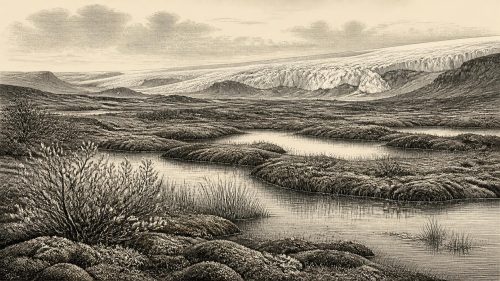
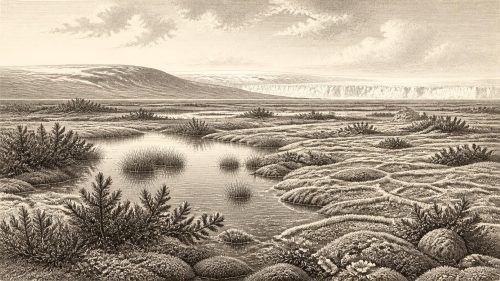
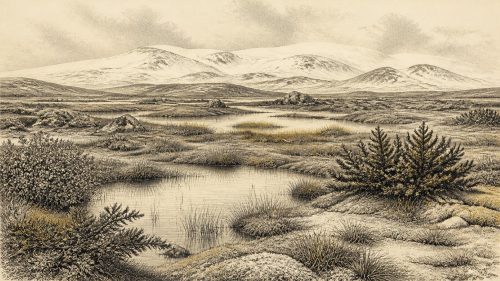
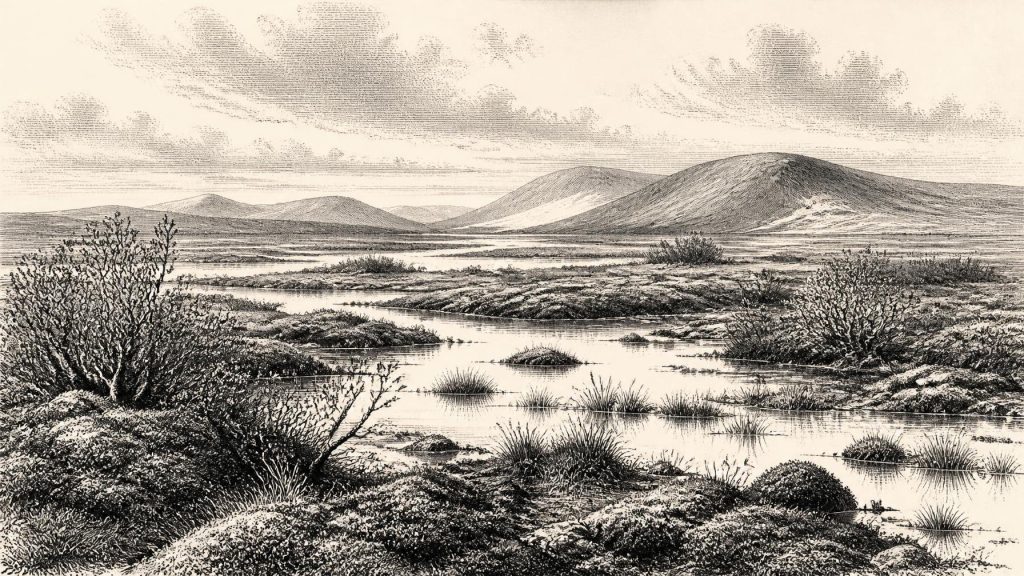
Derryvree was no woodland refuge resembling modern Ireland. Plant macrofossils, pollen and insect evidence point instead to a cold, open and wet periglacial environment: ground affected by repeated freezing and thawing, with freshwater pools or slow-moving water, mosses, sedges and low-growing tundra vegetation. Finds including bogbean (Menyanthes trifoliata), dwarf willow, mountain-avens and Arctic-alpine plants show that sheltered, waterlogged places could preserve life even in an austere wider landscape.
Such evidence should not be made more precise than it is. It supports a tundra-wetland mosaic at Derryvree, not a panoramic reconstruction of every Irish valley. Nevertheless, it matters because it disproves the simple notion that the whole island was continuously entombed beneath ice throughout the later Pleistocene. Other buried organic horizons at Greenagho, also in Fermanagh, and at sites in northern Ireland preserve evidence for changing, sometimes milder conditions during the glacial cycle. Crag Cave in County Kerry adds a different kind of record: episodes of stalagmite growth imply intervals when liquid water could percolate through shallow karst, tracking short-lived climatic ameliorations during the last glacial.
Regional change was sharp. Lowlands could contain wet hollows and open water while uplands carried local ice or lay close to expanding ice masses. By the later Last Glacial Maximum, many thousands of years after the Derryvree organic deposits formed, the British–Irish Ice Sheet was far more extensive. The drumlin itself records the consequence: a freshwater environment was eventually buried, compressed into the geological archive and concealed until twentieth-century road cutting revealed it.
Animals at the Western Edge
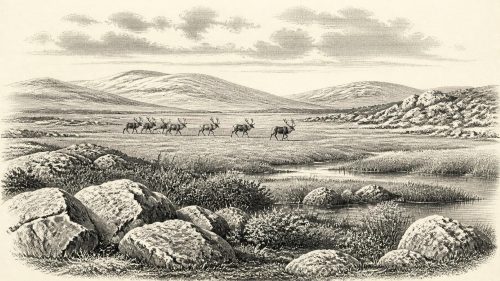
Southern Irish caves, above all Castlepook Cave near Doneraile in County Cork, provide the principal evidence for the island’s larger Pleistocene animals. Cave collections include remains attributed to reindeer, woolly mammoth, brown bear, wolf, hare and spotted hyaena, alongside other species. The Irish Quaternary Fauna Project showed that mammals reached Ireland during the broad period between at least about 45,000 and 20,000 years ago. Reassessment using improved radiocarbon pretreatment has also demonstrated that several older dates from southern cave collections were too young, pushing parts of the fauna further back into Marine Isotope Stage 3.
These bones establish real animal presence, but they are not a census from one moment. Many were excavated in the late nineteenth and early twentieth centuries, when deposits had often already been disturbed by animals, water and earlier digging. Carnivores may have dragged prey into caves; bones can be redeposited; and individual specimens may differ greatly in age. It would be unsafe to picture a single herd of reindeer, a mammoth and a hyaena sharing one Irish hillside in 31,169 BCE simply because all occur in broadly comparable cave assemblages.
Still, the faunal record has large implications. Reindeer and Arctic lemmings fit the evidence for open, cold ground. Mammoth and hyaena demonstrate that, at some points before the maximum ice advance, routes existed by which large mammals could enter or re-enter Ireland. Sea level was much lower than today, and the geography of the Irish Sea basin differed profoundly, although the exact land, coast and crossing conditions changed repeatedly. Ireland was an extreme north-western margin of European animal dispersal, not an isolated modern island.
The Human Question
There is no securely excavated dwelling, hearth, stone-tool assemblage, grave or continuous settlement in Ireland that can be assigned to this date. Consequently, no political affairs, diplomacy, warfare, ruler, tribe, language, religion, school or trade network can responsibly be described for the island in 31,169 BCE. Terms such as Gaelic, Celtic and Irish belong to immensely later historical contexts and should not be projected backwards onto an Ice Age landscape.
There is, however, one provocative object. A reindeer femur from Castlepook, held in the National Museum of Ireland’s natural-history collections, has been reported as bearing a deep mark interpreted by zooarchaeologist Ruth Carden as a fresh-bone incision or chopping trace made with a sharp stone implement. County Cork heritage material identifies the specimen as Palaeolithic and gives it an approximate date of 31,000 BCE. If the mark is confirmed as human butchery, it would indicate that people reached Ireland during a broadly comparable pre-maximum phase.
That conclusion remains necessarily narrow. The femur comes from an old cave collection rather than a modern, intact occupation layer containing associated tools, charcoal, food debris and repeated living surfaces. Dating the animal’s death does not automatically date the mark, identify its maker, show where the animal was killed, or demonstrate that the cave itself was occupied by people. It may record one brief episode of carcass processing; it cannot establish a resident population. The 2022 Castlepook Cave excavation was designed in part to seek stratified evidence—lithics, charcoal, modified bone or cave art—and demonstrates how much remains to be tested.
Society Beyond Recovery
If people did visit Ireland in this broad period, they would have arrived in a landscape in which mobility, weather, animal movements and access to shelter mattered more than fixed fields or permanent villages. European Upper Palaeolithic comparisons suggest that a single reindeer could provide meat, marrow, hide, sinew, antler and bone. But comparison is not evidence that any particular resource was taken at Castlepook, nor that people hunted the animal rather than scavenged it, nor that they belonged to a named archaeological culture.
For the same reason, religious and cultural life cannot be recovered from the Irish evidence. People elsewhere in Ice Age Europe created tools, ornaments, images and formal burial places, but no equivalent material securely attributable to 31,169 BCE has been found in Ireland. Absence of such finds does not prove an absence of belief, speech, kinship or learning. It establishes the more modest point that none can presently be described for this island.
Economy and trade are likewise beyond direct observation. There are no identified Irish exchanges, imported objects or extraction sites of this age. The demonstrable movements are ecological: plants occupying wet ground, animals dispersing through changing northern landscapes, and eventually glacier ice advancing across regions that had supported freshwater habitats. The most secure history of Ireland at this date is therefore environmental, with a possible but unproven human edge.
An Archive of Intervals
Derryvree’s importance lies in its silence as much as in its fossils. The two tills announce glacial phases; the organic silts preserve an interval between them. Together with cave bones, speleothems and modern dating methods, they show a country repeatedly transformed by climate before the later ice sheet obscured much of the evidence. Around 31,169 BCE, Ireland was neither a timeless wilderness nor a known human homeland. It was a changing cold-margin landscape whose wet hollows, caves and buried sediments offer rare, carefully qualified glimpses of deep time.
Primary Sources
- A reconsideration of the radiocarbon dating of the Marine Isotope Stage 3 fauna from southern Ireland
- The Irish Quaternary Fauna Project
- Trimlines, blockfields and the vertical extent of the last ice sheet in southern Ireland
- Middle Midlandian Interstadial Deposits at Greenagho, Near Belcoo, County Fermanagh, Northern Ireland
- Episodic speleothem deposition tracks the terrestrial impact of millennial-scale last glacial climate variability in SW Ireland
- Pattern and timing of retreat of the last British-Irish Ice Sheet
- Early deglaciation of western Ireland: Implications for glacial refugia and the genetic structure of Ireland’s biota
- Figure 6.— The subdivision of the Quaternary Period in Ireland
- IQUA Newsletter 64
- Archaeology Research Excavation Grant 2022
- 2022:564 – Castlepook Cave, Castlepook South, Cork
- Heritage Artefacts of County Cork
- Quaternary
- Menyanthes trifoliata L.
- The Mesolithic in Ireland: when was it?
- ESCR Site Summary: The Quaternary of Northern Ireland
- The IntCal20 Northern Hemisphere Radiocarbon Age Calibration Curve (0–55 cal kBP)
- IntCal Publications
- NGRIP ice-core data and the GICC05modelext timescale
- Exploring controls on marine-terminating ice stream retreat during the last deglaciation of the British–Irish Ice Sheet
- UCD School of Archaeology Research Day 2022