Castlepook’s Possible Butchery31166 BCE
Circa 31,166 BCE, Ireland lay within the unstable cold conditions of Marine Isotope Stage 3, before maximum glaciation. Ice cover varied, while some localities retained ice-free wetlands, open tundra and freshwater habitats, as indicated by Fermanagh sediments and cave evidence. Castlepook Cave in County Cork preserves remains of mammoth, reindeer, giant deer, bear and hyena, reflecting productive cold-stage landscapes, although deposits accumulated over long periods. A marked reindeer femur may indicate human butchery, but remains unconfirmed and cannot prove settlement. No political or cultural history is recoverable. Later ice expansion destroyed much evidence; securely dated human presence is far later.
Dateline
31,166 BCE is not a date at which Irish history can be narrated year by year. It is a modern calendar label applied to a time roughly 33,100 years before AD 1950, during the Late Pleistocene. No written record, settlement sequence or archaeological layer in Ireland can identify events in this particular year. Even scientific dates from this depth of time carry substantial ranges and depend on calibration. The responsible task is therefore to place the notional year within the changing landscapes of Marine Isotope Stage 3, before the Last Glacial Maximum, and to distinguish firmly between what the evidence demonstrates and what it merely allows archaeologists to consider.
A Date Within a Long Cold Age
By this point, north-west Europe was well inside the last glacial cycle, but Ireland was not simply a single, permanently frozen island beneath an unbroken ice sheet. Ice sheets grew and contracted; temperatures, rainfall, sea ice and vegetation altered repeatedly on scales far longer than a human lifetime but shorter than an archaeological period. Greenland ice cores show that the North Atlantic climate was prone to abrupt millennial and shorter shifts. Ireland lay at the western edge of that unstable Atlantic world, and its environmental history must be understood as a sequence of changing conditions rather than a fixed “Ice Age” scene.
The precise extent of ice over Ireland around this notional date remains uncertain. The latest British–Irish Ice Sheet reconstruction begins at 31,000 years ago because older constraints are sparse, and it presents alternative minimum, optimum and maximum ice limits rather than a single uncontested map. Its preferred reconstruction envisages ice accumulation in Northern Ireland while substantial areas of Ireland, especially in the south and east, may have remained outside extensive ice cover. That is a model-based reconstruction, not a photograph of the island on one particular day.
Local stratigraphy independently confirms that at least parts of Ireland experienced ice-free intervals before the ice sheet reached its later maximum. At Derryvree near Maguiresbridge, County Fermanagh, organic-rich freshwater silts lie between two tills: deposits left by glaciers. A conventional radiocarbon age of about 30,500 radiocarbon years BP has been calibrated broadly to c. 36,900–31,700 calibrated years BP. The sequence proves that a wet, non-glacial environment existed locally between glacier advances. It does not prove that every Irish region was open at once, nor can it pin that environment to 31,166 BCE with calendar-year confidence.
Wetlands Beneath Later Ice
Derryvree is valuable because it preserves fragile evidence that later ice might easily have erased. Plant and invertebrate remains from such inter-till sediments indicate cold, open environments with wet ground, pools and sedge-rich or moss-rich vegetation rather than closed woodland. Species recorded from comparable Fermanagh deposits, including dwarf willow, mountain-avens, bogbean and aquatic plants, show that even a severe glacial landscape could contain sheltered freshwater habitats and short productive seasons. These were not modern bogs or forests transplanted into the past: they were elements of a periglacial mosaic shaped by frost, thin soils, exposed ground and seasonal water.
Such evidence also cautions against treating the whole island as environmentally uniform. Upland ground, limestone districts, river valleys, lake basins and coastal lowlands would have responded differently to climatic shifts and advancing ice. The southern Irish record contains cave deposits and speleothems, while northern and central records include buried lake and wetland sediments. Recent work on British and Irish speleothems likewise shows that cave calcite growth, which requires water moving through unfrozen ground, can complicate simple reconstructions of total ice cover. Ireland around this time was a changing patchwork of ice, cold-open terrain, flowing water and protected subterranean spaces.
Castlepook’s Faunal Landscape
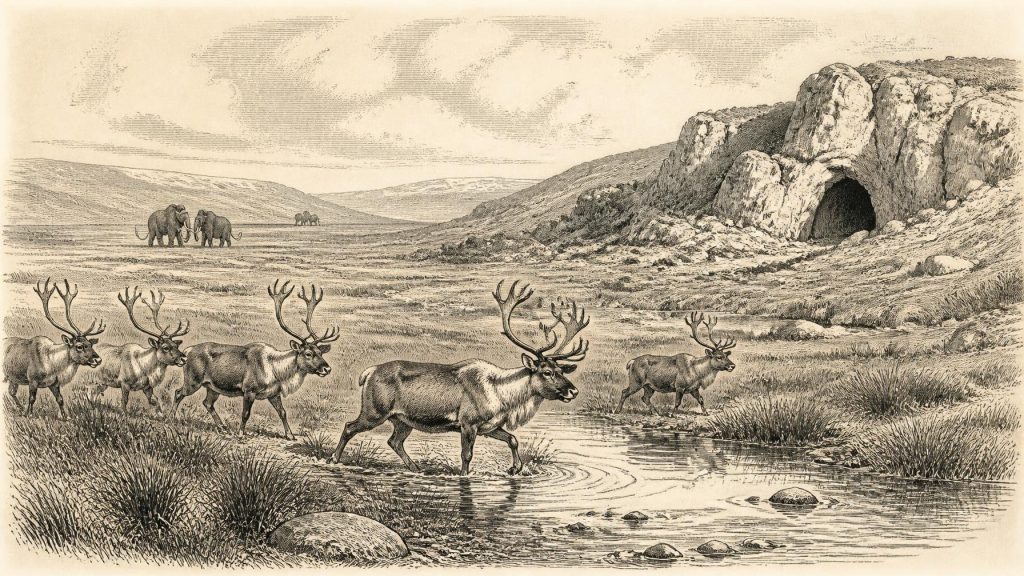
The most evocative Irish evidence close to this broad period comes from Castlepook Cave, near Doneraile in north County Cork. Excavations undertaken chiefly in the early twentieth century recovered a remarkable assemblage of Pleistocene animal remains. The cave is Ireland’s richest known site for vertebrate evidence from the period leading towards the Last Glacial Maximum. Its recorded fauna includes woolly mammoth, reindeer, giant deer, brown bear and spotted hyena, as well as smaller cold-adapted animals in later deposits.
These animals should not be imagined as members of one neatly contemporaneous herd. A cave bone collection may have accumulated over thousands of years. Water movement, natural death, carnivore activity, excavation methods and later disturbance can mix remains from different episodes. Spotted hyena is especially important to interpretation: hyenas could transport bones into a den or feeding place, gnaw carcasses and create concentrations that can superficially resemble human refuse. Castlepook is therefore direct evidence for a rich cold-stage animal world in Ireland, but it is not a single undisturbed camp floor.
Nevertheless, the fauna gives a reasonable picture of the kinds of country available in parts of southern Ireland during suitable phases. Reindeer and mammoth point towards broad, open grassland-tundra or steppe-tundra habitats, rather than dense forest. Large herbivores would have moved through seasonal landscapes in search of forage; wolves, bears and hyenas occupied overlapping ecological niches. The presence of water, caves and varied limestone terrain could have created local refuges. This was a land with living animal communities, not a sterile margin waiting passively for the ice sheet.
The Reindeer Bone Question
A reindeer femur from Castlepook has made this era especially significant. Reassessment of museum collections identified a deep mark on the bone that has been interpreted as a possible chop or cut made by a sharp stone implement while the bone was fresh. The animal bone has been presented as dating to approximately 33,000 years ago, placing it broadly near the chronological horizon represented by 31,166 BCE. If the mark was made by people at the time of carcass processing, it would be potentially the earliest evidence of human handling of an animal in Ireland.
That conditional language matters. A dated bone establishes the age of the animal, not automatically the date, agent or circumstances of every mark upon it. Nor does one modified limb bone establish a settlement, a hunting camp, a resident population or a named cultural group. The bone may have entered the cave through complex processes after any human action. Current excavations seek intact Pleistocene deposits, lithics, charcoal, further modified bone and secure stratigraphic context precisely because these are the materials needed to test the claim properly.
The cautious conclusion is still an important one. Ireland may have been visited intermittently by Upper Palaeolithic people during an earlier, ice-free phase of the last glacial cycle. At the very least, Castlepook demonstrates that its southern landscape supported prey animals and that a possible human signature deserves sustained investigation. It does not yet demonstrate enduring occupation. The securely dated butchered brown-bear patella from Alice and Gwendoline Cave, County Clare, is vastly later, dating to c. 12,810–12,590 calibrated years BP; it remains the published benchmark for a securely dated Upper Palaeolithic human presence in Ireland.
No Recoverable Polity
For political affairs, diplomacy and conflict, the evidence is silence. There were no states, kingdoms, borders, written laws or institutions in Ireland that archaeology can recover for this point in time. Nor is there evidence for an Irish population from which social ranks, kin groups, languages or leaders can responsibly be inferred. A passing hunting party, if one was present, would not constitute a polity. The island’s later political map has no relevance here.
The same restraint applies to everyday life, economy, trade, religion, culture and learning. Continental Upper Palaeolithic communities made sophisticated stone tools, used animal resources intensively and in some regions created portable and cave art. Those facts make a short human visit to Ireland conceivable, particularly when lower sea levels altered the geography of the Irish Sea region. They do not demonstrate that people at Castlepook possessed any particular toolkit, ritual, artwork, exchange network or belief system. No Irish dwelling, hearth, human burial, securely associated stone tool or artwork of this age is presently available to support such claims.
Approaching Maximum Glaciation
The great development illuminated by 31,166 BCE is therefore environmental rather than political: Ireland stood within a volatile pre-maximum glacial interval. In some areas, freshwater wetlands accumulated organic sediment; in others, cold-adapted mammals ranged over open country; in Cork, limestone caves trapped evidence later excavated and preserved in national collections. Yet the climatic trajectory was towards much more extensive glaciation. The British–Irish Ice Sheet later expanded across most of Ireland and the adjoining shelf, remodelling landscapes and destroying or burying much older evidence.
What survives is consequently exceptional and fragmentary. A silt layer under a drumlin, a cave bone, a hyena skull and a contested mark on reindeer bone are not small details in an otherwise complete story; they are much of the story. Around 31,166 BCE, Ireland cannot be assigned a historical event. It can, however, be recognised as a place of ice-free local habitats, severe climatic change and Pleistocene animal life, with a tantalising but unconfirmed prospect that humans briefly shared that world.
Primary Sources
- A Reconsideration of the Radiocarbon Dating of the Marine Isotope Stage 3 Fauna from Southern Ireland
- Trimlines, Blockfields and the Vertical Extent of the Last Ice Sheet in Southern Ireland
- Growth and Retreat of the Last British–Irish Ice Sheet, 31,000 to 15,000 Years Ago: The BRITICE-CHRONO Reconstruction
- BRITICE-CHRONO Maps and GIS Data of the Last British-Irish Ice Sheet 31 to 15 ka
- First Evidence of a Late Upper Palaeolithic Human Presence in Ireland
- New Insights on the Fauna of Ireland's Younger Dryas and Early Holocene from Alice & Gwendoline Cave
- The IntCal20 Northern Hemisphere Radiocarbon Age Calibration Curve (0–55 cal kBP)
- A Stratigraphic Framework for Abrupt Climatic Changes During the Last Glacial Period Based on Three Synchronized Greenland Ice-Core Records
- British–Irish Ice Sheet and Polar Front History of the Goban Spur, Offshore Southwest Ireland Over the Last 250,000 Years
- The Deglaciation of the Western Sector of the Irish Ice Sheet from the Inner Continental Shelf to Its Terrestrial Margin
- Spatio-Temporal Dynamics of Speleothem Growth and Glaciation in the British Isles
- Castlepook Cave, County Geological Site Report
- Spotted Hyena Skull
- Archaeology Research Excavation Grant Report: Castlepook Cave
- Castlepook Cave, County Cork, 2022 Excavation Report
- Heritage Artefacts of County Cork
- The Irish Quaternary Fauna Project
- Proceedings of the Royal Irish Academy, Volume 34
- Irish Quaternary Association
- The Mesolithic in Ireland: When Was It?