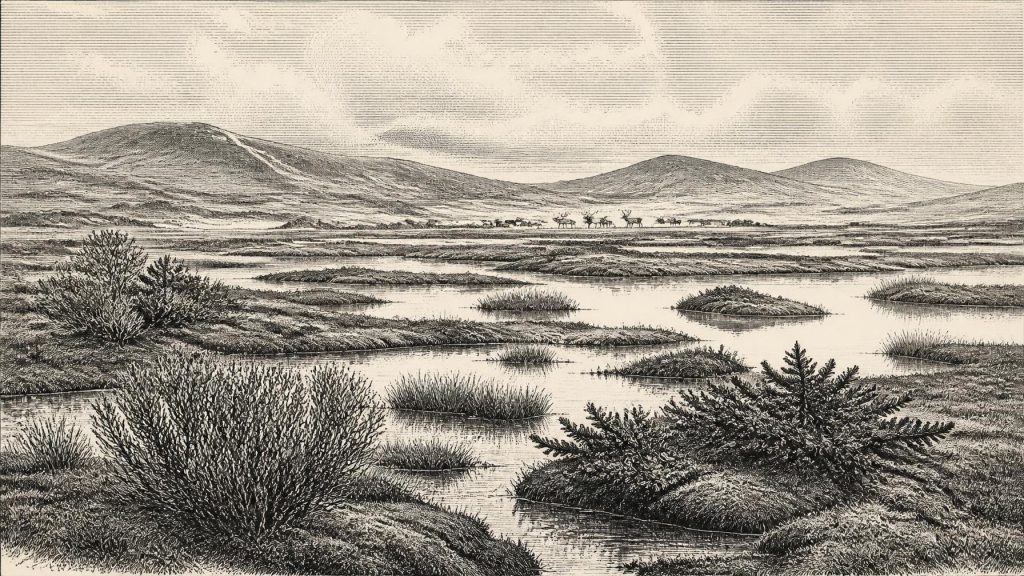
Juniper and Bogbean at Derryvree31123 BCE
31,123 BCE is a modern point within Marine Isotope Stage 3, not a recordable Irish year. Derryvree, County Fermanagh, preserves an organic freshwater deposit between glacial tills, dated broadly to 36,900–31,700 calendar years BP. Its plants, mosses and insects indicate open, tundra-like wetland with sedges, bogbean, juniper and dwarf willow during a locally ice-free interval. Castlepook Cave, County Cork, contains time-averaged remains of cold-climate fauna, including mammoth, reindeer and hyaena. A possibly butchered reindeer bone may indicate early human visitation, but remains contested. No evidence supports settlement, polities, trade or annual events; later ice obscured much evidence across the island.
Dateline
Modern calendar-year precision is not available for Ireland in 31,123 BCE. No Irish community recorded a year, no political event can be attached to it, and no excavated occupation horizon is narrow enough to identify a particular season, family or journey. The date is best treated as a modern point within the Late Pleistocene: roughly 33,070 calendar years before AD 1950, during Marine Isotope Stage 3, a climatically unstable part of the last Ice Age. The evidence closest in age comes in calibrated ranges, and it illuminates environments rather than an annual chronicle.
The most valuable Irish record is the Derryvree freshwater deposit near Maguiresbridge in County Fermanagh. During roadworks in 1969, a cutting through a drumlin exposed organic silts and fine sands lying between two tills, the unsorted sediments left by glacier ice. The sequence provides a firm relative history: ice had occupied the locality; an ice-free interval then permitted a wetland or shallow-water environment to form; and a subsequent ice advance covered it. Organic material from the deposit produced the radiocarbon determination BIRM-166, conventionally dated to 30,500 +1,170/−1,030 radiocarbon years BP. Calibration places it broadly at about 36,900–31,700 calendar years BP, or approximately 34,950–29,750 BCE. The requested year falls within that wide span, but cannot be isolated within it.
A Date Within a Range
This distinction is more than a technical caution. Radiocarbon years are not calendar years: the amount of carbon-14 in the atmosphere has varied, and old measurements must be calibrated against independently dated records. At more than thirty millennia ago, both the original uncertainty and the shape of the calibration curve make a single-year answer impossible. Derryvree may therefore be used to describe a cold Irish interval relevant to 31,123 BCE, but not to claim that a particular bogbean flower opened, a specific reindeer crossed Fermanagh, or people camped beside its water in that named year.
The wider setting was one of sharp climatic variation. Marine Isotope Stage 3 was neither a simple warm pause nor a single uninterrupted freeze. North Atlantic conditions shifted repeatedly between relatively milder interstadial episodes and colder stadials. Ireland’s later glacial history has also been revised substantially as new offshore, terrestrial and cosmogenic dating has accumulated. What is secure is that the island was moving towards the far more extensive glaciation of the Last Glacial Maximum, when the British–Irish Ice Sheet covered almost all of Ireland and much of the surrounding continental shelf. Around this earlier date, ice extent and the survival of ice-free terrain varied by region and through time.
Wet Ground Between Glaciers
Derryvree is important precisely because it contradicts any picture of an Ireland sealed continuously beneath ice throughout the Late Pleistocene. The organic bed preserves a local freshwater landscape within a periglacial climate: ground shaped by severe cold and seasonal freezing rather than necessarily by ice lying directly overhead. Pollen was poorly preserved, but plant macrofossils, mosses and insect remains supplied a more tangible record. They point to open, largely treeless vegetation, with wet hollows, pools and sedge-rich ground amid sparse tundra-like cover.
Among the plants identified or inferred from the deposit are sedges and other herbs, mosses, bogbean, water-milfoil, dwarf willow, juniper and cold-adapted taxa such as mountain-avens and alpine clubmoss. Their significance lies in combination, not in the presence of any one species. They suggest a mosaic of shallow freshwater, saturated ground and exposed mineral surfaces, rather than forest or a uniformly barren polar desert. Juniper and willow indicate that at least sheltered patches could sustain low woody growth; the wider assemblage nevertheless speaks of a landscape open to wind, frost and short growing seasons.
Such evidence supplies the nearest available picture of everyday ecological conditions. Meltwater and groundwater could gather in depressions, while frost action, snow cover and seasonal thaw repeatedly altered the margins. Small insects and mosses are especially useful witnesses because their survival depends on precise combinations of moisture, temperature and vegetation. They show that cold country was still biologically active. Yet Derryvree was a single basin in south Fermanagh, not a survey of the whole island. Its record cannot by itself establish the weather, vegetation or ice cover of Cork, Connacht or the Irish Sea coast at the same moment.
Animals and the Cork Caves
For the larger animals of Ice Age Ireland, Castlepook Cave near Doneraile in north County Cork is the crucial counterpart to Derryvree. Excavations and later study of museum collections have produced remains attributed to woolly mammoth, reindeer, giant deer, brown bear, wolf, Arctic fox, mountain hare, lemmings and spotted hyaena. It is Ireland’s richest known cave archive for Pleistocene vertebrates. These finds demonstrate that, during parts of the Late Pleistocene before the glacial maximum, the island could support a striking cold-climate fauna.
The cave collection must not, however, be read as a photograph of one living community. Caves accumulate material over long periods. Carnivores can drag carcass parts into them; water can move bones; earlier excavations may disturb layers; and later ice and sedimentary processes can remove or mix context. Spotted hyaena remains and damage on bones are particularly important reminders that Castlepook could function as a carnivore den or refuge. A mammoth bone or reindeer limb inside a cave does not prove that the animal died there, still less that every species represented occupied Cork together.
Nor can the Castlepook fauna be assigned neatly to 31,123 BCE. Individual dates from the cave and its historical collections fall across a broad pre-Last-Glacial-Maximum interval, while improved pretreatment and redating have shown why older bone chronologies require care. The responsible conclusion is modest but significant: Ireland was not ecologically empty in this part of the last Ice Age. At intervals, routes across the then-lower surrounding seas and exposed shelf landscapes permitted animals to reach the island, while changing climates and advancing ice repeatedly narrowed or erased habitats.
The Human Question
The most provocative item from Castlepook is a reindeer femur reported to bear a deep mark interpreted as having been made by a sharp stone tool during butchery. The bone has been presented as dating to around 33,000 years ago, making it broadly relevant to the period considered here. If the interpretation of the modification as anthropogenic is sustained, it would be Ireland’s earliest known indication of human activity, far earlier than the better documented terminal-Pleistocene and Mesolithic evidence.
Its importance should not turn one bone into a settled history. A mark on an animal bone is evidence for an action, not automatically for a dwelling, a resident population, a hunting territory or a named cultural group. No securely associated stone-tool assemblage, hearth, shelter floor, burial, ornament or art is presently known from Ireland for this date. Nor can the cave itself be assumed to have been a human home: its carnivore history makes that inference especially unsafe. The best formulation is that Castlepook offers a tantalising, contested and potentially transformative trace of Upper Palaeolithic human presence or visitation.
Should people have reached Ireland during such an interval, they would have been mobile hunter-gatherers operating within a wider north-west European world, not farmers or inhabitants of later-style villages. Their economy would have depended on gathering and hunting, perhaps including the processing of large herbivores, but direct Irish evidence does not permit reconstruction of their diet, social organisation, language, clothing or seasonal routes. The possibility of a human visit does not prove regular migration, trade or permanent settlement. Indeed, the scarcity of secure evidence may reflect both a small human footprint and the destructive power of later glaciers, which scoured landscapes and buried or removed older deposits.
No Polities, No Proven Diplomacy
There is no evidence for political affairs, warfare, diplomacy, chiefs, territories or institutions in Ireland at this date. Those categories require durable traces of human communities and, normally, much denser archaeological evidence than survives. Nor is there responsible evidence for formal religion, ritual practice, learning or artistic traditions on the island in 31,123 BCE. Continental Europe contains rich Upper Palaeolithic evidence for symbolic life, but it cannot simply be projected across the sea onto Ireland. The absence of Irish evidence is not proof that thought, belief or custom were absent from every possible visitor; it is a limit on what can be claimed.
Trade is similarly beyond demonstration. Sea level was substantially lower than today because vast volumes of water were stored in ice sheets, so coastlines and routes were different. But a lower sea does not mean that Ireland was automatically joined to Britain or the Continent by a dry land bridge at this particular time. The changing Irish Sea basin, ice margins, channels and exposed shelves formed a complex physical geography. Animal dispersal proves that some crossings were possible over longer intervals; it does not reveal a human exchange network or regular traffic.
An Island Approaching Transformation
What matters most about Ireland around 31,123 BCE is therefore environmental change. Derryvree records a locally ice-free wetland after an earlier glacial phase. Castlepook preserves the time-averaged remains of animals adapted to cold, open landscapes and of predators that could exploit them. Together they reveal an Ireland of tundra vegetation, freshwater hollows, mobile fauna and unstable climatic boundaries. They also show why the record is fragmentary: later advances of the British–Irish Ice Sheet transformed the ground, covered older surfaces and reduced the chance that campsites or bones would survive.
This is not a year of kings, battles or monuments. It is a narrow modern label placed within a much broader interval of ecological possibility and geological upheaval. The evidence supports a picture of a cold, partly habitable and changing Irish landscape, and perhaps the briefest human touch upon a reindeer carcass. It does not support an annual narrative. In deep prehistory, the most honest history is sometimes a map of limits: what sediments establish, what bones suggest, and what must remain unknown.
Primary Sources
- A Middle Midlandian Freshwater Series at Derryvree, Maguiresbridge, County Fermanagh, Northern Ireland
- Palaeoecology
- The Irish Quaternary Fauna Project
- Irish Pleistocene Biostratigraphy
- Castlepook Cave, County Geological Site Report
- Heritage Artefacts of County Cork
- Archaeology Research Excavation Grant 2022: Final Report
- 2022:564 – Castlepook Cave, Castlepook South, Cork
- Ireland's Palaeolithic Archaeology – Fleeting Footprints in a Frozen Land
- Pleistocene Vertebrates in the British Isles
- Growth and Retreat of the Last British–Irish Ice Sheet, 31,000 to 15,000 Years Ago: the BRITICE-CHRONO Reconstruction
- Extent and Timing of the Last Glacial Maximum (LGM) in Britain and Ireland: A Review
- Late Pleistocene Chronostratigraphy and Ice Sheet Limits, Southern Ireland
- Timing and Pace of Ice-Sheet Withdrawal Across the Marine–Terrestrial Transition West of Ireland During the Last Glaciation
- Stratigraphic and Palaeo-Geomorphological Evidence for the Glacial-Deglacial History of the Last British-Irish Ice Sheet in the North-Western Irish Sea
- Maximum Extent and Dynamic Behaviour of the Last British–Irish Ice Sheet West of Ireland
- Character of Advance and Retreat of the Southwest Sector of the British-Irish Ice Sheet During the Last Glaciation
- Spatio-Temporal Dynamics of Speleothem Growth and Glaciation in the British Isles
- The IntCal20 Northern Hemisphere Radiocarbon Age Calibration Curve (0–55 cal kBP)
- New Insights on the Fauna of Ireland's Younger Dryas and Early Holocene from Alice & Gwendoline Cave