
BIRM-166’s Tundra Silt31122 BCE
Approximately 31,122 BCE, Ireland lay within a Late Pleistocene climatic transition, not a precisely datable historical moment. At Derryvree, County Fermanagh, organic silts beneath glacial till, including radiocarbon sample BIRM-166, preserve evidence of a cold freshwater wetland amid open tundra vegetation. Lesser clubmoss and bogbean indicate marshy, sparsely wooded conditions, while advancing ice reshaped landscapes. Southern caves, especially Castlepook, retain remains of reindeer, mammoth, horse, predators and fauna, but mixed deposits require caution. A possibly tool-marked reindeer bone suggests, without proving, brief human presence. No secure contemporary tools, settlements, farming, polities or cultural practices are known; later glaciation obscured evidence.
Dateline
31,122 BCE is not a date to which Irish prehistory can be fixed in the ordinary calendar sense. No written record, settlement layer or event can be assigned to this particular year. It is best treated as an approximate point within the Late Pleistocene, during the long cold phase conventionally termed the Late Midlandian in Ireland and the Late Devensian in Britain. At this depth of time, radiocarbon determinations, their calibration ranges, cave deposits and glacial sediments provide ranges rather than anniversaries. The evidence illuminates landscapes and ecological changes, not a dated political history.
The closest especially informative Irish evidence is the freshwater deposit found beneath a drumlin at Derryvree, near Maguiresbridge in County Fermanagh. During road works in 1969, researchers recorded organic silts and fine sands sealed between two substantial sheets of glacial till. One measurement from this sequence, BIRM-166, produced an uncalibrated radiocarbon age of 30,500 years BP, with a sizeable error range of +1,170/−1,030 years. Calibration moves such an age further back in calendar time and broadens its uncertainty. It is therefore responsible to place the Derryvree wetland in a wider late-Marine Isotope Stage 3 to early-Marine Isotope Stage 2 interval, rather than declare that it represents conditions in 31,122 BCE precisely.
A Landscape on the Edge of Ice
The numbered year falls close to a major climatic transition. Reconstructions of the British–Irish Ice Sheet show that ice was building rapidly around 31,000 years ago, though its extent varied markedly by region and is not known with equal confidence everywhere. Upland ice centres existed in northern and western Ireland, while glaciers and ice fields occupied several mountain regions. The largest expansion of the ice sheet was still developing; its maximum extent in different sectors occurred at different times, broadly between about 30,000 and 22,000 years ago.
That distinction matters. Ireland was neither uniformly buried beneath ice nor a single open plain. It contained shifting combinations of ice-covered uplands, cold lowlands, meltwater corridors, exposed rock, gravelly ground and wetlands. Derryvree’s organic layer survived because sediment accumulated in freshwater conditions before later ice or ice-related deposits sealed it beneath the drumlin. Such local archives are exceptionally valuable, but they are not a nationwide weather report. They tell us what could persist in one Fermanagh basin during a cold interval, not what every Irish valley looked like at the same moment.
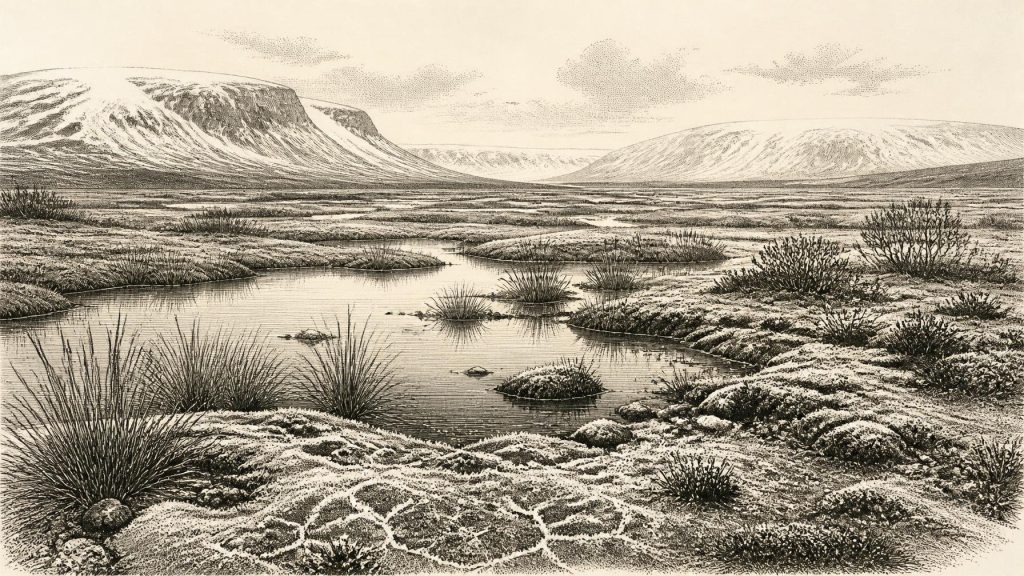
The Derryvree evidence nevertheless gives substance to the phrase ‘Ice Age Ireland’. The deposit contained a flora and fauna described by its excavators as having a full-glacial character, indicating open tundra vegetation and a periglacial climate. Periglacial did not mean permanently ice-covered: it denotes ground and ecosystems shaped by severe cold, repeated freezing and thawing, sparse plant cover and short growing seasons in the vicinity of glaciers or ice sheets. The likely scene was not a forest. It was a low, exposed mosaic of wet ground, shallow water, sedges, mosses, dwarf shrubs and scattered herbs, with seasonal snow and frost exerting more influence than trees.
The Freshwater Archive at Derryvree
Plants are among the strongest witnesses for this period because spores, pollen, seeds and other small remains can survive where wood, skin and entire landscapes do not. The Derryvree material includes indicators of cold open ground and wetland habitats. Fossil records from the deposit have been noted for lesser clubmoss, a plant of open, often upland or wet places, and bogbean, whose seed signals standing or slow-moving fresh water. These finds support an interpretation of pools and marshy margins amid tundra-like vegetation. They do not establish a particular temperature for 31,122 BCE, but they do rule out a densely wooded Irish countryside.
Water was central to the landscape. Fine silts settle in quiet conditions, so the Derryvree sequence points to a freshwater basin that endured long enough to accumulate organic mud. Around it, frost action would have disturbed soil, while meltwater and seasonal runoff carried mineral sediment into hollows. In a world where the coastline lay far from its modern position because sea level was lower, inland drainage and ice margins were also changing. The Ireland of this period cannot be plotted safely on a modern road map: later ice erosion, deposition, peat growth, river change and rising seas have remade its surfaces and shores.
Other Irish localities demonstrate why caution is necessary. Aghnadarragh in County Antrim has yielded organic and stratified deposits between glacial tills, while cave sites in the south preserve animal remains of differing ages. Together they show that apparently barren terrain could contain episodes of open ground, freshwater sedimentation and animal movement. They do not prove that such episodes were continuous, simultaneous or identical across the island. The broad pattern is regional instability: cold habitats existed, but advancing ice repeatedly threatened to erase them.
Animals, Caves and a Fragile Human Question
Southern Irish caves provide a second, very different archive. Castlepook Cave near Doneraile in County Cork has produced remains of reindeer, mammoth, horse, bear, wolf and other Pleistocene animals, as well as evidence for spotted hyaena. These species should not be imagined as a single, permanent community living together in one valley. Cave assemblages can be mixed by carnivores, water, collapse, excavation and later disturbance; individual bones may belong to different millennia. Even so, direct re-dating has established that parts of the Castlepook fauna are substantially older than earlier measurements suggested, confirming that Ireland supported a richer cold-stage mammal fauna during Marine Isotope Stage 3.
Reindeer are the animal most directly relevant to a tundra landscape. Their presence indicates that suitable open habitats and routes into Ireland existed at least intermittently. Mammoth and horse remains suggest broad grazing country, while hyaena bones and gnawing evidence remind us that caves were sometimes dens or scavenging places rather than shelters for people. A cave bone is consequently evidence first for an animal, and only sometimes for the circumstance in which it died or was brought underground.
One Castlepook reindeer femur has attracted particular attention because a mark on it has been interpreted as damage made by a sharp stone tool during butchery. Public heritage accounts have associated the specimen with roughly 31,000 BCE. It is an important possibility, not a secure yearly event. The bone’s age, the identification of the mark, and the presence of a person are three separate propositions. No securely associated stone-tool assemblage, hearth, dwelling, burial or occupation surface of comparable age has yet been found in Ireland. The original cave excavations also disturbed deposits, limiting what can now be reconstructed from provenance alone.
If the mark ultimately withstands further microscopic and contextual study, it would suggest a brief encounter between people and a reindeer carcass during a cold-stage interval. It would not demonstrate a settled community, a named group or continuous occupation of Ireland. Mobile Upper Palaeolithic hunters elsewhere in north-west Europe had sophisticated stone technologies, extensive knowledge of animal behaviour and social connections across wide territories. Those are useful comparisons, but they are not direct evidence that a similar camp, language, ritual or social organisation existed in Ireland at this exact time.
No Polities, No Recorded Conflict
Political affairs, diplomacy and formal warfare are beyond the reach of the Irish evidence for this date. There were no states, kingdoms, borders, inscriptions or historical persons to identify. Nor can archaeology responsibly turn the presence of predators or a possible butchered bone into a story of conflict between human groups. If people did visit, their survival would have depended on small-scale decisions: finding sheltered ground, reading weather and ice, locating animals, maintaining tools and sharing food. These are inferences from human ecology, not recorded facts about a known Irish population.
The same restraint applies to religion, culture and learning. Nothing from Ireland around this time demonstrates shrines, burials, art, ceremony or a distinct local tradition. Caves can acquire powerful meanings in later societies, but their Pleistocene animal deposits do not by themselves show ritual. The most defensible cultural conclusion is negative but significant: Ireland has not yielded an unequivocal human material culture securely dated to this interval. Its archaeological silence is partly genuine and partly the consequence of preservation. Later glaciers scoured and buried land surfaces; the rising post-glacial sea drowned former coastal plains; and many early cave collections were excavated before modern recording standards.
Economy Without Settlement
There is no evidence for farming, herding, villages, trade networks or permanent settlement in Ireland at 31,122 BCE. A possible human visit would belong to a foraging economy, based on wild animals and gathered resources, but even that must remain conditional until a securely excavated Palaeolithic site is found. Reindeer would have offered meat, fat, hide, sinew, bone and antler; yet the inference that people used these materials in Ireland cannot be made from animal presence alone. Carnivores and natural processes could produce much of the surviving bone record.
The more certain history is environmental. Northern Fermanagh preserves the sediment of a cold freshwater wetland, while Cork caves preserve fragments of a wider Pleistocene fauna. At the scale of the island, ice was accumulating and landscapes were becoming increasingly vulnerable to burial beneath till. This was a threshold period rather than a foundation moment. The later Last Glacial Maximum would obscure much of what came before it, leaving historians dependent on rare sealed silts, isolated bones and scientific methods capable of revising old conclusions.
Thus Ireland around 31,122 BCE is best understood not as a year of documented human action but as an interval of tundra, freshwater basins, mobile animals and growing ice. BIRM-166, sealed under a Fermanagh drumlin, is especially eloquent because it preserves a brief ecological world otherwise lost. Its lesson is both vivid and modest: before the island’s later glacial cover reached its greatest power, some Irish lowlands could still hold open cold-country wetlands and the life adapted to them.
Primary Sources
- A Middle Midlandian Freshwater Series at Derryvree, Maguiresbridge, County Fermanagh, Northern Ireland
- The Irish Quaternary Fauna Project
- A Reconsideration of the Radiocarbon Dating of the Marine Isotope Stage 3 Fauna from Southern Ireland
- Growth and Retreat of the Last British–Irish Ice Sheet, 31,000 to 15,000 Years Ago: the BRITICE-CHRONO Reconstruction
- Dimensions and Chronology of the Last Ice Sheet in Western Ireland
- Oscillating Retreat of the Last British-Irish Ice Sheet on the Continental Shelf Offshore Galway Bay, Western Ireland
- Late Pleistocene Chronostratigraphy and Ice Sheet Limits, Southern Ireland
- Response of the Irish Ice Sheet to Abrupt Climate Change During the Last Deglaciation
- New Data for the Last Glacial Maximum in Great Britain and Ireland
- First Evidence of a Late Upper Palaeolithic Human Presence in Ireland
- New Insights on the Fauna of Ireland’s Younger Dryas and Early Holocene from Alice & Gwendoline Cave
- Dublin Radiocarbon Dates II
- The Exploration of Castlepook Cave, County Cork
- Irish Cave Exploration
- 2022:564 – Castlepook Cave, Castlepook South, Cork
- Archaeology Research Excavation Grant 2022: Final Report
- Heritage Artefacts of County Cork
- Mammoth Cave
- Selaginella selaginoides
- Menyanthes trifoliata