BIRM-166’s Mossy Pools31110 BCE
31,110 BCE is not a precise Irish historical date but falls within a broad later Last Glacial Period interval. At Derryvree, County Fermanagh, organic freshwater deposits beneath a drumlin, radiocarbon dated BIRM-166, reveal open, treeless periglacial tundra with sedges, herbs, mosses, pools and cold-adapted plants. Ireland’s conditions varied regionally as ice expanded and sea levels stood lower. Castlepook Cave, County Cork, preserves diverse late Pleistocene fauna, although its disturbed remains span multiple episodes. A possibly tool-marked reindeer bone suggests, but does not establish, human presence. No secure evidence supports settlements, institutions or cultural practices; glacial erosion has severely limited survival.
Dateline
The modern label 31,110 BCE cannot be treated as a date in the ordinary historical sense. Ireland had no writing, calendar, named rulers or recoverable annual sequence at this depth of time. In archaeological terms, the point falls roughly 33,060 calendar years before AD 1950, in the later part of the Last Glacial Period and Marine Isotope Stage 3 (MIS 3). It is therefore better understood through broad, calibrated ranges than through a supposed event of a single year. The closest and most informative Irish evidence is an environmental deposit at Derryvree near Maguiresbridge, County Fermanagh, whose calibrated range of about 36,900–31,700 years before AD 1950 encompasses this notional date.
A Date Within a Long Interval
Derryvree was revealed in 1969 when roadworks cut through a drumlin, one of the streamlined hills shaped by glacier ice. The exposed sequence contained freshwater silts, fine sands and organic sediments trapped between two separate beds of till: unsorted debris deposited by ice. This stratigraphy is the fundamental evidence. It demonstrates that glacial conditions affected the locality, that an intervening period allowed a freshwater environment to form, and that a later advance of ice buried and preserved its deposits. It does not identify the exact year in which a particular plant grew, an insect died or water stood in a pool.
The organic material produced radiocarbon determination BIRM-166, conventionally reported as 30,500 radiocarbon years before present, with a substantial uncertainty. Radiocarbon years are not calendar years. Atmospheric carbon-14 has changed over time, so old results must be calibrated against internationally maintained curves. At around 30,000 radiocarbon years ago, the conversion yields wide probability ranges rather than a precise calendar point. The named year can responsibly be placed inside Derryvree’s broader chronological horizon; it cannot be assigned to the beginning, middle or end of that deposit, still less to a human action.
Freshwater Beneath the Drumlin
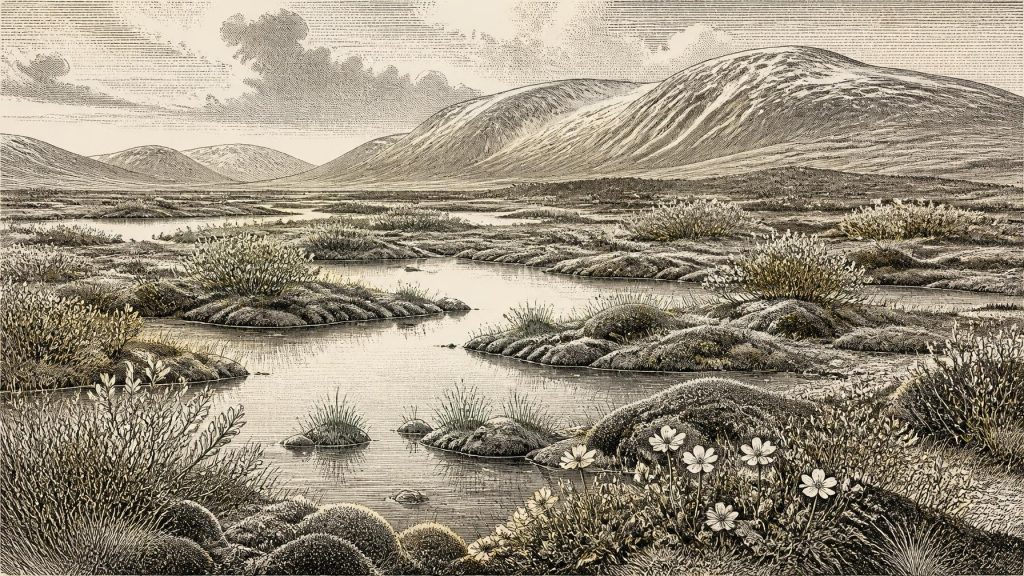
What Derryvree does preserve is an exceptional glimpse of a cold Irish habitat. Its pollen, plant macrofossils, mosses and insects indicate open, treeless vegetation in a periglacial climate: ground subject to long winters, frost and short growing seasons, but not permanently sealed beneath ice. Sedges, grasses and herbs were important. Fossils of plants including mountain avens, dwarf willow and bogbean point to a mixture of exposed ground, wet margins and shallow freshwater. Mosses and insect remains indicate pools with abundant plant material around their edges. Older descriptions call such ground “muskeg”; the useful modern point is that it was a saturated, mossy and locally ponded tundra landscape rather than woodland or blanket bog as later Ireland would know it.
These remains are observations, whereas the broader landscape reconstruction is interpretation. The deposit shows that suitable wetland habitats existed at Derryvree. It does not prove that every valley in Ireland was similarly wet, that the entire island was uniformly treeless, or that modern Arctic conditions can be simply transplanted into the past. A few grains of tree pollen, for example, need not signify a nearby forest, because pollen can travel far. The combined evidence nevertheless makes nearby woodland improbable: the dominant signal is of sparse, low vegetation adapted to cold and open country.
An Uneven, Changing Ireland
Ireland around this time was not yet at the Last Glacial Maximum, the later period when the British–Irish Ice Sheet attained its greatest volume. Recent reconstructions identify substantial ice growth from about 31,000 years ago, but its timing, thickness and extent varied between regions. Modelled reconstructions suggest ice caps and glaciers on Irish uplands while other areas retained ice-free terrain. This makes a single national weather report impossible. Derryvree records one inland Fermanagh setting; uplands, western coasts, lowlands and the Irish Sea basin could have differed greatly in exposure, snow cover, drainage and proximity to ice.
Sea level was far lower than it is now, altering coastlines and the geography of the Irish Sea. Yet the available evidence does not securely establish the precise route by which each animal, or any person, reached Ireland at this particular time. It is reasonable to see Ireland as part of a wider north-west European ecological zone, not as an isolated modern island, but it would be unsafe to draw a specific land bridge, shoreline or migration corridor for 31,110 BCE. Repeated glacial erosion and later rising seas have removed or submerged much of the relevant evidence.
The Cave Record at Castlepook
In north County Cork, Castlepook Cave near Doneraile provides a very different archive. Its limestone passages yielded one of Ireland’s richest assemblages of Pleistocene animal remains, including woolly mammoth, giant deer, reindeer, brown bear and spotted hyena, as well as cold-adapted smaller mammals. The cave is crucial evidence that Ireland supported, or was visited by, a much broader Ice Age fauna than the later island. It also conveys ecological tension: a cave could be a carnivore den, a trap, a place into which water carried material, or a repository of bones accumulated over long spans.
That qualification is essential. Castlepook’s early excavations and disturbed deposits mean that its finds must not be imagined as one contemporaneous herd assembled in 31,110 BCE. Improved radiocarbon methods have shown that several older Irish cave dates need revision, and the faunal collection represents episodes across the late Pleistocene. Its value is regional and chronological, demonstrating a changing cold-stage world before the maximum ice advance, rather than supplying a scene from one day or even one century.
The Human Question
A reindeer femur from Castlepook has attracted particular attention because a mark on it has been interpreted as damage made by a sharp stone tool while the bone was fresh. If that interpretation is sustained, it may signal that people butchered a reindeer in Ireland roughly 33,000 years ago. Such a finding would greatly extend the potential human story of the island. But it is not yet evidence for a settled population, a camp at Castlepook, or a community present in the year considered here. No securely associated stone-tool assemblage, hearth, dwelling, burial or repeated occupation surface has yet demonstrated an Irish Upper Palaeolithic settlement of this age.
Consequently, political affairs, diplomacy and warfare cannot be reconstructed. There are no named groups, territories, leaders or institutions. Nor is there evidence for trade in the usual archaeological sense: no confirmed exchange network, imported artefact or permanent settlement belongs securely to this horizon. If occasional hunter-gatherers did reach Ireland, their movements would have depended upon seasonal knowledge, social ties beyond the island and the hazards of a cold landscape; that is a plausible inference from the wider European Upper Palaeolithic, not an established fact about Derryvree or Castlepook.
Life, Belief and Absence
The evidence supports no claim about language, religious rites, art, learning or kinship systems in Ireland at this date. Nor can it demonstrate houses, clothing, boats or hunting methods. The strongest story is environmental: freshwater persisted in sheltered places; small plants and insects occupied wet ground; larger animals ranged through some Irish landscapes; and advancing ice was beginning to narrow the conditions under which such communities could survive. Any people who may have entered this world left, so far, only a disputed and isolated trace.
That apparent silence is historically meaningful. Later ice sheets scoured bedrock, reworked older sediments and buried or destroyed exposed sites. The survival of a thin organic layer beneath a Fermanagh drumlin and bone collections in a Cork cave is therefore remarkable. Around 31,110 BCE, Ireland’s recoverable past is not a chronicle of rulers or battles. It is a fragile archive of cold water, moss, sedge, animal bone and moving ice: evidence sufficient to show a living, changing landscape, but not sufficient to invent a year-by-year human history for it.
Primary Sources
- A Middle Midlandian Freshwater Series at Derryvree, Maguiresbridge, County Fermanagh, Northern Ireland
- Palaeoecology: IQUA Field Guide
- The Subdivision of the Quaternary Period in Ireland
- Irish Pleistocene Biostratigraphy
- A Reconsideration of the Radiocarbon Dating of the Marine Isotope Stage 3 Fauna from Southern Ireland
- The Irish Quaternary Fauna Project
- Growth and Retreat of the Last British–Irish Ice Sheet, 31,000 to 15,000 Years Ago: the BRITICE-CHRONO Reconstruction
- The Timing and Magnitude of the British–Irish Ice Sheet Between Marine Isotope Stages 5d and 2
- Behavioural Tendencies of the Last British–Irish Ice Sheet Revealed by Data–Model Comparison
- Episodic Speleothem Deposition Tracks the Terrestrial Impact of Millennial-Scale Last Glacial Climate Variability in SW Ireland
- Spotted Hyena Skull
- Castlepook Cave: Cork County Geological Site Report
- 2022:564 – Castlepook Cave, Castlepook South, Cork
- Archaeology Research Excavation Grant Report: Castlepook Cave and Kilcolman Cave
- The IntCal20 Northern Hemisphere Radiocarbon Age Calibration Curve (0–55 cal kBP)
- IntCal Publications
- Dansgaard–Oeschger Events in Climate Models: Review and Baseline Marine Isotope Stage 3 Protocol
- Menyanthes trifoliata L.
- Salix herbacea L.
- Dryas octopetala L.