
Maguirebridge and Mammoth Cave31109 BCE
31,109 BCE is a modern chronological label, not a dateable Irish event. During Marine Isotope Stage 3, Ireland experienced unstable cold conditions before maximum glaciation. Derryvree, County Fermanagh, preserves freshwater sediments between tills, indicating treeless wetlands with grasses, sedges, herbs, juniper, insects and shallow pools during an ice-free interval. Castlepook Cave, County Cork, yielded mammoth, reindeer, hyaena and other cold-adapted fauna, demonstrating open grazing country and changing connections to north-west Europe. A cut-marked reindeer bone may indicate human carcass processing about 33,000 years ago, but cannot prove settlement. Subsequent ice expansion destroyed or buried much earlier evidence across the island.
Dateline
A Modern Year Without a Contemporary Calendar
Modern calendar-year precision is not available for Ireland in 31,109 BCE. No written record, named community, ruler, settlement sequence or event can be assigned to that single year. The number is a modern conversion, approximately 33,058 years before AD 1950, the conventional reference point used for radiocarbon chronology. At this depth in time, even well-dated evidence belongs to ranges of centuries or millennia, not to a particular season or day.
The responsible setting is the Late Pleistocene, during Marine Isotope Stage 3: a long, unstable cold phase before the greatest expansion of the last British–Irish Ice Sheet. Ireland was not yet necessarily the wholly ice-covered landscape often imagined for the Last Glacial Maximum. The fullest ice expansion came later, broadly after c. 26,000 years ago. Around the modern label 31,109 BCE, the island’s environments were changing sharply, and the surviving evidence is fragmentary because later ice repeatedly eroded, buried and rearranged older deposits.
Two very different archives give Ireland’s best evidence for this broad interval. One is a freshwater deposit found beneath a drumlin at Derryvree, near Maguiresbridge in County Fermanagh. The other is the animal-bone assemblage from Castlepook Cave, or Mammoth Cave, near Doneraile in County Cork. Neither is a historical chronicle. Together, however, they reveal an island of cold open habitats, intermittent water, mobile animals and perhaps exceptionally fleeting human visits.
Fermanagh Between Ice Advances
Derryvree was exposed in road works in 1969. Excavators found organic-rich freshwater silts and fine sands trapped between two separate sheets of glacial till. The position of the deposit is crucial: it proves that, at least locally, freshwater sediment accumulated after one ice advance and before another later advance buried the evidence. It is not proof that every part of Ireland was ice-free at the same moment, nor that the site preserves a continuous record of the island.
A conventional radiocarbon determination from the deposit was 30,500 radiocarbon years BP, with a substantial uncertainty. Later syntheses have placed its broad calibrated age approximately within c. 36,900–31,700 cal BP, although the exact calendar expression depends on calibration and treatment of the measurement. The modern date 31,109 BCE lies near this wide chronological horizon, but cannot be fixed to a particular sediment layer. The correct conclusion is therefore modest: Derryvree illuminates conditions in northern Ireland around this part of the late glacial cycle, rather than documenting conditions in one numbered year.
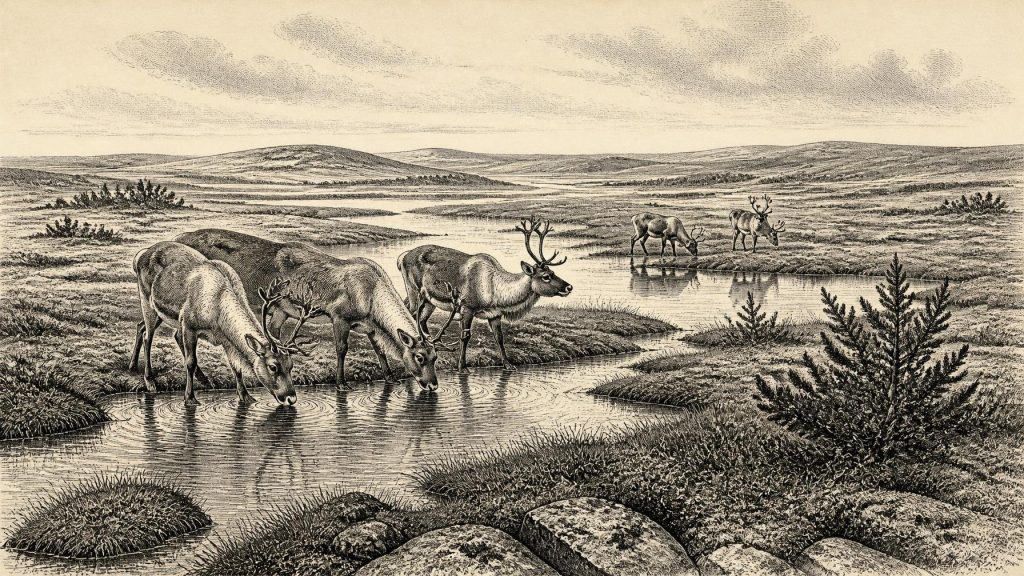
The silts contained pollen, plant macrofossils, mosses and insects. Their combined evidence indicates a largely treeless, cold landscape with grasses, sedges, herbs, juniper and low-growing plants, alongside wet ground and shallow freshwater pools. Bogbean, water-milfoil and aquatic mosses point to local standing or slow-moving water. Insects reinforce the picture of a mossy, plant-rich wetland rather than a barren polar desert. Winters were probably severe, while short growing seasons allowed wetland plants to exploit sheltered waterlogged ground.
This was a mosaic, not a uniform tundra plain. Around the pools may have stood sedge marsh, damp mossy ground, exposed mineral soil and patches of dwarf shrub. Such places could offer water and forage to animals even when the wider terrain was sparse. Yet the evidence records ecology, not human settlement: there are no houses, hearths, tools, fields or graves at Derryvree.
Cork’s Cave Fauna
Castlepook Cave provides a contrasting southern record. Its old excavations recovered bones of woolly mammoth, reindeer, spotted hyaena, brown bear, wolf, Arctic fox, hare, stoat and lemmings. The collection was accumulated through more than one episode and not all specimens have secure modern excavation contexts. It must not be treated as a single living animal community photographed at one instant. Nevertheless, radiocarbon dates on mammoth and spotted-hyaena material, broadly around 35,000–34,000 radiocarbon years BP in older reporting, place important elements of the assemblage in the same general pre-maximum cold-world interval.
The fauna supports the environmental reconstruction from Fermanagh. Reindeer, lemmings and Arctic fox are animals of open, cold country; mammoth implies extensive grazing land rather than closed forest. Spotted hyaenas are especially revealing. They were formidable scavengers and hunters, and caves could act as refuges, dens or places where bones accumulated after carnivores had fed. A cave bone collection consequently records animal behaviour, chance preservation and the history of excavation as much as it records the landscape outside.
There is no basis for describing this as a settled Cork society. Mammoths and hyaenas did not share the landscape with towns, farms or territorial polities. But the animals demonstrate that Ireland could support substantial cold-adapted fauna during parts of this period. Their presence also indicates connections with the wider north-west European land-and-sea landscape, whose coastlines and routes were very different when global sea level was lower.
A Possible Human Trace
Castlepook has become important to Irish prehistory because a reindeer femur fragment was re-examined and reported in 2021 as bearing deep marks interpreted as having been made by a sharp stone tool during carcass processing. Accelerator radiocarbon dating reportedly placed the bone at about 33,000 years ago. If that interpretation is sustained by further analysis, it would be Ireland’s earliest known indication of human activity by a very large margin.
That finding must be expressed with care. A marked bone is not a camp, a tool kit or proof of a permanent population. The old cave collection has limited stratigraphic context, and the surviving evidence does not identify who made the mark, how long they remained, how many people were present, or whether they returned. Nor can a broad date for the bone be converted into an event at 31,109 BCE. The most that can responsibly be suggested is that people may have entered or reached Ireland during this wider interval and processed a reindeer carcass with a stone edge.
If humans were present, their way of life would have been that of highly mobile Upper Palaeolithic hunter-gatherers, relying on detailed knowledge of animals, weather, raw materials and routes across a shifting north-west European world. Reindeer could provide meat, marrow, hide, sinew, antler and bone; but those useful possibilities are general inference, not demonstrated products from this particular bone. No securely associated Irish hearth, dwelling, artwork, burial or lithic assemblage has yet been recovered for this horizon.
What Cannot Be Reconstructed
Political affairs, diplomacy, laws, named leaders and warfare cannot be recovered for Ireland at this date. There is likewise no evidence for organised religion, formal monuments, agriculture, long-distance commerce or an Irish language. It would be misleading to fill these absences with imagined clans, chieftains or rituals. The archaeological record is too slight even to show a continuing human population.
Conflict can be discussed only in an ecological sense. Carnivores and people, if people were present, may have sought the same animal resources, but there is no evidence for violence between human groups. Economy is visible only indirectly in the seasonal productivity of wetlands and in the possible processing of one reindeer bone. Culture and learning are inferred at the broadest level from the skill required to survive a cold, mobile hunting landscape, not from any specifically Irish artwork or tradition.
Approaching the Ice Maximum
The larger development was climatic and geographical. Ireland lay within a period of abrupt northern-hemisphere climate oscillations, when relatively milder interstadial conditions could be interrupted by renewed cold. Speleothems at Crag Cave in County Kerry show that liquid water periodically moved through southern Irish caves during Marine Isotope Stage 3, independently confirming that conditions were not simply one uninterrupted freeze.
Yet cooling was gathering force. Evidence from Derryvree, Greenagho and other inter-till deposits shows that major lowland ice was not continuously present through the whole preceding interval. Subsequent expansion of the Irish and British–Irish ice sheets would transform the island, overrun or remove many older land surfaces and help explain why evidence for human activity is so scarce. Around 31,109 BCE, Ireland’s history is therefore best told not as a year of kings or battles, but as a precarious interval of open country, wetland refuges, Ice Age animals and an unresolved possibility of human passage before the deep freeze intensified.
Primary Sources
- A Middle Midlandian Freshwater Series at Derryvree, Maguiresbridge, County Fermanagh, Northern Ireland
- Middle Midlandian Interstadial Deposits at Greenagho, Near Belcoo, County Fermanagh, Northern Ireland
- Freshwater Organic Deposits and Stratified Sediments Between Early and Late Midlandian (Devensian) Till Sheets, at Aghnadarragh, County Antrim, Northern Ireland
- Trimlines, Blockfields and the Vertical Extent of the Last Ice Sheet in Southern Ireland
- Growth and Retreat of the Last British–Irish Ice Sheet, 31,000 to 15,000 Years Ago: The BRITICE-CHRONO Reconstruction
- New Data for the Last Glacial Maximum in Great Britain and Ireland
- Dating Constraints on the Last British-Irish Ice Sheet: A Map and Database
- Dimensions and Chronology of the Last Ice Sheet in Western Ireland
- Episodic Speleothem Deposition Tracks the Terrestrial Impact of Millennial-Scale Last Glacial Climate Variability in SW Ireland
- Episodic Speleothem Deposition Tracks the Terrestrial Impact of Millennial-Scale Last Glacial Climate Variability in SW Ireland
- Irish Pleistocene Biostratigraphy
- The Irish Quaternary Fauna Project
- Aghnadarragh
- Figure 6.— The Subdivision of the Quaternary Period in Ireland
- References and Recommended Reading
- Prehistoric Details
- Spotted Hyena Skull
- The IntCal20 Northern Hemisphere Radiocarbon Age Calibration Curve (0–55 cal kBP)
- IntCal Publications
- IntCal History
- The Geological Heritage of County Leitrim
- Ireland's Palaeolithic Archaeology – Fleeting Footprints in a Frozen Land
- Reindeer Bone Found in Cork Cave Shows Human Activity in Ireland 33,000 Years Ago
- A North-Western Habitat: the Paleoethology and Colonisation of a European Peninsula