Castlepook’s Reindeer Window31111 BCE
Around 31,000 BCE, Ireland lay within the cold, unstable Marine Isotope Stage 3, with lower seas, shifting ice, and open tundra-like habitats rather than modern coastlines or forests. Wetland deposits in Fermanagh preserve plants adapted to cold, moist conditions. Castlepook Cave, County Cork, contains re-dated animal remains showing that reindeer, mammoth, giant deer, bears, wolves, Arctic foxes and hyaenas occurred during parts of this period. A possibly cut-marked reindeer femur suggests brief Upper Palaeolithic human contact, but no secure occupation site exists. Environmental evidence, not events or societies, defines this fragmentary era, continually reassessed through improved dating and research methods.
Dateline
“31,111 BCE” is a modern chronological label, not a date at which Ireland can be described year by year. No calendar, writing, named community or securely datable event survives from this depth of time. Archaeology cannot identify what happened on one particular day, season or even year. The responsible approach is to place the notional date within a wider calibrated interval: roughly 33,000 calibrated years before present, or about 31,000 BCE, in the later part of Marine Isotope Stage 3, a cold and highly variable phase of the last Ice Age. The evidence is sparse, uneven and often revised as dating methods improve.
A Cold, Changing Island
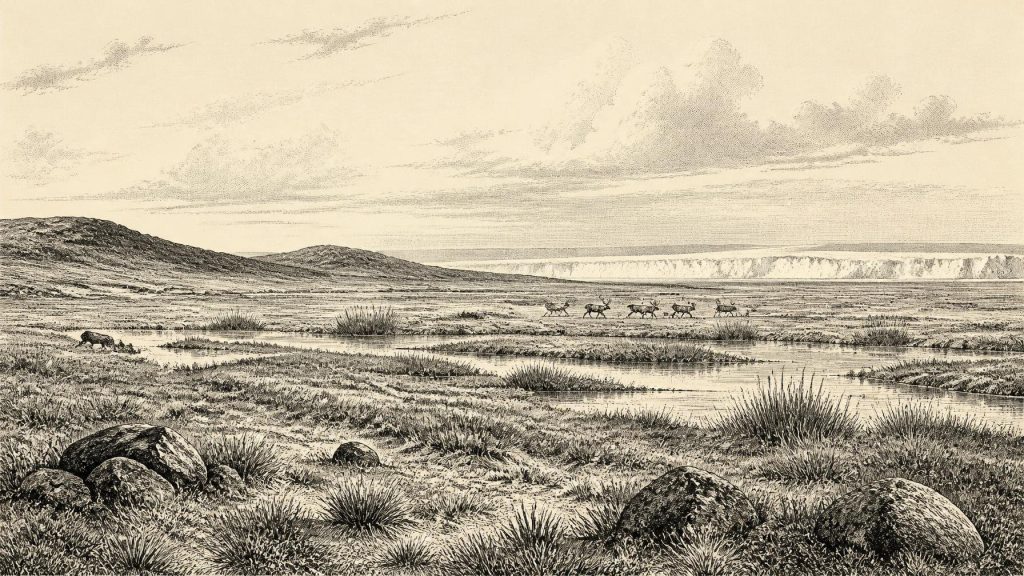
Ireland then occupied the north-western edge of Europe, exposed to abrupt climatic swings in the North Atlantic world. It was not yet at the climatic peak conventionally called the Last Glacial Maximum. Major reconstructions place the maximum expansion of the British–Irish Ice Sheet later, broadly between about 27,000 and 23,000 calibrated years before present. At the approximate horizon represented by 31,111 BCE, however, ice was already an increasingly powerful force in the Irish landscape. Its margins, thickness and timing differed between regions and changed over centuries and millennia; a single map of the island for one supposed year would imply more precision than the evidence allows.
Sea level was far below its modern position because vast quantities of water were stored in continental ice sheets. Ireland’s coastlines therefore lay beyond today’s shore in many places, and the Irish Sea basin was a changing geographical zone rather than the fixed maritime barrier familiar today. Lower sea level did not automatically create a straightforward, continuous land bridge to Britain or continental Europe. Ice, changing channels, exposed shelf, rivers, wetlands and local relief all mattered. The practical routes available to animals, and perhaps to people, remain a matter of reconstruction rather than direct observation.
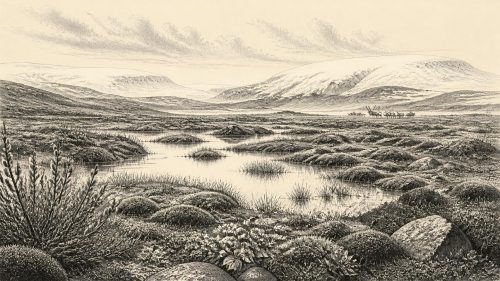
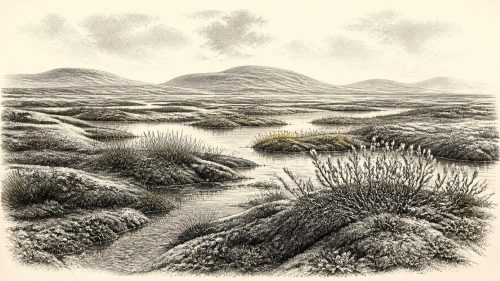
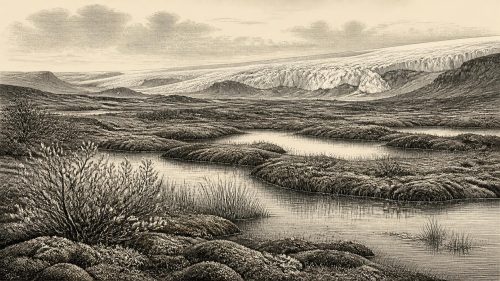
The climate supported open, largely treeless landscapes in many areas. Evidence from Irish fossil deposits points towards a mosaic of grassland, herb-rich tundra, wet ground, dwarf shrubs and scattered cold-tolerant vegetation rather than a uniform white wilderness. In County Fermanagh, organic silts trapped between glacial tills at Derryvree and nearby Maguiresbridge preserve a valuable environmental archive. Plant macrofossils and pollen from such deposits include sedges, mosses, bogbean, water-milfoil, dwarf willow, mountain-avens and other plants suited to open, cold, moist conditions. These remains do not provide a photograph of all Ireland at 31,111 BCE, but they show that ice-free intervals could sustain freshwater pools and varied tundra-like plant communities.
What the Caves Preserve
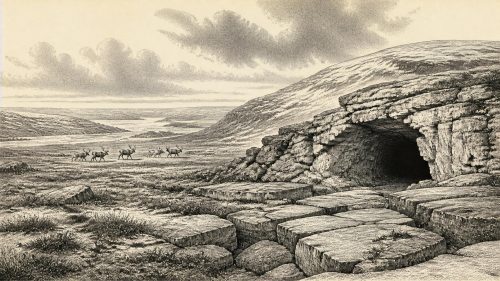
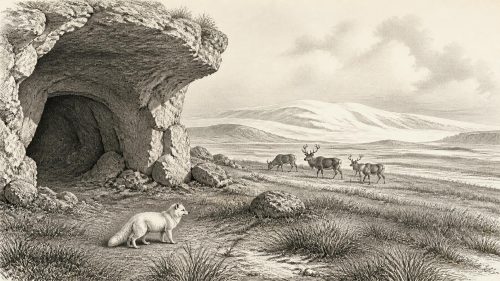
The clearest Irish evidence for this broad period comes not from villages or tools, but from animal bones, especially those protected within limestone caves. Castlepook Cave near Doneraile in north County Cork—long known as Mammoth Cave—has exceptional importance because it contains both pre- and post-Last Glacial Maximum deposits. Early twentieth-century excavations recovered a mixed assemblage accumulated through several processes: animals dying or sheltering in caves, predators carrying prey inside, carnivore denning, water movement and later disturbance. A cave bone collection is therefore not a simple census of animals living together at one moment.
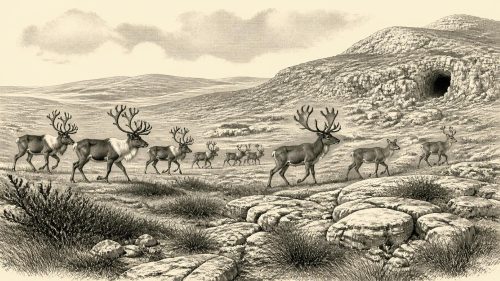
Even so, re-dating has transformed the significance of Castlepook and comparable southern Irish sites. Improved collagen preparation and ultrafiltration have shown that some older radiocarbon determinations substantially underestimated the age of bones. The revised evidence places elements of the southern Irish fauna within Marine Isotope Stage 3, before the Last Glacial Maximum. Reindeer, woolly mammoth, giant deer, brown bear, wolf, Arctic fox and spotted hyaena all figure in the wider Irish Pleistocene record, though not every species can be assigned to precisely the same century, landscape or ecological community. Their presence demonstrates that Ireland was not biologically empty during portions of this long cold phase.
Reindeer are particularly evocative. Their occurrence implies open country with extensive grazing and browsing opportunities, while mammoth and giant deer indicate habitats capable of sustaining very large herbivores. Spotted hyaena remains are equally important: they reveal a large predator and scavenger operating within a food web that included substantial carcasses. Such animals were not curiosities at the edge of a modern Irish landscape. They belonged to a Pleistocene ecology very different from the island’s later wooded Holocene environment. Yet the evidence is chronological and geographical patchwork, not proof that a mammoth, hyaena and reindeer herd stood together near Castlepook in the particular year represented by this article.
The Human Question
Human presence is the most delicate issue. Ireland has no securely excavated camp, hearth, stone-tool assemblage, dwelling, burial or occupation surface dated to around 31,111 BCE. There is consequently no sound basis for describing a settled population, estimating numbers, naming a culture or imagining an established hunting territory. The National Museum of Ireland has rightly long stressed the absence of clear Palaeolithic evidence for human occupation; this remains an essential caution against turning a small body of faunal material into a full social history.
At Castlepook, however, a reindeer femur has been reported as bearing a deep mark consistent with modification by a sharp stone tool. The bone has been associated in public discussion with an age of roughly 33,000 years. If the mark is confirmed as a cut made during carcass processing, it would be striking evidence that a person handled a reindeer in Ireland during the Upper Palaeolithic. It would not, by itself, demonstrate that people hunted the animal, lived beside the cave, arrived in a large group, or returned regularly. The radiocarbon result dates the animal bone within a calibrated range, rather than recording the exact moment of any cut.
The proper conclusion is therefore modest but important. Brief human visits are possible, and the Castlepook bone gives that possibility a serious archaeological basis. The find invites fresh searches of caves, river deposits and now-submerged landscapes. It does not erase the gulf between an isolated indication of animal processing and the later, unmistakable record of settlement. The best-established evidence for people in Ireland comes far later, while the well-known Mesolithic site of Mount Sandel in County Londonderry belongs to a post-glacial world many millennia after this horizon.
No Polities, No Recorded Conflict
There is no evidence for political institutions, rulers, territories, diplomacy, warfare or organised religion in Ireland at this date. Nor can archaeologists responsibly infer them from climate or animal bones. A possible encounter between a small human party and a reindeer carcass would speak only to a practical act of subsistence: the recovery of meat, hide, marrow, sinew or bone. It could suggest knowledge of cutting tools and animal anatomy, but it cannot reveal language, kinship, leadership, ceremonial practice or beliefs.
Nor is there evidence for a local economy in the later historical sense. There were no farms, crops, domestic livestock, markets, metalwork or built settlements. If people did reach the island intermittently, they would have been mobile hunter-gatherers operating in a demanding environment and connected, at most, to wider Upper Palaeolithic worlds beyond Ireland. The existence of sophisticated stone technologies, tailored clothing, hunting knowledge and art elsewhere in Europe at broadly comparable dates should not be projected automatically onto Ireland. No Irish artefact assemblage currently demonstrates those practices here.
Environmental Change as History
For this remote interval, environmental history is the principal history. Ice advance later removed or disturbed many surface deposits, which helps explain why Ireland’s record is so fragmentary. Cave archives, buried wetland sediments and glacial stratigraphy survive precisely because they were sheltered, sealed or deeply buried. They are powerful evidence, but each comes with limits. Fossil pollen and plant remains indicate vegetation and water conditions near a deposit; animal bones identify species, not necessarily the full landscape or a single contemporaneous community; ice-sheet landforms chart movement, but often cannot be dated to a particular century.
The period around 31,111 BCE should thus be understood as an interval of ecological opportunity under mounting climatic pressure. In southern Ireland, large grazing animals and carnivores ranged across an open cold-country mosaic during at least parts of Marine Isotope Stage 3. In the north, wetland sediments show that freshwater habitats and specialised vegetation persisted in some ice-free settings. Across the island, advancing ice, altered drainage and changing sea levels were reshaping the conditions under which animals—and perhaps occasional people—could move.
A Window, Not a Chronicle
Castlepook offers a narrow but remarkable window onto this vanished Ireland. Its bones preserve evidence of animals that disappeared before the later full-glacial ice advance, and its possible reindeer cutmark raises a consequential question about the antiquity of human contact with the island. The decisive fact is not a fabricated event in “31,111 BCE”, but the coexistence of uncertainty and discovery. Ireland’s earliest deep past is not empty: it is preserved in fragments, dated in ranges, and continually open to reassessment as old collections are re-examined with new methods.
Primary Sources
- A reconsideration of the radiocarbon dating of the Marine Isotope Stage 3 fauna from southern Ireland
- The Irish Quaternary Fauna Project
- Growth and retreat of the last British–Irish Ice Sheet, 31,000 to 15,000 years ago: the BRITICE-CHRONO reconstruction
- Pattern and timing of retreat of the last British-Irish Ice Sheet
- Response of the Irish Ice Sheet to abrupt climate change during the last deglaciation
- Stratigraphic and palaeo-geomorphological evidence for the glacial-deglacial history of the last British-Irish Ice Sheet in the north-western Irish Sea
- Trimlines, blockfields and the vertical extent of the last ice sheet in southern Ireland
- New data for the Last Glacial Maximum in Great Britain and Ireland
- Oscillating retreat of the last British-Irish Ice Sheet on the continental shelf offshore Galway Bay, western Ireland
- New Insights on the Fauna of Ireland’s Younger Dryas and Early Holocene from Alice & Gwendoline Cave
- First evidence of a Late Upper Palaeolithic human presence in Ireland
- Prehistoric Details
- 2022:564 – Castlepook Cave, Castlepook South, Cork
- Heritage Artefacts of County Cork
- IQUA Field Guide 16: The Quaternary of Northern Ireland
- A new Bayesian chronology for Mesolithic occupation at Mount Sandel, Northern Ireland
- The exploration of Castlepook Cave, County Cork
- IntCal20 Northern Hemisphere radiocarbon age calibration curve (0–55 cal kBP)
- European Middle and Upper Palaeolithic radiocarbon dates are often older than they look: problems with previous dates and some remedies
- Bayesian analysis of radiocarbon dates
- Investigating seasonal mobility in Irish giant deer Megaloceros giganteus (Blumenbach, 1799) through strontium isotope (87Sr/86Sr) analysis
- Ancient hybridization and an Irish origin for the modern polar bear matriline