Derryvree’s Mossy Shallows30843 BCE
The modern label 30,843 BCE denotes no identifiable Irish event but approximates a Late Pleistocene MIS 3 interval. Derryvree in Fermanagh preserves a freshwater wetland between glacial tills, evidence of cold, open, treeless conditions during an ice-free phase. Its radiocarbon date calibrates broadly to 36,900–31,700 cal BP, precluding annual precision. Castlepook Cave fauna, accumulated over long periods, includes mammoth, reindeer, giant deer, bear and hyaena, showing ecological links with Europe. A marked reindeer femur may indicate human butchery around 31,000 BCE, but cannot establish settlement. Lower seas altered routes, while shifting ice, water and vegetation shaped a fragmentary environmental past.
Dateline
The label 30,843 BCE is a modern device for ordering deep time, not a date at which an event in Ireland can be identified. No calendar, writing system, named people or political community is known from the island at this depth of time. In archaeological terms, the point falls roughly 32,800 calibrated years before present, conventionally counted from AD 1950, within the Late Pleistocene and Marine Isotope Stage 3 (MIS 3). Modern calendar-year precision is not available. The responsible account is consequently built from deposits, fossils and broad calibrated ranges, rather than from a supposed annual narrative.
For Ireland, this was an unstable phase of the last Ice Age, long before the later maximum expansion of the British–Irish Ice Sheet. It should not be imagined either as an island uniformly smothered by ice or as an inviting, continuously inhabited hunting ground. Conditions varied greatly across space and time. Glaciers, bare mineral ground, cold wetlands, caves, rivers and tundra vegetation formed a shifting mosaic. Much evidence has also been erased by later ice movement, erosion, rising seas and the disturbance of cave deposits. What survives is both precious and incomplete.
A Date Within a Range
The single most useful Irish environmental record for this nominal date lies at Derryvree, near Maguiresbridge in County Fermanagh. Roadworks in 1969 cut through a drumlin and revealed freshwater silts, fine sands and organic layers trapped between two thick tills: unsorted debris deposited by glacier ice. The lower till shows that ice had previously occupied the locality. The organic sediments record an intervening period when standing or slowly moving fresh water and wet ground existed there. The upper till demonstrates that ice later returned or expanded over the site. This is a sequence of major environmental change, not a frozen image of one season.
Organic material from the Derryvree beds produced the radiocarbon determination Birm-166, 30,500 radiocarbon years BP, with a substantial laboratory uncertainty. Radiocarbon years are not calendar years: atmospheric carbon-14 has varied through time, and ancient results must be calibrated against internationally maintained curves. A modern calibration places the age broadly within about 36,900–31,700 cal BP at 95.4 per cent probability. That broad interval encompasses the modern label 30,843 BCE, but it cannot establish that every layer at Derryvree formed in that particular year, nor that the whole island shared its conditions.
A Treeless Wetland
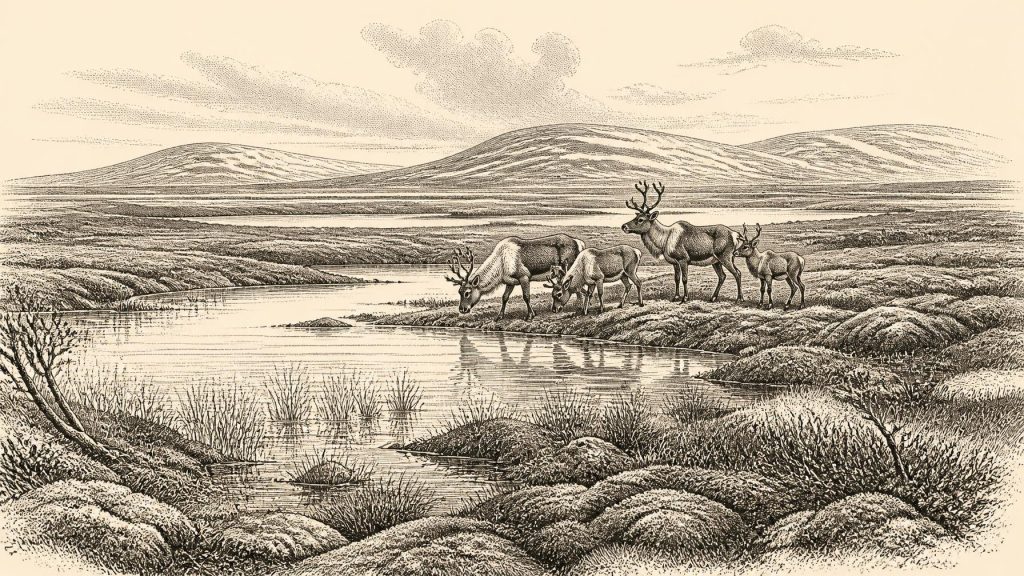
The Derryvree fossils provide direct evidence for a cold, open environment. Freshwater mosses and sedges grew around shallow water; remains of aquatic and wetland plants, including bogbean and water-milfoil, indicate pools and saturated ground. Other plants point towards tundra or periglacial vegetation rather than woodland. The landscape was probably a patchwork of sedgy margins, low herbaceous cover, exposed sediment and seasonally productive watercourses. Long winters, frost action and a short growing season were fundamental facts of life for plants and animals there.
Such evidence permits firm statements about local ecology, but not an overconfident reconstruction of weather. It does not yield an annual temperature for 30,843 BCE, nor does it show that all of Ireland was identical to Fermanagh. Derryvree was an inland locality in the north of the landmass that would later be Ireland. Its organic bed is particularly valuable precisely because later glacial deposits sealed it. Yet one buried wetland cannot settle every question about regional ice limits, precipitation or plant distribution. It is best understood as a well-preserved local window onto a wider cold-stage world.
Animals in the Southern Caves
Castlepook Cave, near Doneraile in County Cork, supplies a different kind of evidence. Its limestone passages have yielded one of Ireland’s richest assemblages of vertebrate remains from before and during the approach to the Last Glacial Maximum. The recorded fauna includes woolly mammoth, reindeer, giant deer, brown bear and spotted hyaena; later cold-stage deposits also contain animals such as Arctic fox and lemmings. These species show that Ireland was connected ecologically to the wider north-west European fauna during parts of MIS 3.
They do not, however, represent a single living community at one instant. Castlepook’s bones accumulated across a long span, conventionally dated between about 45,700 and 19,950 radiocarbon years BP. Water movement, carnivore activity and antiquarian excavation have complicated their original contexts. New ultrafiltration dating has shown that some older Irish cave dates were substantially too young, an important warning against treating legacy collections as simple chronologies. Mammoth, hyaena and reindeer remains demonstrate that those animals reached Ireland during cold phases; they cannot prove that every species stood together in the Awbeg Valley in 30,843 BCE.
Nevertheless, the combined Derryvree and Castlepook evidence indicates an ecologically demanding but not lifeless country. Large herbivores could exploit open vegetation and wetland margins, while predators and scavengers used the same wider landscape and, in the case of hyaenas, may have carried bones into cave shelters. Caves were not necessarily refuges for people. They were natural traps, dens, repositories and sediment-filled spaces whose contents were assembled by several processes over long periods.
The Reindeer Femur Question
A single Castlepook reindeer femur makes this era unusually important for the human history of Ireland. The specimen has been assigned to about 31,000 BCE and bears a deep linear mark which zooarchaeologist Ruth Carden has interpreted as a cut made by a sharp stone tool on fresh bone. If that interpretation is confirmed, it would indicate that people processed a reindeer in Ireland during MIS 3, far earlier than the formerly accepted evidence for human activity on the island.
The qualification matters. The femur is not from a newly excavated, sealed camp floor. No securely associated stone tools, hearth, dwelling, burial, human bone or repeated butchery surface of comparable antiquity has been recovered. Nor can one marked bone tell us whether people killed the animal, encountered an already dead carcass, processed it at the cave, or merely passed through the region. The dating concerns the animal bone, while the identification of the mark’s maker is an interpretation based on its form and position. It is responsible to describe possible human presence; it is not responsible to write of an established population or a permanent Irish settlement.
No Polities, No Proven Trade
There is therefore no evidence for political affairs, warfare, diplomacy, chiefs, territories or institutions in Ireland at this point. There is likewise no evidence for farms, villages, agriculture, livestock, pottery, metalworking, currency or a trade network. If small Upper Palaeolithic groups did visit, their most plausible economy would have been highly mobile hunting, scavenging and gathering within a seasonal landscape, using perishable equipment and perhaps stone cutting edges. That is a conditional inference from the possible cut mark and from comparable hunter-gatherer societies elsewhere in Ice Age Europe, not a documented social description of Ireland.
Religion, language, storytelling, art and formal learning are equally beyond recovery here. No Irish cave art, portable art, burial or ritual place can securely be assigned to the Derryvree–Castlepook horizon. The absence of such evidence need not mean that visitors, if there were any, lacked beliefs or cultural knowledge; it means that archaeology cannot responsibly specify them. Later prehistoric monuments and traditions belong to vastly different worlds and must not be projected backwards into this one.
Changing Ground and Routes
Sea level was lower than today because much of the world’s water was held in ice sheets. Coastlines were consequently farther out, and the distances separating Ireland, Britain and continental Europe were different. Lower sea level may have made movement through the wider region easier at some times, but it does not demonstrate a continuous dry land bridge, a regular migration route or any actual crossing by people. Ice extent, sea channels, climate, available prey and the hazards of travel all changed over millennia.
The large-scale ice-sheet reconstructions are also deliberately cautious. Their most detailed mapped sequence begins around 31,000 years ago, later than this nominal date, and identifies the growth of ice over Ireland and Britain thereafter. Derryvree’s buried wetland confirms that at least one Fermanagh locality experienced an earlier ice-free interval before being overridden again. Together, these records show regional change rather than a simple advance of cold in a single direction.
An Environmental, Not National, Past
In 30,843 BCE there was no Ireland in the political or cultural sense. There was a portion of the north-west European landmass whose future terrain was being shaped by frost, water and ice. Its clearest inhabitants in the surviving record are mosses, sedges, aquatic plants, reindeer, mammoths and carnivores. Derryvree’s shallow, plant-rich waters and Castlepook’s accumulated bones give that remote landscape a real, if fragmentary, texture.
The central lesson is one of scale. A numbered year can make the past appear precise, but the evidence speaks in calibrated ranges, sediment layers and changing habitats. Around this point in time, Ireland’s history is not yet a chronicle of rulers or communities. It is an environmental history in which a cold wetland briefly flourished between glacial advances, large mammals moved through an unstable world, and one reindeer bone may preserve the faintest trace of a human encounter.
Primary Sources
- A Middle Midlandian Freshwater Series at Derryvree, Maguiresbridge, County Fermanagh, Northern Ireland
- Early Midlandian–Middle Midlandian, Pleistocene, Northern Ireland
- A Reconsideration of the Radiocarbon Dating of the Marine Isotope Stage 3 Fauna from Southern Ireland
- Castlepook Cave: County Geological Site Report
- Heritage Artefacts of County Cork 2021
- The Castlepook Cave Project
- Growth and Retreat of the Last British–Irish Ice Sheet, 31,000 to 15,000 Years Ago: the BRITICE-CHRONO Reconstruction
- BRITICE-CHRONO Maps and GIS Data of the Last British-Irish Ice Sheet 31 to 15 ka
- Timing, Pace and Controls on Ice Sheet Retreat: an Introduction to the BRITICE-CHRONO Transect Reconstructions of the British-Irish Ice Sheet
- Late Pleistocene Chronostratigraphy and Ice Sheet Limits, Southern Ireland
- Trimlines, Blockfields and the Vertical Extent of the Last Ice Sheet in Southern Ireland
- BRITICE Glacial Map, Version 2: a Map and GIS Database of Glacial Landforms of the Last British–Irish Ice Sheet
- The IntCal20 Northern Hemisphere Radiocarbon Age Calibration Curve (0–55 cal kBP)
- IntCal Publications
- The Subdivision of the Quaternary Period in Ireland
- Geology of Northern Ireland: Our Natural Foundation
- Aghnadarragh
- Castlepook Caves
- New Insights on the Fauna of Ireland’s Younger Dryas: a Reassessment of Alice and Gwendoline Cave, County Clare
- Ireland: Submerged Prehistoric Sites and Landscapes
- The Irish Quaternary Fauna Project
- The Quaternary of Western Ireland
- The Geological Heritage of County Leitrim
- The Mesolithic in Ireland: When Was It?