
Dryas Octopetala Silts30842 BCE
Around 30,842 BCE, Ireland lay within the climatically unstable Late Pleistocene MIS 3, rather than a datable historical year. Derryvree, County Fermanagh, preserves freshwater silts between tills, indicating an interglacial interval of open tundra wetland with sedges, mosses, bogbean and mountain avens. Castlepook Cave, County Cork, yielded cold-adapted fauna including mammoth, reindeer, deer, predators and hares, demonstrating episodic viable habitats. Growing ice sheets, changing sea levels and uncertain routes shaped the island. A possibly cut-marked reindeer bone suggests human butchery, but cannot prove settlement or continuous occupation. Evidence supports a changeable Ice Age ecosystem, not identifiable communities, institutions or cultures.
Dateline
Modern calendar-year precision is not available for Ireland in 30,842 BCE. This is a retrospective label imposed on a period far beyond written records, named communities or dateable historical events. In radiocarbon terms it lies roughly 32,800 years before AD 1950, within the Late Pleistocene and Marine Isotope Stage 3 (MIS 3), a long, climatically unstable phase before the fullest expansion of the last British–Irish Ice Sheet. The responsible subject is therefore not a year in the ordinary historical sense, but an environmental and archaeological horizon spanning centuries and millennia.
No Irish evidence can identify the weather, a journey, a hunt or an individual in this particular modern-numbered year. The closest relevant records have their own ranges and uncertainties. They come chiefly from a freshwater deposit at Derryvree near Maguiresbridge in County Fermanagh, from Ice Age animal remains in Castlepook Cave near Doneraile in County Cork, and from the wider reconstruction of glacial growth around Ireland and the Irish Sea. Together, they show that parts of the island could support cold-adapted life during MIS 3. They do not demonstrate a single, uniform Irish landscape, nor do they establish a permanent human population.
A Date Within a Range
The principal Fermanagh evidence was exposed during road works in 1969, when a cut through a drumlin at Derryvree revealed freshwater silts and fine sands between two distinct sheets of till: unsorted sediment deposited by glacier ice. Organic material from the intervening deposits produced a conventional radiocarbon determination of 30,500 years BP, with an uncertainty of approximately a thousand radiocarbon years. That measurement cannot be converted honestly into one precise BCE date. Radiocarbon years and calendar years differ because atmospheric carbon levels have varied; calibration produces probability ranges, not a single historical timestamp.
Derryvree is nevertheless unusually important. The lower till proves that glacier ice had previously affected the locality. Above it, silts, fine sands and organic remains accumulated in fresh water or wet ground. A later till sealed the sequence, showing that glacial conditions returned. The deposit therefore records an interval of environmental change between ice advances. It does not say that all Ireland was ice-free simultaneously, and it cannot tell us that its plants or pools survived unchanged into 30,842 BCE. It is, however, a rare Irish window on the kind of cold-stage ecosystem that existed in the broad period relevant to that date.
Fresh Water in Treeless Country
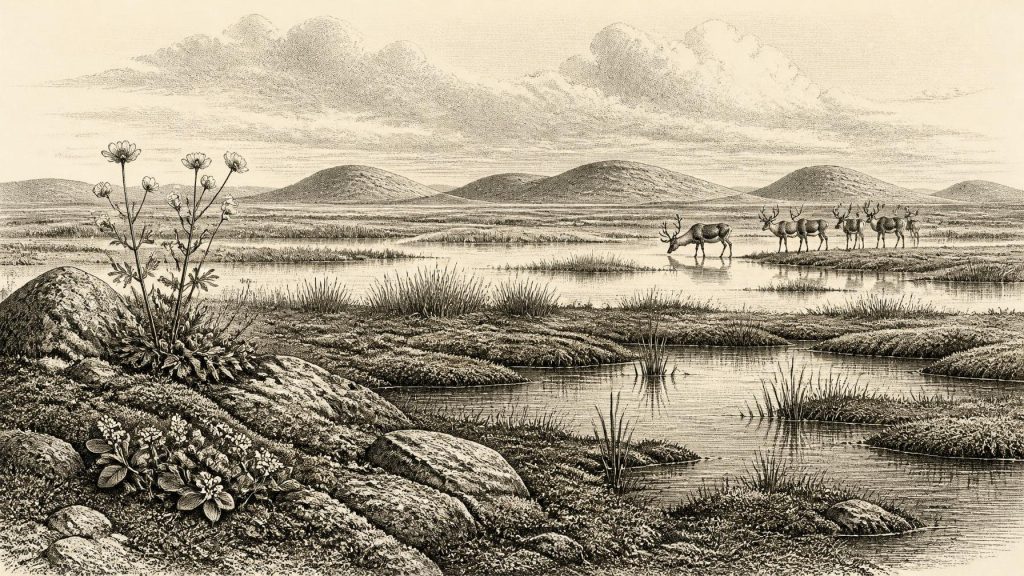
The Derryvree fossils indicate open tundra or periglacial wetland rather than woodland. Herb pollen, mosses, sedges, aquatic and waterside plants, and small animal remains point towards a low, sparse vegetation cover in a severe climate. Finds include bogbean (Menyanthes trifoliata) and mountain avens (Dryas octopetala), plants now associated in Ireland with wetland and northern or alpine environments respectively. Their presence is direct evidence that suitable local habitats existed; the wider reconstruction of a patchwork of shallow pools, sedgy margins, mossy ground and exposed mineral soils is an interpretation based on that assemblage and its sedimentary setting.
Such a landscape was not an unbroken white wilderness. Freshwater deposits require liquid water, while plants require at least a growing season. Summer thaw could sustain insects, grazers and scavengers around sheltered basins even as long winters, hard frosts and low biological productivity constrained life for much of the year. A few grains of tree pollen do not overturn this picture. Wind can carry pollen over very long distances, and old material may be reworked into younger sediment. The stronger local signal comes from the plant macrofossils and mosses: Derryvree was overwhelmingly open and cold.
Ice, Sea and Changing Ground
At this date, Ireland stood on the threshold of more extensive glaciation, not yet in the later maximum state familiar from maps of the Last Glacial Maximum. The most detailed modern reconstruction of the British–Irish Ice Sheet begins at about 31,000 years ago and stresses both uncertainty and regional variation in its early growth. By roughly 26,500–19,000 years ago, global ice volumes reached their maximum, and Ireland was deeply affected by the ice sheet. Around 30,842 BCE, however, the island’s precise ice margins, coastline and connections with Britain changed through time and remain imperfectly constrained.
Lower global sea level exposed parts of the modern continental shelf, but that fact must not be simplified into a proven dry land bridge or an easy walking route into Ireland. Local relative sea level depended on ice loading, crustal movement, changing coastlines and the behaviour of nearby ice masses. Animals evidently reached the landmass at intervals; how particular species moved, whether across exposed ground, shorelines, ice margins or water gaps, is harder to prove. This uncertainty matters especially for any discussion of people.
Castlepook’s Animal World
Castlepook Cave, also known as Mammoth Cave, in north County Cork preserves Ireland’s most significant known assemblage of MIS 3 large-mammal remains. Excavated principally by the naturalist Richard Ussher and others in the early twentieth century, the cave yielded bones of woolly mammoth, reindeer, giant deer, brown bear, wolf, Arctic fox, hare and small cold-adapted mammals, as well as evidence for spotted hyaena. Improved radiocarbon work has shown that parts of this fauna belong broadly to the period before the Last Glacial Maximum, although individual specimens belong to different moments within a long and complicated cave history.
The assemblage supports a picture of open country able to sustain grazing animals and their predators in southern Ireland during portions of MIS 3. Mammoth and reindeer should not be imagined as residents of a neat modern-style wildlife reserve: cave bones may result from carnivore activity, natural death, water movement and disturbance, and their survival says little about exact herd sizes or seasonal routes. Yet the range of fauna demonstrates that Ireland was, at least episodically, part of the wider north-west European world of cold-adapted animal movement.
A Possible Human Trace
One reindeer femur from Castlepook has received particular attention because zooarchaeologist Ruth Carden identified a deep mark interpreted as having been made on fresh bone by a sharp stone implement during carcass processing. County Cork heritage publications describe it as a possible Palaeolithic indication of human activity about 33,000 years ago. If that interpretation is confirmed, it would be an exceptionally early sign that people handled an animal in Ireland during the broad period under discussion.
Its limits are as important as its promise. The bone does not provide a securely excavated hearth, stone-tool collection, dwelling floor, human burial or repeated occupation surface. Much of Castlepook’s material was recovered before modern excavation standards, while cave deposits can be mixed by animals, water, frost and collapse. The date of a bone concerns the life and death of the animal, not automatically the exact moment when a surface mark was made. Accordingly, the femur is best treated as a potentially important trace of butchery, not proof of a settled camp or continuous occupation.
Society Beyond Recovery
If people did enter Ireland during MIS 3, they would most plausibly have been small, mobile hunter-gatherer groups, dependent on shared labour, detailed knowledge of animals and weather, and portable stone technology. That is an inference from the broader Upper Palaeolithic world, not a social description recovered from an Irish settlement. There is no basis for naming a people, language, leader, kin group or territory. Nor can archaeology at present establish how long visitors stayed, whether they returned, or whether they travelled from Britain, mainland Europe or another route.
There were no identifiable Irish states, kingdoms, diplomatic relations or political institutions. Conflict between human groups cannot be detected. Predators, hunger, cold and difficult movement were real dangers, but environmental hardship is not evidence of warfare. Equally, there is no Irish evidence from this horizon for religion, formal ritual, art, music, burial practice or teaching. Later Celtic traditions, megaliths and Christian narratives belong to vastly different worlds and should not be projected backwards onto this deep past.
What Can Be Known
The most meaningful culture of this period is the modern culture of investigation. Stratigraphy establishes the order of deposits; palaeobotany reconstructs vegetation; zooarchaeology identifies animals and examines marks on bone; radiocarbon dating and calibration provide age ranges; and glacial geomorphology maps the changing terrain. The evidence is fragmentary because later ice advances, erosion, rising seas and tens of thousands of years of natural processes removed or buried much of the earlier landscape.
Ireland around 30,842 BCE was therefore not a blank space, but neither was it a historical society that can be narrated year by year. Derryvree’s bogbean-bearing wetland and Castlepook’s cold-climate fauna illuminate a changeable island of tundra, pools, grazers and carnivores during MIS 3. The possible cut-marked reindeer bone offers a cautious opening onto human presence. The absence of a secure settlement record, however, remains decisive: this was an Ice Age environment with a tantalising human question, not yet a documented Irish community.
Primary Sources
- A Middle Midlandian Freshwater Series at Derryvree, Maguiresbridge, County Fermanagh, Northern Ireland
- A Reconsideration of the Radiocarbon Dating of the Marine Isotope Stage 3 Fauna from Southern Ireland
- Palaeoecology: Irish Association for Quaternary Studies Field Guide
- Menyanthes trifoliata L. — Fermanagh Species Account
- Dryas octopetala L. — Fermanagh Species Account
- First Evidence of a Late Upper Palaeolithic Human Presence in Ireland
- New Insights on the Fauna of Ireland's Younger Dryas and Early Holocene from Alice & Gwendoline Cave
- Archaeology Research Excavation Grant 2022: Final Report
- Heritage Artefacts of County Cork
- Archaeological Heritage of County Cork
- Quaternary
- Geology of Ireland
- The IntCal20 Northern Hemisphere Radiocarbon Age Calibration Curve (0–55 cal kBP)
- Growth and Retreat of the Last British–Irish Ice Sheet, 31,000 to 15,000 Years Ago: the BRITICE-CHRONO Reconstruction
- BRITICE-CHRONO Maps and GIS Data of the Last British-Irish Ice Sheet 31 to 15 ka
- The Timing and Magnitude of the British–Irish Ice Sheet Between Marine Isotope Stages 5d and 2
- Trimlines, Blockfields and the Vertical Extent of the Last Ice Sheet in Southern Ireland
- Timing and Pace of Ice-Sheet Withdrawal Across the Marine–Terrestrial Transition West of Ireland During the Last Glaciation
- Oscillating Retreat of the Last British-Irish Ice Sheet on the Continental Shelf Offshore Galway Bay, Western Ireland
- The Deglaciation of the Western Sector of the Irish Ice Sheet from the Inner Continental Shelf to its Terrestrial Margin
- Late Pleistocene Chronostratigraphy and Ice Sheet Limits, Southern Ireland
- The Mesolithic in Ireland: When Was It?