Derryvree’s Sedge-Moss Basin30806 BCE
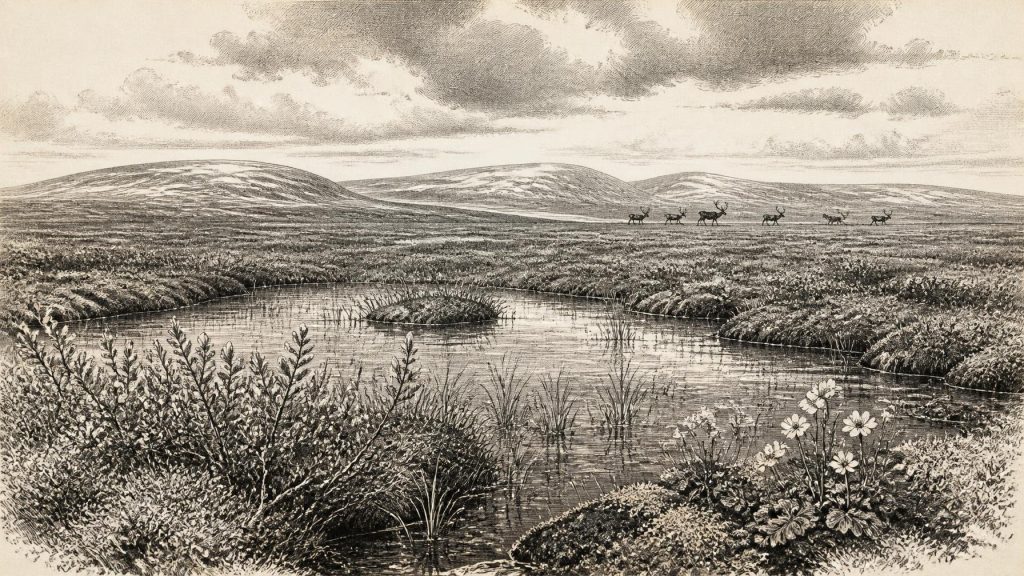
30,806 BCE is a modern label within a broad Late Pleistocene range, not a recoverable Irish year. At Derryvree, County Fermanagh, organic freshwater sediments between glacial tills indicate a temporary interruption of local ice cover, dated broadly to 34,950–29,750 BCE. Plant remains reconstruct cold, treeless, marshy tundra with sedges, mosses and dwarf shrubs. Cave faunas, especially Castlepook’s, demonstrate episodic presence of mammals including reindeer, mammoth and hyaena, but not a single contemporary ecosystem. A possibly tool-marked reindeer bone suggests brief human visits, not settlement. Dynamic ice expansion increasingly shaped Ireland, while evidence supports neither polities, farming nor monuments at all.
Dateline
The label 30,806 BCE is a modern chronological convenience, not a year that can be recovered from Irish evidence. No people in Ireland then used a calendar recognisable to us, and no written, archaeological or environmental record can identify a particular event, season, ruler or community in that single year. In the radiocarbon convention whose “present” is AD 1950, it falls roughly 32,755 calendar years ago. The responsible setting is a broad part of the Late Pleistocene, within Marine Isotope Stage 3, rather than an annual chronicle.
The strongest evidence relevant to this notional date comes from scattered natural archives: buried wetland sediments, pollen and plant macrofossils, animal bones from caves, and the landforms left by later ice. These sources illuminate environment and animal life much better than human affairs. They show an Ireland undergoing repeated climatic change before the most extensive phase of the last British–Irish Ice Sheet. They do not reveal political institutions, diplomacy, religion, trade networks or settled communities.
A Date Inside a Wide Range
The closest especially valuable Irish sequence is at Derryvree, near Maguiresbridge in County Fermanagh. Roadworks exposed a drumlin whose internal layers included organic freshwater silts and fine sands between two deposits of till: the unsorted debris laid down directly by glacier ice. The sequence establishes a clear order. Ice had earlier covered this locality; an interval followed in which water, sediments and organic remains accumulated; then a later ice advance overrode and sealed the wetland beneath fresh till.
Organic material from the Derryvree freshwater deposit produced a conventional radiocarbon age of about 30,500 years BP, with a large error margin. Calibration against the modern IntCal20 curve has placed the deposit broadly at approximately 36,900–31,700 calibrated years BP, or around 34,950–29,750 BCE. The modern label 30,806 BCE falls within that span, but cannot be assigned to a particular bed, plant, pool or episode. At this depth in time, calibration ranges are necessarily wide. The Derryvree deposit is therefore a valuable window on a phase of Ice Age Ireland, not a dated scene from one year.
Its position between two tills matters as much as its radiocarbon result. It demonstrates that local glacier cover was interrupted at Derryvree. It does not demonstrate that all of Ireland was ice-free, nor that conditions in Fermanagh precisely matched those in Cork, the west coast or the Irish Sea basin. Ireland was a varied north-western European landmass exposed to abrupt North Atlantic shifts. Ice margins, permafrost, meltwater, sea level, vegetation and animal ranges could change substantially over centuries and millennia.
A Treeless Wetland Landscape
The Derryvree fossils indicate cold, open and largely treeless country. Mosses, sedges and wetland plants, including bogbean, occurred around freshwater or marshy ground. Dwarf willow, mountain-avens, clubmoss and other cold-adapted plants recorded from the sequence support the reconstruction of a tundra-like muskeg landscape rather than the wooded island familiar from later prehistory. The evidence is direct for plants growing near the former water body; the wider image of a mosaic of pools, saturated ground, sparse vegetation and exposed mineral soil is an interpretation based on those remains, sedimentary context and comparison with northern cold environments.
This need not have been an unchanging white wilderness. A freshwater basin between ice advances implies seasonal thaw and local hydrological complexity. Summer light could support plant growth, insects and grazing animals, even where winters were long and severe. Yet tree cover was absent or negligible at Derryvree, and the landscape was vulnerable to frost action, waterlogging and shifting sediment. It was not the later pastoral countryside of fields, hedges and permanent settlements. Nor was it a natural setting in which agriculture was possible: farming in Ireland lay more than twenty-five millennia in the future.
Sea level was lower than today because vast quantities of water were stored in northern ice sheets, but it would be hazardous to draw a simple coastline or migration route for this exact date. The position of land and water around Ireland was shaped not only by global sea level but by the weight of regional ice depressing the crust, and by changing marine ice margins. The landmass that later became Ireland was not automatically joined to Britain or continental Europe merely because seas were lower. Any claim about an easy overland crossing at 30,806 BCE would go beyond the available evidence.
Animals in a Changing Country
Cave collections, above all from Castlepook Cave near Doneraile in north County Cork, show that late-Pleistocene Ireland supported a striking fauna during parts of the broader cold-stage period. The assemblage includes woolly mammoth, reindeer, giant deer, brown bear, wolf, fox, mountain hare, Arctic and Norway lemmings, and spotted hyaena. These animals should not be imagined as one neatly contemporaneous herd or food chain. Castle deposits accumulated across long periods; carnivores, water movement and earlier excavation practices complicate their histories; and direct dating of individual bones has revised earlier conclusions.
Even so, the combined record firmly overturns any picture of an empty or uniformly ice-covered Ireland throughout the Late Pleistocene. Large herbivores and carnivores reached the island during favourable windows. Reindeer are particularly evocative of open northern landscapes, while lemmings and cold-adapted plants reinforce the evidence for harsh conditions. Mammoth and hyaena remains testify to the wider ecological links of Ireland’s Pleistocene fauna with Britain and continental Europe. They do not tell us how many animals lived there at once, how regularly they arrived, or whether their routes were dry land, coastal corridors, ice, or intermittent combinations of these.
The impending growth of the last British–Irish Ice Sheet is the great regional development framing this period. Older accounts often treated Irish Late Pleistocene glaciation in simple advance-and-retreat terms. Recent work instead emphasises dynamic, regionally uneven ice growth and fluctuations. Reconstructions place a major build-up of the ice sheet after roughly 35–32 thousand years ago, with its maximum extent later, broadly around 27–21 thousand years ago. Thus 30,806 BCE belongs to a world in which glaciation was a dominant force but the later maximum had not yet produced a single, uniform Irish ice cover.
The Human Question at Castlepook
The most provocative item associated with this long interval is a reindeer femur from Castlepook. It has been reported as approximately 33,000 years old and bears a deep mark interpreted by zooarchaeologist Ruth Carden as consistent with fresh-bone cutting or chopping by a sharp stone tool. If that interpretation is confirmed, it may be evidence that an Upper Palaeolithic person processed a reindeer in Ireland far earlier than the island’s long-established terminal-Pleistocene archaeological traces.
That is an important possibility, but it is not a licence to invent a settlement. The bone came from an old cave collection, not a modern excavation of an intact occupation floor. No securely associated hearth, lithic assemblage, dwelling, burial, food store or repeatedly used butchery site of this age has been published from Castlepook. A radiocarbon determination dates the death of the animal, not automatically the moment when a surface mark was made, the site of killing, or the length of any human visit. The identification of the mark as human-made is likewise a specialist taphonomic judgement, distinct from the date of the bone.
The cautious conclusion is therefore limited but significant: brief human incursions into Ireland during the Upper Palaeolithic are possible, and the marked femur may be evidence of one. Permanent occupation, a local population, or cultural continuity cannot be demonstrated. If people did reach Ireland at some point in this period, they were more likely to have been members of very small, mobile hunter-gatherer groups using perishable gear and stone cutting edges than inhabitants of villages. That is an inference from the ecological setting and wider European comparison, not a documented Irish society.
No Polities, No Monuments
For 30,806 BCE, political history has no evidential footing. There are no known rulers, tribes, territorial boundaries, alliances, wars or diplomatic exchanges. Nor is there evidence for formal religion, shrines, graves, cave art, decorated objects, ceremonial monuments or systems of learning in Ireland from this horizon. It would be misleading to transfer the rich artistic and ritual evidence of Upper Palaeolithic France, Iberia or parts of Britain directly across the sea.
Equally, there is no basis for discussing an Irish economy in the later historical sense. There were no farms, livestock, markets, metalwork or documented trade. At most, the Castlepook bone permits the possibility of animal processing by a mobile visitor. Derryvree’s wetland shows the resources such people or animals might have encountered—fresh water, seasonal vegetation and open terrain—but not ownership, exchange or routine habitation.
The history of Ireland at this date is consequently best told through restraint. Derryvree’s sedge-and-moss basin records a local interval of cold freshwater life between glacier advances. Castlepook preserves a complex archive of Ice Age animals and a potentially momentous, still limited clue to human activity. Together they reveal not a named year of Irish history, but a changing Pleistocene country: ecologically inhabited, climatically unstable, and approaching the great expansion of ice that would erase or bury much of what had come before.
Primary Sources
- The IntCal20 Northern Hemisphere Radiocarbon Age Calibration Curve (0–55 cal kBP)
- Growth and Retreat of the Last British–Irish Ice Sheet, 31,000 to 15,000 Years Ago: The BRITICE-CHRONO Reconstruction
- BRITICE-CHRONO Maps and GIS Data of the Last British-Irish Ice Sheet 31 to 15 ka
- Extent and Timing of the Last Glacial Maximum (LGM) in Britain and Ireland: A Review
- The Timing and Magnitude of the British–Irish Ice Sheet Between Marine Isotope Stages 5d and 2
- Timing and Pace of Ice-Sheet Withdrawal Across the Marine–Terrestrial Transition West of Ireland During the Last Glaciation
- Sedimentology and Chronology of the Advance and Retreat of the Last British-Irish Ice Sheet on the Continental Shelf West of Ireland
- Dimensions and Chronology of the Last Ice Sheet in Western Ireland
- Last Glacial Maximum Cirque Glaciation in Ireland and Implications for Reconstructions of the Irish Ice Sheet
- New Insights on the Fauna of Ireland’s Younger Dryas and Early Holocene from Alice & Gwendoline Cave
- New Insights on the Fauna of Ireland’s Younger Dryas and Early Holocene from Alice & Gwendoline Cave
- Heritage Artefacts of County Cork
- Our Ancient Landscapes: Hunter-Gatherers in Ireland
- Figure 6.—The Subdivision of the Quaternary Period in Ireland
- Soils of County Waterford
- Pleistocene Climate Change: The Evidence from Irish Sequences
- The Stratigraphic Position and Age of the Gortian
- Pleistocene Vertebrates in the British Isles
- The Irish Quaternary Fauna Project
- Proceedings: Postglacial Colonisation Conference
- Growth and Retreat of the Last British–Irish Ice Sheet, 31,000 to 15,000 Years Ago: The BRITICE-CHRONO Reconstruction
- Reindeer Bone Found in Cork Cave Shows Human Activity in Ireland 33,000 Years Ago