
Derryvree’s Frostwater Herbarium30605 BCE
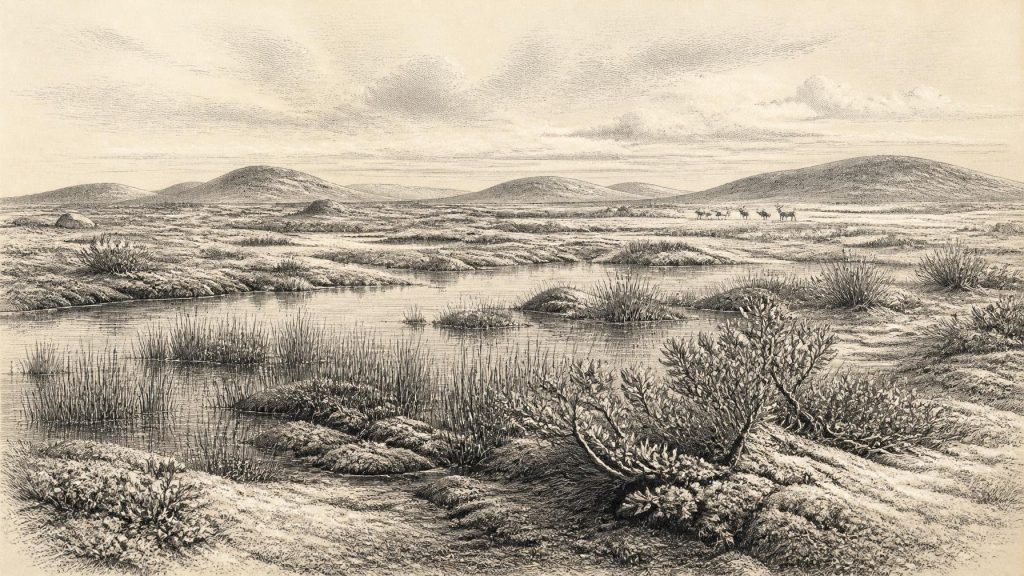
Thirty thousand six hundred and five BCE is not recoverable as an Irish year, but falls within the volatile Marine Isotope Stage 3. Derryvree, County Fermanagh, preserves freshwater sediments between glacial tills, indicating a temporary local ice-free, treeless periglacial wetland with sedges, mosses, bogbean and cold-adapted plants. Castlepook Cave, County Cork, provides faunal evidence including mammoth, reindeer, giant deer, hyaena and lemmings, though its mixed deposits do not represent one moment. A marked reindeer femur may suggest butchery, but cannot establish occupation. Later glaciation and sea-level change erased evidence. Ireland was a changing, open Ice Age environment, not settled country.
Dateline
The label “30,605 BCE” is a modern point on a retrospective calendar, not a year that anyone in Ireland could have named, recorded or experienced as such. There is no annal, settlement sequence or annual environmental archive that can identify an event in this exact year. The responsible approach is to place it within a much broader Late Pleistocene interval. In radiocarbon convention it falls roughly 32,554 years before AD 1950, within Marine Isotope Stage 3: a long and climatically volatile portion of the last Ice Age.
The closest securely relevant Irish environmental record is the Derryvree freshwater deposit near Maguiresbridge, County Fermanagh. Its organic sediments yielded the conventional radiocarbon determination BIRM-166, 30,500 with an uncertainty of roughly 1,100 radiocarbon years BP. Calibration is necessary because atmospheric radiocarbon concentrations changed through time. Published discussion places the deposit broadly at about 36,900–31,700 calibrated years BP, approximately 34,950–29,750 BCE. Thus 30,605 BCE lies within the range illuminated by Derryvree, but cannot be attached to a particular plant, animal, season or human action.
Freshwater Between the Tills
Derryvree was revealed by roadworks in 1969, which cut through a Fermanagh drumlin. The exposure contained glacial till below, freshwater silts, sands and organic material in the middle, and a second till above. This sequence matters because till is debris deposited directly by glacier ice. It establishes that ice occupied the locality, that an interval followed in which water and organic sediment accumulated, and that a later advance sealed the evidence beneath more glacial material.
That is strong evidence for a locally ice-free phase, but it is not a map of the entire island at one instant. Ireland’s ice-age environments were regionally varied and repeatedly changing. Nor does “interstadial” mean mild in any modern Irish sense. The Derryvree basin was a severe, treeless setting, subject to cold winters, short growing seasons and frost-driven processes. Yet it was not lifeless. Its sediments preserve a rare ecological archive of freshwater and wet-ground life in Ireland before the Last Glacial Maximum.
The remains indicate shallow or slow-moving water edged by sedges, mosses and low vegetation. Aquatic and wetland plants included bogbean and water-milfoil; other fossil plants included forms associated with cold, open ground, such as dwarf willow, mountain-avens and lesser clubmoss. Insect evidence likewise points to cold, exposed country with wet margins. These finds do not reconstruct every hillside or valley, and they cannot produce a precise annual temperature. Together, however, they support a picture of pools, muddy shallows, marshy ground and sparse tundra-like vegetation set within a periglacial landscape.
An Island Before Maximum Ice
At this date Ireland had not yet reached the fullest extent of the last British–Irish Ice Sheet. That later maximum developed in the period broadly around 27,000–21,000 years ago, though the timing of advance and retreat differed between sectors. Around 30,605 BCE, the island belonged to the unstable pre-maximum world in which ice margins, meltwater systems and open habitats could alter over long spans and sometimes rapidly. Derryvree’s wetland was eventually overridden or buried by renewed ice, preserving the very evidence that reveals its existence.
This geological setting is central to understanding why Ireland’s deep human past is so hard to recover. Later glaciers eroded landscapes, rearranged sediments and covered earlier surfaces. Sea-level change also transformed coasts and drowned or removed possible routes and sites. A lack of camps, hearths or tools may partly reflect genuine absence, but it also reflects an unusually harsh archaeological filter. The record that survives is therefore dominated by caves, bones, buried sediments and scattered landforms rather than recognisable settlements.
Castlepook’s Animal World
Far to the south, Castlepook Cave near Doneraile in north County Cork provides the chief Irish faunal counterpart to Derryvree. Often called Mammoth Cave, it produced a substantial collection during early twentieth-century excavation. The cave is associated with woolly mammoth, reindeer, giant deer, brown bear, wolf, red fox, Arctic fox, mountain hare, collared lemming, Norwegian lemming and spotted hyaena. A mammoth bone and a hyaena tooth historically produced radiocarbon ages in the middle of the last glacial cycle, and later reassessment has strengthened the case that important parts of the assemblage belong to Marine Isotope Stage 3.
The collection should not be read as a single scene from 30,605 BCE. Cave deposits accumulated over time; carnivores brought in prey and scavenged remains; water moved material; and the original excavations predated modern standards of stratigraphic recording. Some bones may also derive from different episodes. The sound conclusion is not that every listed species stood together outside the cave, but that cold-adapted and open-country mammals reached Ireland during this broad interval. The fauna is a powerful correction to the familiar image of an always wooded, temperate island.
Spotted hyaena is especially revealing. Castlepook’s hyaena bones, teeth and gnawed material show that caves could be part of a carnivore landscape as well as a potential shelter for people. Mammoths and giant deer signal the capacity of parts of the Irish landscape to sustain large herbivores; reindeer and lemmings indicate cold, open habitats. Predators and scavengers, meanwhile, shaped where carcasses accumulated. This was an ecosystem structured by seasonal pressures, animal movement, grazing, pursuit and decomposition, not an untouched backdrop to human history.
The Reindeer Femur Question
A reindeer femur from Castlepook makes this period archaeologically tantalising. Re-examined in recent years, it was reported as about 33,000 years old and as bearing a deep mark interpreted by palaeozoologist Ruth Carden as possible damage from a sharp stone tool during butchery. If that interpretation is sustained, it would be Ireland’s earliest claimed indication that a person handled and processed an animal, pushing possible human activity far beyond the better established terminal-Pleistocene evidence from Alice and Gwendoline Cave in County Clare.
But the qualification is vital. The femur dates the death of an animal, not a named human visit or the instant when its surface was marked. It was not recovered from a sealed occupation floor with an associated hearth, stone-tool assemblage, dwelling, human remains or a concentrated butchered deposit. Castlepook’s mixed cave history makes taphonomic analysis—the study of what happened to remains after death—indispensable. A mark may be highly significant, but one marked bone cannot demonstrate a resident population, a village, or a continuous tradition of occupation.
It is therefore inaccurate to describe Ireland at this point as securely inhabited in the ordinary sense. It is equally inaccurate to ignore the femur. The cautious position is that Ireland held habitats and animal populations potentially accessible to Upper Palaeolithic foragers, while a single object raises the serious possibility of a brief human encounter with that landscape. Future work, including controlled excavation, microscopic study, direct dating and sedimentary DNA analysis, may clarify the question.
What Society Leaves Unsaid
There is no evidence from Ireland around this date for political authorities, territories, warfare, diplomacy, named communities or social ranks. There are no known fields, livestock, pottery, metal objects, roads, monuments, graves, writing or religious structures. Consequently, political affairs and diplomacy cannot responsibly be reconstructed. Nor can a distinctive Irish language, ritual system, artistic tradition or body of learned knowledge be assigned to this period.
That absence does not mean that people elsewhere in north-west Europe lacked social lives or cultural practices. Anatomically modern humans had occupied parts of Europe by this stage of the Upper Palaeolithic, where mobile groups made sophisticated stone and organic technologies, maintained social networks and created art. Applying any particular continental tradition to Ireland, however, would be interpretation rather than Irish evidence. No securely dated Irish artefact assemblage identifies who, if anyone, came to Castlepook or Derryvree’s wider region.
Likewise, “economy” here should not suggest markets or long-distance trade. The evidence records natural productivity: vegetation taking root during a local ice-free interval, herbivores feeding in open country, and carnivores using caves and carcasses. If people did briefly enter Ireland, hunting and scavenging large animals are plausible possibilities, especially in light of the reindeer femur; they are not proven as a settled way of life. Any movement between Ireland, Britain and continental Europe would have depended on changing seas, coasts, ice and ecological corridors whose exact configuration remains debated.
A Record of Possibility
For 30,605 BCE, the important Irish story is therefore not a ruler, battle or foundation. It is the survival of a delicate record beneath and within ice-age deposits. Derryvree preserves the botanical detail: cold water, bogbean, mosses, sedges and low plants in a temporary freshwater world between glacier advances. Castlepook preserves the animal dimension: mammoth, reindeer, hyaena and other creatures occupying parts of an open, demanding landscape. The reindeer femur adds a provocative but still limited human question.
These sites show that prehistoric Ireland was neither simply buried beneath permanent ice nor already a recognisably settled country. It was a changing northern environment in which local wetlands could flourish for a time, large mammals could move through open habitats, and evidence of both could later be sealed by ice. That is the scale on which this date can be known: not as one recoverable year, but as a point within a long, fragile and remarkable Ice Age interval.
Primary Sources
- A Middle Midlandian Freshwater Series at Derryvree, Maguiresbridge, County Fermanagh, Northern Ireland
- A Reconsideration of the Radiocarbon Dating of the Marine Isotope Stage 3 Fauna from Southern Ireland
- The IntCal20 Northern Hemisphere Radiocarbon Age Calibration Curve (0–55 cal kBP)
- Irish Quaternary Vertebrates
- The Exploration of Castlepook Cave, County Cork
- Archaeology Research Excavation Grant 2022: Castlepook Caves Project Final Report
- 2022:564 – Castlepook Cave, Castlepook South, Cork
- Archaeological Heritage of County Cork
- Spotted Hyena Skull
- Mammoth Cave, Castlepook
- Irish Association of Hydrogeologists Field Trip 2014 Guide
- Growth and Retreat of the Last British–Irish Ice Sheet, 31,000 to 15,000 Years Ago: The BRITICE-CHRONO Reconstruction
- Pattern and Timing of Retreat of the Last British-Irish Ice Sheet
- Trimlines, Blockfields and the Vertical Extent of the Last Ice Sheet in Southern Ireland
- Early Deglaciation of the British-Irish Ice Sheet on the Atlantic Margin
- New Insights on the Fauna of Ireland’s Younger Dryas and Early Holocene from Alice & Gwendoline Cave
- New Insights on the Fauna of Ireland’s Younger Dryas and Early Holocene from Alice & Gwendoline Cave
- The Irish Quaternary Fauna Project
- Pleistocene Vertebrates in the British Isles
- Ireland’s Palaeolithic Archaeology – Fleeting Footprints in a Frozen Land
- Proceedings of the Irish Biogeographical Society: Postglacial Colonisation Conference