Mixed Fauna30320 BCE
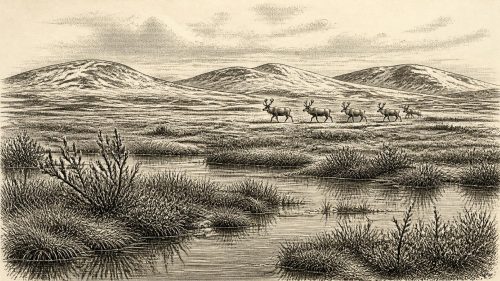
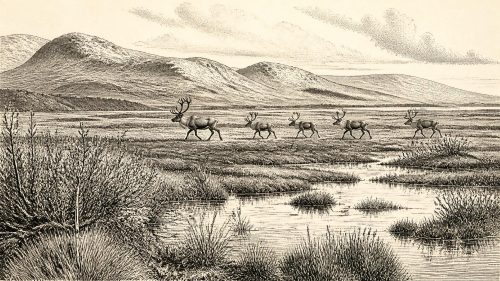
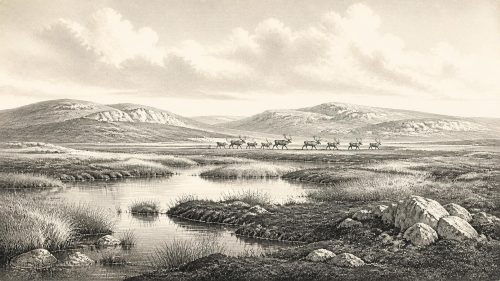
Around 30,320 BCE, a modern date within broad radiocarbon ranges, Ireland experienced unstable Late Pleistocene conditions across regions rather than a documented annual event. Derryvree, County Fermanagh, preserves freshwater sediments between glacial tills, indicating cold, open tundra wetlands with sparse vegetation during an ice-free interval. Castlepook Cave, County Cork, contains a long, mixed assemblage of mammoth, reindeer, giant deer, hyaena and other fauna, demonstrating repeated animal access but not contemporaneity. A marked reindeer bone may indicate human carcass processing around 33,000 years ago, although no secure occupation evidence exists. Later glaciation erased much evidence, leaving fragmented environmental and faunal records.
Dateline
“30,320 BCE” is a useful modern label, not a recoverable Irish year. No written chronology, named community, event, or calendar survives from this depth of time. In archaeological terms, it corresponds roughly to 32,270 calendar years before 1950, during the Late Pleistocene and Marine Isotope Stage 3. The responsible way to approach it is through broad calibrated ranges, stratified deposits and fossil evidence. Those sources describe changing environments over centuries or millennia; they cannot tell us what happened in Ireland in one particular year.
A Date Inside Wide Ranges
The closest important Irish environmental sequence is at Derryvree near Maguiresbridge, County Fermanagh. Roadworks in 1969 exposed a drumlin cut through by two separate deposits of glacial till. Between them lay freshwater silts, fine sand and organic matter. The lower till proves that ice had earlier occupied the locality; the intervening sediments show a later period in which open water and vegetation existed; the upper till records renewed glacial influence or ice advance. This order of layers is firmer evidence than any attempt to turn it into an annual timetable.
Organic sediment from Derryvree, laboratory number BIRM-166, produced a conventional radiocarbon determination of 30,500 ± 1,100 radiocarbon years BP. Published calibrations express its broad possible age at about 36,900–31,700 calibrated years BP, approximately 34,950–29,750 BCE. The requested date falls within that wide bracket. It would nevertheless be wrong to say that the Derryvree pool, its plants, or the surrounding animals existed specifically in 30,320 BCE. Radiocarbon results carry statistical uncertainty, calibration is not a simple one-to-one conversion, and an organic layer accumulates through time rather than on a single day.
Ice, Water and Open Tundra
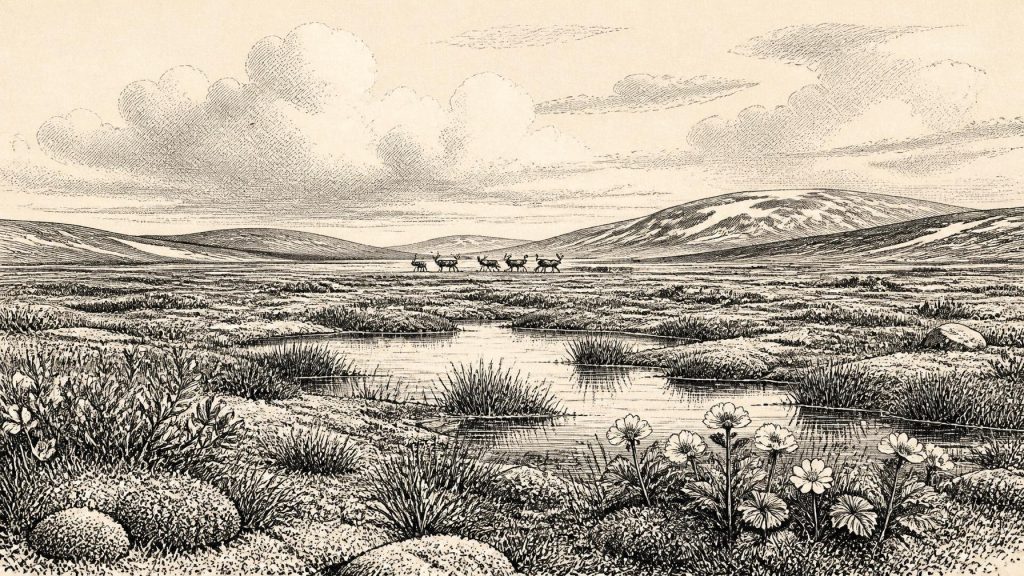
Derryvree offers a local glimpse of an Ireland that was cold but not uniformly sealed beneath the later ice sheet. Its pollen and plant macrofossils indicate open, treeless tundra or tundra-like wetland, with mosses, herbs, sedges and plants adapted to cold, exposed ground and shallow water. Fossil records associated with the deposit include such northern or alpine elements as dwarf willow, mountain avens and bogbean. These are not a complete inventory of the island’s vegetation. They demonstrate, rather, that a freshwater margin in south Fermanagh could support a sparse but varied plant community during an interval between glacial episodes.
That regional qualification matters. The British–Irish Ice Sheet did not grow as a neat blanket over a timeless Ireland. Its margins, upland ice caps and fast-flowing outlets shifted over long periods, while local ground conditions differed sharply between mountains, lowlands, coasts and sheltered basins. Modern reconstructions suggest that ice was already expanding in northern and north-western sectors around this wider period, while evidence from Derryvree and other buried organic deposits preserves earlier or locally ice-free phases. The great maximum of the last Irish ice sheet lay later, principally in the later part of the glacial cycle. Around the date represented here, Ireland was therefore a landscape of severe climatic instability and regional contrasts, not simply an island buried beneath ice.
Castlepook’s Uneven Bone Archive
The strongest evidence for animal life comes from Castlepook Cave, also called Mammoth Cave, near Doneraile in north County Cork. Its galleries, including Hyenahall and Elephant Hall, yielded one of Ireland’s richest Pleistocene bone collections. More than two thousand specimens have been recovered, and direct dates on individual bones range across a very long span. Woolly mammoth, reindeer, giant deer, brown bear, wolf, fox, hare and spotted hyaena all occur in the wider assemblage, alongside smaller cold-adapted mammals. Together they establish that Ireland was repeatedly accessible to, and ecologically capable of sustaining, a far richer Ice Age fauna than survives today.
But Castlepook is not a single frozen scene. Caves collect material in complicated ways: animals die there, carnivores drag in prey, water moves bones, sediments are disturbed, and early excavators often recorded contexts less precisely than modern investigators require. A hyaena bone, mammoth bone and reindeer bone may belong to substantially different episodes. The cave can therefore illuminate the kinds of animals present in pre-Last Glacial Maximum Ireland, but cannot prove that every listed species met at the cave or shared the exact landscape of 30,320 BCE. Its importance lies in its long archive, not in a one-year snapshot.
The Human Question
Castlepook has also changed the question of whether people reached Ireland before the ice sheet’s maximum expansion. A reindeer femur from the cave, re-dated by accelerator mass spectrometry to roughly 33,000 years ago, bears a deep surface mark interpreted by Ruth Carden as a possible cut made while fresh tissue was being removed with a stone edge. If that interpretation is confirmed, it would be the earliest evidence that people handled animal carcasses in Ireland, many millennia before the better-known post-glacial settlement record.
The distinction between evidence and interpretation is essential. The dated bone is real; the mark is real; its attribution to human butchery remains a specialist taphonomic judgement. No securely associated stone tool, hearth, dwelling, human bone or intact camp of this age has yet been excavated at Castlepook. Recent fieldwork has sought surviving undisturbed Pleistocene deposits precisely because the older collections and cave sediments are so complex. The cautious conclusion for this period is not that Ireland had a settled population, but that brief human visits or carcass-processing activity are plausible and archaeologically important possibilities.
Life Without a Recorded Society
If people did enter Ireland during this wider interval, they would have lived by highly mobile hunter-gatherer practices comparable with those known elsewhere in Upper Palaeolithic north-west Europe. Reindeer could offer meat, fat, hide, sinew and bone; stone blades or flakes could cut meat and hide. Such observations explain why a worked reindeer limb would matter, but they are informed comparisons, not a description of a documented Irish household. There is no reliable evidence here for permanent villages, farming, herding, pottery, metalworking, boats, formal trade routes or a resident population tied to one locality.
Nor can political affairs, diplomacy, religion, language, art or learning be reconstructed for Ireland at this date. There were no states or chiefs visible in the evidence, and no monument, burial, artwork or inscription from which to infer a shared belief system. Even the word “Ireland” needs care: it names the modern island, whereas lower sea levels altered coastlines and the Irish Sea world. Changing land and sea routes may have affected animal and human movement, but the available Irish evidence does not establish a particular crossing or connection at this point in time.
A Landscape Later Erased
The most important development represented by 30,320 BCE is thus environmental and evidential. Derryvree preserves a cold freshwater ecosystem between phases of glaciation; Castlepook preserves the accumulated remains of a vanished mammal world and a tantalising possible sign of human action. Later ice advances scoured much of the landscape, reworked sediments and destroyed or concealed many open-air traces. This helps explain why Ireland’s record is sparse beside that of parts of Britain and continental Europe.
What can responsibly be said is powerful enough. In the broad age-range containing this modern date, parts of Ireland supported open tundra vegetation, freshwater pools and grazing or browsing mammals; other regions were increasingly shaped by advancing ice. Carnivores used caves, large herbivores moved through the landscape, and people may have appeared briefly at its western edge. The historical certainty is not an event in a calendar year, but a changing Ice Age Ireland whose most revealing witnesses are a buried Fermanagh wetland and bones from a Cork cave.
Source References
Hover over a number to see the source. Select it to open the source.

- [1] Cork County Geological Site Report: Castlepook Cave
- [2] Trimlines, Blockfields and the Vertical Extent of the Last Ice Sheet in Southern Ireland
- [3] Growth and Retreat of the Last British–Irish Ice Sheet, 31,000 to 15,000 Years Ago: The BRITICE-CHRONO Reconstruction
- [4] Exploring Controls of the Early and Stepped Deglaciation on the Western Margin of the British Irish Ice Sheet
- [5] Stratigraphic and Palaeo-Geomorphological Evidence for the Glacial-Deglacial History of the Last British-Irish Ice Sheet in the North-Western Irish Sea
- [6] The Timing and Magnitude of the British–Irish Ice Sheet Between Marine Isotope Stages 5d and 2
- [7] Palaeoecology
- [8] The Subdivision of the Quaternary Period in Ireland
- [9] Pleistocene Glaciations in Ireland
- [10] Episodic Speleothem Deposition Tracks the Terrestrial Impact of Millennial-Scale Last Glacial Climate Variability in Southwest Ireland
- [11] The Colonization of Ireland: A Human Ecology Perspective
- [12] The Irish Quaternary Fauna Project
- [13] Occurrence of Mammalia Relicts at Site Castlepook Cave
- [14] 2022:564 – Castlepook Cave, Castlepook South, Cork
- [15] Archaeology Research Excavation Grant 2022: Final Report
- [16] The Archaeological Heritage of County Cork
- [17] Ireland’s Palaeolithic Archaeology – Fleeting Footprints in a Frozen Land
- [18] New Insights on the Fauna of Ireland’s Younger Dryas and Early Holocene From Alice and Gwendoline Cave
- [19] The IntCal20 Northern Hemisphere Radiocarbon Age Calibration Curve (0–55 cal kBP)
- [20] IntCal Publications
- [21] The Greenland Ice Core Chronology 2005, 15–42 ka: Part 1, Constructing the Time Scale
- [22] Natural History Division Acquisition Strategy
- [23] Castlepook Caves
Primary Sources
- Cork County Geological Site Report: Castlepook Cave
- Trimlines, Blockfields and the Vertical Extent of the Last Ice Sheet in Southern Ireland
- Growth and Retreat of the Last British–Irish Ice Sheet, 31,000 to 15,000 Years Ago: The BRITICE-CHRONO Reconstruction
- Exploring Controls of the Early and Stepped Deglaciation on the Western Margin of the British Irish Ice Sheet
- Stratigraphic and Palaeo-Geomorphological Evidence for the Glacial-Deglacial History of the Last British-Irish Ice Sheet in the North-Western Irish Sea
- The Timing and Magnitude of the British–Irish Ice Sheet Between Marine Isotope Stages 5d and 2
- Palaeoecology
- The Subdivision of the Quaternary Period in Ireland
- Pleistocene Glaciations in Ireland
- Episodic Speleothem Deposition Tracks the Terrestrial Impact of Millennial-Scale Last Glacial Climate Variability in Southwest Ireland
- The Colonization of Ireland: A Human Ecology Perspective
- The Irish Quaternary Fauna Project
- Occurrence of Mammalia Relicts at Site Castlepook Cave
- 2022:564 – Castlepook Cave, Castlepook South, Cork
- Archaeology Research Excavation Grant 2022: Final Report
- The Archaeological Heritage of County Cork
- Ireland’s Palaeolithic Archaeology – Fleeting Footprints in a Frozen Land
- New Insights on the Fauna of Ireland’s Younger Dryas and Early Holocene From Alice and Gwendoline Cave
- The IntCal20 Northern Hemisphere Radiocarbon Age Calibration Curve (0–55 cal kBP)
- IntCal Publications
- The Greenland Ice Core Chronology 2005, 15–42 ka: Part 1, Constructing the Time Scale
- Natural History Division Acquisition Strategy
- Castlepook Caves