The Castlepook Reindeer Mark30232 BCE
Around 30,232 BCE, Ireland experienced a variable Late Pleistocene climate during MIS 3, before the Last Glacial Maximum. Derryvree deposits in County Fermanagh indicate ice-free tundra wetlands with grasses, sedges, mosses, pools and limited shrubs between glacial advances. Southern caves, notably Castlepook in County Cork, preserve remains of reindeer, mammoth, giant deer and predators, demonstrating intermittent ecological connections with Britain and continental Europe. A cut-marked reindeer femur may indicate Upper Palaeolithic butchery and brief human visits, but cannot prove permanent settlement. No securely associated tools, camps, culture or social organisation survive. Evidence shows harsh landscapes, mobile fauna and possible people.
Dateline
The label 30,232 BCE is a modern way of placing a point in deep time, not a date that can be recovered from an Irish calendar, document or human memory. No year-specific event, ruler, community or expedition can responsibly be assigned to it. In archaeological terms, it falls within the Late Pleistocene, during Marine Isotope Stage 3 (MIS 3), part of the Midlandian cold stage in Ireland. The most useful evidence consists of radiocarbon-dated animal bone, cave deposits, fossil plants and insects, and glacial sediments. Such evidence normally provides ranges measured in thousands of years, not an annual narrative.
In calibrated terms, the closest well-known environmental sequence is the organic deposit at Derryvree, near Maguiresbridge in County Fermanagh. Its legacy radiocarbon determination has been calibrated broadly to about 31.7–36.9 thousand years before present, a range which encompasses the modern numerical label used here. The interval indicates that at least part of northern Ireland was ice-free long enough for freshwater sediments, plants and invertebrates to accumulate before later ice overrode the site. It does not mean that the whole island shared one climate or landscape, nor that every year in this wide range resembled the next.
A Landscape Between Ice Advances
Ireland at this point was not the familiar green island of later prehistory. It was also not yet simply an island buried beneath the fullest extent of the last ice sheet. The Last Glacial Maximum lay ahead: the British–Irish Ice Sheet later expanded across Ireland and far onto the surrounding continental shelf, broadly during the period after about 27,000 calibrated years before present. Around the notional date of 30,232 BCE, conditions were cold, variable and regionally uneven. Ice margins advanced and retreated over longer timescales, while shorter climatic oscillations altered vegetation, water supply and animal habitats.
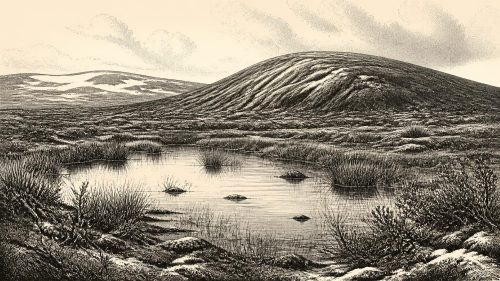
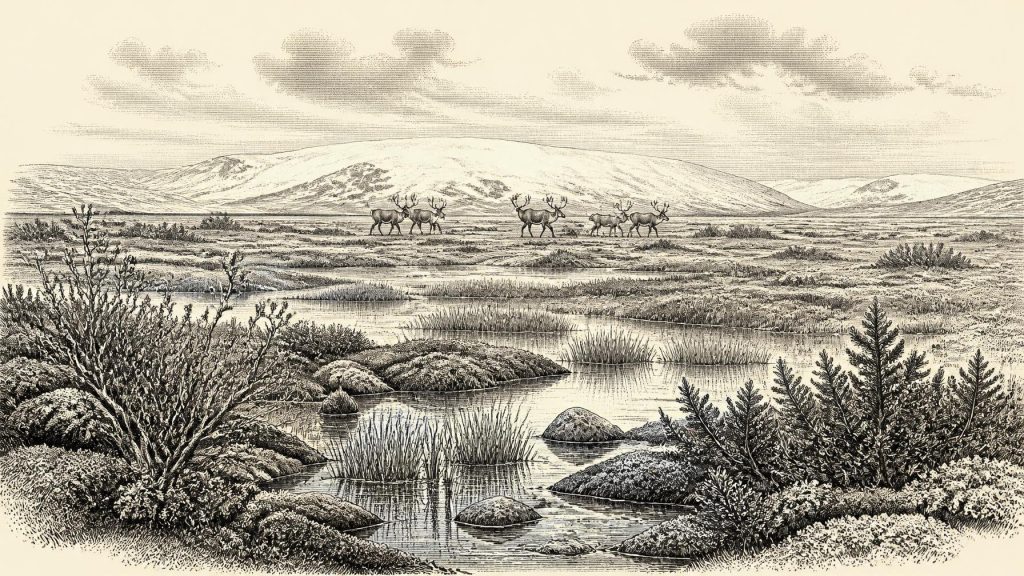
Derryvree offers an unusually vivid, if local, glimpse. Roadworks exposed fine sands and organic silts trapped between two separate sheets of till within a drumlin. The lower till records an earlier ice advance; the upper till records a later one. Between them lay evidence for an open, periglacial wetland rather than woodland: grasses, sedges, dwarf shrubs and herbs, mosses, aquatic plants, insects and signs of shallow pools rich in decaying vegetation. Researchers have described this as a tundra or muskeg environment, marked by severe winters and a short growing season. That interpretation is strongly grounded in the biological assemblage, although the exact timing and duration of the deposit remain limited by the precision of the old radiocarbon measurement.
The scene was therefore one of exposed ground, wet hollows, small water bodies and low vegetation, not mature forest. Juniper and dwarf willow could occur in protected places, but the evidence does not justify imagining a continuous cover of trees. Wind, frost action, seasonal thaw and waterlogged soils would have shaped daily conditions for any animals moving through the landscape. Rivers and wetlands were important ecological corridors, while caves and rock shelters could preserve bones that open-air sites seldom retained through later glaciation.
Animals of a Cold-Stage Ireland
Southern Irish caves, especially Castlepook Cave near Doneraile in north County Cork, provide the principal faunal evidence for the wider MIS 3 world. Collections made during antiquarian excavations include remains attributed to reindeer, woolly mammoth, giant deer, brown bear, horse, wolf, Arctic fox, hare, lemmings and spotted hyaena. Taken together, these finds show that Ireland supported, or was at least visited by, a varied cold-stage fauna before the great ice expansion. They also show that access to the landmass was possible for sizeable terrestrial mammals at some points in the Late Pleistocene.
But this list needs careful handling. The animals were not necessarily all alive together, in one cave, or in one century. Early excavations often removed bones from complicated deposits without the recording now expected. Cave entrances can accumulate remains brought in by predators, scavengers, water, collapse and people; they can also be disturbed by later animals and excavators. Recent re-dating of bones from Castlepook and neighbouring caves, using improved collagen pretreatment, has shown that several older radiocarbon results were substantially too young. The revision confirms the importance of a pre-Last Glacial Maximum fauna, but makes simple chronological tables unreliable.
For 30,232 BCE, the responsible conclusion is modest. Cold-adapted herbivores and their predators had habitats in Ireland during the broader period. Reindeer were especially suited to open, seasonal environments; wolves and hyaenas occupied the carnivore guild; mammoth and giant deer point to wider grazing landscapes, though their particular local histories may have differed. Their presence is evidence of ecological connectivity with Britain and continental north-west Europe. It is not proof of a permanent wildlife population for every species, still less a guarantee that any one animal stood in Cork or Fermanagh in this particular modern-numbered year.
The Reindeer Bone and Human Possibility
The most consequential Irish object associated with this broad horizon is a reindeer femur from Castlepook Cave. It bears a deep linear modification interpreted by zooarchaeologist Ruth Carden as a cut made with a sharp stone tool while the bone was fresh. County Cork heritage material presents it as evidence of reindeer butchery around 33,000 BCE. If that reading is correct, it would push human activity in Ireland far back into the Upper Palaeolithic, long before the better-established post-glacial settlement record.
Its importance should not be mistaken for certainty about a population. The bone is not a securely excavated camp floor accompanied by a tool-kit, hearths, dwellings, human remains or a dense scatter of food waste. Its recovery belongs to an old cave collection whose original contexts were imperfectly recorded. The date concerns the bone and its wider faunal horizon, rather than providing an exact hour, season or lifetime for the alleged butchery. Nor can one mark reveal whether hunters killed the reindeer, encountered a carcass, processed it at the cave, travelled in a small party, or made repeated visits.
Nevertheless, the interpretation is archaeologically significant because a sharp, fresh-bone cut is not the same thing as random breakage. If made by people, it records a practical act: separating tissue, removing meat or otherwise processing an animal. It does not allow a named culture to be assigned to Ireland, and no Irish evidence of this age identifies language, ancestry, social organisation or religious belief. The safest formulation is that Castlepook raises the strong possibility of a brief Upper Palaeolithic human presence or visit during the broader MIS 3 interval. It does not demonstrate continuous occupation of Ireland.
Mobility Rather Than Settlement
Political affairs, diplomacy and warfare cannot be reconstructed for Ireland at this depth of time. There are no states, boundaries, treaties, monuments or written voices. Even “society” must be approached through analogy rather than direct observation. If people did reach Ireland, they were almost certainly highly mobile hunter-gatherers operating in small groups, dependent on knowledge of animals, seasons, terrain and weather. Such an inference follows from the subsistence possibilities of Upper Palaeolithic north-west Europe; it is not evidence for a particular Irish camp or community in 30,232 BCE.
Travel was probably shaped by a geography unlike that of modern Ireland. Sea level was much lower during the ice age, exposing broad areas of what are now the Irish Sea, Celtic Sea and continental shelf. Yet lowered seas did not automatically create an easy, permanent land bridge or a single route. Ice, tidal channels, rivers, coastlines and changing sea levels made connections episodic and difficult. Animal movements establish that dispersal occurred; they do not reveal whether people came overland, by water, from Britain, directly from the continent, or through a combination of routes.
Economically, the evidence supports hunting and scavenging only as a possibility tied to the Castlepook bone, rather than a documented Irish subsistence system. There was no farming, stock-keeping, pottery, metalworking or trade network that can be demonstrated here. Stone tools have not been securely associated with the Castlepook reindeer femur. Nor is there evidence for houses, storage pits, clothing, boats, burial rites, art or formal learning in Ireland from this horizon. It would be misleading to fill these absences with vivid but untestable scenes.
What Can Be Said of Culture
Upper Palaeolithic people elsewhere in Europe made sophisticated stone and bone tools, ornaments and art, and maintained social networks across great distances. Those wider comparisons establish what was possible among contemporary human communities, but they cannot be imported wholesale into Ireland. No comparable Irish assemblage has yet been recovered from around 30,232 BCE. The island’s archaeological record has been repeatedly damaged, buried or removed by later glaciation, erosion and rising seas, so absence of evidence is not proof that nothing occurred. It remains, however, absence of evidence.
The most revealing development is therefore environmental rather than political: Ireland contained habitable, though harsh, patches during an unstable cold stage. Wetland deposits at Derryvree preserve a northern tundra ecology; cave faunas in the south preserve a more extensive record of animals; Castlepook preserves a possible trace of human action. Together they replace an older image of an entirely empty, uniformly frozen Ireland with a more qualified picture of changing landscapes and intermittent connectivity. They do not turn 30,232 BCE into a historical year in the conventional sense.
That distinction matters. Modern calendar precision makes deep prehistory appear sharper than it is. For Ireland around this point, archaeology can describe an interval of cold open country, freshwater refuges, mobile animals and possible human butchery. It cannot name a leader, locate a village, reconstruct a belief system or narrate an event on a particular day. The Castlepook reindeer mark and the Derryvree wetland are valuable precisely because they are rare surviving witnesses to a world later ice sheets almost erased.
Primary Sources
- A reconsideration of the radiocarbon dating of the Marine Isotope Stage 3 fauna from southern Ireland
- A Middle Midlandian Freshwater Series at Derryvree, Maguiresbridge, County Fermanagh, Northern Ireland
- The Irish Quaternary Fauna Project
- New insights on the fauna of Ireland's Younger Dryas and Early Holocene from Alice & Gwendoline Cave
- Radiocarbon constraints on the age of the maximum advance of the British–Irish Ice Sheet in the Celtic Sea
- New data for the Last Glacial Maximum in Great Britain and Ireland
- Episodic speleothem deposition tracks the terrestrial impact of millennial-scale last glacial climate variability in SW Ireland
- The IntCal20 Northern Hemisphere Radiocarbon Age Calibration Curve (0–55 cal kBP)
- IntCal Publications
- Prehistoric Details
- Heritage Artefacts of County Cork
- Archaeology Research Excavation Grant Report
- IE GSI Quaternary Geomorphology 50K Ireland
- County Meath Groundwater Protection Scheme: Quaternary (Subsoils) Geology
- The Geological Heritage of Wicklow
- The Geological Heritage of Clare
- Occurrence of mammalia relicts at site Castlepook Cave
- Mammoth Cave
- Irish Cave Exploration
- Cenozoic: Tertiary and Quaternary (until 11,700 years before 2000)