
Derryvree Roadworks Discovery30207 BCE
Around 30,207 BCE, Ireland lay within a fluctuating Late Pleistocene environment, not a datable historical year. Roadworks at Derryvree, County Fermanagh, exposed freshwater silts between glacial tills, proving a local ice-free interval with open, wet tundra vegetation before renewed glaciation. Radiocarbon evidence provides only a broad chronological range. Castlepook Cave, County Cork, preserves Ice Age animal remains, including a reindeer bone possibly cut by a stone tool, suggesting but not proving human presence. No settlement, institutions or continuous population can be demonstrated. Glacial erosion, changing coastlines and poor preservation severely limit evidence, making uncertainty central to understanding Ireland’s earliest past.
Dateline
The label 30,207 BCE is a modern point on a retrospective timeline, not a year that can be recovered from the Irish prehistoric record. No community in Ireland then kept calendars, named rulers or left written accounts. Even archaeological dating cannot isolate a single year at this depth of time. The most responsible approach is therefore to place this nominal date within a much wider Late Pleistocene setting: the later part of Marine Isotope Stage 3, before the Last Glacial Maximum, when Ireland’s environments changed sharply and repeatedly.
The most relevant Irish evidence is not a settlement, battle or burial, but a buried freshwater deposit at Derryvree near Maguiresbridge in County Fermanagh. It offers a rare window onto an interval when at least part of Ireland was free of glacier ice. Its radiocarbon result, BIRM-166, was published as 30,500 +1,170/−1,030 radiocarbon years BP. Radiocarbon years are not calendar years: calibration produces a broad and uncertain calendar-age distribution, rather than a single conversion. A recent synthesis places the indication of ice-free conditions at Derryvree around 35.1 ± 3.2 thousand calendar years BP. Thus 30,207 BCE, equivalent to roughly 32,156 years before AD 1950, should be treated as falling near the younger side of a wide evidence-based horizon, not as the date of a particular event.
A Freshwater Interval Beneath the Drumlin
In 1969, roadworks cut through a drumlin at Derryvree, about two kilometres north-east of Maguiresbridge. The exposure revealed two thick layers of till: unsorted sediment laid down directly by glacier ice. Between them lay fine sands and organic freshwater silts. That sequence has unusual historical force. It records, in order, an earlier glacial phase, an interval in which water, sediment and organic remains accumulated in an ice-free landscape, and a later advance that buried the deposit beneath fresh till.
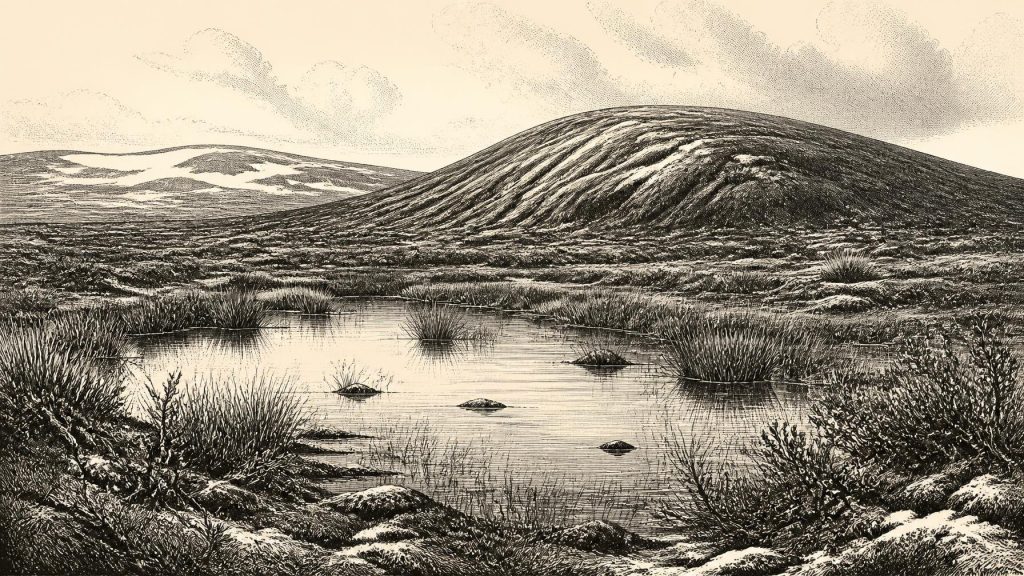
The organic bed does not prove that all Ireland was green, mild or continuously inhabited. It does prove that this particular part of Fermanagh was not under an ice sheet when the freshwater sediments formed. Plant and animal remains in the silts indicate open tundra vegetation and a periglacial climate: ground subject to intense seasonal freezing and thawing, with wet hollows, shallow water and sparse low-growing plants rather than woodland. Mosses, sedges, dwarf shrubs and aquatic plants could exploit the short growing season. Such a landscape was demanding, but it was not lifeless.
At 30,207 BCE the island’s geography was also unlike that of the present. Global sea level was considerably lower during the Ice Age, exposing continental shelf around Ireland and Britain. That did not automatically mean a simple, permanent land bridge to Britain at every moment, nor can the Derryvree deposit establish a route used by people or animals. It does, however, place Ireland within a broader north-west European zone in which advancing and retreating ice, changing coastlines and open habitats altered opportunities for movement.
Climate in Motion
Derryvree belongs to a period once often described in Irish literature as the Middle Midlandian. Modern studies more commonly relate it to Marine Isotope Stage 3 and to the abrupt warm and cold oscillations registered in Greenland ice cores. Those large-scale records are essential context, but they should not be mistaken for a weather diary for Fermanagh. Ireland’s response depended on local topography, moisture, sea conditions and the behaviour of the British–Irish Ice Sheet.
The later growth of that ice sheet would become decisive. The Last Glacial Maximum in Ireland is generally placed after this Derryvree interval, broadly around 27,000–23,000 years ago, although the timing and extent of ice varied greatly by region. The two tills enclosing the Fermanagh freshwater deposit demonstrate a fundamental point: glaciation was neither one smooth advance nor one uniform frozen state. There were local episodes of ice cover, ice-free ground and renewed encroachment. The landscape that supplied the organic silts was eventually overridden or surrounded by ice again, while the deposit’s burial helped preserve it.
This geological instability governs what can be known about early Ireland. Glaciers eroded older soils and sediments, rearranged boulders and reshaped valleys. Rising seas after the Ice Age then drowned much of the former coastal plain. The survival of one sheltered, sealed deposit at Derryvree is therefore exceptional rather than typical. Absence of evidence elsewhere cannot safely be read as absence of plants, animals or people.
Animals at Castlepook
County Cork provides a second, very different line of evidence. Castlepook Cave, near Doneraile and also known as Mammoth Cave, has long been Ireland’s principal archive of pre-Last Glacial Maximum animal remains. Antiquarian excavations in the early twentieth century recovered bones of animals associated with Ice Age environments, including reindeer, mammoth, giant deer, brown bear, wolf and spotted hyaena. Later research has shown both the importance and the difficulty of this collection: caves collect material over long periods, bones may be moved by carnivores or water, and early excavations rarely preserved the contextual detail expected today.
Recent re-dating has substantially altered the chronology of Castlepook fauna, with some specimens proving older than earlier radiocarbon work had suggested. The cave confirms that large mammals entered Ireland during Marine Isotope Stage 3, but it does not supply a neat census for 30,207 BCE. Nor should every species found in the cave be pictured together on one day or in one small landscape. The assemblage accumulated across millennia and under changing environmental conditions.
One reindeer femur has attracted particular attention because Ruth Carden identified a deep mark as consistent with cutting by a sharp stone tool while the bone was fresh. County Cork’s heritage publication assigns the bone broadly to about 31,000 BCE and presents it as possible evidence for Palaeolithic hunters processing a reindeer. If that interpretation is sustained, it would be an extraordinarily early indication of human action in Ireland.
Yet its limits are as important as its promise. A marked bone is not a camp. Castlepook has not yielded a securely associated stone-tool assemblage, hearth, dwelling surface, burial, human bone or stratified concentration of butchered food waste from this age. The femur’s date concerns the animal’s death, not a calendar date for the incision. The cave’s disturbed history also prevents confident reconstruction of where the carcass was killed or whether people entered the cave at all. The most careful conclusion is that a brief Upper Palaeolithic encounter with a reindeer is possible; permanent settlement, a named hunting people or a continuous population cannot be claimed.
Society Beyond Recovery
There is no evidence from Ireland around this nominal year for political institutions, chiefs, warfare, treaties, territorial states, organised religion, formal learning, agriculture, metalworking or trade networks. None should be invented to fill a chronological entry. There are no known Irish houses, graves, ceremonial monuments, pottery vessels or farms attributable to this horizon. The familiar archaeological vocabulary of later prehistoric Ireland simply does not apply.
If people did reach Ireland during the wider period suggested by the Castlepook femur, they would have been highly mobile hunter-gatherers operating in small groups, as elsewhere in Upper Palaeolithic Europe. That is an inference from wider archaeological comparison, not a directly observed fact about a Fermanagh camp or a Cork family. Their practical knowledge would have concerned animal movement, exposed terrain, weather, stone resources, shelter and the risks of a cold-season landscape. Whether visits were single expeditions, recurring seasonal movements or something else remains unknown.
There is likewise no direct Irish evidence for ritual practice, language, music, art or exchange at this date. The absence is partly a problem of preservation. Organic equipment, clothing, wooden shelters and skin vessels rarely survive in exposed glacial landscapes, while later ice repeatedly destroyed or concealed surface sites. Even so, preservation bias is not a licence to turn possibility into fact. Derryvree and Castlepook illuminate environment and fauna far better than belief or social organisation.
What This Date Can Mean
For Ireland, 30,207 BCE is best understood not as an anniversary but as a position within a fragile environmental archive. At Derryvree, freshwater sediments lodged between two tills preserve proof of an ice-free, open and wet tundra landscape during a long cold stage. At Castlepook, cave bones show that substantial mammals reached the island in the wider interval; one reindeer femur raises the prospect, still unproven beyond doubt, that people processed an animal here.
These traces revise the old image of Ice Age Ireland as an unchanging blank beneath ice. They do not replace it with a settled prehistoric nation. The evidence points instead to a dynamic island at the north-western edge of Europe: ecologically connected at times, environmentally severe, repeatedly transformed by ice, and only intermittently visible to modern research. That uncertainty is not a failure of the record. It is the central historical fact of Ireland at this depth of time.
Primary Sources
- Middle Midlandian Freshwater Series at Derryvree, Maguiresbridge, County Fermanagh, Northern Ireland
- Middle Midlandian Freshwater Series at Derryvree, Maguiresbridge, County Fermanagh, Northern Ireland
- Exploring Controls of the Early and Stepped Deglaciation on the Western Margin of the British-Irish Ice Sheet
- Deglaciation Chronology of the Donegal Ice Centre, North-West Ireland
- Trimlines, Blockfields and the Vertical Extent of the Last Ice Sheet in Southern Ireland
- Dimensions and Chronology of the Last Ice Sheet in Western Ireland
- Irish Quaternary Association Guide 16: Fermanagh Field Guide
- Figure 6: The Subdivision of the Quaternary Period in Ireland
- A Reconsideration of the Radiocarbon Dating of the Marine Isotope Stage 3 Fauna from Southern Ireland
- The Irish Quaternary Fauna Project
- Occurrence of Mammalia Relicts at Site Castlepook Cave
- The Exploration of Castlepook Cave, Co. Cork
- Heritage Artefacts of County Cork
- 32564: Castlepook Cave, Castlepook, Cork
- Mammoth Cave, Castlepook
- New Insights on the Fauna of Ireland's Younger Dryas and Early Holocene from Alice & Gwendoline Cave
- First Evidence of a Late Upper Palaeolithic Human Presence in Ireland
- The IntCal20 Northern Hemisphere Radiocarbon Age Calibration Curve (0–55 cal kBP)
- IntCal Publications
- The IntCal20 Approach to Radiocarbon Calibration Curve Construction: A New Methodology Using Bayesian Splines and Errors-in-Variables
- High-Resolution Record of Northern Hemisphere Climate Extending into the Last Interglacial Period
- A Stratigraphic Framework for Abrupt Climatic Changes During the Last Glacial Period Based on Three Synchronized Greenland Ice-Core Records