Tobin’s Ultimatum and Tailteann1924 CE
In 1924, the Irish Free State strengthened its authority after civil war. Government resistance to Liam Tobin’s Army Crisis affirmed civilian control and led towards a smaller professional army. New courts, policing and administrative laws established regular state institutions, while prosecutions for Civil War acts ended. The Boundary Commission began work amid nationalist expectations. Fiscal retrenchment, notably reduced old-age pensions, caused hardship. Railway legislation sought economic integration. Ireland competed independently at the Paris Olympics and hosted the Tailteann Games, projecting cultural confidence despite republican boycott. Irish-language education expanded. The year combined constitutional consolidation, austerity, unresolved partition and contested national self-presentation.
Dateline
In 1924 the Irish Free State was still a state in the making. The Civil War had ended the previous year, but its armed forces, prisons, finances and political loyalties all bore the weight of the conflict. W. T. Cosgrave’s government had to make authority practical: not merely claim the allegiance of citizens, but subordinate soldiers to ministers, organise policing and courts, restrain expenditure, and make public institutions work across twenty-six counties. At the same time, the frontier with Northern Ireland remained unsettled, while Dublin staged ambitious international sporting and cultural events intended to present Ireland as a nation newly visible to the world.
An Army Crisis in March
The year’s most dangerous domestic confrontation came not from the defeated anti-Treaty IRA but from within the National Army that had fought for the Free State. The wartime force was expensive, oversized for peacetime and internally divided. Demobilisation threatened the positions and expectations of officers who had entered the army from different revolutionary organisations and personal networks. For a government attempting fiscal restraint, a smaller, disciplined military answerable to civilian ministers was essential. For officers who believed the army’s revolutionary standing gave it a special political role, retrenchment seemed both a practical injustice and a betrayal.
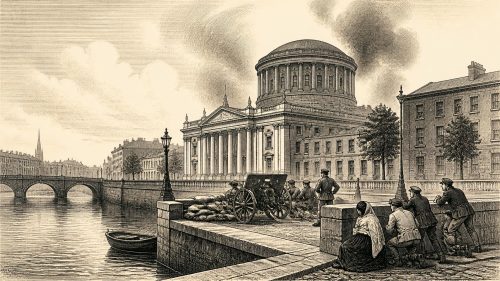
On 6 March Major-General Liam Tobin and Colonel Charles Dalton presented an ultimatum to the government. The crisis that followed, conventionally called the Army Mutiny, ran through the middle of the month. Its language and atmosphere were alarming in a country only recently emerged from civil war: officers challenged the direction of the elected administration, while ministers feared that a military faction might dictate policy or split the army. The issue was not simply pay or redundancy. It concerned whether the Free State would be governed by constitutional institutions or remain vulnerable to armed political intervention.
Cosgrave’s Executive Council acted against the challenge. The Army Council resigned after the government objected to its handling of the affair, and Richard Mulcahy left the Ministry of Defence. These were painful developments for a pro-Treaty leadership whose legitimacy had been bound closely to the National Army, and Mulcahy’s departure was a substantial political sacrifice. Yet the outcome mattered more than the individual careers involved. The government did not yield control of army policy to the dissident officers. Civilian supremacy, a principle easily asserted but difficult to establish in a revolutionary aftermath, survived a severe test.
On 3 April the government appointed an Army Inquiry Committee to investigate the indiscipline and insubordination that had surfaced. Its work continued into June. The inquiry did not erase resentment or solve every problem of army reorganisation, but it turned a potentially existential political rupture into an administrative and constitutional process. The army was subsequently reduced and refashioned as a permanent force of the state rather than a collection of victorious Civil War formations. In that sense, 1924 was a decisive year in the making of professional, politically subordinate defence forces.
Law, Policing and the End of War Politics
State-building also proceeded through legislation. The Oireachtas passed the Courts of Justice Act, the Garda Síochána Act and the Dublin Police Act during 1924, alongside measures concerning firearms, public safety, unemployment insurance, housing, fisheries and civil administration. Such titles can appear dry, but they reveal the reach of the new government’s task. Justice had to move from emergency and revolutionary arrangements into regular courts; policing had to be housed in a national framework; and the administration needed rules for records, recruitment, revenue and local government.
The coexistence of ordinary and emergency legislation is revealing. Public Safety and enforcement measures showed that ministers still judged security to be fragile. Meanwhile, the Garda legislation provided a statutory basis for the unarmed Civic Guard as a national police service. The Free State was therefore not simply “returning to normal”; it was deciding what normal government would look like after revolution. The presence of former combatants, prisoners, bereaved families and damaged property made that process immediate in towns and villages as well as in Dublin offices.
There was also a carefully limited gesture towards reconciliation. On 7 November Cosgrave announced that there would be no further criminal prosecutions for acts committed on either side during the Civil War. This did not settle questions of memory, compensation, imprisonment or political loyalty. Nor did it mean that the conflict’s divisions vanished. It did, however, mark a deliberate decision to draw a line under further criminal proceedings, recognising that an indefinitely punitive approach could keep the war alive in public life.
Boundary Without Settlement
Partition remained the Free State’s great external and national question. The border had acquired a customs function in 1923, disrupting older commercial and social connections. Its final territorial settlement was still expected by many nationalists to bring significant adjustments, especially in areas with Catholic and nationalist majorities close to the line. That expectation was a powerful element in southern political life during 1924, although the Treaty’s wording offered no simple promise of large transfers.
A London conference on 24 April failed to secure agreement between the British, Free State and Northern Ireland governments. The Boundary Commission process therefore moved forward. Northern Ireland’s government refused to nominate a commissioner; Eoin MacNeill, historian, Gaelic League founder and Free State minister, was appointed as the Free State representative in June. By November the commission had begun meeting in London. Its later collapse and the confirmation of the existing border belong to 1925, not 1924. What can responsibly be said of this year is that the commission finally became operational, carrying hopes and anxieties which would make its eventual outcome intensely contentious.
Austerity at the Kitchen Table
The Free State’s balance sheet was shaped by the costs of war, compensation and administration. The Appropriation Act allotted large sums for property damage arising from the conflict, personal injuries and pensions, alongside the ordinary expenses of government. Finance Minister Ernest Blythe pursued economy in this difficult environment. His most politically memorable decision came with the Old Age Pensions Act of 1924, which reduced the maximum pension from ten shillings to nine shillings a week.
The reduction was small in official arithmetic but substantial in the life of a poor older person. A shilling could mean food, fuel or household necessities, especially in rural households dependent on modest farm incomes and family support. The measure became an enduring symbol of Cumann na nGaedheal austerity. It also illustrates a central tension of the decade: the government sought a credible, solvent state, but those savings were felt most sharply by people with the least margin against hardship.
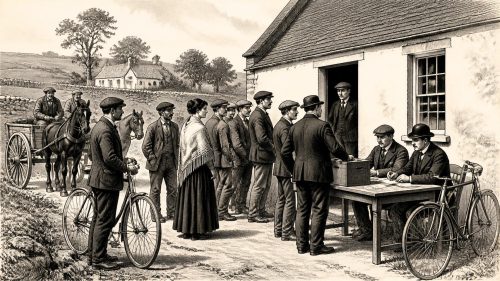
Administrative changes touched everyday civic identity too. The Local Government Electors Registration Act and the October regulations made detailed provision for electoral lists. Electoral registration, juror qualifications and the machinery of local government were unglamorous but consequential elements of democracy. The electorate was becoming one that belonged to the Free State’s own institutions, rather than merely inheriting a framework from the United Kingdom.
Rails, Roads and Economic Integration
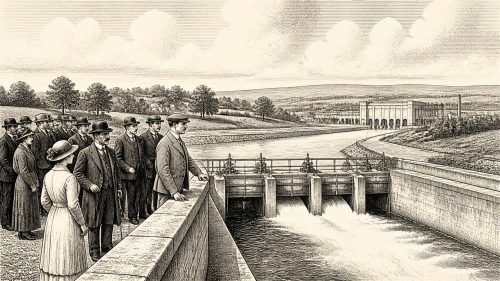
Transport was another practical test of independence. On 23 July the Railways Act set out to reorganise railways wholly within the Free State into an amalgamated system, with a Railway Tribunal to oversee important aspects of the new order. The legislation aimed at more efficient and economical operation, but it addressed a network built for an all-Ireland and British-centred economy. Partition had left major routes crossing the new frontier outside the scheme, while smaller local lines often faced weak receipts and heavy maintenance costs.
The first Great Southern preliminary amalgamation scheme was approved in November. The full Great Southern Railways structure developed across the following year, so it would be misleading to treat every consequence as complete in 1924. Nevertheless, the Act was a major statement of policy: the Free State would intervene to rationalise a vital commercial and social network. For farmers sending livestock and produce, traders receiving goods, railway workers, emigrants travelling to ports, and families making long journeys, the condition of the railways remained a matter of everyday importance.
Paris, Dublin and a National Stage
Amid these sober concerns, 1924 supplied striking occasions for public display. At the Paris Olympic Games, held from May to July, Ireland competed independently for the first time. Jack O’Grady carried the flag at the opening ceremony. Ireland’s medals came in the Olympic art competitions: Jack B. Yeats won silver for The Liffey Swim, while Oliver St John Gogarty won bronze for an ode connected with the Tailteann Games. Hilda Wallis and Phoebe Blair-White became the first women to compete for Ireland at the Olympics, both in tennis. The delegation did not resolve the constitutional ambiguities surrounding the island, but it made a new international claim: Ireland could appear in Paris under its own name and symbols.
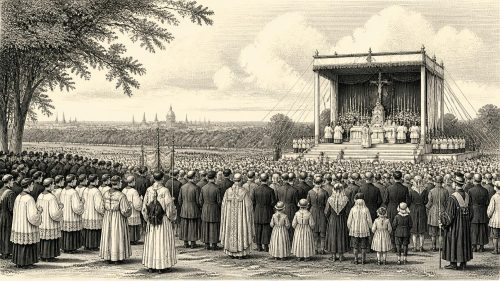
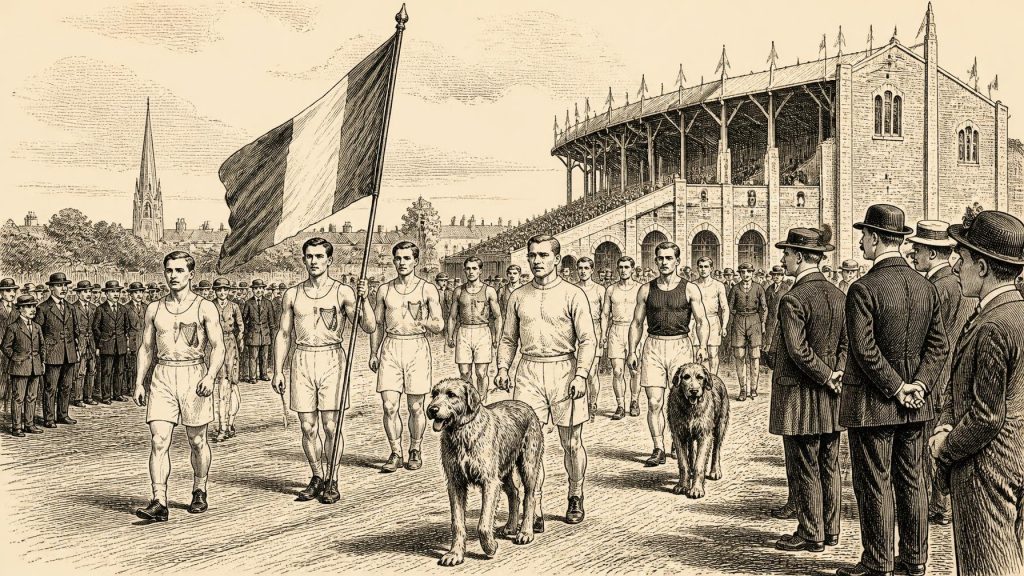
That claim was amplified in Dublin when the revived Aonach Tailteann opened on 2 August. Promoted energetically by J. J. Walsh, Minister for Posts and Telegraphs, the festival combined athletics with music, art, crafts and displays of Irish identity. Its organisers invoked the legendary fair of Tailtiu, but the event was unmistakably modern: a state-sponsored effort to attract visitors, engage the diaspora and associate the Free State with cultural confidence after war. Croke Park received public support for a new stand, and Dublin became a stage for athletes and visitors from Ireland and abroad.
The Games were not politically neutral. Sinn Féin issued a statement urging republicans not to participate in an event organised by the Free State. That boycott underlined the fact that cultural nationalism could not be separated neatly from constitutional allegiance. Still, the Aonach showed the government’s ambition to make Irishness visible through recreation and artistic achievement rather than solely through uniforms, elections or diplomatic documents.
Language, School and State
Education remained another arena in which national identity was to be made habitual. The revised primary programme introduced in the early Free State already gave Irish language, Irish history and geography a central place. During 1924 the Department of Education decided that junior classes were to be taught through Irish, a demanding aspiration in a system where teacher preparation, school resources and local linguistic realities varied greatly. The aim was cultural restoration, but the burden of carrying it fell upon teachers, children and families in the daily routines of the classroom.
Thus 1924 was not a year of one uncomplicated national triumph. It was a year in which a fragile state constrained its army, legislated for courts and police, began to reorganise transport, imposed unpopular economies, and sought recognition through sport, art and language. The Army Crisis demonstrated that constitutional authority could prevail. The Boundary Commission reminded Ireland that national territory and allegiance remained unsettled. Tailteann and Paris, by contrast, offered images of possibility: a country presenting itself, in its own contested fashion, to its people and to the wider world.
Primary Sources
- The Army Inquiry Committee Papers
- The ‘army mutiny’ of 1924 and the assertion of civilian authority in independent Ireland
- Papers of the Army Inquiry Committee (1924)
- Appointment of McNeill as Boundary Commissioner
- The Northern Ireland border
- International boundaries
- Northern Ireland 1921-1925: a state of emergency
- Irish Statute Book: Public Acts of 1924
- Railways Act, 1924
- Railways (Great Southern) Preliminary Amalgamation Scheme, 1924
- Railways Bill, 1924—Report Stage (Resumed)
- The Railways Act, 1924
- Merger of Irish Railways into the Great Southern Railway Company
- Old Age Pensions Bill, 1924
- Appropriation Act, 1924
- A costly shilling – Ernest Blythe and the old-age pension
- The Registration of Electors (Electors Lists) Order, 1924
- Paris 1924
- The Olympic Council of Ireland
- Marking the Centenary of the Tailteann Games
- Pamphlet issued by Sinn Féin containing a statement from Éamon De Valera regarding the Tailteann Games
- Tailteann Games opening parade. Men in Irish costume with wolfhounds
- The Irish government and physical education in primary schools, 1922–37
- 70 years of infant education