Harps, Hammers and Head-Races1928 CE
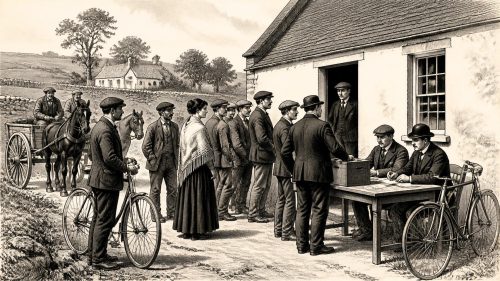
In 1928, the Irish Free State consolidated institutions after civil conflict through constitutional, administrative, economic and cultural measures. The Oireachtas abolished direct-democracy provisions, revised Seanad arrangements, increased old-age pensions and extended regulation of trade, agriculture, welfare, safety and forestry. New Saorstát banknotes and coinage displayed Irish symbols while retaining sterling parity. Construction of the Shannon hydroelectric scheme advertised modernisation before generation began. Major James Fitzmaurice joined the first east-to-west Atlantic flight, and Cosgrave signed the Kellogg–Briand Pact. Tailteann Games, Pat O’Callaghan’s Olympic victory, new Irish-language and cosmopolitan theatres, and gallery legislation promoted cultural visibility despite partition and deep political division.
Dateline
In 1928, the Irish Free State continued the less dramatic but no less consequential work of making a state visible in ordinary life. Five years after the Civil War, W. T. Cosgrave’s administration was legislating, building, issuing symbols of authority and presenting Ireland abroad. The year did not erase division: the Treaty settlement, partition and the recently reorganised party system remained fundamental political facts. Yet the emphasis of public life was increasingly on institutions rather than emergency. A pension payment, a stamped measuring instrument, a new banknote, an international treaty signature or a theatre curtain each offered a different answer to the practical question of what the Saorstát was for.
Reworking the Free State Constitution
The Oireachtas made substantial constitutional changes during the year. On 12 July, the Constitution (Amendment No. 10) Act repealed Articles 47 and 48 of the 1922 constitution. Those articles had provided, respectively, a route by which legislation could be referred to the people after a petition and a route for legislative initiatives from voters. Their removal narrowed the constitution’s provisions for direct democracy. The arguments in the Dáil were fierce. Éamon de Valera, then leading Fianna Fáil in opposition, portrayed the measure as taking a safeguard from the electorate, while the Government maintained that the provisions could be exploited to generate destabilising agitation. The episode illustrates a central tension of the period: the Government sought a settled parliamentary order, whereas its opponents feared that stability might be bought at the expense of popular control.
The upper house was also reshaped. The Seanad Electoral Act of 1928 provided for Seanad elections in which the electorate consisted of members of Dáil Éireann and Seanad Éireann, rather than the wider public. A further constitutional amendment in October reduced the terms of senators elected thereafter and adjusted the retirement cycle. These were technical measures, but their effect was political. The Free State’s original institutions had been designed amid revolution and treaty compromise; in 1928 they were being altered by statute and parliamentary vote. That was itself evidence of a Government determined to govern through regular constitutional machinery, however contested its choices were.
Security, Welfare and Everyday Administration
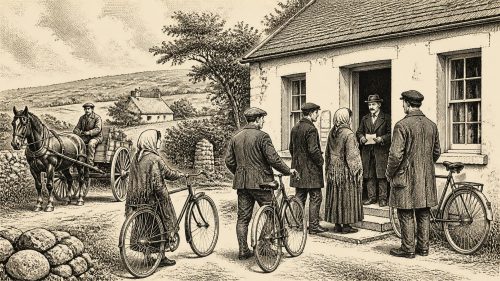
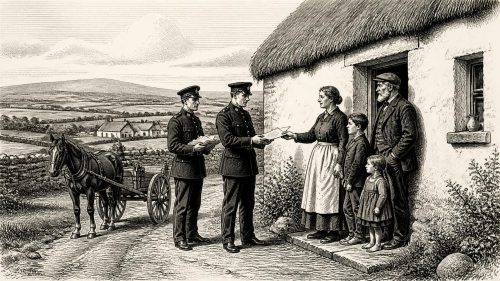
State-building reached far beyond constitutional controversy. The Old Age Pensions Act, enacted on 30 March and operative from 6 April, raised the pension to ten shillings a week for people whose assessed yearly means did not exceed £15 12s 6d. It also included pensions payable under the Blind Persons Act within its definitions. This was not a universal old-age income, nor did it remove the intrusive means test that shaped many claims. But for poorer elderly people, especially in rural districts where cash incomes could be slight and irregular, the increase was a material intervention in household survival.
Other legislation reveals how closely public authority was entering commerce and local life. The Weights and Measures Act of 1928 expanded rules governing instruments used in trade. From late 1928, regulations required inspection arrangements and verification marks for the scales, measures and other devices by which goods were bought and sold. Such provisions may appear mundane beside constitutional amendment, yet they mattered to shopkeepers, farmers, customers, publicans and travelling traders. A state that could regulate the measure of milk, cloth, fuel or grain made its presence felt in transactions repeated every day.
Acts on agricultural credit, creameries, housing, national health insurance and public safety also passed through the Oireachtas. Their combined significance should not be exaggerated into a single social programme, but they show the breadth of concerns before government: farm finance and dairy standards, homes, insured workers, policing and the continuing legacy of political violence. In December, the Forestry Act made further provision for afforestation and restricted the felling of trees. It required notice before many trees over ten years old could be cut and allowed prohibition orders. The Act did not come into operation until 1930, so its immediate effect did not belong to 1928; nevertheless, its enactment showed that questions of timber, land use and the depleted Irish woodland resource had entered national policy.
Money Marked Saorstát Éireann
The most tangible assertion of state identity came in people’s purses. On 10 September, the Currency Commission began issuing the new Series A legal-tender notes of the Saorstát pound. On 12 December, the first Irish Free State coins entered circulation. The monetary unit remained at parity with sterling, an important sign of continuing economic connection with Britain rather than a break into an independently floating currency. Still, Irish notes and coinage made an immediate visual difference.
The coins carried the words Saorstát Éireann and a harp adapted by Percy Metcalfe from the medieval harp preserved at Trinity College Dublin. Their reverse designs featured animals associated with an overwhelmingly agricultural society: horse, bull, salmon, sow, hen, pig, woodcock and hare. W. B. Yeats chaired the committee that selected the animal theme. These objects were practical currency, designed to match familiar denominations, but they were also miniature public statements. Rather than a monarch’s portrait, purchasers encountered an Irish-language state name, a harp and animal life. The decision joined nationalism to the farm economy and to an ideal of native landscape.
The Shannon as Construction Site
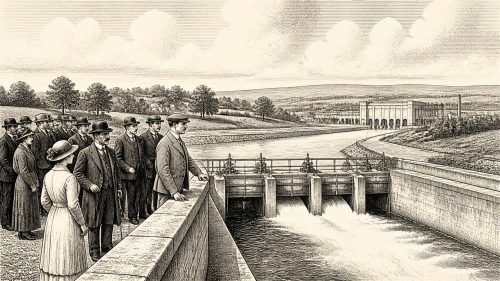
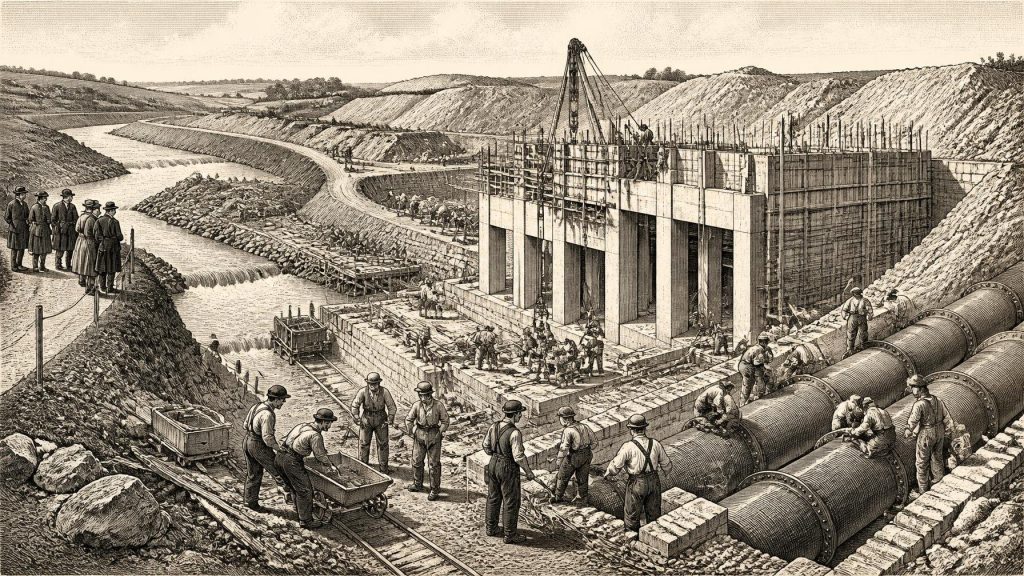
At Ardnacrusha in County Clare, the Shannon hydroelectric scheme was physically transforming the ground. Begun in 1925 and due for completion in 1929, it was the Free State’s great engineering undertaking. In 1928, construction encompassed embankments, the power-station structure, penstocks and the channels that would redirect water from the Shannon. Contemporary photographs record the site under construction in December, while material from the ESB archive shows work on the penstocks during the year.
The scheme was already a spectacle as well as a workplace. Rail excursions brought visitors to see the vast industrial landscape; across 1927–29, more than 250,000 sightseers were reportedly taken to the works. In April 1928 the scheme’s public-relations staff arranged for Pathé to film construction, and the footage was shown in cinemas in Dublin and elsewhere. This was a striking conjunction of technology, tourism and propaganda. The project had not yet generated electricity in 1928, so it would be misleading to describe the year as one of completed electrification. What Ireland saw instead was a promise in concrete, steel and excavated earth: a state claiming competence through an enterprise on a scale previously unfamiliar in the country.
Across the Atlantic and Across Europe
Ireland’s connections with the wider world were unusually visible. On 12 April, the German Junkers aircraft Bremen departed Baldonnel Aerodrome with Hermann Köhl, Baron Günther von Hünefeld and the Irish Air Corps officer Major James C. Fitzmaurice. It reached Greenly Island, Labrador, on 13 April, completing the first successful east-to-west aeroplane crossing of the Atlantic. Fitzmaurice’s part in the flight and Baldonnel’s role in its departure gave the Free State a place in a feat of international aviation, even though the aircraft and two of its crew were German.
Diplomacy offered a more formal demonstration. On 27 August, Cosgrave signed the Kellogg–Briand Pact in Paris on behalf of the Irish Free State. The treaty renounced war as an instrument of national policy and committed its signatories to peaceful settlement of disputes. Its practical weakness would later be painfully apparent, but the signature mattered in 1928. The treaty document listed the Irish Free State separately among the participating dominions, with Cosgrave named as its representative. For a state whose sovereignty remained qualified by the Treaty connection, international recognition was not merely ceremonial.
Games, Stages and Cultural Institutions
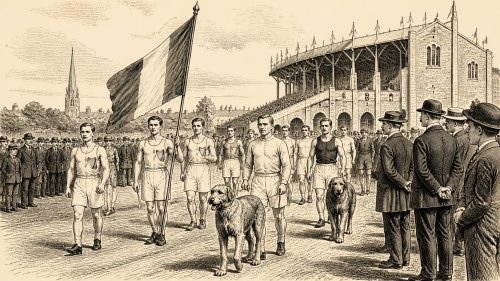
Dublin hosted the second modern Aonach Tailteann from 11 to 26 August. The festival blended sport, music, pageantry and tourism, invoking the legendary Tailteann assemblies while drawing on the model of the modern Olympics. Its programme ranged across athletics, hurling, handball, cycling, boxing, swimming, chess and other competitions. Croke Park staged prominent events, while rowing was held in Cork and boating activity reached Lough Ree. The National Library of Ireland preserves both a tourist leaflet advertising routes to Ireland and a Cork rowing programme, reminders that the Games were intended to draw visitors as well as competitors.
The Amsterdam Olympics had already delivered a powerful sporting image that summer when Cork-born hammer thrower Pat O’Callaghan won gold for Ireland. The Tailteann Games therefore took place in a moment of heightened athletic confidence. Their international participation, diaspora appeal and use of Irish visual motifs made them an exercise in cultural diplomacy as much as recreation. Yet they were not an uncomplicated national consensus: participation rules and the claim to represent all Ireland existed alongside partition and competing sporting allegiances.
Theatre supplied two enduring institutional landmarks. On 27 August, Taibhdhearc na Gaillimhe opened in Galway with Micheál Mac Liammóir’s Diarmuid agus Gráinne, becoming Ireland’s first Irish-language theatre. Its opening gave public expression to the language revival in a city closely connected with the western Irish-speaking districts. Later in the year, Hilton Edwards and Micheál MacLiammóir founded the Gate Theatre in Dublin. Beginning in the Peacock Theatre space, the Gate’s first season included work by Ibsen, O’Neill and Wilde, signalling a deliberately cosmopolitan repertoire beside the national canon.
Nor was cultural policy confined to the stage. The National Gallery of Ireland Act, passed on 30 July, authorised public exhibitions of Gallery pictures around the Free State and permitted loans both within and beyond it. The measure envisaged art moving beyond its Dublin home, with rules for transport, insurance and care. In this respect, too, 1928 was a year of circulation: coins and notes, films and trains, aircraft and treaties, paintings and plays all carried an emerging state into public view.
Primary Sources
- Chronological Table of the Statutes (1928)
- Constitution (Amendment No. 10) Act, 1928
- Constitution (Amendment No.10) Bill, 1928 – Declaration Under Article 47 of the Constitution
- Seanad Electoral Act, 1928
- Constitution (Amendment No. 7) Act, 1928
- Old Age Pensions Act, 1928
- Weights and Measures Act, 1928, Section 11
- Weights and Measures (General) Regulations, 1928
- National Gallery of Ireland Act, 1928
- Forestry Act, 1928
- Old Irish Coins
- How Farmyard Animals Ended up on Ireland’s First Coins
- The Establishing of the Irish Pound
- Kellogg-Briand Peace Pact—August 27, 1928
- Timeline of Events, 1919–69
- The Shannon Scheme
- The Shannon Scheme
- Flight of the Bremen
- Fitzmaurice, James Christopher
- Aonach Tailteann 11th to 26th August Dublin
- Tailteann Games: Aonach Tailteann Athletics—Croke Park, Hurling America v Ireland
- The Rise and Fall of the Tailteann Games
- Irish-Born Medal Winners
- Taibhdhearc na Gaillimhe
- History & Archive — Taibhdhearc
- About The Gate Theatre