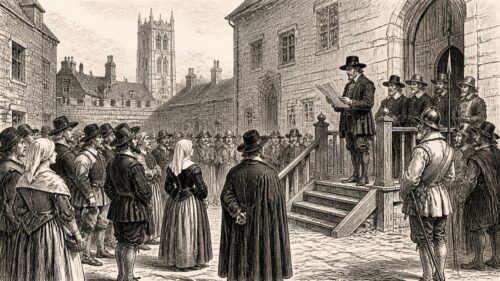
Rossa’s Grave, Kinsale Waters1915 CE
In 1915, the First World War intensified Ireland’s political, social and cultural divisions. The sinking of RMS Lusitania off Kinsale brought global conflict directly to Cork, killing about 1,198 people, including Hugh Lane and Thomas O’Brien Butler. John Redmond’s National Volunteers demonstrated continued constitutional strength, while Irish troops endured heavy losses at Gallipoli and prepared for France. Recruitment increasingly provoked opposition. Meanwhile, IRB-linked Volunteers secretly planned a 1916 rising, seeking German aid, while James Connolly promoted socialist militancy. O’Donovan Rossa’s Dublin funeral became a major republican demonstration. Cultural bodies debated nationalism, and wartime prices and hardship affected communities nationwide unevenly.
Dateline
In 1915 Ireland was not a separate belligerent in the First World War, yet the war reached deeply into Irish politics, households, ports and imaginations. The Home Rule settlement passed in 1914 remained suspended for the duration of the conflict, while Irish people pursued sharply different answers to the question of loyalty: enlist for Britain and the Allies, preserve Ireland’s constitutional claim through John Redmond’s parliamentary party, or prepare for an independent Irish rising. The year did not make the Easter Rising inevitable. It did, however, bring together public military display, overseas loss, cultural change and clandestine planning in ways that made the political landscape markedly more volatile.
War at the Coast
The most immediate catastrophe occurred off County Cork. On 7 May the German submarine U-20 torpedoed the Cunard liner RMS Lusitania south of the Old Head of Kinsale. The ship had sailed from New York for Liverpool and sank rapidly. About 1,198 passengers and crew died, although totals in contemporary and later accounts vary slightly as the identities of victims and survivors were established. The disaster made the Irish coast a place of international consequence: rescue work, the recovery of bodies and hurried burials centred on Queenstown, now Cobh. Local people encountered the human wreckage of a global naval war directly, rather than merely reading battlefield reports in newspapers.
The sinking also had a particular cultural resonance in Ireland. Sir Hugh Lane, the art collector and director of the National Gallery of Ireland, was among those lost; his body was never recovered. Thomas O’Brien Butler, an Irish composer and conductor, also died. Lane’s death sharpened an already contentious question over his paintings, especially the group of French Impressionist works associated with Dublin and London. For families in Cork harbour, meanwhile, the pressing realities were less constitutional or artistic than practical: survivors required help, bodies had to be identified, and a busy port community became the setting for mourning on an exceptional scale.
Irishmen in Imperial War
Many Irishmen were already serving in the British armed forces, and 1915 brought their experience of war into sharper focus. On Easter Sunday, 4 April, John Redmond reviewed National Volunteers in Dublin’s Phoenix Park. Contemporary nationalist reporting placed the turnout at roughly 25,000 to 27,000 men, though such crowd figures should be treated cautiously. The important point is secure: Redmond’s organisation could still stage a major public demonstration and present itself as the disciplined national force of constitutional Ireland. Its members had been encouraged to support the Allied cause, and thousands of Irish recruits had joined the army since war began.
Yet recruitment was neither uncomplicated nor universally popular. Meetings, bands, posters and local political influence promoted enlistment, while anti-recruiting activists answered them with speeches, leaflets and, in some places, public disruption. Bureau of Military History testimony from Charleville recalls a 1915 recruiting campaign accompanied by anti-recruiting slogans and arrests; such recollections were recorded later, but they convey the local friction that wartime enlistment could provoke. By the end of the year, observers noted that recruiting enthusiasm had slackened. Service in the British forces was a real and honourable commitment for many families, but it was also becoming an increasingly divisive public question.
Irish units now suffered in campaigns far beyond the island. The 10th (Irish) Division, raised after the outbreak of war and trained largely at the Curragh, went to Gallipoli for the August offensive. Elements landed at or near Suvla Bay on 6 and 7 August. The division’s battalions included men from Irish regiments and recruits from many parts of Ireland; their operations quickly produced heavy casualties amid heat, inadequate water, confusion and determined Ottoman resistance. The 16th (Irish) Division, associated closely with Redmondite recruitment, transferred to France in December. Thus letters, casualty notices and the absence of men from farms, workshops and streets connected Irish communities ever more closely to the Mediterranean and western fronts.
Conspiracy in a Smaller Ireland
At the same time, a minority of the original Volunteer movement was building a different military project. The split after Redmond’s 1914 call for Volunteers to support Britain had left the Irish Volunteers smaller than the National Volunteers, but more politically homogeneous and more susceptible to influence from the Irish Republican Brotherhood (IRB). Its members continued drilling, route marching and maintaining local companies. Their activity was not simply a prelude to a known future event: in 1915 the timing, scale and prospects of an insurrection remained unsettled, and many Volunteers did not know of the secret plans being developed by a small inner circle.
Several firmly dated developments reveal that inner circle at work. Seán Mac Diarmada was imprisoned in Mountjoy from May to September after an anti-recruiting speech at Tuam. During his imprisonment, Thomas Clarke established a small military committee, later called the military council, bringing together Patrick Pearse, Joseph Plunkett and Éamonn Ceannt. Plunkett travelled to Berlin between March and June to seek German assistance. German officials rejected the more ambitious proposal for a coordinated invasion, but negotiations helped sustain the prospect of an arms landing for a future rising. By December, the conspirators had settled on Easter 1916 as their intended moment. These were secret decisions, not public mandates; their significance lay precisely in the distance between the planners’ intentions and ordinary political life.
James Connolly’s Dublin added another strand. As acting leader in the Irish Transport and General Workers’ Union and commander of the Irish Citizen Army, he combined socialist politics with militant nationalism. In May 1915 he revived The Workers’ Republic, and during the year published his series Insurrectionary Warfare. The Citizen Army was small, but its presence showed that the armed politics of the period could be rooted in the city’s labour movement as well as in the Volunteer and Fenian tradition. Connolly’s writings insisted that national freedom should involve social as well as political change, a proposition that distinguished his outlook from both Redmondite constitutionalism and more conventional nationalism.
A Funeral as Demonstration
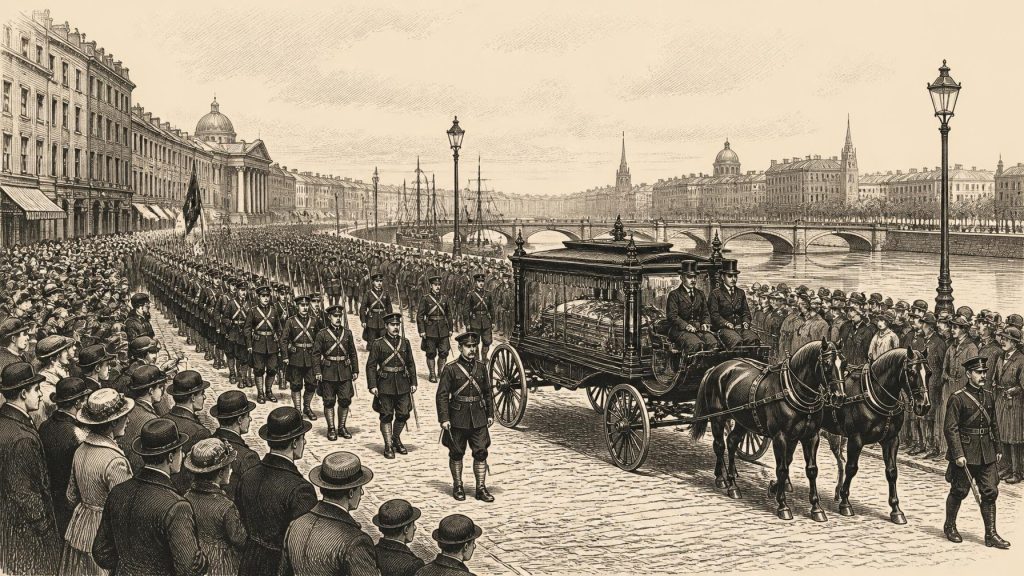
The year’s best-known nationalist spectacle followed the death in New York on 29 June of Jeremiah O’Donovan Rossa, the ageing Fenian veteran from west Cork. His remains were returned to Ireland, lay in state at Dublin City Hall, and were buried in Glasnevin Cemetery on 1 August. The funeral was carefully organised by Irish republican networks on both sides of the Atlantic. Irish Volunteers provided much of the order and ceremony; National Volunteers, Citizen Army members, sporting bodies, bands and other organisations also appeared. Estimates of the crowd and procession vary considerably, but there is no doubt that it was an enormous public gathering.
Patrick Pearse delivered the graveside oration, first in Irish and then in English. Its rhetoric presented Fenian sacrifice as an unfinished inheritance and ended with the declaration that an unfree Ireland would never be at peace. The speech became famous because later events gave it retrospective force, but in August 1915 it was also a calculated act of political theatre. Clarke, who chaired the funeral committee, had chosen Pearse for the task. A firing party, flags, uniforms, music and the burial ground’s existing Fenian graves turned commemoration into a display of continuity between nineteenth-century separatism and a new generation of Volunteers. Dublin Castle observed the proceedings closely, yet the event passed without the confrontation that its organisers may have anticipated.
Language, Association and Daily Pressures
Political contention also entered cultural institutions. In August Douglas Hyde resigned the presidency of Conradh na Gaeilge, the Gaelic League, after its ard-fheis voted to identify the organisation explicitly with nationalism. Hyde had founded the League on a broad cultural basis and hoped it might include sympathetic unionists as well as nationalists. His departure did not mean that Irish-language revival ceased; rather, it exposed a growing difficulty in keeping cultural work separate from the politics of national self-determination. The Gaelic Athletic Association likewise continued to provide a national network of clubs and occasions. Laois won the 1915 All-Ireland hurling championship and Wexford the football championship, reminders that organised sport continued through wartime disruption.
For most people, however, 1915 was lived through work, prices, family responsibilities and news from elsewhere. Wartime demand and transport disruption affected food and fuel costs, while agricultural prices generally rose faster than the cost of living over the wider war years. The evidence does not permit every local experience in 1915 to be reduced to a single pattern: farmers selling livestock or produce could benefit, whereas urban wage-earners faced greater pressure. Reports that children missed school for farm work and that child mortality in Dublin was high point to the unequal burdens beneath patriotic rhetoric. In north-western parishes, Fr Michael O’Flanagan publicly argued for more land redistribution and warned against food exports, linking social need to a language of national grievance.
By December, therefore, Ireland had not chosen one course. Redmond’s constitutional nationalism still possessed impressive public organisation; Irish soldiers were fighting and dying in imperial uniforms; cultural associations were debating their political identity; and a concealed revolutionary council was fixing its sights on the following Easter. The year’s defining images were strikingly different: a stricken liner off Cork, recruits and Volunteers on parade, and a Fenian coffin carried through Dublin. Together they show an Ireland in which war had widened the field of political possibility while making the costs borne by ordinary people ever more immediate.
Primary Sources
- Enormous crowds attend funeral of O’Donovan Rossa
- O'Donovan Rossa, Jeremiah
- Clarke, Thomas James (‘Tom’)
- Pearse, Patrick Henry
- Mac Diarmada (McDermott), Seán
- Plunkett, Joseph Mary
- Hyde, Douglas (de hÍde, Dubhghlas)
- O'Flanagan, Michael
- The Irish Volunteer, 7 August 1915
- The Irish Volunteer, 31 July 1915
- The Workers’ Republic, 1915
- Insurrectionary Warfare
- Part 1 of Insurrectionary Warfare
- Cumann na mBan
- 10th (Irish) Division
- 10th (Irish) Division, Chocolate Hill, Gallipoli
- 200,000 people cheer on Redmond's Volunteers in Dublin
- Volunteer Demonstration in Dublin
- Torpedoes and Tragedy: The Sinking of RMS Lusitania
- Cobh Museum Lusitania Commemoration Exhibition
- The Lady and the V.C.
- Economy: Life in 1916 Ireland: Stories from statistics
- Irish consequences of the Great War
- 1915