Harcourt Street, Cullenswood and Belfast1908 CE
In 1908, Ireland remained within the United Kingdom, but institutional developments strengthened its public sphere. The Irish Universities Act created frameworks for the National University of Ireland and Queen’s University Belfast, addressing Catholic educational grievances while preserving regional distinctions. Patrick Pearse’s St Enda’s school promoted culturally nationalist bilingual education. Hanna Sheehy-Skeffington and Margaret Cousins founded the Irish Women’s Franchise League, demanding equal parliamentary voting rights. Hugh Lane’s Municipal Gallery and the Georgian Society advanced civic cultural memory, while Derry’s Guildhall fire exposed urban vulnerability. Tom Clarke’s Dublin return indicated emerging republican organisation, and impending old-age pensions promised limited social support.
Dateline
In 1908, Ireland remained within the United Kingdom, and its most consequential public decisions were still made at Westminster. Yet several developments of this year gave unusually clear shape to an Irish public sphere: a university settlement addressed a long-running educational grievance; new cultural and civic bodies opened doors in Dublin; and activists created organisations whose importance would become much more obvious in the following decade. The events did not amount to a constitutional transformation or a sudden national crisis. Rather, they reveal an Ireland in which arguments over religion, education, citizenship, heritage and political identity were being placed in new institutions.
The Universities Settlement
The central political achievement of the year was the Irish Universities Act 1908, dated 1 August. Its immediate legal effect was to provide for two new universities, one seated in Dublin and one in Belfast, and to dismantle the existing arrangement of the Royal University of Ireland and Queen’s College, Belfast. The Royal University had principally examined students and awarded degrees; it was widely criticised as an inadequate substitute for a properly endowed teaching university. The new legislation therefore answered an educational question that had frustrated governments, churchmen, academics and Irish politicians for decades.
The measure established the framework for the National University of Ireland and Queen’s University of Belfast. In the Dublin system, University College Dublin, Queen’s College Cork and Queen’s College Galway were to become constituent colleges; Cork and Galway would accordingly become University College Cork and University College Galway. The transition was not completed in a single day. The National University received its charter on 2 December 1908, while the Royal University continued until October 1909. It is important, then, to distinguish the firmly dated legislation and chartering of 1908 from the practical replacement of the older university system during the following year.
The settlement was a compromise shaped by the religious divisions of Irish higher education. Catholic bishops and many nationalist representatives had long argued that the existing provisions did not serve Catholic students adequately, particularly in Dublin. Trinity College remained outside the new structure. At the same time, the Act explicitly prohibited religious tests for students, teachers, graduates and office-holders in either of the new universities. Parliamentary debate demonstrated how contested the compromise remained. Supporters saw a chance to give Irish Catholics meaningful access to university teaching and research; opponents feared an arrangement that would strengthen denominational influence. Neither description wholly captures the eventual institutions, but both explain the intensity of the 1908 controversy.
The geography of the settlement also mattered. Belfast retained and enlarged its place as a university city through Queen’s University, built upon the existing Queen’s College. Its institutional future was separate from that of Cork, Galway and Dublin. That distinction did not create the later political partition of Ireland, which lay years ahead, but it gave formal educational expression to regional differences already visible in the island’s political, religious and economic life. In Belfast, a heavily industrial city with a strong unionist and Protestant public culture, the new university offered continuity as well as change. In Dublin, the National University offered a major new setting in which Catholic and nationalist educational aspirations could operate with state recognition and public funding.
Cullenswood’s National School
University legislation was not the only educational initiative of 1908. Patrick Pearse opened Scoil Éanna, or St Enda’s School, at Cullenswood House in Rathmines, Dublin. An advertisement placed in August announced that its first term would begin on 7 September. Pearse described it as an Irish-Ireland boarding and day school for Catholic boys, with Thomas MacDonagh as second master. Its prospectus promised bilingual instruction, direct teaching of modern languages, attention to science and other modern subjects, and a distinctly national standpoint.
St Enda’s was small beside the universities created by statute, and it should not be treated as representative of Irish schooling as a whole. Its significance lay in its deliberate experiment. Pearse sought an education that joined intellectual training to Irish language, history, landscape and cultural self-respect. The school’s ideals belonged to the wider Gaelic revival, but its methods also looked towards contemporary educational reform. In 1908, St Enda’s was a new and financially vulnerable school rather than a revolutionary institution. Its later association with Pearse’s political career must not obscure the immediate purpose: an attempt to educate boys in a consciously Irish cultural environment.
A New Demand for Women’s Votes
Another firmly dated foundation came on 11 November, when Hanna Sheehy-Skeffington, Margaret Cousins and their associates established the Irish Women’s Franchise League. Ireland already had constitutional suffrage organisations, including the Irish Women’s Suffrage and Local Government Association associated with the veteran campaigner Anna Haslam. The new League, however, announced a more vigorous and independent form of agitation. Its constitution demanded the parliamentary franchise for women on the same terms as men, rejected subordination to political parties, and aimed to organise Irishwomen and educate public opinion through meetings, debates, literature, deputations and other necessary means.
That wording matters. The League’s creation did not secure votes for women in 1908, nor did it settle the difficult relationship between suffrage, nationalism, unionism and Home Rule. It did establish an Irish organisation prepared to press the issue directly upon Irish MPs and to insist that women’s enfranchisement could not simply be postponed until a future constitutional settlement. Men could become associates, but full membership was reserved to women. The small foundation meeting therefore marked a practical enlargement of political participation: women who were excluded from the parliamentary electorate built an organisation to challenge that exclusion.
Art, Architecture and Civic Memory
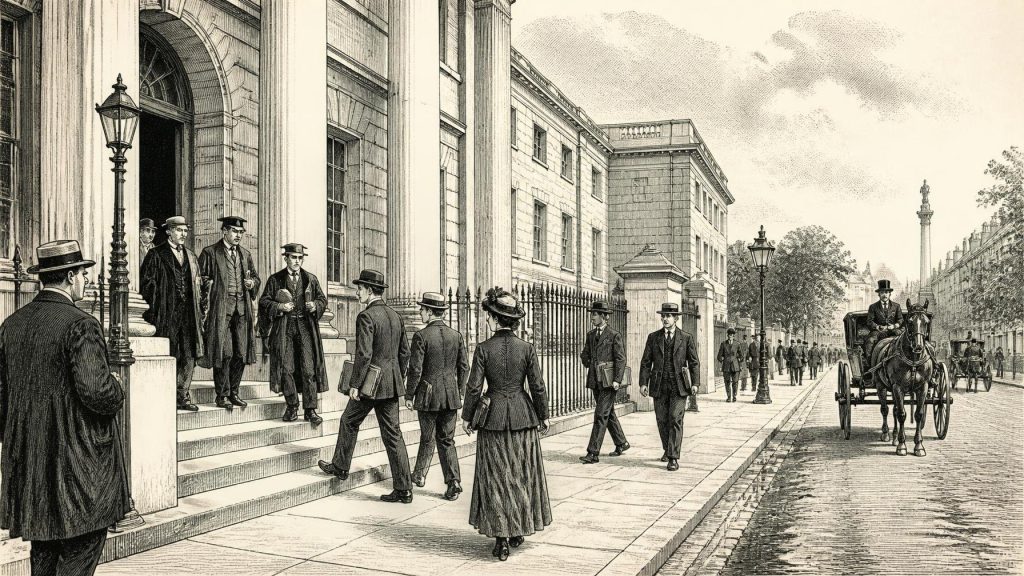
Dublin’s cultural life acquired a conspicuous new public institution on 20 January, when the Municipal Gallery of Modern Art opened in temporary premises at 17 Harcourt Street. It was the achievement of the collector and dealer Hugh Lane, whose collection included Irish, British and French work. The gallery was not yet securely housed or securely financed, and its later history would be marked by controversy over Lane’s bequest. But its opening in 1908 was an important act of municipal cultural ambition. It offered the public access to modern art in a city where questions of national culture were increasingly debated beyond literary circles.
In February, the original Georgian Society was inaugurated at the Royal Irish Academy on Dawson Street. Its stated task was recording eighteenth-century domestic architecture in Ireland, beginning with Dublin. The Society was not primarily a preservation campaign in the later sense; it was a documentation project. Even so, its creation reflected concern that the physical inheritance of the former eighteenth-century capital might disappear before it had been properly studied. Its annual published records, drawings and photographs gave architectural history a more organised public footing.
Elsewhere, the vulnerability of civic buildings was made stark when fire devastated Derry’s Guildhall, destroying all but its clock tower and rear block. The Guildhall had been the administrative centre of Londonderry Corporation since 1890 and its destruction was a serious blow to the city’s civic life. The rebuilding lay in the future, but the 1908 fire serves as a reminder that modern municipal Ireland depended on buildings, records and public spaces that could be suddenly lost.
Politics Beyond Westminster
Constitutional nationalism remained centred on parliamentary representation and Home Rule, but other political currents were quietly acquiring footholds. In February, the former Fenian prisoner Tom Clarke rented a tobacconist’s and newsagent’s shop at 55 Amiens Street, Dublin. It was not yet the famous Parnell Street premises later associated with Irish Republican Brotherhood activity, and it would be misleading to cast the shop itself as a decisive revolutionary headquarters in 1908. Nevertheless, Clarke’s return to Irish political life and his connection with younger IRB activists belong securely to this year’s developing republican network.
Social policy also entered everyday expectations. The Old Age Pensions Act was passed in 1908 and made provision for claims to be handled through pension officers, local committees and post offices. Payments were to begin on 1 January 1909, so they do not belong to the lived calendar of 1908 itself. But during the latter part of the year, the approaching pension was already a concrete prospect for poorer people aged over seventy. Its importance should be set beside the very unequal circumstances of Irish life: rural districts shaped by migration and small farming, industrial Belfast, and Dublin’s severe overcrowding. The latter is documented especially clearly by the census of 1911, which must be used cautiously as later evidence rather than as a statistical snapshot of 1908.
By the end of the year, Ireland had not resolved its constitutional future, its social inequalities or its religious divisions. Yet 1908 left a durable institutional imprint. The university settlement remade higher education; St Enda’s advanced a culturally nationalist educational ideal; the Irish Women’s Franchise League made women’s political equality an organised demand; and the gallery and Georgian Society asserted that art and the built environment were matters of public value. These were not identical projects, but together they show a society arguing more insistently over who should learn, vote, remember and belong.
Primary Sources
- Irish Universities Act, 1908
- Irish Universities Act 1908
- History
- Timeline | 180
- Irish Universities
- Irish Universities Bill
- Irish Universities Bill
- ‘Nobody’s ideal’: Augustine Birrell, William Walsh and the evolution of the Irish Universities Act, 1908
- ‘Nobody’s ideal’ – the Irish Universities Act, 1908: a historical perspective
- Sgoil Éanna Advertisement
- Pearse and Education
- St Enda’s Given To Nation
- Irishwomen’s Campaign for the Vote, 1870
- Hugh Lane, Sir Hugh Percy
- Hugh Lane 100 Years
- Sarah Cecilia Harrison and Sir Hugh Lane
- Georgian Society to Irish Georgian Society 1908–2008
- History of the Guildhall
- Clarke, Thomas James (‘Tom’)
- Old Age Pensions Act, 1908
- Children Act, 1908
- Census of Ireland, 1911: Dublin City
- National Archives: Census of Ireland 1901/1911
- Parnell Monument