Rotunda’s National Council1905 CE
In 1905, Irish politics exposed divisions over government and national identity. George Wyndham resigned after devolution proposals alienated both unionists and nationalists, while the Ulster Unionist Council strengthened northern organisation. On 28 November, the National Council adopted Arthur Griffith’s Sinn Féin policy, advocating Irish institutions, economic self-reliance and withdrawal from Westminster, though not yet republicanism. Land purchase continued, but emigration remained. Disputes over Irish teaching and postal usage demonstrated cultural revival’s political reach. Abbey Theatre productions, scholarly recovery and Belfast’s Presbyterian Assembly Buildings reflected institutional confidence. The A5 submarine disaster at Haulbowline killed six crewmen, bringing naval modernity’s dangers locally.
Dateline
In 1905 Ireland’s public life was marked less by a single dramatic rupture than by the sharpening of rival answers to a persistent question: how should the island be governed, and by whom? The year began with the collapse of a tentative attempt to find common ground between moderate unionists and nationalists. It ended with a new nationalist organisation adopting a language of self-reliance that would acquire immense later significance. Between those points, disputes over Irish in schools and even on postal labels showed that nationality was being argued over in ordinary institutions as well as on political platforms.
A New Departure at the Rotunda
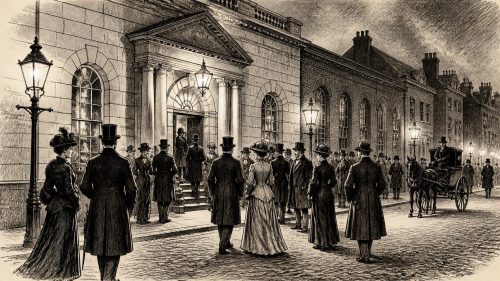
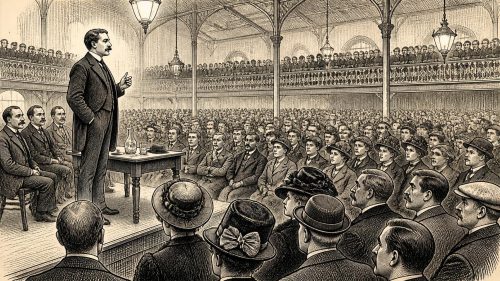
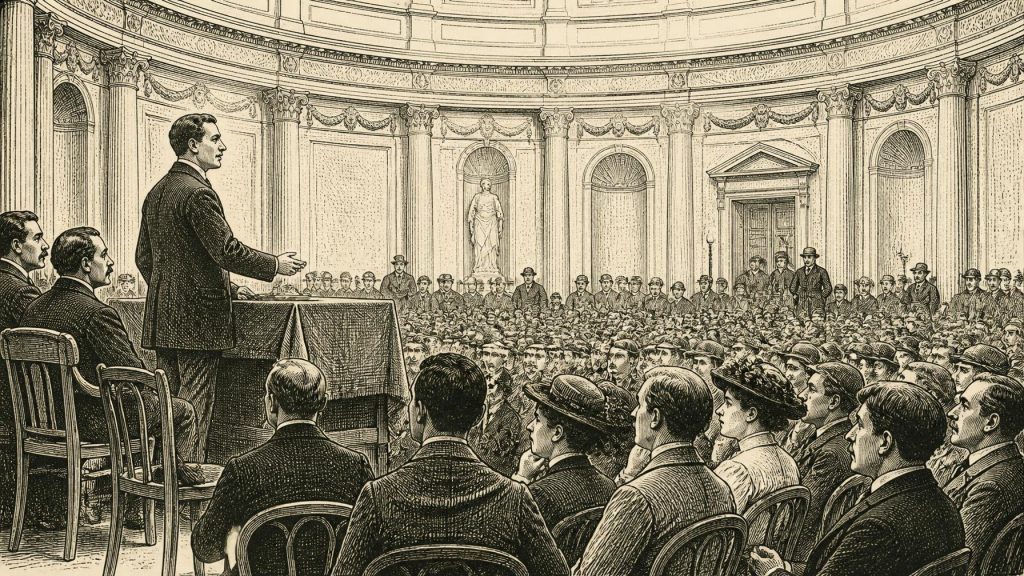
The most consequential firmly dated event came on Tuesday, 28 November. At the Rotunda in Dublin, the first annual convention of the National Council met under the presidency of Edward Martyn. Arthur Griffith presented what was called the “Sinn Féin Policy”. The convention’s importance lay in organisation as much as doctrine: delegates from outside Dublin successfully pressed for a national body with branches, rather than a small metropolitan circle. For that reason, 28 November 1905 is conventionally treated as the founding moment of the movement that became Sinn Féin.
That wording requires some care. The organisation of 1905 was not yet the mass Sinn Féin party of the revolutionary years, and it did not formally take Sinn Féin as its official title until 1908. Nor did Griffith’s programme simply propose the republic later associated with the name. His political inspiration was the constitutional settlement between Austria and Hungary. In The Resurrection of Hungary, published in 1904, he had argued for ending Irish representation at Westminster and rebuilding Irish national institutions at home, while envisaging a relationship with the Crown comparable to a dual monarchy. The policy placed economic development, Irish industry, cultural revival and political action in Ireland at its centre.
The new movement was therefore a challenge to the established constitutional nationalism of John Redmond’s Irish Parliamentary Party. Redmond’s MPs sought Home Rule through parliamentary pressure at Westminster. Griffith insisted that dependence upon Westminster had itself become a political weakness. His argument was intentionally practical as well as rhetorical: national freedom, in this view, required Irish people to support local enterprise, cultivate their own language and organisations, and act collectively without waiting for British legislation. In 1905 this remained a minority politics, but it created a distinct alternative at a moment when the old parliamentary route was about to face a changed British political climate.
The Devolution Crisis
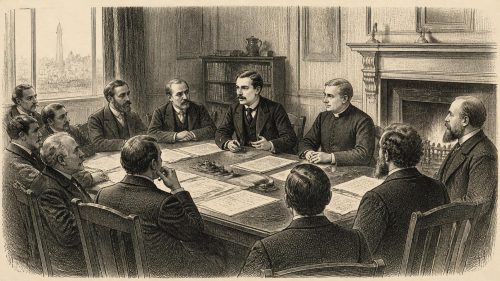
Earlier in the year, the controversy surrounding limited devolution had brought down George Wyndham, the chief secretary for Ireland. Wyndham resigned on 6 March 1905. The immediate background was the Irish Reform Association, founded by Lord Dunraven in 1904 after the co-operative atmosphere that had helped produce the Wyndham Land Act of 1903. Dunraven and Sir Antony MacDonnell, the permanent under-secretary at Dublin Castle, had promoted a scheme that would transfer substantial administrative authority over Irish affairs to a partly representative body. It fell well short of a restored Irish parliament, but it went beyond routine local government.
The proposal exposed how narrow the room for compromise had become. Ulster unionists regarded it as a concealed route to Home Rule and were angered that MacDonnell, a senior Dublin Castle official, had assisted in framing it. Nationalist opponents, meanwhile, feared that a limited administrative arrangement might distract from the demand for legislative self-government. In the House of Lords in February, the scheme was debated as an issue of both constitutional principle and official responsibility. Wyndham was caught between political forces that distrusted the plan for very different reasons. His resignation was not the defeat of a Home Rule bill; no such bill had been introduced. It was, however, a clear failure of an attempt to make Irish administration more autonomous without reopening the whole constitutional settlement.
The crisis also mattered in Ulster. During 1905, the Ulster Unionist Council was established under the presidency of the second Duke of Abercorn, bringing local unionist associations into closer contact with parliamentary representatives and providing a mechanism for expressing a united Ulster unionist position. It was not yet the mass anti-Home Rule mobilisation of the 1910s, and partition was not an established outcome in 1905. Yet the Council’s formation gave northern unionism a more durable co-ordinating structure precisely when devolution had convinced many unionists that constitutional concessions could not be treated as harmless administrative adjustments.
Land, Work and Departure
Political arguments unfolded in a society still being transformed by land purchase. The 1903 Land Act had established the Estates Commissioners and made landlord-to-tenant transfer possible on a much larger scale. Its effects could not be completed in a single year, but in 1905 the practical business of sales, advances, valuation and title continued to reshape rural expectations. Ownership promised security and status to many tenant farmers; it did not automatically resolve the problems of labourers, smallholders, congested districts or those without sufficient land.
Emigration remained an equally hard fact of everyday life. On 6 April 1905 the official statistics for the preceding year were presented to parliament. They recorded 36,902 people leaving Ireland during 1904, a decline from some earlier years but still a large annual loss from a population already reduced by decades of departure. The total included young women and men whose absence was felt in households, farms and villages. Seasonal migration to Britain also connected Irish rural labour to work beyond the island. For many families, remittances and letters formed part of the household economy; for others, departure was the acknowledgement that a holding or local wage could not sustain another generation.
These conditions help explain why economic self-help carried political force. Co-operative creameries, agricultural improvement, technical instruction and Irish manufacture were not merely abstractions in nationalist pamphlets. They addressed an economy in which farming dominated much of the island, while Belfast’s industrial and commercial world stood in marked contrast to many western and southern districts. The year’s political language of “national development” drew its persuasiveness from that unequal landscape.
Irish in the School and Post Office
The Irish-language revival was tested in the machinery of government. In 1905 the number of children studying Irish in national schools had risen dramatically, but the funding arrangement was under attack. During parliamentary debate in August, Thomas O’Donnell, MP for West Kerry, stated that roughly 100,000 pupils had been learning Irish and argued that ending payments to teachers for the subject as an extra would cripple instruction. The Treasury and the National Board of Education proposed to end the special fees after 1906, while maintaining that Irish could be taught during ordinary school hours where appropriate.
This was more than a disagreement over accounting. Supporters of the Gaelic League saw the policy as evidence that a subject attracting parents and pupils was still treated as marginal. Officials argued that learning should be integrated into the ordinary curriculum rather than confined to paid extra lessons. The difficulty was practical: schools had crowded timetables, teachers needed training, and Irish-speaking districts had needs different from those of urban pupils learning the language anew. Yet the dispute confirmed that Irish had become a national political issue. In July, O’Donnell also challenged the Post Office rule requiring an English translation on parcels addressed in Irish, even though letters in Irish could be delivered if deciphered. A parcel counter became, in miniature, a site of argument about recognition and equal standing.
Stages, Scholarship and Churches
Cultural institutions gave the revival a public presence beyond formal politics. At the Abbey Theatre, J. M. Synge’s The Well of the Saints opened on 4 February, followed by Padraic Colum’s The Land on 2 October. Both plays engaged rural Irish speech and social relationships, though neither should be mistaken for a documentary record of country life. Their staging nevertheless demonstrated that the still-young national theatre could present new Irish writing to Dublin audiences as serious modern drama. In scholarship, Mary Elizabeth Byrne’s translation of the Old Irish devotional poem Rop tú mo baile, printed as “A Prayer” in Ériu in 1905, was another act of recovery from the Irish textual inheritance.
Religion and civic confidence were visible in Belfast as well. In June, the Presbyterian Church in Ireland opened its new Assembly Buildings at Fisherwick Place, popularly known as Church House. Built in Scrabo stone and dominated by a clock tower, it provided offices and a large assembly hall for a church with a substantial place in Ulster society. Its opening was not a political declaration, but the scale and prominence of the building reflected the institutional strength of Presbyterian Belfast at a time when unionist organisation was becoming more closely co-ordinated.
Cork Harbour’s Warning
One sharply dated local tragedy revealed a different face of modernity. On 16 February, two explosions aboard the newly commissioned Royal Navy submarine A5 at Haulbowline in Cork Harbour killed six of its eleven crewmen and injured the survivors. Petrol vapour ignited while the small vessel was preparing for exercises. The submarine had arrived only days earlier and had attracted public attention as the first of its kind seen at the base. The subsequent funeral for five ratings at Cobh drew a major public response. For communities around Cork Harbour, imperial naval power was not distant policy: it brought employment, spectacle, danger and bereavement into the harbour itself.
By the close of 1905, Ireland had not chosen one political future. The failure of administrative devolution, the organisation of Ulster unionism and the National Council’s adoption of the Sinn Féin policy pointed in incompatible directions. At the same time, school fees, postal practice, land transfer, migration, theatre and church building showed how arguments about belonging reached into the texture of daily life. The year’s enduring significance lies in that combination: a constitutional impasse, and a widening determination among competing communities to build institutions of their own.
Primary Sources
- Griffith, Arthur Joseph | Dictionary of Irish Biography
- Wyndham, George | Dictionary of Irish Biography
- Quin, Windham Thomas Wyndham- | Dictionary of Irish Biography
- Martyn, Edward | Dictionary of Irish Biography
- O'Kelly, Seán Thomas (Ó Ceallaigh, Seán Tomás) | Dictionary of Irish Biography
- Stephens, James | Dictionary of Irish Biography
- Hannay, James Owen (‘George A. Birmingham’) | Dictionary of Irish Biography
- The "Sinn Fein" Policy | National Library of Ireland catalogue
- The Sinn Féin Policy, delivered at the First Annual Convention of the National Council
- Arthur Griffith and Sinn Féin | National Library of Ireland
- The Resurrection of Hungary: A Parallel for Ireland | Open Library
- Sir Antony MacDonnell and Irish Devolution | Hansard, 17 February 1905
- Ulster Unionist Council Archive | Irish Archives Resource
- Ireland 1900–1925: Crisis, War and Revolution | Public Record Office of Northern Ireland
- Irish Land Act, 1903
- Land Registry Collection | Irish Archives Resource
- Emigration Statistics (Ireland) | Hansard, 6 April 1905
- Census of Ireland for the Year 1911: General Report, Ireland
- Irish Language in the Irish Post Office | Hansard, 31 July 1905
- Consolidated Fund (Appropriation) Bill | Hansard, 8 August 1905
- Schooling, the Gaelic League, and the Irish language revival in Ireland 1831–1922
- The Well of the Saints 1905 (Abbey) | Abbey Theatre Archives
- The Land 1905 (Abbey) | Abbey Theatre Archives
- Vol. 2, 1905 of Ériu | JSTOR
- Assembly Buildings | Presbyterian Church in Ireland
- HM Submarine A5, lost Cork 1905 | National Maritime Museum of Ireland